
Acts and Monuments
John Foxe — commonly known as Foxe's Book of Martyrs — Volume III
A New and Complete Edition, edited by Rev. Stephen Reed Cattley, M.A. — 1837
This is the classic work by John Foxe, first published in 1563, documenting the sufferings and martyrdom of Protestant Christians. This edition is a complete reprint of Volume III with a preliminary dissertation by the Rev. George Townsend. The text is sourced from Wikisource and is in the public domain.
Table of Contents
- Continuation of Book V.
- Book VI.
- The Public Testimony given by the University of Oxford
- The Testimony and Judgment of Master John Huss
- The Sentence given by the Council of Constance
- Articles gathered out of Wickliff's Books
- Articles against Wickliff collected by William Woodford
- The Determination of John Huss upon the Thirteenth Article
- The Defence of the Fifteenth Article of John Wickliff
- The Second Disputation in the University of Prague
- The Second Disputation of John Huss, continued
- Hildegard's Prophecy respecting Friars and Monks
- The Third Disputation of John Huss
- The Story of William Swinderby
- The Process of John Tresnant, Bishop of Hereford
- Matters articulated against William Swinderby
- The Protestation of William Swinderby
- William Swinderby keeping from the Bishop
- First Sitting against William Swinderby
- The Sentence against William Swinderby
- The Appeal of William Swinderby
- A fruitful Letter sent to the Nobles and Burgesses
- Articles drawn out by John Huss and his Adherents
- The Objections of John Huss
- Substance of the Answer of the Catholic Doctors
- The Letter of Pope John to King Wenceslaus
- And, furthermore, it followeth in these words
- A Recapitulation of Matters done in the Council of Constance
- The Safe-conduct given to Master John Huss
- The Letters of John Huss set up in Prague
- Another Intimation of John Huss
- This Epistle of John Huss
- The Testimonial of the good Bishop of Nazareth
- An Instrument of Recognition
- An Instrument of Testimonial
- The Copy of the Letters which John Huss set up
- Articles presented unto Pope John XXIII.
- Answer of the Bishop of Luthonis
- The Copy of a public Testimonial of the University of Prague
- The History of Master Jerome of Prague
- The forced Abjuration of Master Jerome of Prague
- The History of John Claydon and Richard Turming
- Continuation of the Memorable History of the Bohemians
- The Story of Zisca
- Thomas Bagley, Priest
- Paul Craw, a Bohemian, Martyr
- The Memorable History of the Bohemians
- Richard Wiche, Priest, Martyr
CONTINUATION OF BOOK V.
BOOK VI.
The Public Testimony given by the University of Oxford, touching the great Learning and good Life of John Wickliff.
Unto all and singular the children of our holy mother the church, to whom this present letter shall come, the vice-chancellor of the university of Oxford, with the whole congregation of the masters, wish perpetual health in the Lord. Forasmuch as it is not commonly seen, that the acts and monuments of valiant men, nor the praise and merits of good men should be passed over and hidden with perpetual silence, but that true report and fame should continually spread abroad the same in strange and far distant places, both for the witness of the same, and the example of others; forasmuch also as the provident discretion of man's nature, being recompensed with cruelty, hath devised and ordained this buckler and defence against such as do blaspheme and slander other men's doings, that whensoever witness, by word of mouth, cannot be present, the pen, by writing, may supply the same:
Hereupon it followeth, that the special good will and care which we bear, unto John Wickliff, sometime child of this our university, and professor of divinity, moving and stirring our minds (as his manners and conditions required no less), with one mind, voice, and testimony, we do witness all his conditions and doings, throughout his whole life to have been most sincere and Great learning joined with good life and godliness. commendable; whose honest manners and conditions, profoundness of learning, and most redolent renown and fame, we desire the more earnestly to be notified and known unto all the faithful, for that we understand the maturity and ripeness of his conversation, his diligent labours and travails, to tend to the praise of God, the help and safeguard of others, and the profit of the church.
Wherefore we signify unto you by these presents, that his conversation, even from his youth upward, unto the time of his death, was so praiseworthy and honest, that never at any time was there any note or spot of suspicion reported of him. But, in his answering, reading, preaching, and determining, he behaved himself laudably, and as a stout and valiant champion of the faith; vanquishing by the force of the Scriptures, all those, who, by their wilful beggary, blasphemed and slandered Christ's religion. Neither was this doctor convicted of any heresy, nor burned of our prelates after his burial. God forbid, that our prelates should have condemned a man of such honesty, as a heretic; who, amongst all the rest of the university, had written in logic, philosophy (divinity, morality, and the speculative arts, without his peer. The knowledge of which all and singular things, we do desire to testify and deliver forth; to the intent that the fame and renown of this said doctor may be the more evident and had in reputation amongst them unto whose hands these present letters of testimonial shall come. In witness whereof, we have caused these our letters testimonial to be sealed with our common seal.
Dated at Oxford in our congregation-house, the fifth day of October, in the year of our Lord, 1406.
The Testimony and Judgment of Master John Huss, touching Master John Wickliff.
Verily, as I do not believe, neither grant, that Master John Wickliff is a heretic, so do I not deny, but firmly hope that he is no heretic; forasmuch as in all matters of doubt, I ought, as near as I can, to choose the best part. Wherefore I surely trust, that Master John Wickliff is one of the number of them who are saved. The words of Christ move me thereunto, saying [Matt, vii.] "Do ye not judge, that ye be not judged," and [Luke vi.] "Do not condemn, and ye shall not be condenmed;" and the words of the apostle [1 Cor. iv.]Motives of John Huss to undertake Wickliff's defence. "Do ye not judge before the Lord himself do come, who shall open those things that are hid in darkness, to manifest the secrets of all hearts."
Secondly, The love and charity which I ought to bear unto my neighbour, loving him as myself, doth move me thereunto. [Luke x.]
Thirdly, His good fame and report moveth me, v.'hich he bath of the good priests of the university of Oxford, and not of the wicked, and commonly of the vulgar sort; although not of the covetous, proud, and luxurious priests and prelates.
Fourthly, His own works and writings do stir me thereunto, by which he goeth about with his whole endeavour to reduce all men unto the law of Christ, and especially the clergy, that they should forsake the pomp and dominion of this world, and, with the apostles, lead the life of Christ.
Fifthly, His own protestations, which he doth often times use in his sentences, often repeating the same, do not a little move me.
Sixthly, His earnest desire and aftection which he hath unto the law of Christ, doth not a little allure me thereunto, disputing of the verity thereof, which cannot fail in any one jot or tittle. Whereupon he made a book of the verity of the holy Scripture, approving, even unto the uttermost, the truth of God's law.
Therefore, it were too foolish a consequence to say that because the multitude of the prelates and clergy in England, France and Bohemia, do count John Wickliff a heretic, that therefore he is a heretic, &c. Like as is the Burning of books no proof of his being heretical. reason for burning the books; for it is written in the first book of Maccabees, the first chapter, that "They did burn the books of the Lord, tearing them in pieces, and whosoever was found to have kept any books of the Testament of the Lord, or which observed and kept the law of the Lord, he was, by the king's commandment, put to death." If then the burning of the books by wicked men, did argue or prove the evil of these books, then was the law of God evil and naught.
So likewise the burning of St. Gregory's books, and those of divers other saints and good men, should argue and prove that they were evil and naughty men. Whereupon as it doth not follow, that because the bishops, scribes, and pharisees, with the elders of the people, condemned Christ Jesus as a heretic, that therefore he is a heretic; so likewise doth it not follow, of any other man, False consequence reproved by Chrysostome. that because the bishops, masters of divinity, monks, and prelates, condemned that man as a heretic, ergo, he is a heretic. For this consequent is reproved by the blessed John Chrysostome, who was twice condemned as a heretic by the bishops and the whole of he clergy. Likewise St. Gregory, in his books, was condemned by the cardinals.
By like proof also, as they affirm Master John Wickliff to be a heretic,Duke of Lancaster a defender of Wickliff. John duke of Lancaster, a man of worthy memory, and progenitor of Henry, king of England, should be a heretic. Because the said duke defended, favoured, and greatly loved Master John Wickliff: ergo, the said duke is or was a heretic; the consequent is good. The minor is well known to Englishmen. The major appeareth in the canon, where it is said, "He who defendeth a heretic," &c. But, these things set apart, I demand of the adversary, whether Master JohnWickliff proved no heretic. Wickliff be damned for ever or no? If he say, that he is damned because he is a heretic, I propound this unto him: whether Master John Wickliff, whilst he lived, held any false doctrine contrary to the holy Scriptures? If he do affirm it, let him then show what doctrine it is, and afterwards declare that he held it obstinately. But he shall find that in his books, he always wrote most commendable protestations against obstinacy and stiff-neckedness. And, by and by, afterwards. Master John Stokes in his "Intimation" saith, that Master John Wickliff, in England, is counted for a heretic.
This seemeth also false by the letter testimonial of the university of Oxford, to which there is more credit to be given than unto him. And this shall suffice for the present.
Now as we have declared the testimony of the university of Oxford, and of John Huss, concerning the praise of John Wickliff, it followeth, likewise, that we set forth and express the contrary censures and judgments of his enemies, blinded with malicious hatred and corrupt affections against him, especially of the pope's council gathered at Constance; proceeding, first, in condemning his books, then his articles, afterwards burning his bones. The copy of the sentence driven against him by that council here followeth.
The Sentence given by the Council of Constance, in condemnation of the Doctrine, and Five and Forty Articles of John Wickliff. a.d.
415.
The most holy and sacred council of Constance, making and representing the catholic church, for the extirpation of this present schism, and of all other errors and heresies springing and growing under the shadow and pretence of the same, and for the reformation and amendment of the church, being lawfully congregated and gathered together in the Holy Ghost, for the perpetual memory of the time to come:
We are taught by the acts and histories of the holy fathers, that the catholic faith, without which, as the holy apostle St. Paul saith, it is impossible to please God, hath been always defended by the faithful and spiritual soldiers of the church, by the shield of faith, against the false worshippers of the same faith, or rather perverse impugners; who, through their proud curiosity, will seem to know more, and to be wiser than they ought to be, and for The spiritual wars of holy church pre-figured by the carnal wars of the Israelites.the desire of the glory of the world, have gone about oftentimes to overthrow the same. These kinds of wars and battles have been prefigured to us before in those carnal wars of the Israelites against the idolatrous people. For in those spiritual wars the holy catholic church, through the virtue and power of faith, being illustrated with the beams of the heavenly light by the providence of God, and being holpen by the help and defence of the saints and holy men, hath always continued immaculate, and, the darkness of errors, as her most cruel enemies, being put to flight, she hath most gloriously triumphed over all. But in these our days, the old and unclean enemy hath raised up new contentions and strifes, that the elect of this world might be known, whose prince and captain in time past was one John Wickliff, a false christian; who, during his lifetime, taught and sowed very obstinately many articles contrary to and against the christian religion, and the catholic faith. Dialogue and Trialogue of Wickliff.And the same John Wickliff wrote certain books which he called a Dialogue, and a Trialogue, besides many other treatises and works, which he both wrote and taught, in which he wrote the aforesaid, and many other damnable and execrable articles; which his books for the publication and advancement of his perverse doctrine, he did set forth openly for every man to read, whereby, besides many offences, great hurt and damage of soul hath ensued in divers regions and countries, but, especially in the kingdoms of England and Bohemia. Against whom the masters and doctors of the universities of Oxford and Prague, rising up in the truth and verity of God, according to the order of the schools, within a while after did reprove and condemn the said articles.
His books condemned to be burnedMoreover, the most reverend fathers, the archbishops and bishops, at that time present, of Canterbury, York, and Prague, legates of the apostolic see, in the kingdoms of England and Bohemia, did condemn the books of the said Wickliff to be burnt. And the said archbishop of Prague, commissary of the apostolic see, did, likewise, in this behalf, determine and judge. And, moreover, he did forbid that any of those books, which did remain unburned, should be hereafter any more read. And again, those things being brought to the knowledge and understanding of the apostolic see, and in the general coimcil, the bishop of Rome, in his last council, condemned the said books, treatises, and volumes, commanding them to be openly burned: most straitly forbidding that any men who should bear the name of Christ should be so hardy either to keep, read, or expound any of the said books or treatises, volumes, or works, or by any means to use or occupy them; or else to allege them openly or privily but to their reproof and infamy. And, to the intent that this most dangerous and filthy doctrine should be utterly wiped away out of the church, he gaveWords of authority without due probation. commandment throughout all places, that the ordinaries should diligently inquire and seek out, by the apostolic authority and ecclesiastical censure, for all such books, treatises, volumes, and works; and the same so being found, to burn and consume them with fire; providing withal, that if there be any such found who will not obey, the same process to be made against them, as against the favourers and maintainers of heresies. And this most holy synod hath caused the said forty-five articles to be examined, and oftentimes perused, by many most reverend fathers of the church of Rome, cardinals, bishops, abbots, masters of divinity, and doctors of both laws, besides a great number of other learned men;Ask my fellow if I be a thief.So we hear you. which articles being so examined, it was found (as in truth it was no less) that many, yea and a great number of them be notoriously, for heretical, reproved and condemned by the holy fathers; others not to be catholic, but erroneous; some full of offence and blasphemy; certain of them offensive unto godly ears, and many of them to be rashful and seditious. It is found, also, that his books do contain many articles of like effect and quality, and that they do induce and bring into the church unsound and unwholesome doctrine, contrary unto the faith and ordinance of the churchSo thought the soldiers perpetually to keep down Christ from rising. O marvelous sacred synod! Though the sepulchre be watched, Christ will rise.Wherefore, in the name of our Lord Jesus Christ, this sacred synod, ratifying and approving the sentences and judgments of the archbishops and council of Rome, do, by this their decree and ordinance perpetually, for evermore, condemn and reprove the said articles, and every one of them, his books which he entitled his "Dialogue" and "Trialogue," and all other books of the same author, volumes, treatises, and works, by what name soever they be entitled or called, which we will here to be sufficiently expressed and named. Also, we forbid the reading, learning, exposition, or alleging of any of the said books unto all faithful Christians, but so far forth as shall tend to the reproof of the same; forbidding all and singular catholic persons, under the pain of curse, that from henceforth they be not so hardy openly to preach, teach, or hold, or by any means to allege the said articles, or any of them, except, as is aforesaid, that it do tend unto the reproof of them; commanding all those books, treatises, works, and volumes aforesaid, to be openly burned, as it was decreed in the synod at Rome, as is before expressed: for the execution whereof duly to be observed and done, the said sacred synod doth straitly charge and command the ordinaries of the place diligently to attend and look to the matter, according as it appertaineth to every man's duty by the canonical laws and ordinances.
What these articles were, here condemned by the council, collected out of all his works, and exhibited to that council, to the number of forty-five, the copy of them here following declareth.
Certain other Articles gathered out of Wickliff's Books by his Adversaries, to the Number of Forty-five, exhibited to the Council of Constance after his Death, and in the same Council condemned.
Note.—Besides the twenty-four articles above mentioned, there were others also gathered out of his books, to the number of forty-five, which his malicious adversaries, perversely collecting, and maliciously expounding, did exhibit to the council of Constance; all which to repeat, though it be not here needful, yet to recite certain of them as they stand in that council, it shall not be superfluous.
25. All such as be hired for temporal living to pray for others, offend, and sin of simony.
26. The prayer of a reprobate prevaileth for no man.
27. All things happen from absolute necessity.
28. The confirmation of young persons, the ordination of the clergy, and the consecration of places, be reserved to the pope and prelates, from a desire of temporal lucre and honour.
29. Graduations and doctorships in universities and colleges as they be used, conduce nothing to the church.
30. The excommunication of the pope and his prelates is not to be feared, because it is the censure of Antichrist.
31. Such as found and build monasteries, do offend and sin, and all such as enter into the same, be members of the devil.
32. To enrich the clergy is against the rule of Christ.
33. Silvester the pope, and Constantine the emperor, erred in enriching the church.
34. A deacon or a priest may preach the word of God without the authority of the apostolic see or that of a bishop.
35. Such as enter into orders, or religion monastical, are thereby unable to keep God's commandments, and also to attain to the kingdom of heaven, except they return from the same.
36. The pope with all his clergy, having those great possessions which they have, be heretics in so having; and the secular powers in so suffering them do not well.
37. The church of Rome is the synagogue of Satan; nor is the pope immediately the vicar of Christ and of the apostles.
38. The letters decretal be apocryphal, and seduce from the faith of Christ; and the clergy that study them be fools.
39. The emperor and secular lords be seduced by the devil, when they enrich the church with temporal goods.
40. It is not necessary to salvation to believe the church of Rome to be supreme head over all churches.
41. It is infatuation to believe in the indulgences of the pope.
42. All oaths which be made for any contract or civil bargain betwixt man and man, be unlawful.
43. Augustine, Benedict, Bernard, with all such as have been patrons of private religion, except they have repented, with such also as have entered into the same, be in a damnable state, and so from the pope to the lowest novices, they be altogether heretics.
44. All private rehgions whatsoever, indiscriminately introduced, are not from Christ.
45. That all in the order of mendicants be heretics, and all who give them alms are excommunicate.
Besides these articles, to the number of forty-five, condemned, as is said, by the council of Constance, other articles also I find diversely collected, or rather wrested out of the books and writings of Wickliff; some by William Woodford, and some by Walden, friar Tissington, and others, whom they, in their liooks, have impugned rather than confuted; in the number of which writers William Woodford especially findeth out these articles, and writeth against the same, to the number of eighteen, as hereunder follow.
Articles against Wickliff collected by William Woodford.
1. The bread remaineth in its own substance, after the consecration thereof upon the altar, and ceaseth not to be bread still.
2. As John was figuratively Elias, and not personally; so the bread is figuratively the body of Christ, and not naturally. And, without all doubt, this is a figurative speech, to say, “This is my body;” as to say, “This John is Ehas.”
3. In the decree, “Ergo Berengarius,” the court of Rome hath determined, that the sacrament of the holy Eucharist is naturally true bread.
4. They who do affirm that the infants of the faithful, departing without the sacrament of baptism, are not saved, be presumptuous and fools in so affirming.
5. The administration of the sacrament of confirmation is not only reserved to the bishops.
6. In the time of St. Paul, only two orders of clerks did suffice in the church, priests and deacons. Neither was there in the time of the apostles any distinction of popes, patriarchs, archbishops, and bishops ; but these the emperor’s pride did find out.
7. Such as in times past, either for covetousness of temporal lucre, or in hope of mutual succour by kindred, or for cause to excuse their lust (although they despaired of issue), were married, were coupled together not by true matrimony.
8. The causes of divorcement, either for spiritual consanguinity, or for affinity, be not founded on Scripture, but are only ordinances of men.
9. These words, “I will take thee to wife,” are rather to be taken in contract of matrimony, than these words, “I do take thee to wife.” And the contract with any party, by the words of the future tense, ought not to be frustrated for the contract with any party afterwards made by the words of the present time.
10. There be twelve disciples of Antichrist: popes, cardinals, patriarchs, archbishops, bishops, archdeacons, officials, deans, monks, canons, friars, and pardoners.
11. In the Book of Numbers, chap, xviii., and in Ezekiel, chap, xliv., it is commanded simply, that neither the priests of Aaron, nor the Levites should have any part of inheritance with other tribes, but should live merely by tithes and oblations.
12. There is no greater heretic or Antichrist than that clerk who teacheth that it is lawful for priests and Levites, by the law of grace, to be endued with temporal possessions. And if there be any heretics, apostates, or blasphemers, these clerks be such.
13. It is not only lawful for the lords temporal to take away goods of fortune from the churchmen, sinning usually, but also they are bound so to do, under pain of eternal damnation.
14. He that is the more humble and more serviceable to the church, and more enamoured with the love of Christ, is, in the church militant, the greater, and, then, nearest vicar of Christ.
15. If corporal unction or anoyling were a sacrament, as now it is feigned to be, Christ and his apostles would not have left the ordinance thereof untouched.
16. Unto the true dominion secular, is required virtuous life of him that ruleth.
17. All things that happen do come absolutely of necessity.
18. Whatsoever the pope or his cardinals can deduce clearly out of the Scripture, that only is to be believed, or to be done at their monition; and whatsoever otherwise they do command, is to be condemned as heretical.
Besides this William Woodford aforementioned, divers others there were who wrote against these articles of Wickliff aforesaid, maintaining the pope's part, as seemeth, for flattery, rather than following any just cause so to do, or showing forth any reason or learning in disproving the same. Notwithstanding, on the contrary part, some there were again both learned and godly, who, taking the part of Wickliff, without any flattery, defended the most of the said articles openly in schools and other places.
🞼Thus you have the whole sum of Wickliff's articles, containing nis whole doctrine, described and set forth; albeit not as he hath uttered them, but as his froward adversaries have compiled and collected them out of his writings. Wherefore, if some of them seem hard or strange, I think it rather to be imputed to their evil will, than to his good meaning; as it might soon appear if his books had been now extant to testify of his doctrine. But this is certain; howsoever his articles were taken of the wicked and evil disposed, with all good men he was highly favoured, and had in such estimation for his profound knowledge and great learning, that also foreign nations were moved with his authority. Amongst all others the Bohemians had him in great reverence for the opinion of his singular learning, that John Huss, the greatest doer in the university of Prague, not only took profit of his doctrine, but also openly defended his articles. Insomuch that in his public disputation and solemn acts after the manner of schools, he took upon him the public defence of divers of the said articles; namely, upon the fourteenth, fifteenth, and seventeenth, with others more; whose disputation upon the same matter, if it shall not seem tedious to the reader to understand, it shall not seem grievous to me to declare; not only for the antiquity of the matter, but also for the utility of the same.🞼
THE PUBLIC DEFENCE OF CERTAIN ARTICLES OF JOHN WICKLIFF, IN THE FIRST ACT BEFORE THE WHOLE UNIVERSITY OF PRAGUE, IN CHARLES'S COLLEGE.
The Determination of John Huss upon the Thirteenth Article of Wickliff, touching the Preaching and Hearing of the Word of God, made in the Year of our Lord 1412.
Forasmuch as to condemn the truth wittingly, or without reasonable examination, doth tend to great danger of salvation, as the Lord saith, [Luke vi.] "Do ye not condemn, and ye shall not be condemned:" therefore, to avoid this great danger, the university of Prague, and the whole commonalty thereof, the rector, masters, doctors, bachelors, and students, in their general assembly, not agreeing a to the condemnation pronounced by the doctors in their council-house, require of the said doctors a reasonable proof of their condemnation, and that theyThe whole university of Prague is against the judgment of the doctors who cendemned the forty-five articles. should by Scripture, authority, or infallible reason, prove the falsehood of every those five and forty articles; the which being once done, the said university will agree to the said condemnation as just. For the university doth well know, that, as Augustine saith, at the end of his second book of Christian Doctrine, "Whatsoever a man doth learn besides the holy Scriptures, if it be hurtful, there it is condemned; if it be profitable, there it is found. And when a man hath found all things therein which he hath profitably learned elsewhere, he shall much more abundantly find those things which are found in no place else, but are learned in the marvellous depth and marvellous profoundness of those most sacred Scriptures only."
Thus writeth Augustine. And Gregory, in his twenty-third book of Morals, saith thus: "God, in the holy Scripture, hath comprehended whatsoever thing may happen unto any man, and in the same hath, by the examples of those who are gone before, taught those who are to come, how to reform their lives." Whereby it appeareth that if every of the five and forty articles containeth in it wholly the thing that is false and untrue, the same is either plainly or darkly condemned in the holy Scriptures.
Secondly, it followeth by the sentence and mind of this holy man, that if the condemnation of the five and forty articles be profitable, the same is found in the holy Scriptures. And whereas again St. Augustine writeth unto St. Jerome, in his eighth epistle, and the ninth distinction, "I," saith he, "have learned to attribute this honour and reverence unto those writers only who are called canonical, that I dare affirm none of them to have erred in their works or writings. As for all other writers, I do so read them, that although they abound with never so much holiness, or excel in doctrine, I do not by and by think it true because they themselves do so judge; but if they can, by other canonical authors or probable reasons, persuade or prove that they do not digress from the truth."
Also the said Augustine, in his book 'De Unico Baptismo,' lib. ii., saith thus: "Who doth not know or understand the holy canonical Scripture to be contained in his own bonds and limits, and the same to be preferred before all other letters and decrees of bishops," &c. And, a little after, he hath the like saying, as for the letters of other bishops which have been written, or be written (after the canon, being confirmed), they may lawfully be reprehended and reproved, both by the word of them that be more skilful in that matter, and also by the ancient authority of other bishops, or by the prudence and wisdom of such as be better learned, or more expert, or else by general councils, if it so chance that they in any point have erred and gone astray from the
sincere truth.
By these sayings of St. Augustine and others, &c., the university of Prague hath concluded and determined, that they will not receive the condemnation of the five and forty articles, made by the doctors in their council-house, as just and true, unless they who condemned them will prove their condemnation by the holy Scriptures and probable reasons upon every of the five and forty articles.
Wherefore, for the due examination of the aforesaid condemnation, whether it be effectual or no, we will at this present take in hand the fourteenth article of the number of the five and forty; which article is this:—
"They who leave off preaching and hearing of the word of God, for fear of excommunication of men, are already excommunicate, and in the day of judgment shall be counted the betrayers of Christ."
This article containeth: First, that all priests, omitting the preaching of the word of God for fear of excommunication of men, are already excommunicated.
Secondly, It containeth that all such as do omit the hearing of the word of God, for fear of excommunication, are already excommunicated.
Thirdly, That both these sorts of men in the day of judgment, shall be counted traitors to Christ. As concerning the first point, it is pre-supposed, that the preaching of the word of God is commanded unto the apostles and their followers, as it appeareth in Matt, x., where it is said, "Jesus sent his twelve disciples, commanding them and saying, Go and preach that the kingdom of heaven is at hand." Also in the last of Matthew, and the tenth of Luke. Whereupon Peter, the apostleThe preaching of the gospel commanded by God. of Christ, acknowledging this precept and commandment for himself, and for the other apostles and successors, in Acts x., saith thus: "He commanded us to preach and testify, that it is he which is ordained of God, the judge both of the quick and the dead." This commandment, also, the other apostles did acknowledge, and especially the chosen vessel, pronouncing under a great threatening, [1 Cor. ix.] "Wo be unto me if I do not preach the gospel." And pope Nicholas, considering that great threatening in the forty-third distinction, saith: "The dispensation and distribution of the heavenly seed is commanded and enjoined unto us; wo be unto us if we do not sow it abroad, or if we hold our peace." Which thing when the vessel of election did fear and cry out upon, how much more ought all other inferiors to fear and dread the same! To the same purpose doth St. Gregory write, in his Pastoral, in the distinction, "Sit rector." It is also evident by many other doctors and holy men, as by St. Augustine, Jerome, Isidore, Bernard, whose words it were too long here to rehearse.
The hearing of the word commanded by God.As touching the second point, That the hearing of the word and law of God is commanded unto the people, it is evident both by the old and new law; for it is said in Proverbs [chap, xxviii.], "He that turneth away his ear, and will not hear the law of God, his prayer shall be cursed." And our Saviour, rebuking the Scribes and Pharisees, concludeth thus in John viii., saying, "He that is of God, heareth God's word; but forasmuch as you are not of God, therefore you hear not his word."
Excom-munication.Thirdly, It is to be noted that excommunication is a separation from the communion, 11 quest. 3 par., "Nihil;" et cap. "Canonica;" and 27 quest. 1 par., "Viduas;" 34 quest. 3 par., "Cum sacerdos." And this excommunication is Excom-munication double.double, that is to say, either secret or manifest. The secret excommunication is, whereby a man is separated from the mystical body of Christ, and so from God through sin, according unto the 59th of Isaiah, "Your iniquities have made separation between your God and you." And with this excommunication doth the apostle excommunicate every man who doth not love the Lord Jesus Christ; saying in the firsth epistle to the Corinthians, and the last chapter, "If any man do not love the Lord Jesus Christ, let him be accursed." The manifest and apert excommunication may be divided into a manifest excommunication by God, which is spoken of in Matt, xxv., "Go, ye cursed," &c., and oftentimes else in the law of God: also into a manifest excommunication by men, whereby the prelate doth either justly or unjustly cast out any man from the participation of the communion of the church; whereof this shall suffice at this present.
The proofs of the first part of the article.Then, as touching the first part of the article, it is thus argued, &c.
Whosoever forsake or leave the commandments of God undone, they are
excommunicate of God. But the priests who leave off the preaching of the word of God, for fear of the unjust excommunication of men, do leave the commandment of God undone. Ergo, those priests who do leave off preaching of the word, are excommunicated of God.
The first part of this article is true: the major appeareth by the Psalm, "Cursed be they which do decline and swerve from thy precepts." The minor is evident by the first proposition, which proveth that the preaching of the word of God is the commandment of God enjoined unto those priests and ministers. Whereupon the saying of our Saviour [Matt, xv.] is spoken unto them: "Wherefore do you transgress the commandments of God for your own traditions?" leaving off the preaching of the word of God for fear of unjust excommunication; and so dishonouring the father Christ, and the mother the holy church.
It is thus confirmed: All they who do omit or let slip any manner of work, principally and straitly enjoined them by the Lord Jesu Christ, under the cloak and colour of grace, for fear of any excommunication of men, are already excommunicate. But priests, and especially curates, admonished by the Spirit of God, leaving off the preaching of the word of God for fear of the excommunication of
men, omit and leave off, for fear of the same excommunication, a work principally and straitly enjoined them by the Lord Jesus Christ, under the cloak and colour of grace: ergo, priests, and especially curates and such as be admonished and warned by the Spirit of God, omitting the preaching of the word of God for fear of excommunication, are excommunicate. The consequence is well known. The major appeareth by the Psalm, "Cursed be they which do decline and go away from thy commandments." The minor is also evident again by the first supposition.
The apostles did not obey any wicked inhibition.Item, If the apostles of Christ had left off the preaching of the word of God for fear of the excommunication of men, which the Lord did foreshow unto them in John xvi., saying, "They shall excommunicate you out of their synagogues;" they had been excommunicated of God: ergo, by like evidence, the priests and ministers of Christ, being inspired with the same spirit to preach and declare the word of God, if they leave it undone for fear of the excommunication of men, are already excommunicate. The consequence dependeth upon a similitude, and the antecedent is evident; for if the apostles had left off preaching for fear of excommunication, they had broken the commandments of God, and consequently had been accursed. Wherefore they, willing to observe and keep the commandments of God, and to put off the excommunication of men, said unto the high priests, elders, and scribes at Jerusalem, to Annas, Caiphas, John, and Alexander, and all others of the kindred of the priests who were gathered together, and commanded them that they should not preach or teach in the name of Jesus, "If it be just in the sight of God, that we should rather obey you than God, that judge you." [Acts iv.] And in the fifth of the Acts they said unto them, "We ought rather to obey God than man." By this saying of the Holy Ghost it is concluded, that the priests and ministers of Christ, inspired by the Holy Ghost to preach the word of God, ought rather to obey the Holy Ghost, than those that shall prohibit and command them to the contrary, and to suffer the excommunication of men patiently. Whereupon pope Anacletus spake very well in this, as it is written [Dist. 43,]: "We know," saith he, " that many do go about to molest and trouble the doctors and teachers to this end, that they might utterly destroy them, and fulfil their own proper lusts and desires: yet, notwithstanding, the said doctors, as much as in them lieth, ought not to depart or go back from their good doings and intent, knowing assuredly that blessed are they who suffer persecution for righteousness' sake." Thus much writeth he. And, upon these words, "Ye shall find an ass tied up, and a he-foal with her; loose her and bring her unto me: and if any man say any thing unto you, say ye that the Lord hath need of them," the reverend Bede writeth thus: "Here it is mystically commanded unto the doctors and teachers, that if any adversity do let or hinder, or any man do prohibit or stop, that sinners cannot be loosed from their bonds or snares, and be brought unto the Lord by the confession of their faith, that they, notwithstanding, should not leave off preaching, but constantly and boldly affirm and say, that the Lord hath need of such to edify and build again his church. For so did the apostles; so likewise ought all the humble and meek ministers of Christ to do." And St. Jerome, writing to Rusticus, the bishop of Narbonne, saith thus: "Let no bishop from henceforth be puffed up or inflamed with the envy of devilish temptation, if the priests now and then do exhort and teach the people, or preach openly in the churches; or, as it is said, do bless the people; for unto him who should deny unto me the doing hereof, I would say in this manner: He that wills not that priests shoidd do those things which they are commanded by God, let him say that he is greater and above Christ;" by which words St. Jerome doth openly declare, that priests are commanded to exhort and teach the people, and to preach in the churches. Secondly, That a bishop, denying or forbidding the same to be done, specially the priests or ministers being apt men thereunto, is extolled above Christ; and therefore, consequently, is not to be obeyed nor heard in his doings.
If the pope be a heretic, the godly bishops may preach against him.Item, Admit that the pope be a heretic, and teach doctrine perverse and contrary to the holy Scriptures, and that the bishop be a catholic man, unto whom the pope giveth in commandment that he shall suffer no man to preach contrary to his opinion, as it happened in pope Leo, and St. Hilary the bishop: adding this also, that the bishop do execute the pope's commandment, under pain of excommunication; this notwithstanding, if the catholic priests, learned in the law of God, do leave off preaching against the pope's heresies, for fear of excommunication of men, they are already excommunicate; which thing is evident, forasmuch as they are accursed through the consent of their silence, as St. Isidore saith, 11 quest. 1 par.: "He that doth consent unto sinners, or defendeth a sinner, he shall be cursed both before God and man, and shall be punished with a most severe rebuke." And in the 7th question, 4 par., "Omnis," it is said: "He that doth neglect to amend that which he may correct, committeth no less fault than he who had before offended; for not only they who do commit the offence, but also they who consent thereunto, are judged partakers thereof." In like case, priests who do not preach against the heresy which the pope teacheth, are dumb dogs, not able to open their mouths or bark against the wolf, which will kill the sheep of Jesus Christ: ergo, how can it then be otherwise, but they must needs be betrayers of the sheep of their own shepherd?
Though the chief priests be adulterers, yet outght the ministers to preach against adultery.Item, Let it be so, that the bishop with the chief prelates be adulterers, or otherwise open offenders, and that he, together with his prelates, do command under pain of excommunication, that none be so hardy as to preach against adultery; in such a case, they who do omit their duty in preaching against adultery, for fear of excommunication of men, are already excommunicated of God: ergo, the first part of the article is true. The antecedent is proved: for our Saviour, in Mark viii., saith thus: "He that acknowledgeth me and my words in this wicked and adulterous generation, the Son of Man shall also acknowledge and confess him when he shall come in the glory of his Father with his angels." Therefore he that shall confess Christ, and these words of Christ, [Matt, v.] "You have heard that it was said to them in old time, Thou shalt not commit adultery: but I say unto you, that every one which shall behold a woman to lust after her, hath already committed adultery with her in his heart:" he, I say, that shall confess these things before an adulterous bishop, with his chief prelates, who, perchance, are the wicked and adulterous generation, the Son of Man shall also acknowledge him, when he shall come in the glory of his Father, and so consequently is he blessed. Contrariwise he who, for the fear of excommunication of men, will not confess Christ and his words before the sinful and adulterous generation, is accursed. The consequence holdeth by the words of Christ, [Luke ix.] "He that is ashamed of me and my words, him shall the Son of Man be ashamed of, when he shall come in his majesty, and in the glory of his Father, and his holy angels:" pronouncing that which is spoken, [Matt, xxv.] "Verily I say unto you, I know you not; go you cursed into everlasting fire."
Example of Christ.Also our Saviour Jesus Christ did not omit, or leave off the preaching of the kingdom of God for any pretended excommunication of the bishops, Scribes, and Pharisees; so likewise his true and humble priests ought not to omit their preaching for any pretended excommunication of men; the consequence holdeth by the saying of Christ, [John xv.] "Be ye mindful of the words which I have spoken unto you, the servant is not greater than his master: if they have persecuted me, they will persecute you also." The antecedent is apparent by the saying of St. John, chap. ix.: "Even now the Jews had conspired, that whosoever did confess him to be Christ, should be excommunicate." And likewise, John vii.: "Whether did any of the princes or rulers, or any of the Pharisees believe in him? but this people which knoweth not the law are accursed."
Obedience of christian priests towards their prelates.Also the humble and just ministers of God ought not, under pain of sin, to cease from the fruitful preaching of the law of God for any unjust excommunication, or unlawful commandment; and it is proved thus: the humble and just ministers of Christ ought not to obey their prelates in such things as are contrary to God; as all the holy doctors, and such as are learned in the law of God, do wholly with one consent affirm. And, forasmuch as an unjust excommunication and unlawful commandments are against God, therefore the just and true ministers of God ought not to obey such unlawful excommunication and commandments; and, consequently, ought not to cease for them from the fruitful preaching of the gospel of our Lord Jesus Christ; but ought boldly and gladly to preach the same. Forasmuch as the Lord doth comfort them in Matt. v., saying thus: "Blessed and happy are ye when men do curse you and persecute you, and speak all kind of evil against you, making lies and slanders upon you for my sake; rejoice and be glad, for great is your reward in heaven."
Also every minister having power given him from above to preach the gospel, hath the same given unto him for the edifying of the church, and not for the destruction of the same; as the apostle saith, [2 Cor. x.,] "But every one leaving off the preaching of the gospel, for fear of any pretended excommunication of men, should frustrate the power given him for the edifying of the church." And, therefore, in so doing, he should sin against God and his church, and consequently ought rather to choose not to cease from preachingPreaching of the gospel meant for edification, not for destruction. for fear of any such excommunication, lest that he be excommunicated of our Lord Jesus Christ.
Item, Set a case that the pope doth command that there shall be no preaching in any place: then the ministers of Christ, leaving off their preaching- for fear of the pope's curse, are already excommunicated of God: it is evident, forasmuch as they have neglected the commandment of God for the commandment of men. And this case is possible; for by what reason may the pope command, under pain of excommunication, that there shall be no preaching inThe preaching of the gospel is not to be left off for all the pope's prohibitions. some place, and namely in the parish churches? by the same reason he may command that no man should preach in any place. The first part is evident not to be by the prohibition of pope Alexander, who in his bull did prohibit to preach the word of God unto the people in chapels, although the said chapels were confirmed by the privilege of the see apostolic; the which bull the lord Subincon, archbishop of Prague, with his canons, obtained. By these aforesaid, the first part of the article is evident, which is this, that all priests omitting the preaching of the word of God, for fear of the excommunication of men, are already excommunicate. The second part of the article is this: that all they who doThe proofs of the second part of the article. omit the hearing of the word of God, for fear of the excommunication of men, are already excommunicate. And it is proved thus: all such as neglect the commandments of God are excommunicate. But they who neglect the hearing of the word of God, for the excommunication of men, are they who neglect the commandments of God. Therefore they who omit the hearing of the word of God, for the excommunication of men, are already excommunicate. The major is apparent by Psalm cxviii., "Cursed be they which decline from thy commandments;" and the minor is evident by the second supposition, which saith, that the hearing of the word of God is commanded unto the people. This is confirmed: all such as omit the necessary means unto salvation areMeans necessary unto salvation are not to be omitted. excommunicate. But, such as omit the hearing of the word of God, for the excommunication by men, be such as do omit the necessary means unto salvavation: therefore, in so doing, they are excommunicate. The consequence is not to be plain: the major is made evident by this, that all such as do omit the necessary means unto salvation, do also neglect their salvation, and so are out of the way of salvation, and be excommunicated of God. The minor appeareth hereby, that to hear the word of God is the means most necessary unto salvation, as the apostle doth prove in Romans x.; "How," saith he," shall they believe on him, whom they never heard of? and how shall they hear without a preacher?" And, by and by afterwards, the apostle inferreth to the same purpose, "That faith cometh by hearing, and hearing by the word of God."
A man ought to do nothing against his conscience.Item, Whatsoever is done contrary to conscience, doth tend to eternal damnation; as it is said, touching the restitution of the spoiled goods, chap. "Literas porro." But to omit the hearing of the word of God for fear of excommunication of men, is a thing which is done against conscience: therefore, to omit the hearing of the word of God for excommunication, doth tend to eternal damnation, and therefore consequently ought not to be done, for fear of any excommunication. Wherefore a woman being adjudged to a man, whom she knoweth to be within the degrees of consanguinity which God's law hath prohibited, ought not to obey that judgment, lest she offend against God; but meekly and patiently to sustain the excommunication, as it appeareth in the chapter before alleged. So, likewise, all true Christians ought, rather than offend against God, meekly to suffer the excommunication of men, and not to omit the hearing of the word of God. To this purpose also serveth that which is spoken in the 11 quest. 3 par., " He that feareth the omnipotent God, will not presume by any means to do any thing contrary unto the gospel or apostles, either contrary unto the prophets, or the institutions of the holy fathers." By these premises, the second part of this article is manifest, that all such as do omit the hearing of the word of God, for fear of excommunication of men, are already excommunicated.
And forasmuch as all Christians, being of lawful age, not repenting at the end, shall be counted in a manner as traitors to Christ in the day of judgment, because they were unfaithful servants of Christ,—therefore they who through fear omit the preaching and hearing of the word of God, for the excommunication of men, shall be counted as traitors to Christ, and shall render account thereof unto the Lord. Whereupon Chrysostome touching The proofs of the third part of the article.both those sorts in his 41st homily, showing how the Lord would have some to be teachers, and others to be disciples, saith thus: "For unto those whom he would have to be teachers, he speaketh thus by his prophet Isaiah: 'Ye priests speak to the hearts of the people, for if the priests do not manifest all the truth unto the people, they shall render account thereof at the day of judgment: and, likewise, if the people do not learn the truth, they shall also give an account at the day of judgment.'" It is also made more evident by him in Matt, x., "'Do not fear those which kill the body,' lest through the fear of death, you do not freely speak that which you have heard, neither boldly preach that unto all men which you alone have heard in your ears. So that hereby alone it is evident that not only he is a betrayer of the truth, who, transgressing the truth, doth openly speak lies instead of the truth; but he also who doth not freely pronounce, or doth not freely defend the truth, which he ought boldly to defend, is also a traitor unto the truth. For like as the priest is a debtor to preach the truth which he hath heard of the Lord, even so the layman is bound to defend the truth, which he hath heard of the minister, approved by the Scriptures: which if he do not, then is he a traitor to the truth; for steadfast belief with the heart, prevaileth unto righteousness; Chrysostome, although he was excommunicate, yet he did preach.the confession which is made with the mouth, helpeth unto salvation." Thus much writeth Chrysostome, who, together with the people meekly bearing the excommunication of the bishops, freely preached the truth, and the people heard him; and so by his word and his works he freely taught the truth, lest he should be a traitor to the truth, and consequently be counted as a traitor to our Lord Jesus Christ in the day of judgment. And thus the third part of the article aforesaid is manifest.
The Defence of the Fifteenth Article of John Wickliff by John Huss.
"It is lawful for any deacon or priest to preach the word of God without the authority of the apostolic see, or of his catholics."
First, I understand here by the authority of the apostolic see, his special consent properly authorizing. And, likewise, I understand by authority of the bishop, a special consent of the bishop authorizing the said deacon or priest to preach.
Confirmation of the fifteenth article. Every man being lawfully called by the church, ought to preach the word of God without the pope's license.Now as touching the truth of this article, I thus argue: like as after matrimony once complete, the man and wife may lawfully, without any special license of the pope or bishop, procreate carnal children, so likewise deacons or priests, by the motion of God through the gospel of Jesus Christ, may lawfully, without any special license either of pope or bishop, generate spiritual children. Ergo, this article is true, and the antecedent is thus proved. For as it is an acceptable work unto God for man and wife, without the special license of the pope or bishop, to generate carnal children; so it is acceptable unto him, that deacons or priests, by the motion of God through the gospel of Jesus Christ, should lawfully generate spiritual children, without the special license of the pope or of any other bishop: ergo, the assumption is true.
But if any man will deny this similitude, let him show the diversity. Yea, as it is worse not to receive or to choke the seed of God's word, than the carnal seed, so contrariwise, it is better to receive and sow abroad that seed of the word of God, whereby children might be raised up unto God, than to receive or give seed whereby carnal children may be gotten. Whereupon our Saviour, in Matthew x., saith thus; "Whosoever doth not receive you, neither heareth your words, wipe off the dust from your feet: verily I say unto you, that in the day of judgment it shall be better unto the land of Sodom and Gomorrah than to that city."
Also a deacon or priest, being stirred by the Spirit of Jesus Christ, may preach the word of God without the special license of the pope or bishop. Ergo, it is lawful for him so to do. The consequence is thus manifest; so much as the Spirit of God, moving the deacon or priest unto the preaching of the gospel, is of greater force than any prohibition of pope or bishop invented by man: ergo, according unto the rule of the apostles, they ought infallibly to be obedient unto the Spirit of Christ, which doth so move them thereunto, and rather to obey God than man: [Acts v.] Also, by like reason, as Eldad and Medad, upon whom the Spirit of God did rest, did lawfully prophesy without requiring any license at Moses' hands, as it is written Numb. xi.; for the same reason may the meek minister of Christ, upon whom the Spirit of God doth rest, without the requiring of any license either of the pope or bishop, lawfully preach the word of God unto the people. And would to God in this behalf all prelates had the spirit of Moses; for it is said, Numb, xi., that when Eldad and Medad were prophesying in the tents, a child ran unto Moses, and told him, saying; "Eldad and Medad do prophesy in the tents;" and by and by Joshua the son of Nun, the servant of Moses, whom he had chosen out amongst many, said, " My master Moses, forbid them:" and he said, " Why enviest thou for my sake? God grant that all the people may prophesy. St. Gregory.Would God that all the people could prophesy, and that God the Lord would give them his Spirit!" O would to God the pope and bishops had the affections which this holy man, the friend of God, had! Then would he not prohibit the meek deacons and ministers of Jesus Christ to preach the gospel of Jesus Christ. The like affection had the blessed man Gregory, who, in his twenty-second book of Morals, writing upon these words of Job, "And I have not afflicted the soul of his husbandmen," saith thus: "The husbandmen of this earth are these, who, being set in small authority, with as fervent desire as they can, and with as great labour as they may, do work by the preaching of grace, to the erudition of the holy church, which husbandmen of this world not to afflict, is not to envy their labours and doings: neither ought the ruler of the church, albeit he do challenge unto himself alone the title of preaching, through envy gainsay others who do preach truly and uprightly. For the godly mind of the pastor, who seeketh not his own glory amongst men, desireth to be holpen; which thing also the faithful preacher doth wish, if it might by any means be brought to pass, that the truth, which he alone cannot sufficiently express, all men's mouths might declare. Wherefore, when Joshua would have resisted the two who were prophesying in the host, 'why dost thou envy,' saith he, ' for my sake?' for he did not envy that good in others which he himself had." Thus writeth St. Gregory.
The course of the word of God ought not to be stopped.Also the meek ministers of Christ have, by a special gift of God, knowledge and mind to preach the gospel; but it is lawful neither for the pope nor bishop, nor any other man, to let or hinder them, lest thereby they should hinder the word of God, that it have not its free course. Ergo, this article is true; for the king doth not so much rule over the goods of his subjects, no not of his own sons, but that they may give alms to whom they will: much more the bishop hath not so great authority over the knowledge of the meek minister, with his other gifts of God, but that he may now freely, under the title of spiritual alms, freely preach the gospel unto the people. Ergo, forasmuch as it should seem strange, that a bishop should forbid any man to give any corporal alms to the poor that are an-hungered; much more strange and marvellous would it be, if he should prohibit the spiritual minister of Christ to give spiritual alms, by the preaching of the gospel of the word of God.
Item, No catholic man ought to doubt, but that a man able for the purpose, is more bound to teach those who are ignorant, to counsel and comfort the weak in spirit, to correct such as are unruly, to forgive those that do them wrong, than to do any other work of mercy forasmuch then as he that hath sufficient is bound, under pain of damnation, to give corporal alms, as it appeareth in Matthew XXV., much more he who is able, is bound to do spiritual alms. And this alms St. Bernard.St. Bernard, writing unto Eugenius in his third book, perceived to be very necessary for the bishop of Rome, where he saith thus: "I fear no greater poison, nor greater sword nor mischief, will happen unto thee, than this insatiable desire of dominion." With what face, then, can the faithful minister withdraw or keep back the spiritual alms for the pope and any other, even without the special license of the pope or of the bishop; which license, through the far distance from the pope, the ministers cannot so easily obtain or come by? For any prohibition of any prelate, being broken through necessity, is not to be blamed. 11 quest. 3 par. "Intercessor," and also in the chapter following.
Item, All authority of preaching given unto deacons and priests in their consecration, were but vain, except that in case of necessity, without any special license, they might preach the gospel. For it is evident, inasmuch as it is not lawful for them to use that authority without the special license of their adversary: ergo, it is given them in vain. The consequence is evident by the common saying of the philosopher, that "power is but vain, whereof proceedeth no use of action." But forasmuch as this article doth, as it were, depend upon the preceding article, therefore this shall suffice to be spoken thereof at this present.
Objection.But, against the affirmations of both these articles, this is objected out of the 16 quest. 1 par.: "All faithful people, and especially all priests, deacons, and all others of the clergy, ought to take heed that they do nothing without the license of their bishop." It is also objected out of the fifth book of Decretals, "Tituli de hæreticis;" cap. "Cum ex injuncto;" where it is said, no man ought to usurp to himself indifterently the office of preaching, forasmuch as the apostle saith, "How shall they preach, except they be sent?" Whereas, also, Innocent doth declare, that it is not sufficient for a man to say, that he is sent of God to preach except he do show the same. Answers to the objection.As touching the first point, the Gloss doth sufficiently answer upon this word, "without license;" "that is to be expounded," saith he, "without general license; which is obtained and given, when a bishop doth appoint any priest to govern the people;" " for thereby," saith he, "it seemeth a bishop is thought to give him general power to minister unto the people, and to rule the church." Thus much in the Gloss. And to the same end and purpose it is said in the 7 quest. 1 chapter, "Episcopi:" "Bishops or priests, if they come into the church of another bishop to visit the same, as it is said Gloss 1. 'in honore suo,' let them be received in their degree, and desired as well to preach the word, as to do any other consecration or oblation."
What is falsely to usurp the office of a preacher.
Secondly, it is to be noted, which is very well expressed in the same place; "No man ought to usurp unto himself the office of preaching, as a thing indifferent," for to usurp, is unlawfully to use any thing: ergo, the same deacon or priest doth then usurp the office of preaching indifterently, who, living viciously, contrary unto the law of Christ, or being ignorant of the law of God, doth preach either for gain or covetousness of living, either for his belly or dainty Who is a true minister of the church.life, or for any vain glory; but he who doth live according to the laws of Christ, and being moved with the affection of sincere charity, intending purely the honour of God and the salvation of himself and his neighbours, doth preach no lies or vain jests or other things not authorized, but only the law of Christ and the minds of the holy doctors. And he that doth so preach, necessity occasioning or moving him thereunto, in case there be no pope or bishop, or in case possible, to withstand the preaching of heritics or false preachers, in so doing doth not usurp the office of preaching; and in such case there is no doubt but he is sent of God. And this doth also answer unto that which is consequently said, that if any man will peradventure craftily answer, that such preachers are invisibly sent of God, although not visibly of men, when the invisible sending of God is much better than the visible sending of men; a man may reasonably answer thereunto, that forasmuch as that internal sending is secret, it is not sufficient for a man only to say that he is sent of God, forasmuch as every heretic may so say; but he ought to prove the same his invisible calling by the working of some miracle, or by some special testimony of the Scripture.
Four kinds of sending or calling according to St. Augustine.Here it is to be noted, that according to St. Augustine, in his 65th book of Questions to Orosius, there are four kinds of sending. The first is from God only, whereof we read in Moses and others, who were inspired by God. And this kind of sending looseth from the danger of the statute; so that he whom the Spirit of God hath inspired, this prelate (giving thanks) may proceed unto a better life. Whereupon pope Urban saith, 19th quest. 2 par., "There be," said he, The common law."two laws, the one public, the other private. The public law is that which is confirmed in writing by the holy fathers, such as is the canon law, which is only given for transgressions. As for example, it is decreed in the canons, that none of the clergy shall go from one bishopric to another, without the letters commendatory of his bishop; which was ordained only for offenders, that no infamed persons should be received by any bishop; for they were wont, when they could not celebrate or do their office under their own bishopric, to go to another; which now is forbidden by the laws and precepts. The private law.The private law is that, which, by the instruction of the Holy Ghost, is written in the heart, as the apostle speaketh of many who have the law of God 'written in their hearts.'" And in another place: "Forasmuch as the Gentiles have not the law of God, but naturally do those things which are of the law, they are laws unto themselves." Private law, that is, the secret and inward working of God's Spirit in the heart.And afterwards he saith, "the private law is much more worthy than the public law. For the Spirit of God is a law ; and 'they who are moved by the Spirit of God, are led by the law of God. And who is he, that can worthily resist against the Holy Ghost?' Whosoever therefore is led by the Spirit of God, albeit his bishop do say him nay, let him go freely by our authority; for 'the law is not appointed for the just man,' for ' where the Spirit of God is, there is liberty: and if ye be led by the Spirit of the God, ye are not under the law.'"
Behold, here it is affirmed, that the sending by God through inspiration, is not bound under the bondage of the law; for that law is more worthy than the public law. Secondly, that the law is made for transgressors and offenders, and not for the just. Thirdly, that whosoever is led by the Spirit of God, although his bishop stand against him, he may proceed unto a better life. Whereby it is evident, that a deacon or priest disposed to preach, and being led by the Spirit of God, may freely preach the gospel of Christ, without the spiritual license of his bishop. It is evident, forasmuch as it is good, that a deacon or priest do live well, and preach fruitfully. Ergo, he may proceed from idleness unto the labour and office of preaching, and so to a better life.
Every man may pretend to be sent of God immediately. Two kinds of preachers.But whereas it is said before, that forasmuch as the inward sending or calling is secret, therefore it is not sufficient for a man barely to affirm only that he is sent of God, when every heretic may so say; but it is necessary, that he do confirm and prove his invisible sending by the working of some miracle, or by some special testimony of the Scripture: here is to be noted, that there are two kinds of preachers; those of the Saviour Christ, and those of the seducer Antichrist. The first sort, following their Master, Christ, teach the people in truth. The kinds of other sort, being of a corrupt mind, and reprobate touching faith, resist against the verity; and, through covetousness by their feigned words, do make merchandize of the people. And these men do give, and shall give miracles, as our Saviour saith [Matt, xxiv.], "There shall arise false Christs and false prophets which shall show great signs and wonders, insomuch that even the elect themselves, if it were by any means possible, should be brought into error." And the apostle [2 Thes. ii.], as touching their head, Antichrist, writeth thus:— "Whose coming shall be according to the operation of Satan, with all power and signs, false miracles, seducing unto iniquity those which do perish, because, they have not received the charity and love of truth, that they might be saved: therefore will the Lord send upon them the operation of error, that they shall give credit unto lies; that all such as have not believed the truth, but consent unto wickedness, should be judged." Of the signs and wonders of Antichrist.Behold how expressly our Saviour, by himself, and by his apostle, doth teach us, how the disciples of Antichrist, with their head, should shine through their great signs and wonders. But the true disciples of Christ shall not so do in the time of Antichrist. For, as St. Isidore saith, in his first book, 22 par., "De summo bono:" "Before Antichrist shall appear, all virtues and signs shall cease from the church, that he may the more boldly persecute the same, as an abject. For this profit, shall all miracles and signs cease under Antichrist, that thereby the patience of the holy men might be known, and the lightness of the reprobate, who are offended, may be opened, and also that the cruelty of the persecutors should be made more fierce."
Why true miracles shall cease under Antichrist.
Thus writeth St. Isidore; and St. Gregory, in his twenty-fourth book of Morals, saith, "For why? By a terrible examination of God's secret dispensation shall all signs of virtue or power be taken away from the holy church, before that the Leviathan appear in that most wicked and damnable man, whose shape he doth take upon him. For prophecy is hidden, the gift of healing is taken away, the virtue of long abstinence is diminished, the words of doctrine are put to silence, and the wonderful works of miracles are extinguished; which things nothing can utterly take away, but only the dispensation of God. But this dispensation is not so openly and manifoldly declared, as it hath been in times past; which also is done by a marvellous dispensation, that through one only thing both God's love and justice should be fulfilled. For the power of miracles being for a while taken away, the holy church appeareth the more abject and forsaken, and the reward of good men doth cease, who reverenced the same for the hope of heavenly riches, and not for any present signs; and that the minds of evil men against the same might the sooner be known, who neglect to follow the invisible things which the church doth promise, while they be led with visible signs."
Forasmuch then as the humility of the faithful is, as it were, destitute of the multitude and appearing of signs by the terrible working of God's secret dispensation, whereby mercy is given unto the good and just, wrath heaped upon the evil; forasmuch then, as it is truly said, that before this Leviathan shall plainly and manifestly come, poverty shall go before his face (for, before that time, the riches of miracles shall be taken away from the faithful), then shall that ancient enemy show himself against them by open wonders; that, as he is extolled through signs and wonders, so shall he the more manfully be vanquished of the faithful, without any signs or miracles. Also in his sixteenth book upon these words, which the blessed man Job [chap, xxiv.] said; "Who shall reprehend his way before him, or who shall cast in his teeth what he hath done?" While he did speak of the body of all evil, he suddenly converted his speech unto the head of all the wicked; for he did see that, towards the end of the world,The description of Antichrist out of St. Gregory.Satan should enter into man, whom the Scripture calleth Antichrist; he shall be extolled with such pride, he shall rule with such power, he shall be exalted with such signs and wonders, under the pretence of holiness, that his doing cannot be controlled of men, forasmuch as his signs and tokens are joined with power and terror, and with a certain show of holiness. Wherefore, he saith, "Who shall control his ways before him?" what man is he that dare once rebuke or check him? whose look or countenance is he afraid of? But, notwithstanding, not only Enoch and Elias, who are brought as example for his probation, but also the elect, do argue and reprove his way, while they do contemn, and by the force and power of their minds, resist his malice. But forasmuch as this thing is not done by their own power and strength, but by God's help and grace, therefore it is very well said: "Who shall argue or reprove his ways before him?" who, but only God, by whose help, the elect are aided and ade able to resist.
The proof of holiness.And, a little after, upon the same book of Job, Gregory saith, "Inasmuch as holy men do withstand his iniquity, it is not they themselves who do so rebuke his ways, but it is He through whose help they are strengthened." Also in his second book he saith, "Now the holy church doth not regard, but despise the signs and miracles of the heretics, if they do any; forasmuch as the church doth sufficiently understand, that it is no kind of holiness: for why? the proof of holiness is not to make signs or wonders, but to love every man as himself, to think truly of the very true God, and to think better of thy neighbour than of thyself: for true virtue and holiness consisteth in love, and not in showing of miracles. This the Verity declareth, saying; 'Hereby shall all men know that ye are my disciples, if ye love one another:' but he saith not, that 'hereby men shall know that ye are my disciples, because ye work miracles;' but contrariwise, 'if ye love one another:' declaring plainly thereby, that it is not miracles, but the mere charity and love of God which maketh us the servants of God. Wherefore the chief testimony of being God's disciple is to have the gift of brotherly love." This throughout doth St. Gregory write, and oftentimes, in other places, he speaketh very much of miracles, how they shall cease amongst the just, and abound amongst the wicked.
Signs of common and indifferent to the ministers of Christ and Antichrist.
Also Chrysostome, in his fifty-fifth homily, saith thus: "It is a common and an indifferent work between the ministers of God and the ministers of the devil, to cast out devils; but to confess the truth, and to work righteousness, is the only work of the saints and holy men: therefore, whomsoever thou dost see casting out devils, if he have not the confession of the truth in his mouth, neither righteousness in his hands, he is not a man of God: but if thou dost see a man openly confessing and declaring the truth, and doing justice, although he do cast out no devils, yet is he the man of God." And it followeth, The principal of miracles."Let us know, that like as at the coming of Christ, before him the prophets, and with him the apostles, wrought miracles, through the Holy Ghost; for such as the thing is, which is stirred, such scent and savour will proceed from the same." He writeth also upon the beginning of Matthew, "The whole world did marvel and wonder at three things,— that Christ rose again after his death; that flesh ascended into heaven; and that he did convert the whole world by his eleven apostles. There are four causes which wrought the same; that is to say, the contempt of riches or money; the despising of pomp and glory; the separation of themselves from all worldly occupation and business, and the patient suffering of torments." Thus much writeth Chrysostome.
Cause why the church now worketh not miracles. Also St. Isidore, in his first book and twenty-fifth chapter, "De summo bono," writeth thus: "Like as in the apostles, the marvellous effect and power of works was much more commendable than the virtue of their signs; even so now in the church, it is much better to live well, than to work any signs or miracles. And the cause why the church of God doth not at this present work miracles, as it did in the time of the apostles, is this; that it was necessary at that time that the world should believe miracles, and now, at this present, every faithful believer ought to shine with good works, for to this end were signs and miracles then outwardly wrought, that their faith thereby might be inwardly strengthened and established: for whatsoever faithful man he be that seeketh to work miracles, he seeketh vain-glory to be praised of men; for it is written, 'Miracles are signs and tokens unto the infidels and unbelievers, and not unto the faithful.'" Thus much writeth Isidore.
A great miracle to love a man's enemy. Item, St. Augustine, in his book of confessions, saith thus: "There is no greater miracle amongst men, than to love our enemies." By these words of these holy men a man may easily gather, that, both in our days, and in the time to come, the disciples of Antichrist both do and shall flourish and show themselves more by strange signs and miracles, than did the disciples of Christ, according to the saying of our Saviour Jesus Christ; "There shall rise up amongst you false prophets, which shall work strange miracles." Secondly, it is proved that they are greater and stranger miracles, to confess the truth, and to do justice, than to work any other kind of miracle. Thirdly, it is gathered thereby, that whatsoever minister or deacon loveth his enemies, contemneth riches, despiseth the glory of the world, and flieth from all worldly troubles, and meekly sustaineth and suffereth most terrible and cruel threatenings and strokes for the gospel's sake, he worketh miracles, having thereby a testimony and witness, that he is the true disciple of Jesus Christ.The true miracles of Christ's ministers. And it is evident by the saying of our Saviour Jesus Christ, [Matt, v.] "Let your good works so shine before men, that they may see your good works, and glorify your Father which is in heaven." And likewise, John x. 38, "Believe the works." Whereupon St. Gregory, in his first book of Dialogues, writeth thus: "The estimation of a true life consisteth in the virtue of its works, and not in the showing of signs." Whereby it is fourthly concluded by what is aforesaid, that it is a more effectual testimony and witness for a priest or deacon that he is sent of God to confess the truth, and follow Christ in the aforesaid virtues, than to cast out devils, or to do any other miracles, as it is evident by the saying of Chrysostome before alleged: "Whomsoever thou dost see to cast out devils, if the confession or acknowledging of the truth be not in his mouth, neither righteousness nor justice in his hands, he is not a man of God." This is also confirmed by the words of Christ [Matt, vii.], "Many shall say unto me in that day. Lord, Lord, have not we prophesied in thy name; have not we cast out devils in thy name; and have not we also wrought many great wonders and miracles in thy name? Then I will answer and say unto them; Forasmuch as I have not known you at any time, depart from me, ye workers of iniquity." And as touching the second part, Chrysostome saith; "If you see a man confessing and preaching the truth, and working righteousness, although he do not cast out devils, he is a man of God."
The testimony of a true priest.Hereby it appeareth, that every deacon, priest, or minister, confessing the truth and working justice, hath a perfect and sure testimony that he is sent of mony God; and that it is not necessary for him to approve this his sending by the working of any miracle, instead of working righteousness; neither by any testimonial, which should plainly declare him by name, that he was sent of the Lord to preach.
The first part appeareth manifest by that which is already spoken, that all miracles in the time of Antichrist shall cease in the elect.
The second part is also evident: forasmuch as none of the present preachers can show by the Scripture of the law of God, that he is specially named thereunto.
And likewise, I do also affirm and say, as touching all preachers who shall come hereafter, that they are not named by name; but let no man here object Enoch and Elias, who were ancient preachers, and prophesied by the Holy Spirit of God. And it is apparent, that like as it is not a cause sufficient to prove, that this priest or deacon is sent of God to preach, because he worketh miracles; so is it not a cause sufficient to prove that he is not sent of God to preach, because he doth no miracles; but to confess the truth, to work righteousness, to contemn the world with the glory thereof, patiently to suffer rebukes, is a sufficient testimony for any priest or deacon, having knowledge of the law of God, freely to preach the gospel of Jesus Christ, forasmuch as, in such case, he is sent of God. And this is the sending which the apostle speaketh of in Romans xii. "How should they preach, except they be sent?" Whereupon the Gloss of St. Augustine writeth thus; "These things serve to set forth God's grace, declaring that
all our goodness is prevented by grace." "For," he saith, "belief cometh of hearing, hearing cometh of preaching, and preaching by the sending of God; so that it altogether and wholly cometh out of the fountain of grace, and preaching truly cometh of sending." This hath the Gloss: "How shall they then preach, without they be sent of God? And this is evident, that the great and principal sending is from God alone, as it is proved by Moses."
The second sending is both from God and man; as by the example of Joshua and others, who were sent both by God and the rulers to preach.
The third sending is from man alone; which is not founded in the law of God, but in men's traditions, which they rather esteem.
The fourth sending, which hath but the name only, is proper to them, who of themselves unworthily usurp the office of preaching, as those false prophets of whom God speaketh in Jeremy xxiii., "I did not send them, and they ran; I spake not unto them, and they prophesied: if they had continued in my counsels, and had declared my words unto my people, I would have converted them from their evil ways, and wicked imaginations." And our Saviour speaketh of these prophets in Matthew, saying, "There shall arise false prophets." And Peter, his true vicar, in his second epistle and second chapter, prophesying unto the faithful believers in Christ, speaketh thus of them: "There were amongst the people false prophets, as there shall be amongst you also masters of lies, through whom the truth shall be blasphemed and slandered;" and that he might the better instruct the people to know them, he addeth, "They shall go about with feigned words, for coveteousness' sake, to make merchandize of you."
Difference between the ministers of Christ and Antichrist.Wherefore every faithful man, diligently weighing these things in his mind, may now easily perceive how great a number of false prophets there be, through whom the christian truth is blasphemed, and all covetous dealing is exercised; and these are they who freely preach lies. But the humble and true ministers of Christ, wheresoever they do appear, by and by are persecuted, whereby the prophecy of the apostle is verified, which is written in the second epistle to Timothy, chap. iii. "All men," saith he, "which desire to live godly, shall suffer persecution; but the evil men and seducers shall prosper in their wickedness, running daily more and more into all kinds of errors." Ministers of Antichrist do cloak the vices of their prelates.The wicked have now so much prevailed, that they do preach lies, making heretics of the faithful Christians; neither is there any man that dare prohibit them their lying, so that they do not preach against the vices of the prelates. How then can you say, that Antichrist is not exalted above all that is called God, suppressing the members of Christ in his office, fortifying and fostering his members in lying? Therefore the true and faithful disciples of Christ ought to stand ready girt about their loins, and shoes upon their feet, in defence of the gospel, taking the sword in hand, which is the word of God [Ephes. vi.], and to fight against the crafts of Antichrist, who goeth about utterly to extinguish the true preaching of the gospel of our Lord Jesus Christ.
The Second Disputation in the University of Prague, upon the Seventeenth Article of John Wickliff, most fruitful to be read; proving, by four and twenty reasons out of the Scriptures, that Princes and Lords Temporal have lawful Authority and Jurisdiction over the Spiritualty and Churchmen, both in taking from them, and in correcting their Abuses according to their doings and deserts. By John Huss.
Condemnation of the forty-five articles, and wherefore it is not to be allowed.To the honour of Almighty God, and our Lord Jesus Christ, both for the trying out of truth, and the profit of the holy mother the church, according to the congregation of our university of Prague, which, avoiding always to do that which shall be prejudicial to the truth, hath deferred to give their consent unto the condemnation of the forty-five articles, wishing, even unto this present time, sufficient probation to be given of the condemnation of the said articles, and particularly of every one of them: whereupon the said university doth always require due proof of the same, forasmuch as pope Damasus, in his canon, Distinction, chapter lxviii. "Chorepiscopi," saith thus; "That it is necessary that whatsoever thing standeth not by due reason should be rooted out;" whereby it appeareth, that the condemnation of the five and forty articles, if it stand not with proof and sufficient demonstration for every article, is necessarily to be rooted out.
But, if any man will object and say, that to require a reason for every thing, is to derogate from God's divine power: unto this objection Master William doth answer himself in his philosophy, the first book, almost at the end, where he, treating of the place in Genesis ii. "God made man of the slime of the earth," &c., hath these words; Allowable to seek to declare by reason, why things recorded in Scripture are done."For in what point," saith he, "are we contrary to the holy Scriptures, if we seek by reason to declare wherefore any thing is done, which is said in the Scriptures to be done? For if a wise man should say that a thing is done, and do not declare how it is done, and another man speaketh the very self-same thing, and declareth how it is done, what contrariety is there? But, forasmuch as they themselves know not the force of nature, to the intent that they might have all men partakers with them of their ignorance, they would have no man to inquire it out; but they would have us believe as ignorant people, and not to seek any reason of our belief, that the prophecy might be fulfilled, "Such as the people is, such shall be the priest." But we truly do say, that in all things a reason is to be sought, if it may by any means be found. But if any man do stay at any thing which the Scriptures do affirm, let him commit the same unto faith, and unto the Holy Ghost. For Moses saith, "If the lamb cannot be eaten, let it not be by and by consumed in the fire; but let him first call his neighbour which dwelleth in the next house unto him; and if they also be not sufficient to eat the lamb, then let it be burned in the fire." So likewise, when we go about to seek any thing as touching the godhead, and be not able of ourselves to comprehend the same, let us call our neighbour who dwelleth in the next house unto us; that is to say, let us seek out such a one as dwelleth in the same catholic faith with us; and if then neither we, nor yet he, be able to comprehend the same, let it then be burned with the fire of faith.
An allegory upon the Paschal Lamb.But these men, albeit they have many neighbours dwelling near unto them, yet for very pride they will not call any man unto them; choosing rather to continue still ignorant, than to ask any question. And if they do know any man to inquire for his neighbour in such case, by and by, they cry out upon him as a heretic; presuming more upon their own head, than having confidence in their wisdom. But I exhort you to give no credit unto their outward appearance, for already it is verified in them which the satirical poet saith: "No credit is to be given unto the outward show; for which of them all is it that doth not abound with most shameful and detestable vices?" And in another place he saith: "They are very dainty of their speech, and have great desire to keep silence." And
thus much hath Master William. Let all such hear whom this parable doth touch; for I, with the rest of the masters, bachelors, and students of our university, considering how hard a matter the condemnation of the forty-five articles of Wickliff, without reason, is, and how grievous a thing it were if we should thereunto consent, do call together my neighbours, the doctors of this university, and all others who would object any thing against the same, that we might presently find out the reason of the condemnation of this article, concerning the taking away the temporalties from the clergy.
A protestation, whereby he giveth light unto the reader, how the proposition aforesaid is to be understood, and addeth, that the goods of the clergy are not utterly to be taken away, but in case the clergy do abuse the same.Notwithstanding, I do profess that it is not my intent, like as it is not the meaning of the university, to persuade, that princes or secular lords should take away the goods from the clergy when they would, or how they would, and convert them to what use they list. But our whole intent is diligently to search out whether this article, as touching the taking away of temporalties from the clergy, may have in it any true sense, whereby it may be defended without reproof. Wherefore this article, being the seventeenth in the number of the forty-five, is propounded under this form: "The lords temporal may, at their own will and pleasure, take away the temporal goods from the clergy, if they do offend, and therein continue." It is thus proved: the kings of the Old Testament took away the temporal goods at God's commandment from the clergy; that is to say, from the priests offending. Therefore the kings also of the New Testament, at God's commandment, may do the like, when the priests of the new law do offend. The consequence dependeth upon a similitude; and the antecedent is evident. First, it is proved by Solomon, 1 Kings ii. 27, which Solomon deposed Abiathar the high priest, because he had taken part with Adonijah, the brother of Solomon, to make him king, without the advice either of David, or of Solomon himself, who ought to reign, and set up Zadoc the priest in the place of Abiathar, because he had not consented with Abiathar unto Adonijah, First reason. Solomon.as it is written, 1 Kings i. 5—8; where it is said; "Adonijah, the son of Haggith, exalted himself, saying, I will reign; and made unto himself chariots and horsemen, and forty men which should run before him; neither did his father rebuke him at any time, saying, Wherefore hast thou done this? For he was very comely, being second son, next to Absalom, and his talk was with Joab the son of Zeruiah and Abiathar the priest, which took part with Adonijah. But Zadoc the priest, and Benaiah the son of Jehoiada, and Nathan the prophet, and Shimei, and Serethei, and Felethi, and all the power of David's host, were not on Adonijah's part."
This was the cause of the deposing of Abiathar, because he took part with Adonijah, that he should be king against Solomon, the eldest son of king David: wherefore it is written, 1 Kings ii. 26; "The king said unto Abiathar the priest. Go your ways unto Anathoth thine own field, for thou art a man of death: but this day I will not slay thee, because thou hast carried the ark of the Lord before my father David, and didst labour in all things wherein my father laboured." Then did Solomon cast out Abiathar, that he should be no more the priest of the Lord; that the word of the Lord might be fulfilled, which he spake concerning the house of Eli in Shiloh.
Behold, the most prudent king Solomon, according to the wisdom which was given him of God, did exercise his power upon the said priest, putting him out of his priesthood, and setting in his place Zadoc the priest. This was a greater matter than to take away the temporalties. If, then, in the law of Christ, who now reigneth over us, a bishop should likewise rebel against the true heir of the kingdom, willing to set up another for king, why should not the king or his heir have power, in like case, to take away the temporalties from him so offending?
Second reason. Nebuchadnezar.It is also evident by the king Nebuchadnezzar, who had power given him of God to lead away the children of Israel, with their priests and Levites, into the captivity of Babylon, as it is written in 2 Kings xxv.
Item, We read in 2 Kings xii., how that Jehoash, the most godly king of Judah,Third reason. Jehoash. according to the wisdom which God had granted him, "took away all the consecrated vessels which Jehoshaphat, Jehoram, and Ahaziah, his forefathers, kings of Judah, had consecrated, and those which he himself had offered, and all the treasure that could be found in the temple of the Lord and in the king's palace, and sent it unto Hazael, king of Syria, and he departed from Jerusalem." Mark how this most holy king exercised his power, not only in taking away the temporalties of the priests, but also those things which were consecrated in the temple of the Lord, to procure unto the commonwealth the benefit of peace.
Fourth reason. Hezekian.Item, In 2 Kings xviii., it is written, how that the holy king Hezekiah took all the treasure that was found in the house of the Lord, and in the king's treasury, and brake down the pillars of the temple of the Lord, and all the plates of gold which he himself had fastened thereupon, and gave them unto the king of the Assyrians; yet was he not rebuked of the Lord for it, as he was for his other sins, as it appeareth in 2 Chron. xxxii. Forasmuch, then, as in time of necessity all things ought to be in common unto Christians, it followeth that the secular lords, in case of necessity, and in many other common cases, may lawfully take away the moveable goods from the clergy, when they do offend.
Fifth reason. Matthew.We also read in Matthew xii., that the disciples of Jesus, to slake their hunger, upon the Sabbath-day pulled the cars of corn, and did eat them, and the Pharisees rebuked them for it; unto whom Christ answered, "Have ye not read what David did when he was hungry, and those that were with him;David. how he entered into the house of the Lord, and did eat the shewbread, which it was not lawful for him, neither for them that were with him to eat, but only for the priests?" This story is written in 1 Sam. xxi., and the commandment in Deuteronomy xii., whereby it appeareth, that it is lawful, in Case of necessity.time of necessity to use any thing, be it ever so much consecrated. Otherwise, children by giving their moveables to the consecration of any temple, should not be bound to help their parents; which is contraiy and against the gospel of St. Matthew [chap, xvi.], where our Saviour sharply rebuked the Pharisees, that, for their own traditions, they did transgress the commandment of God.
Sixth reason. Titus and Vespasian.Item, Titus and Vespasian, secular princes, had power given them by God, twenty-four years after the Lord's ascension, to take away the temporalties from the priests who had offended against the Lord's Holy One, and thereby, also, bereft them of their lives: and it seemeth unto many, they did, and might, worthily do the same according to God's good will and pleasure. Then, forasmuch as our priests, in these days, may transgress and offend as much, and rather more, against the Lord's anointed, it followeth, that, by the pleasure of God, the secular lords may likewise punish them for their offence.
Seventh reason. The example of Christ paying tribute.St. Ambrose's mind.Our Saviour, being King of kings, and high Bishop, with his disciples, did give tribute unto Cæsar, as it appeareth in Matthew xvii., and commanded the Scribes and Pharisees to give the like unto Cæsar [Matt, xxii.]; whereby he gave example unto all priests that should come after him to render tribute unto their kings. Hereupon blessed St. Ambrose, in his fourth book, upon these words in Luke v. 4., "Cast out your nets," writeth thus; "There is another kind of fishing amongst the apostles, after which manner the Lord commanded Peter only to fish, saying, 'Cast out thy hook, and that fish which cometh first up, take him.'" And then unto the purpose he saith; "It is truly a great and spiritual document, whereby all christian men are taught that they ought to be subject unto the higher powers, and that no man ought to think that the laws of a king here on earth are to be broken. For if the Son of God did pay tribute, art thou so great a man, that thou thinkest thou oughtest not to pay tribute? He payed tribute who had no possessions; and thou who daily seekest after the lucre of the world, why dost thou not acknowledge the obedience and duty of the world? Why dost thou, through the arrogancy of thy mind, exalt thyself above the world, whereas, through thine own miserable covetousness, thou art subject unto the world?" Thus writeth St. Ambrose, and it is put in the 11 quest. 1 par., "Magnum quidem." Christ commanded tribute to be paid unto the emperor.He also writeth upon these words in Luke xx. 24., "Show me a penny; whose image hath it?" "If Christ had not the image of Cæsar, why did he pay any tribute? He gave it not of his own, but rendered unto the world that which was the world's; and if thou wilt not be in danger of Cæsar, possess not those things which are the world's, for if thou hast riches thou art in danger of Cæsar."
Wherefore, if thou wilt owe nothing unto any earthly king, forsake all those things, and follow Christ. If, then, all ecclesiastical ministers having riches ought to be under the subjection of kings, and give unto them tribute; it followeth that kings may lawfully, by the authority which is given them, take away their temporalties from them.
Hereupon St. Paul, acknowledging himself to be under jurisdiction of the emperor, appealed unto Cæsar, as it appeareth, Acts xxv. 10.: "I stand," saith he, "at Cæsar's judgment seat; there I ought to be judged." Whereupon, in the eighth distinction, chapter "Quo jure," St. Ambrose allegeth, that all things are lawful unto the emperor, and all things under his power. For the confirmation whereof it is said, [Daniel ii. 37, 38,]Eighth reason. Paul appealeth to the emperor. St. Ambrose. (Daniel ii.) "The God of heaven hath given unto thee a kingdom, strength, empire and glory, and all places wherein the children of men do dwell; and hath given into thy power the beasts of the field, and fowls of the air, and set all things under thy subjection."
Also, in the 11 quest, par. 1, St. Ambrose saith, "If the emperor require tribute, we do not deny that the lands of the church shall pay tribute; if the emperor have need of our lands, he hath power to challenge them, let him take them, if he will: I do not give them unto the emperor, neither do I deny them."Ninth reason. St. Ambrose. This he writeth, expressly declaring that the secular lord hath power at his pleasure to take away the lands of the church; and so, consequently, the secular lords have power at their pleasures, to take away the temporal goods from the ecclesiastical ministers when they do offend.
Tenth reason. St. Augustine.Also, St. Augustine writeth, "If thou sayest, 'What have we to do with the emperor?' But now, as I said, we speak of man's law. The apostles would be obedient unto kings, and honour them, saying, 'Reverence your kings; and do not say, What have I to do with the king?' What hast thou then to do with possessions? By the king's law thy possessions are possessed. Thou hast said, 'What have I to do with the king?' but do not say, what have thy possessions to do with the king? For then hast thou renounced the laws of men, whereby thou didst possess thy lands." Thus writeth St. Augustine in his eighth distinction, by whose words it is manifest, that the king hath power over the church goods, and consequently may take them away from the clergy transgressing or offending.
Eleventh reason. Magistrates, keepers of both laws. The duty of kings to punish the clergy.Item, in his thirty-third epistle to Boniface, he saith, "What sober man will say unto our kings, 'Care not you in your kingdom, by whom the church of the Lord is maintained, or by whom it is oppressed; it pertaineth not unto you, who will be either a religious man, or who will be a church-robber?' Unto whom it may be thus answered, 'Doth it not pertain unto us in our kingdom, who will either live a chaste life, or who will be an unchaste whoremonger?'" Behold, this holy man showeth here how it is the duty of kings to punish such as are robbers of churches, and consequently the proud clergy when they do offend.
Twelfth reason.Item, he writeth in the 33 quest. 7 par., "Si de rebus," "The secular lords may lawfully take away the temporal goods from heretics; and forasmuch as it is a case greatly possible that many of the clergy are users of simony, and thereby heretics, therefore the secular lords may very lawfully take away their temporalties from them." "For what an unworthy thing is it," continues St. Augustine, "if the catholics do possess, according unto the will of the Lord, those things which the heretics held? forasmuch as this is the word of the Lord unto all wicked men [Matt, xxi.], 'The kingdom of God shall be taken away from you, and given unto a nation, which shall do the righteousness thereof.' Is it in vain which is written in the Book of Wisdom [chap, xi.], 'The just shall eat the labours of the wicked?'"
An objection of the desire of other men's goods.And whereas it may be objected as touching the desire of other men's goods, St. Augustine answereth, "That by that evidence the seven nations, which did abuse the Land of Promise, and were driven out from thence by the power of God, may object the same unto the people of God, which inhabit the same;" and the Jews themselves, from whom, according unto the word of the Lord, "The kingdom is taken away, and given unto a people, which shall do the works of righteousness," may object the same unto the church of Christ, as touching the desire of other men's goods: but St. Augustine's answer is this; "We do not desire another man's goods, forasmuch as they are ours by the commandment of Him by whom all things were made." By like evidence the clergy having offended, their temporal goods are made the goods of others, for the profit of the church. To this purpose also, according to St. Augustine, serveth the 14 quest. 4 par., "Unto an unbeliever it is not a halfpenny matter; but unto the faithful it is a whole world of riches." Shall we not then convince all such that they possess another man's goods, who seem to have gathered great riches together, and know not how to use them? for that truly is not another's, which is possessed by right; and that is lawfully possessed, which is justly possessed; and that is justly possessed, which is well possessed. Ergo, all that which is ill possessed, is another man's, and he doth ill possess it, who doth ill use it.
If then any of the clergy do abuse the temporal goods, the temporal lords may, at their own pleasure, according unto the rule of charity, take away the said temporal goods from the clergy so transgressing. For then, according to the allegation aforesaid, the clergy do not justly possess those temporal goods, but the temporal lords, proceeding according; to the rule of charity, do justly possess those temporalties, forasmuch as all things are the just man's [1 Cor. iii. 21—23]. "All things," saith the apostle, "are yours; whether it be Paul, or Apollo, or Cephas; either the world, or life or death, or things present, or things to come: for all things be yours, you be Christ's, and Christ is God's." Also in the 23 quest. 7 par., "Quicunque," it is written; "Jure divino omnia sunt justorum." 🞼The words of St. Augustine in that place, "Ad Vincentium," be these: "Whosoever," saith he, "upon the occasion of this law or ordinance of the emperor, doth molest or persecute you, not for love of any charitable correction, but only for hatred and malice to do you displeasure, I hold not with him in so doing."
By God's law. Cuncta justorum esse dicuntur.And although there is nothing here in this earth, that any man may possess assuredly, but either he must hold it by God's law, by which "cuncta justorum esse dicuntur;" that is, "all things be said to pertain to the possession of the just:" or else by man's law, which standeth in the king's power to set and to ordain; here, by the words of St. Augustine alleged, ye see all things belong to the possession of the just, by God's law.🞼
Thirteenth reason. The clergy subject unto the emperor and king by means of their possessions.Item, Forasmuch as the clergy by means of their possessions are in danger of the emperor and king, it followeth, that if they do offend, the emperor or king may lawfully take away their possessions from them. The consequent dependeth on this point, forasmuch as, otherwise, they were not in subjection under the emperor or king: and the antecedent is manifest by the 11 quest, 1 par., "His ita respondetur," where it is specified in Latin thus: "Clerici ex officio episcopo sunt suppositi, ex possessionibus imperatori sunt obnoxii: ab episcopo unctionem, decimas, et primitias accipiunt; ab imperatore vero possessiones nanciscuntur:" that is to say, "The clergy, by means of their office, are under the bishop; but by reason of their possessions they be subject unto the emperor: of the bishop they receive unction, tithes, and first-fruits; of the emperor they receive possessions." Thus then it is decreed by the imperial law, that livelihoods should be possessed; whereby it appeareth, that the clergy, by the possession of their livelihoods, are in danger of the emperor for him to take away from them, or to correct them according to their deservings, and to have the controlment of them, as it shall seem good unto him.
Fourteenth reason. Users of simony are punished by he civil magistrate.Item, The temporal lords may take away the temporalties from such as use simony, because they are heretics. Ergo, this article is true. The antecedent is manifest, forasmuch as the secular lords may refuse such as use simony, and punish them except they do repent. For, by the decree of pope Paschasius, in the first and last questions it appeareth, that all such as used simony were to be refused of all faithful jieople, as chief and principal heretics; and if they do not repent after they be warned, they are also to be punished by the extern power. For all other faults and crmes, in comparison of simony, be counted but light, and seem small offences. Whereupon the Gloss, expounding the same text, saith, that by this word 'extern,' is understood the laity, who have power over the clergy, besides the church, as in the seventeenth distinction, "Non licuit," and 23 quest. 5 par., "Principes." Whereby it is evident, that the temporal lords may take away the temporal goods from the clergy when they do offend.
Gregory writeth to the French queen. Wicked priests the destruction of the people.Item, St. Gregory, in the register upon his seventh book and ninth chapter, writeth thus unto the French queen: "Forasmuch as it is written that 'righteousness helpeth the people, and sin maketh them miserable ;' then is that kingdom counted stable, when the offence which is known, is soon amended. Therefore, forasmuch as wicked priests are the cause of the ruin of the people (for who shall take upon him, to be intercessor for the sins of the people, if the priest who ought to entreat for the same, have committed greater offences), and under your dominions the priests do live wickedly and unchastely; therefore, that the offence of a few might not turn to the destruction of many we ought earnestly to seek the punishment of the same. And it followeth, if we do command any person, we do send him forth, with the consent of your authority, who, together with other priests, shall diligently seek out, and according unto God's word, correct and amend the same. Neither are these things to be dissembled, which we have spoken of, for he that may correct any thing, and doth neglect the same, without all doubt he maketh himself partaker of the sin or offence. Therefore, foresee unto your own soul; provide for your nephews, and for such as you do desire to reign after you; provide for your country, and with diligence provide for the correction and punishment of that sin, before our Creator do stretch out his hand to strike."
Gregory to the French King.And in his next chapter he writeth unto the French king: "Whatsoever you do understand to pertain either unto the honour and glory of our God, to the reverence of the church, or to the honour of the priests, that do you diligently cause to be decreed, and in all points to be observed. Wherefore, once again we do move you, that you command a synod to be congregated, and as we wrote lately unto you, do cause all the carnal vices, which reign amongst your priests, and all the wickedness and simony of your bishops, which is most hard, to
be condemned and reproved, utterly to be banished out of your kingdom; and that you will not suffer them to possess any more substance under your dominion, than God's commandment doth allow."
Behold, how carefully blessed Gregory doth exhort the queen and the king to punish the vices of the clergy, lest, through their negligence, they should be partakers of the same, and how they ought to connect their subjects. For as it is convenient to be circumspect and careful against the outward enemies, even so, likewise, ought they to be against the inward enemies of the soul. And, as in just war against the outward enemies it is lawfiil to take away their goods, so long as they continue in their malice, so also it is lawful to take away the goods of the clergy, being the inward enemy. The consequent is proved thus: for so much as the domestical enemies are most hurtful.
Sixteenth reason.Item, It is thus argued; if God be, the temporal lords may meritoriously and lawfully take away the temporal goods from the clergy, if they do offend. For this point let us suppose that we speak of power as the true authentic Scripture doth speak [Mat. iii. 9], "God is able even of these stones to raise up children to Abraham."
Whereupon it is thus argued: If God be, he is omnipotent; and if he so be, he may give like power unto the secular lords; and so consequently they may meritoriously and lawfully use the same power. But, lest any man object, that a proof made by a strange thing is not sufficient, it is therefore declared that the temporal lords have power to take away their alms bestowed upon the church, the church abusing the same, as it shall be proved hereafter. And first thus: it is lawful for kings, in cases limited by the law, to take away the moveables from the clergy when they do offend: it is thus proved; for the temporal lords are most bound unto the works of greatest mercy most easy for them: but, in case possible, it should be greater alms and easier temporal dominion, to take away their alms from such as build therewithal unto eternal damnation, through the abuse thereof, than to give the said alms for any bodily relief. Ergo, the assumption is true.
Whereupon first this sentence of the law of Christ in 2 Thess. iii., is noted, where the apostle writeth thus: "When we were amongst you, we declared this unto you, that he that would not work, should not eat." Wherefore the law of nature doth license all such as have the governance of kingdoms, to correct the abuse of the temporalties, which would be the chief cause of the destruction of their kingdoms; whether the temporal lords, or any other, had endowed the church with those temporalties or not. It is lawful for them in some cases to take away the temporalties, as it were by way of physic to withstand sin, notwithstanding any excommunication, or other ecclesiastical censure; forasmuch as they are not endowed, but only with condition thereunto annexed.
When and how the title of any gift is lost.Hereby it appeareth, that the condition annexed to the endowing or enriching of any church, is, that God should be honoured: which condition if it once fail, the contrary taking place, the title of the gift is lost, and consequently the lord who gave the alms ought to correct the offence. Excommunication ought not to hinder the fulfilling of justice. Secondly, according to the canon law, sixteenth question, 7 par., this sentence is noted, where it is thus spoken as touching the children, nephews, and the most honest of the kindred of him who hath builded or endowed any church: That it is lawful for them to be thus circumspect, that if they perceive the priest do defraud any part of that which is bestowed, they should either gently admonish or warn him, or else complain of him to the bishop, that he may be corrected. But if the bishop himself attempt to do the like, let them complam of him to his metropolitan; and if the metropolitan do the like, let them not defer the time to report it in the ears of the king; for so saith the canon, "Let them not defer to report it in the ears of the king." To what end, I pray you, but that he should do correction? neither is it to be doubted, but that correction doth more appertain unto the king in this point for their goods, whereof he is chief lord, by a subtraction proportional, according to the fault or offence.
Seventeenth reason. Lawful forthe civil ruler to corect the clergy.Item, It is thus proved: it is lawful for the secular lords, by their power, to do correction upon the clergy by some kind of fearful discipline appertaininb to their secular power. Ergo, by like reason it is lawful for them by their power to do such correction by all kind of fearful discipline pertaining unto their secular power. Forasmuch, then, as the taking of their temporalties is a kind of fearfful discipline pertaining unto the secular power, it followeth that it is lawful for them thereby to do such correction: and, consequently, it followeth that the truth is thus to be proved. The consequent is evident; and the antecedent is proved by Isidore, twenty-third question, 5 par., "Principes;" where it is thus written: "There should be no secular powers within the church, but only for this purpose, that whatsoever thing the priests or ministers cannot bring to pass by preaching or teaching, the secular powers may command the same by the terror and fear of discipline. For, oftentimes, the heavenly kingdom is profited and holpen by the earthly kingdom; that they who are in the church, and do any thing contrary unto faith and discipline, by the rigour of the princes may be trodden down, and that the power of the rulers may lay that discipline upon the necks of the proud and stiffnecked, which the utility and profit of the church cannot exercise or use.
Eighteenth reason.Item, All things that by power ought to work or bring to any perfect end by the reasonable measuring of the mean thereto, may lawfully use by power the subtraction or taking away of the excess, and the addition of the want of their means, according as shall be convenient or meet for the measure to be made. Forasmuch, then, as the secular lords ought by their power, to provide for the necessary sustentation of the christian clergy by the reasonable measuring of their temporalties, which they are bound to bestow upon the christian clergy, it followeth, that they may lawfully, by their power, use the taking away, or adding unto, those temporalties, according as shall be convenient for the performance of that reasonable matter.
Nineteenth reason.Item, It is lawful for the clergy, by their power, to take away the sacraments of the church from the laity customably offending, forasmuch as it doth pertain to the office of the christian ministers, by their power, to minister the same unto the lay-people. Wherefore, forasmuch as it doth pertain unto the office of the laity, according unto their power, to minister and give temporalties to the clergy of Christ, as the apostle saith [1 Cor. ix.,], it followeth, that it is also lawful for them by their power to take away the temporalties from the clergy, when they do habitually sin and offend.
Twentieth reason.Item, By like power may he who giveth a stipend or exhibition, withdraw and take away the same from the unworthy labourers, as he hath power to give the same unto the worthy labourers: forasmuch then as temporalties of the clergy are the stipends of the laity, it followeth that the lay-people may, by as good authority, take away again the same from the clergy who will not worthily labour, as they might, by their power, bestow the same upon those who would worthily labour, according to the saying of the gospel [Matth. xxi.], "The kingdom shall be taken away from you, and given unto a people which shall bring forth the fruits thereof."
Twenty first reason.Item, It is also lawful for the secular lords, by their power, to chastise and punish the lay-people when they do offend, by taking away their temporalties according to the exigent of their offence, forasmuch as the lay-people are subjected to their dominion. Wherefore the clergy being also subject to the dominion of the secular lords, as appears from Rom. xiii., and many other places, it is evident that it is lawful by their power to punish the clergy, by taking away their temporalties, if their offence do so deserve.
Item, The most easy reformation of the clergy to the life of Christ and the apostles, and the most profitable to the laity, (that the clergy should not live contrary unto Christ), seemeth to be the withdrawing of their alms, and the taking away of those things which had been bestowed upon them. Twenty-second reason.And it is thus proved: that medicine is the most apt to be laid to the sore, whereby the infirmity may soonest be holpen, and which is most agreeable to the patients; such is the taking away of the temporalties. Ergo, this article is true. The minor is thus proved: forasmuch as by the abundance of temporalties the worm or serpent of pride hath sprung up, whereupon insatiable desire and lust is inflamed, and from which proceed all kinds of gluttony and lechery. It is evident in this point, forasmuch as the temporalties being once taken away, every one of those sins is either utterly taken away, or at least diminished, by the contrary virtue induced and brought in. It seemeth also most pertinent unto the laity, forasmuch as they ought not to lay violent hands upon their ministers, nor to abject the priestly dignity, neither to judge any of the clergy in their open courts. It seemeth, also, by the law of conscience to pertain unto the lay-people, forasmuch as every man who worketh any work of mercy, ought diligently to have respect unto the ability of them that he bestoweth his alms upon; lest by nourishing or helping loiterers, he be made partaker of their offence. Whereupon, if priests do not minister in their spiritual things, as of their tithes, first-fruits and oblations, as Hostiensis teacheth in his third book,
the people ought to take away the alms of their tithes from them.
Twenty-third reason.Item, It is confirmed by the last chapter of the seventeenth question, out of third the decree of Rents appropriate unto the church, "Quicunque," where the case is put thus: That a certain man having no children, and not hoping to have any, gave all his goods to the church, reserving to himself the use and profits thereof: it happened afterwards, that he had children, and the bishop restored again his goods unto him not hoping for it. The bishop had it in his power, whether to render again, or not, those things which were given him; but that was by the law of man, and not by the law of conscience. If then, by the decree of the holy doctor St. Augustine, in his sermon on the life of the clergy, Aurelius, bishop of Carthage, had no power by God's law to withhold that which is bestowed upon the church for the necessity of children; by which law, the wanton, proud, and unstable clergy, being more than sufficiently possessed and enriched, do detain and keep back the temporalties to the detriment and hurt of their own state, and of the whole militant church, the secular patrons being thereby so impoverished, that they are compelled by penury to rob and steal, to oppress their tenants, to spoil and undo others, and, oftentimes, by very necessity are driven to beggary.
Twenty fourth reason.Item, Suppose that a priest and minister, how grievously soever he do offend, by what kind or sign of offence soever it be, as it was in the case of bishop Judas Iscariot, of the religious monk Sergius, of pope Leo the heretic, and many other priests, of whom the Scripture and Chronicles make mention, and daily experience doth teach us the same: it is evident, that, as it is supposed, the priests in the kingdom of Bohemia grievously offending, it is the king's part, forasmuch as he is supreme head next under God, and lord of the kingdom of Bohemia, to correct and punish those priests. And, forasmuch as the gentlest correction and punishment of such as be obdurate in their malice, is, the casting away of their temporal goods, it followeth, that it is lawful for the king to take away temporalties. Wherefore it should seem very marvellous and strange, if priests, riding about, should spoil virgins, and violently corrupt and defile honest matrons: if, in such case, it were not lawful for them to take away their armour, weapons, horses, guns, and swords from them. The like reason were it, also, if they had unlawfully conspired the death of the king, or that they would betray the king unto his enemies.
Twenty-fifth reason.Item, Whatsoever any of the clergy doth require or desire of the secular power, according unto the law and ordinance of Christ, the secular power ought to perform and grant the same. But the clergy, being hindered by riches, ought to require help of the secular power for the dispensation of the said riches. Ergo, the secular power ought, in such case, by the law of Christ, to take upon it the office or duty of getting, keeping, and distributing, all such manner of riches. The minor is hereby proved, that no man ought to have riches, but to that end, that they be helps, preferring and helping unto the office which is appointed of God. Therefore, in case secular possession do hinder the clergy from their duty, the secular power ought to take it away, for so did the apostles, Acts vi., saying, "It is not lawful for us to leave the word of God untaught, and to minister unto tables."
And thus, hitherto, hath John Huss prosecuted Wickliffs articles with long arguments and reasons; and it were too long a travail, neither agreeable for this place, to allege all the whole order of the reasons and proofs which he used in that disputation, above the number of twenty more, besides the testimonies of all the writers before recited, which he allegeth out of the Scriptures, the decretals, Ambrose, Augustine, Isidore, council of Nice, Gregory, Bernard, and others.St. Ambrose in his book of offices, St. Augustine in his fifth book and fifth question, and also unto Macedo, Isidore, the council of Nice, Gregory in his eleventh question, Bernard unto Eugene in his third book, and out of Lincolniensis, the sixty-first epistle, besides many other more: the sum of all which testimonies tends to this end, that he might utterly take away all earthly rule and dominion from the clergy, and bring them under the subjection and censure of kings and emperors, as it were within certain bonds, which is not only agreeable to equity and God's word, but also profitable for the clergy themselves. He teacheth it also to be necessary, that they should rather be subjected under the secular power, than be above it; because that else it were dangerous, lest they, being entangled with such kind of business, should be an easier prey to Satan, and sooner entrapped in his snares; and, thereby, it should come to pass, that the governance and principality of all things being at length brought into the hands of the clergy, the lawful authority of kings and princes should not only be given over unto them, but in a manner, as it were, grow out of use; especially forasmuch as already, in certain kingdoms and commonwealths, the ecclesiastical power is grown to such a height, that not only in Bohemia, but also almost throughout all the commonwealths, they do occupy the third, or at least the fourth part of the rents and revenues. And, last of all, he allegeth the examples of Gregory and of Mauritius, and afterwards the prophecy of Hildegard, writing in this manner.
The Second Disputation of John Huss, continued.
As the ecclesiastical ministers do willingly receive reward and praise of kings and rulers for their good deeds, so also ought they, when they do offend, willingly to suffer and receive punishment at their hands for their evil doings. The consequent holdeth thus, forasmuch as the punishment meekly and humbly received for his offence doth more profit a man, than his praise received for any good work: whereupon St. Gregory writeth thus unto Mauritius, the emperor, when he did persecute him, saying, "I believe that you do please Almighty God so much the better, in so cruelly afflicting me, who have been so evil a servant unto him." If then this holy pope did so humbly and meekly, without any offence, suffer this affliction of the emperor, why should not any of the clergy, when they do offend, meekly sustain punishment at the king's or ruler's hands, under whom they are bound to be subject, when the true vicar of Christ saith [1 Pet. ii.], "Be ye subject unto every creature for God's cause, whether it be unto the king, as most excellent, or unto the rulers, as men sent of God for the punishing of the wicked, and to the praise of the good: for so is the good will of God?"
Whereupon pope Leo, leaning to this rule, submitted himself to Louis, the emperor, as it is written in the second question, 7 par., in these words, "If we have done any thing incompetently, or if we have not observed the upright path and way of equity amongst subjects, we will amend the same, either by your own judgment, or else by the advice or judgment of those whom you shall appoint for that purpose. Pope Leo submitteth himself unto the emperor Louis.For if we, who ought to correct and punish other men's faults, do commit more grievous ourselves, we are not then the disciples of the truth, but, with sorrow we speak it, we shall be above all others the masters of error."
And, in the tenth distinction, he writeth thus, touching the obedience unto the emperor: "As concerning the precepts and commandments of our emperors and our predecessors the bishops (whom the Gloss calleth emperors, who are anointed after the manner of bishops) to be observed and kept unbroken, we do profess ourselves by all means possible, as much as in us lieth, or that we may and can, we will, by the help of God, preserve and keep them both now and ever. And if, peradventure, any man do inform, or hereafter shall inform you otherwise, know you him assuredly to be a liar and slanderer."
Tyranny and pride of the clergyMark how this devout and holy pope, calling the emperors bishops, submitted himself, according to the rule of St. Peter the apostle, under the obedience, and also punishment of the emperor. Wherefore, then, should not the clergy of the kingdom of Bohemia submit themselves under the obedience of their king, for
God's cause, to be punished if they do offend; and not only submit themselves unto the king, but also unto the rulers; and not only unto the rulers, but unto every other creature? For by how much they do so humble and abase themselves in this world for God's sake, so much the more shall they be exalted with him: but what is the hindrance thereof, but only pride, whereby Antichrist doth exalt himself above the most humble and meek Lord Jesus Christ?
Prophecy of Hildegard.Also, it seemeth to appear by that which is aforesaid on the taking away of temporalties, in the prophecy of Hildegard, the virgin, which she writeth in her books under Eugene the pope, in the council of Treves, approved and allowed by many bishops of France, Italy, and Almain, who were there present, where also St. Bernard himself was present. The virgin prophesying, spake in this manner: "The kings and other rulers of the world, being stirred up by the just judgment of God, shall set themselves against them, and run upon them, saying, 'We will not have these men to reign over us with their rich houses and great possessions, and other worldly riches, over which we are ordained to be lords and rulers: and how is it meet or comely that those shavelings, with their stoles and chisils, should have more soldiers, or more or richer armour or artillery than we? So is it not convenient that one of the clergy should be a man of war, or that a soldier should be one of the clergy. Wherefore, let us take away from them that, which they do not justly, but wrongfully possess.'"
And, immediately after, she saith thus: "The Omnipotent Father equally divided all things; that is to say, the heavens he gave unto the heavenly creatures, and the earth unto the earthly. Just division intended by God between the spiritual and the secular people.And by this means was there a just division made between the children of men, that the spiritualty should have such things as belong unto them, and the secular people, such things as are meet and necessary for them, so that neither of these two sorts should oppress each other by violence; for God doth not command, that the one son or child should have both the cloak and the coat, and the other should go naked; but he willeth that the one should have the cloak, and the other the coat. Wherefore the secular sort ought to have the cloak for the greatness of their worldly cares, and for their children, which daily increase and multiply. The coat he giveth unto the spiritualty, that they should not lack clothing, and that they should not possess more than necessity doth require. Wherefore we judge and think it good, that all these aforesaid be divided by reason and equity; and that where the cloak and the coat are both found, the cloak should be taken away, and given unto the needy, that they do not perish for lack or want." These things spake the virgin Hildegard, plainly foreshowing the taking away of the temporalties from the clergy by the secular lords; and showing for what cause they shall be so taken away, and what manner of division shall be made of those things that are taken away, that they be not consumed, and spent unprofitably.
Forasmuch as mention is here made of Hildegard, it shall not seem impertinent, moved by the occasion hereof, to give forth unto the reader such things as we have found in certain old volumes, touching her prophecy of the coming of certain false prophets, only meaning, as it seemeth, the begging-friars, who sprang up shortly after her time. The tenor whereof is this, word for word, as we find it written.
Hildegard's Prophecy respecting Friars and Monks.
In those days there shall rise up a people without understanding, proud, covetous, untrusty, and deceitful, that shall eat the sins of the people, holding a certain order of foolish devotion, under the feigned cloak of beggary; preferring themselves above all others, by their feigned devotion, arrogant understanding, and pretended holiness; walking without shamefacedness, or the fear of God; inventing many new mischiefs, being strong and stout: but this order shall be accursed of all wise men and faithful Christians; they shall cease from labour, and give themselves over unto idleness; choosing rather to live through flattery, and by begging. Moreover, they shall together study, how they may perversely resist the teachers of the truth, and slay them together with the noble men; how to seduce and deceive the nobility, for the necessity of their living and the pleasures of this world. For the devil will graft in them Four principal vices in the friars.four principal vices; that is to say, flattery, envy, hypocrisy, and slander: flattery, that they may have large gifts given them: envy, when they see gifts given unto others, and not unto them: hypocrisy, that by false dissimulation, they may please men: detraction, that they may extol and commend themselves, and backbite others, for the praise of men, and the seducing of the simple.
Also, they shall instantly preach without devotion or example of the martyrs, and shall traduce the secular princes, taking away the sacraments of the church from the true pastors, receiving alms of the poor, diseased, and miserable, and also associating themselves with the common people, having familiarity with women, instructing them how they shall deceive their husbands and friends by their flattery and deceitful words, and rob their husbands to give it unto them:
for they will take all these stolen and evil-gotten goods, and say, "Give it unto us, and we will pray for you;" so that they, being curious to hide other men's faults, do utterly forget their own: and alas, they will receive all things of rovers, pickers, spoilers, thieves, and robbers; of sacrilegious persons, usurers, and adulterers; of heretics, schismatics, and apostates; of noblemen, perjurers, merchants, false judges, soldiers, tyrants, princes; of such as live contrary to the law, and of many perverse and wicked men: following the persuasion of the devil, the sweetness of sin, a delicate and transitory life, and fulness even unto eternal damnation.
All these things shall manifestly appear in them unto all people, and they, day by day, shall wax more wicked and hard-hearted; and when their wickedness and deceits shall be found out, then shall their gifts cease, and then shall they go about their houses hungry, and as mad dogs looking down upon the earth, and drawing in their necks as doves, that they might be satisfied with bread. Then shall the people cry out upon them, "Woe be unto you, ye miserable children of sorrow. The world hath seduced you, the devil hath bridled your mouths; your flesh is frail, and your hearts without savour; your minds have been unsteadfast, and your eyes delighted in much vanity and folly; your dainty bellies desire delicate meats; your feet are swift to run unto mischief." Remember when you were apparently blessed yet envious, poor but rich, simple, mighty devout flatterers, unfaithful betrayers, perverse detractors, holy hypocrites, subverters of the truth, overmuch upright, proud, unshamefaced, unsteadfast teachers, delicate martyrs, confessors for gain, meek slanderers, religious, covetous, humble, proud, pitiful, hard-hearted, liars, pleasant flatterers, peace-breakers, persecutors, oppressors of the poor, bringing in new sects newly invented of yourselves, merciless, wicked, lovers of the world, sellers of pardons, spoilers of benefices, unprofitable orators, seditious conspirators, drunkards, desirers of honour, maintainers of mischief, robbers of the world, insatiable, preachers, men-pleasers, seducers of women, and sowers of discord. For Moses, the gloiuous prophet, spake very well of you in his song: "A people without counsel or understanding; would to God they did know, understand, and foresee the end."
You have builded up on high, and when you could ascend no higher, then did you fall, even as Simon Magus whom God overthrew, and did strike with a cruel plague; so you, likewise, through your false doctrine, naughtiness, lies, detractions, and wickedness, are come to ruin. And the people shall say unto you, "Go! ye teachers of wickedness, subverters of the truth, brethren of the Shunamite, fathers of heresies, false apostles, who have feigned yourselves to follow the life of the apostles, and yet have not fulfilled it in any part: sons of iniquity! we will not follow the knowledge of your ways, for pride and presumption have deceived you, and insatiable concupiscence hath subverted your erroneous hearts; and when ye would yet ascend higher than was meet or comely for you, by the just judgment of God you are fallen back into perpetual opprobry and shame."
This blessed Hildegard, whose prophecy this is, flourished about the year of our Lord, 1146, as it is written in Martin's Chronicles.
Hugo, also, in his second book of Sacraments, part ii. chapter 3, saith, "The laity, forasmuch as they intermeddle with earthly matters necessary unto an earthly life, they are the left part of the body of Christ. And the clergy, forasmuch as they do dispose those things which pertain unto a spiritual life, are, as it were, the right side of the body of Christ." And, afterwards, interpreting both these parts himself, he saith, "A spiritual man ought to have nothing but such as pertaineth unto God, unto whom it is appointed to be sustained by the tithes and oblations which are offered unto God; but unto the christian and faithful laity the possession of the earth is granted; and unto the clergy the whole charge of spiritual matters is committed, as it was in the Old Testament. And in his seventh chapter he declareth, how that certain things are given unto the church of Christ by the devotion of the faithful, the power and authority of the secular power reserved, lest there might happen any confusion; forasmuch as God himself cannot allow any disordered thing. Whereupon oftentimes the worldly princes do grant the bare use of the church, and oftentimes use power to exercise justice, which the clergy cannot; exercise by any ecclesiastical minister, or any other person of the clergy. Notwithstanding they may have certain lay-persons ministers unto that office; "but in such sort," saith he, "that they do acknowledge the power which they have, to come from the secular prince or ruler, and that they do understand their possessions can never be alienated away from the king's power; but, if necessity or reason do require, the same possessions, in all such case of necessity, do owe him obeisance and service. For, like as the king's power ought not to turn away the defence or safeguard which he oweth unto others, so, likewise, the possessions obtained and possessed by the clergy, according to the duty and homage which are due unto the patronage of the king's power, cannot by right be denied." Thus much writeth Hugo.
The Third Disputation of John Huss, upon the Eighteenth Article of Wickliff, made in the third Act, the same Year, after the Feast of St. Vitis, touching Tithes, &c.
"Tithes are pure Alms."
Alms mercy.Upon this article it is to be noted, that forasmuch as alms is a work of mercy, as St. Augustine, St. Chrysostome, and others do jointly affirm, and mercy, according to Lincolniensis' mind, for the present, is a love or desire to help the miserable out of his misery: and forasmuch as the misery of mankind is twofold; that is to say, spiritual and bodily, which is the want or taking away of the goods; and the goods of man are either the goods of the soul or of the body: and the goods of the soul are twofold; that is to say, the enlightening of the mind, and the uprightness of affection: Two kinds of misery. Two kinds of goodness. The miseries of the mind and body.the misery of the soul is also twofold; as the darkness of ignorance, and a froward and wilful swerving from the truth. And both the goods of the soul are wont to be comprehended under one title or name; that is to say, 'wisdom:' and both the miseries of the soul, under the name of 'folly.' Whereupon all the whole goodness of the soul is wisdom, and all the whole misery thereof is ignorance. The miseries of the body are lack of meat; that is to say, hunger; and lack of drink, called thirst: and, briefly, all misery is the want of some thing which is desired. Also these are bodily miseries: nakedness, lack of harbour, sickness, and imprisonment. All the miseries therefore being numbered together, are but one of the soul, which is folly and lack of wisdom, and six of the body, which the Lord, in Matthew xxv., doth plainly rehearse. There are also commonly appointed seven bodily alms; that is to say, to feed the hungry, to give drink unto the thirsty, to clothe the naked, to harbour the stranger or harbourless, to visit the sick, and to bury the dead; which all together are contained in these verses:
"Visito, poto, cibo, redimo, tego, colligo, condo."
Which verse is thus Englished:
Visit the sick, the hungry feed,
Give drink to the thirsty, clothe the naked,
Bury the dead, the captive redeem,
The harbourless receive to thy lodging.
There be also seven other spiritual alms appointed, which are these: to teach the ignorant; to counsel him that is in doubt; to comfort him who is in heaviness; to correct the offender; to forgive him who hath offended against thee; to bear with those who are grievous; and to pray for all men: which are also contained in these verses following:
"Consule, castiga, solare, remitte, fer, ora."
Which verse is thus Englished:
Instruct the ignorant, the weak confirm,
Comfort the heavy heart, and correct sin:
Forgive the offender, bear with the rude,
Pray for all men both evil and good.
So that, notwithstanding, under the same, counsel and doctrine be comprehended, as writeth Thomas in the second part of the second question, art. xxxii. par. 2.
Secondly, it is to be noted that in this present article our intent is only to treat of bodily alms: which, as Thomas writeth in his second part, second question
(art. xxxii. par. 1), according to some men's minds is thus defined: "Alms is a
work whereby anything is given unto the needy, out of compassion, for God's sake." And forasmuch as this definition serveth as well for the spiritual as for the corporal alms, therefore, to the purpose: alms is a work, whereby any thing is given unto the needy in body for compassion, and for God's sake; or that is given of compassion or pity unto the bodily needy for God's sake.
Whereupon it is manifest that alms, as St. Augustine and other holy men say, is a work of mercy, as also to give alms, as it appeareth by the name; for in the Greek it is derived from this word 'elemonia,' which is 'mercy;' for as in the Latin this word 'miseratio,' which signifieth 'pity,' is derived from 'misericordia,' which is 'mercy;' so this word 'eleemosyna,' which signifieth 'alms,' is derived from the Greek word 'elemonia,' which is to say 'mercy,' and from the word 'sina,' which is to say 'commandment,' as it were a commandment of mercy, or otherwise from this word, 'elimonia.' By this letter 'I,' which is to say, 'God,' and this word 'sina,' which is 'commandment:' it is as if it were said, 'the commandment of God;' as Januensis, in his book entitled 'Catholicon,' affirmeth.
For our Saviour doth command, in Luke xi., to give alms, saying, "Give alms, and behold all things are clean unto you:" lest that in this point there
may be any equivocation, it is supposed, presently that the alms given by men is a corporal alms, given simply under the name of alms. Tithes.Secondly, it is to be noted, that tithes, in this case, are the tenth part of goods of fortune, given by man simply under the name of alms for God's sake.
These things being thus noted and supposed, the article is thus proved: Every gift of fortune, or temporal gift simply given under the name of alms, is alms. But some tithes are the gift of fortune, or a temporal gift under the name of alms; therefore some tithes are alms. This consequent is manifest of itself. The major appeareth by the first supposition; and the minor by the second.
Item, Every gift given by a man, even of love, to relieve and help the miserable out of his misery, is an alms. The tenth part of the goods of fortune given by a man, simply under the name of alms for God's sake, is given by the same man even of love, to help the miserable out of his misery; therefore, the tenth part of the goods of fortune, being given by any man simply under the name of alms for God's sake, is alms. The consequent is manifest. The major appeareth by this, that every such gift is either a spiritual or bodily alms. The minor seemeth hereby true, forasmuch as many holy men have given, and do give, even for love, to relieve the miserable out of his misery; neither is it to be doubted but that such kind of tithes are alms. St. Augustine proveth tithes to be pure alms.For St. Augustine, upon these words of the Lord in the Gospel, "Woe be unto you Pharisees, which do tithe the mint and anise," writeth thus: " If they cannot be cleansed without they believe in him who doth cleanse the heart by faith, to what purpose is it that He saith, 'Give alms, and behold, all things are clean unto you?' Let us give ear, and peradventure He doth expound it himself. They did take out the tenth part of all their fruits, and give it for alms; which any christian man doth not willingly. Then they mocked Him, when He spake these words to them, as unto men who would do no alms. This the Lord foreknowing said, 'Woe be unto you Pharisees, which tithe mint and rue, and all kind of herbs, and pass over the judgment and charity of God;' for this it is to do alms, if thou dost understand it, begin with thyself; for how canst thou be merciful unto another, who art unmerciful unto thyself?" This writeth St. Augustine, plainly saying, that "tithes are alms."
Also in his Enchiridion, chap. lxxvi., upon these words of St. Luke, chap, xi., "Notwithstanding that which is more than sufficient, give in alms, and all things shall be clean unto you," he saith thus: "When he had rebuked them, that they washed themselves outwardly, and inwardly were full of iniquity and abomination, admonishing them in what, and how, a man ought first to bestow alms upon himself, and first to cleanse himself inwardly, he saith, 'That which doth remain, give in alms; and behold, all things are clean unto you.' Afterwards, that he might the better declare what he had given them warning of, and what they had neglected to do, that they should not judge him ignorant of their alms, he saith, 'Woe be unto you Pharisees;' as though he should say, 'I verily gave you warning that you should give such alms, whereby all things might be clean unto you; but woe be unto you who tithe the mint, rue, and all kind of herbs, for I do know these your alms, that you should not think with yourselves that you had given me warning thereof, and neglect and pass over the judgment and charity of God, by which alms ye might be cleansed from all your inward filthiness, and your bodies also, which you do wash, should be clean, and all these things, both inward and also outward;' as it is said in another place, 'Cleanse that which is within, and the outward tilings shall be also clean' But lest he should seem to refuse those alms which are given of the fruits of the earth, he saith, 'You ought to have done these things;' that is to say, the judgment and love of God; and not to neglect the other, that is to say, the alms of the fruit of the earth." This writeth St. Augustine, expressly calling the tithes, 'alms.'
Chrysostome.Also Chrysostome, upon the same words, in Luke xi., "That which remaineth give in alms," saith thus: "Whereas it was spoken of the Jewish kind of cleansing, it is wholly passed; but forasmuch as tithes is a certain alms, and the time was not yet expressly come to kill the sacrifices of the law, for this cause," he saith, "Ye ought to do those things, and not omit the other." St. Thomas allegeth the same in his gloss upon St. Luke. And Chrysostome himself doth touch two points: first, that tithes are alms; secondly, that tithes are in a manner lawful, forasmuch as the gift thereof unto the priests did not cease in the time of Christ.
Also St. Augustine, in a certain sermon on giving alms, saith thus: "What is it to say, 'Give alms, and behold, all things are clean unto you?' Let us give ear, and peradventure he doth expound it himself. When he had spoken these words, without doubt they thought within themselves, Who do give alms, and how do they give it? They tithed all that they had, and took out the tenth part of all their fruits, and gave it for alms: which no Christian readily doth. Mark what the Jews did: they tithed, not only their wheat, but their wine and oil; and not that only, but also vile things, at the commandment of the Lord, as cummin, rue, and anise; of which they took the tenth part, and gave it for alms. I think, therefore, forasmuch as they called to mind, and thought within themselves, that our Lord Christ spake in vain unto them that they did no alms, when they knew their own works, that they tithed the smallest and worst of all their fruits, and gave alms thereof, they mocked him amongst themselves, because he did speak in such sort luito them, as unto men that did no alms. This the Lord foreseeing, by and by added notwithstanding, 'Woe be unto you Scribes and Pharisees, hypocrites, who tithe your mint, cummin, and rue, and all kind of herbs; for be assured that I do understand your alms. Truly, these are your tithes, these are your alms; you tithe out the least and worst of all your fruits, and have left the weighty matters of the law undone.'" Here St. Augustine often expoundeth that tithes are alms; also he writeth the like in his book of Homilies, in his sixth homily.
Item, For the proof of this article. That tithes are pure alms, it is thus argued. For this proposition. Tithes are pure alms, is infinite; taking the truth for many
of its particularities. It is most certain that it is not damnable, but most catholic, that God is something; which being false in all particulars, it is only true for that alone which doth surmount all kind. Ergo, by like reason, this particular is true, tenths are pure alms: for it is thus proved. These tenths of a good layman being wholly distributed by a faithful minister unto a needy layman, according to a good intent, how can they be but pure alms, yea, and more pure than any alms given by any of the clergy who may be a fornicator? The whole antecedent I suppose as possible, and doubtful unto the condemners, if it be true.
Item, It is also thus proved; These tithes, and all other goods of fortune, are pure alms in respect of God, forasmuch as every man, emperor and king, is a beggar of God, as St. Augustine doth oftentimes affirm ; and, consequently, if he do receive fruitfully any such goodness at the hand of God, the same is pure alms in respect of God; neither is there any faithful man who will deny the same, but that it simply followeth that the same is pure alms before God: ergo, it is pure alms.
It is also thus argued; All tithes are by themselves, and every part of them, alms; neither is there any reason contrary to this, that they are alms: ergo, they are pure alms; for they are by no other means or reason other than alms, if they be altogether themselves alms; forasmuch as it followeth, if they be by any other means or otherwise than alms, then they are otherwise than some alms, and forasmuch as they themselves are some alms, it followeth that they are otherwise than they are indeed; which is false.
But now to pass beyond the bounds of logic, it is to be demanded, whether before the church was endowed, or sustenance and clothing were given to the apostles, there was any pure alms, or whether alms were given by any other means by bond of debt amongst men.Sustenance and clothing given to the apostles, was alms, ergo also tithes. And, forasmuch as the reason is not to be feigned, but that they were pure alms, so, afterwards, the custom of the same thing according unto like reason doth not alter the kind of the reason; for so might beggars challenge by custom, beyond the purity of alms, the temporalties which they do beg. Neither doth debt utterly exclude the purity of alms before God; for every man duly giving alms, doth as he ought to do: as every man duly receiving his alms, ought so to receive it as according to God's will; and simply to establish any human title upon the continuance of any such alms, it is altogether contrary unto the reason of alms. Therefore, they do continually observe and keep the reason of the purity of alms, which they had from the beginning, when the bond conditioned doth not destroy the purity thereof: wherefore, there is ho cause why it should be denied that tithes are pure alms, except that the proud should be marvellously extolled, contrary to the humility of Christ; for they do challenge, by the title of their lack or want, so to be pleased for their tithes: for so might the begging friar, by the continuance of his daily begging, challenge according to the like quantity or circumstance. But it is no argument, that if the curate do perform his coqjoral ministry, that he ought, therefore, to challenge tithes by any civil title; because that as well on the behalf of him who giveth the tithe, as also on the behalf of the curate, every such ministry ought freely to be given, and not by any civil exchange; forasmuch as it is not required, but that rather the comparison of such exchanges is repugnant; for so much also as no man freely giveth any alms, except he do look for the duty of recompense, by the law of conscience.
Item, All temporal goods bestowed upon the clergy by the lay-people under condition, as the goods of the church, are the alms of them who give them: it is proved thus, forasmuch as all those goods are the goods of the poor; as it appeareth by many sayings of holy men and by the laws. But they were not the goods of the poor, after they were mere secular goods, but only by means of the work of mercy, whereby they were bestowed upon the poor: ergo, they were pure alms. The consequent dependeth upon the definition of pure alms.
Item, All things changed to the use and power of another, either by civil exchange or evangelical, are changed; but the church goods are so changed by one of these ministries. But the evangelical exchange is not to be feigned, because it is not done either by buying or selling, or any other civil exchange. Therefore there doth only remain a pure gift, for hope of a heavenly reward, which is mercy, and so pure alms. The clergy beggars.And it seemeth to follow, consequently, that all the clergy receiving such alms are not only in respect of God, as all other men, but in respect of men, beggars. For they would not so instantly require those alms except they had need of them: neither ought we to be ashamed thereof, or to be proud beggars; forasmuch as Christ, touching his humanity, became a beggar for us, because he declared his need unto his Father, saying, &c.
Item, When any king, prince, knight, citizen, or any other man, doth give unto the clergy, or to any priest for his stipend, he giveth the same imto the church of God, and to the private party, as a perpetual alms, that he should attend to his vocation, preaching, praying, and studying. But this kind of giving doth not suffice to ground any secular dominion amongst the clergy: it followeth that the bare use remaineth in them, or the secular use without any secular power.
Tithes are to be given of the ninth part of goods.The major appeareth hereby, forasmuch as, otherwise, alms should not be a work of mercy. Whereby it may also appear, that tenths are pure alms given to the church, to the use of the poor. And hereupon the holy men do say, that part of tenths are the tributes of the needy souls. Whereupon St. Augustine, in a sermon made upon the restoring of tithes, saith, "The giving of tithes, most dear brethren, is the tribute of poor souls therefore pay your tribute unto the poor." And by and by afterwards he saith, "Therefore whoso desireth either to get any reward, or to have any remission of sins by giving his tenths, let him study to give alms even of the ninth part: so that whatsoever shall remain more than a competent living and decent clothing, it be not reserved for riot, but that it be laid up in the heavenly treasury, by giving it in alms to the poor. For whatsoever God doth give to us more than we have need of, he doth not give it us specially for ourselves; but doth send it us to be bestowed upon others by our hands: if we do not give it, we invade another man's possessions."
Thus much writeth St. Augustine, and it is repeated in the 16 question, 1. "Decimæ."
Also St. Jerome in an epistle, and it is put in the sixteenth question, chap. ii. "Quiquid." " Whatsoever the clergy have, it is the goods of the poor."
Also St. Augustine in his thirty-third epistle to Boniface; and it is alleged in
the first question, and 12.
Also in the twenty-third question, 7. "If we do possess any things privately which do suffice us, they are not ours, but the goods of the poor, whose stewards we are, except we do challenge to ourselves a property by some damnable usurpation." The Gloss upon that part of the twenty-third question, 7. saith, "The prelates are only the stewards of the church-goods, and not lords thereof."
St. Ambrose, also, upon this saying of the gospel (Luke xvi.), "Give account of your bailiship or stewardship:" "Hereby then do we learn, that they are not lords, but rather stewards and bailiffs of other men's substance."
The clergy are stewards of the church-goods, and not lords thereof.And St. Jerome, writing to Nepotianus, saith, "How can they be of the clergy, who are commanded to contemn and despise their own substance? To take away from a friend is theft; to deceive the church is sacrilege, and to take away that which should be given unto the poor."
And St. Bernard, in his sermon upon these words, "Simon Peter said unto Jesus" (John xix.), said "Truly, the goods of the church, are the patrimony of the poor: and whatsoever thing the ministers and stewards of the same, not lords or possessors, do take unto themselves more than sufficient for a competent living, the same is taken away from the poor by a sacrilegious cruelty."
And Eusebius, in his treatise upon the pilgrimage of St. Jerome, writeth
thus: "If thou dost possess a garment, or any other thing more than extreme necessity doth require, and dost not help the needy, thou art a thief and a robber. Wherefore, dearly beloved children, let us be stewards of our temporalties, and not possessors."
And Isidore, in his treatise, "De summo bono," chap, xlii., saith, "Let the bishop know that he is the servant of the people, and not lord over them."
Also in the fifth book of Decretals, "Extra de donationibus," sub auctoritate Alexandri tertii, episcopi Parisiensis.' He saith, "We believe that it is not unknown unto your brotherhood, that a bishop, and every other prelate, is but a steward of the church-goods, and not lord thereof." By these sayings of these holy men it is evidently declared, that not only tithes, but also all other substance which the clergy have by gift or work of mercy, are pure alms, which, after the necessity of the clergy is once satisfied, ought to be transported unto the poor.
Secondly, it is declared how the clergy are not lords and possessors of those goods, but ministers and stewards thereof.
Thirdly, it is showed, that if the clergy do abuse the same, they are thieves, robbers, and sacrilegious persons, and, except they do repent, by the just judgment of God they are to be condemned.
And thus, hitherto, I may peradventure seem to have made sufficiently long recital out of John Huss, but so notwithstanding, that the commodity of those things may abundantly recompense the prolixity thereof. Wherefore, if I shall seem unto any man, in the rehearsal of this disputation, to have passed very far the bounds of the history, let him think thus of me, that at what time I took in hand to write of these ecclesiastical matters, I could not omit these things which were so straitly joined with the cause of the church. Not that I make more account of the history which I had taken in hand, than of the common utility whereunto I had chief respect.
There were besides these, certain other articles whereupon the said John Huss had very wisely and learnedly disputed; but these shall suffice us for the present. And for the residue, we will pass them over to the intent we may the more speedily return to where our story left off, declaring what cruelty they used not only against the books and articles of John Wickliff, but also in burning his body and bones, commanding them to be taken up forty-one years after he was buried; as appeareth by the decree of the said synod, the form whereof we thought hereunto to annex.
SUBSTANCE OF THE DECREE OF THE SYNOD OF CONSTANCE, TOUCHING THE TAKING UP OF THE BODY AND BONES OF JOHN WICKLIFF, TO BE BURNED FORTY-ONE YEARS AFTER HE WAS BURIED IN HIS OWN PARISH AT LUTTERWORTH.—A. D. 1425.
"Forasmuch as by the authority of the sentence and decree of the council of Rome, and by the commandment of the church and the apostolic see, after due delays being given, they proceeded unto the condemnation of the said John Wickliff and his memory, having first made proclamation, and given commandment to call forth whosoever would defend the said WicklifF or his memory, if there were any such (but there did none appear, who would either defend him or his memory): and, moreover, witnesses being examined, by commissioners appointed by pope John and his council, upon the impenitency and final obstinacy and stubbornness of the said John Wickliff (reserving that which is to be reserved, as in such business the order of the law requireth), and his impenitency and obstinacy, even unto his end, being sufficiently proved by evident signs and tokens, and also by lawful witnesses, of credit lawfully given thereunto: wherefore, at the instance of the steward of the treasury, proclamation being made to hear and understand the sentence against this day, the sacred synod declareth, determineth, and giveth sentence, that the said John Wickliff was a notorious obstinate heretic, and that he died in his heresy: cursing and condemning both him and his memory.
"This synod also decreeth and ordaineth, that the body and bones of the said John Wickliff, if it might be discerned and known from the bodies of other faithful people, should be taken out of the ground, and thrown away far from the burial of any church, according to the canon laws and decrees. Which determination and sentence definitive
being read and pronounced, and it being demanded and asked of the lord president, and the aforesaid presidents of the four nations, whether it did please them or no, they all answered, and first, Hostiensis, the president, and after him the other presidents of the nations, that it pleased them very well: and so they allowed and confirmed all the premises." 🞼This wicked and malicious sentence of the bishop, would require here a diligent apology, but that it is so foolish and vain, and no less barbarous, that it seemeth more worthy of derision and disdain, than by any argument, to be confuted. For what will it prevail to talk with reasons and arguments, against him who followeth neither reason nor argument? except, perad venture, thou wouldst seem to play Parmenio's part in the comedy, that is, to join perfect reason and mad folly together. First, under many glorious and bragging words, they pretend here a great colour of the catholic faith, and yet bring no reason at all to declare the catholic
faith. If the catholic faith consist in men's seats, and not in the men; in words and not in deeds, then would I grant that the see of Rome might seem catholic. Next, they pretend here, the authority of the holy synod; and that, in the name of our Lord, when they bring forth no Scripture of our Lord. "Lawfully" say they "congregated together:" I hear it very well! and to the intent that this authority may be of greater force and effect, the consent also of the synod of Rome is annexed and joined unto this council; for these be their words: " As it was decreed," say they, "in the synod of Rome," &c. Which synod of Rome, how lawfully it was gathered together, The council of Rome began by the good sign or token of an owl.the owl did sufficiently declare, which oftentimes (as Clemagis doth witness), flying into the council of Rome where pope John did sit, she could sooner put him out from his catholic seat (and so did), than she could be driven away from him with kind of weapon. Hereof, Christ so willing, more shall be declared, when we come to the place severally to speak of the council of Constance. In this synod, being thus gathered together, the works, and forty-five articles of Wickliff, were condemned, and he himself, forty-one years after his death, was taken out of his grave and burned. And what was the cause? Only for that he, with most firm and strong reasons, enterprised and went about to control and rebuke their life, errors, filthiness, and pride, which was now grown unto that
point, that it was not any longer to be suffered. But how much rather ought they in this behalf to have rendered thanks unto Wickliff, for his most godly and wholesome admonition, unto whose good counsel, if they had any thing framed themselves, much more truly had that seat seemed catholic. Now, if it shall be sufficient to condemn men or their books, whatsoever the pope's treasurer, or the four presidents of the four nations shall say, or pleasure is, and so we, standing upon the same, will defend the liberty of sin, that we will neither amend ourselves, nor yet will suffer ourselves to be controlled or corrected by others, to what end then faith, godliness, conscience, learning, or the knowledge of holy Scripture doth serve, I do not greatly perceive. Wherefore, seeing the decree of this council hath nothing in it that can be revinced with argument, beside only bare names and authority of cardinals, archbishops, abbots, masters of divinity, and doctors of the law, we have, on the contrary part, against the witness of these seditious persons, alleged the testimonies of certain good men; first of all the testimonial of the whole university of Oxford, and afterwards the testimony of John Huss, which, if it hath been read, with equal and indifferent ears or the readers, I doubt not, but that it hath made as much for the defence of Wickliff, as these men's witnesses shall do to the contrary.🞼
What Heraclitus would not laugh, or what Democritus would not weep, to see these so sage and reverend Catos occupying their heads to take up a poor man's body, so long dead and buried before, by the space of forty-one years; and yet, peradventure, they were not able to find his right bones, but took up some other body, and so of a catholic made a heretic! Albeit herein Wickliff had some cause to give them thanks, that they would at least spare him so long till he was dead, and also give him so long respite after his death, forty-one years to rest in his sepulchre before they ungraved him, and turned him from earth to ashes; which ashes they also took and threw into the river. And so was he resolved into three elements, earth, fire, and water, thinking thereby utterly to extinguish and abolish both the name and doctrine of Wickliff for ever. Not much unlike the example of the old Pharisees and sepulchre-knights, who, when they had brought the Lord unto the grave, thought to make him sure never to rise again. But these and all others must know, that as there is no counsel against the Lord, so there is no keeping down of verity, but it will spring up and come out of dust and ashes, as appeared right well in this man; for though they digged up his body, burnt his bones, and drowned his ashes, yet the word of God, and the truth of his doctrine, with the fruit and success thereof, they could not burn, which yet to this day, for the most part of his articles, doth remain: notwithstanding the transitory body and bones of the man were thus consumed and dispersed, as by this picture here set forth to thine eyes (gentle reader), may appear.
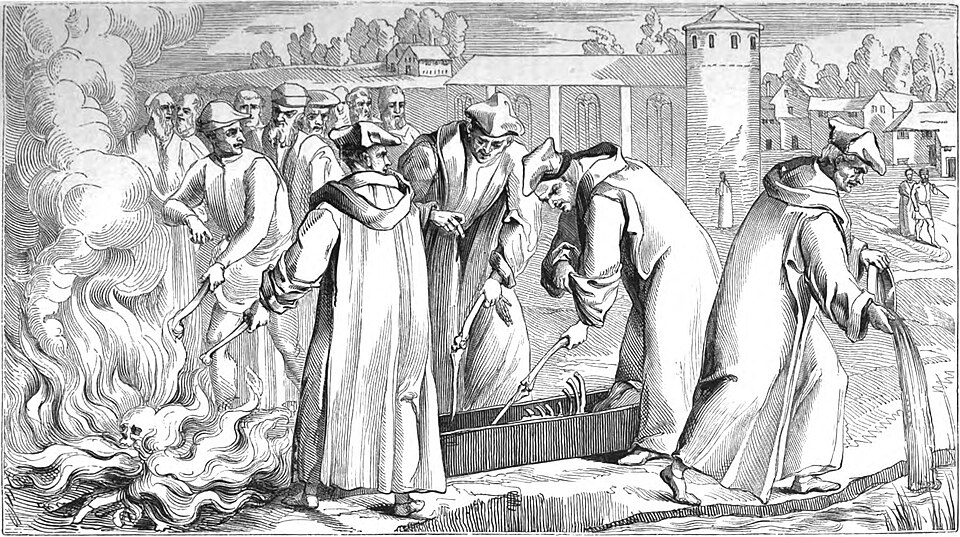
Exhumation of Wickliff
These things thus finished and accomplished, which pertain to the story and time of Wickliff, let us now, by the supportation of the Lord, proceed to treat and write of the rest, who either in his time or after his time, springing out of the same university, and raised up, as ye would say, out of his ashes, were partakers of the same persecution; of whom speaketh Thomas Walden in his book, "{{lang|la|De
Sacramentis et Sacramentalibus," cap. liii. where he saith, that after Wickliff many suffered most cruel death, and many more did forsake the realm;Martyrs and exiles. in the number of whom were William Swinderby, Walter Brute, John Purvey, Richard White, William Thorpe, and Reynold Peacock, bishop of St. Asaph, and afterwards of Chichester.
To this catalogue also pertaineth (mentioned in ancient writers) Lawrence Redman, master of arts; David Sautre, a divine; John Ashwarby, vicar, as they call him, of St. Mary's church at Oxford; William James, an excellent young man, well learned; Thomas Brightwell, and William Hawlam, a civilian; Rafe Greenhurst, John Scut, and Philip Norise; who, being excommunicated by pope Eugene IV., a. d. 1446, appealed unto a general or œcumenical council. 🞼Many more did forsake the realm, but what they were, or what kind of punishment they suffered, Walden left no mention. But we will not suffer their names to be blotted out with silence, which we might by any means pick out; but sure we are greatly sorry that there came nothing else into our hands but only their bare names. Would to God that the constant diligence of our
Exhumation of Wickliff.
EXHUMATION OF WICKLIFF.
predecessors had preserved in memory for us the whole order of their life, the form of their process and judgment, and what was to be observed in their adversaries, or to be commended in them. Albeit that matter were not greatly for our purpose, forsomuch as all those things could not be contained in a few volumes; and that also, by those few, it were easy to be judged what a man may think as touching the cruelty of the papists against all men.🞼
Peter Paine also, who flying from Oxford unto Bohemia, did stoutly contend against the sophisters, as touching both kinds of the sacrament of the last supper; who, afterwards, among the rest of the orators, was one of the fourteen that were sent unto the council of Basil; where, by the space of three days, he disputed upon the fourth article, which was touching the civil dominion of the clergy, A. D. 1438. Also the lord Cobham, with divers others besides, whose names are mentioned in the king's writ, sent to the sheriff of Northampton, the tenor of which writ of the king here followeth:
The king to the sheriffs of Northampton, health. Forasmuch as John Attyate of Chepingwarden, John Warryner, R. Brewood, &c. being receivers and favourers of heretics, and especially of one John Woodward, priest, publicly defamed and condemned of heresy, will not be justified by the censures of the church, as the reverend father John, bishop of Lincoln, hath certified us: We, therefore, willing to withstand all defenders and favourers of such heresies, do will and command as well the beforenamed, as namely, the aforesaid John Woodward to be apprehended, straitly charging the same to be imprisoned by their bodies, or otherwise punished as shall seem good to the justices, until they and every of them shall submit themselves to the obedience of the aforesaid bishop in that behalf accordingly. Whereof fail you not, under pain of a hundred pounds. Witness ourselves: Given at our manor of Langley, the eighth day of March, the twelfth year of our reign.
To these above rehearsed, and other favourers of Wickliff, within this our country of England, we may add also the Bohemians; forasmuch as the propagation of the said doctrine of Wickliff in that country also took root, coming from England to Bohemia by this occasion, as in story here followeth.
How the doctrine of Wickliff came to Bohemia.There chanced at that time a certain student of the country of Bohemia to be at Oxford, one of a wealthy house, and also of a noble stock; who returning home from the university of Oxford to the university of Prague, carried with him certain books of Wickliff, 'De Realibus Universalibus,' 'De Civili Jure, et Divino,' 'De
Ecclesia,' 'De Quæstionibus Variis contra Clerum,' &c. It chanced that at the same time a certain nobleman in the city of Prague had founded and built a great church of Matthias and Matthew, which church was called Bethlehem, giving to it great lands, and finding in it two preachers every day, to preach both on holy days and working-days to the people. The great affection of John Huss to John Wickliff.Of these two preachers this John Huss was one; a man of great knowledge, of a pregnant wit, and excellently favoured for his worthy life amongst them. This John Huss having familiarity with this young man in reading and perusing these books of Wickliff, took such pleasure and fruit in reading thereof, that not only he began Wicklevus vir bonus sanctus cœlo dignus.to defend this author openly in the schools, but also in his sermons, commending him for a good man, a holy man and a heavenly man, wishing himself, when he should die, to be there placed, where the soul of Wickliff should be. And thus for the spreading of Wickliff's doctrine enough, and thus much briefly concerning the favourers and adherents of John Wickliff in general. 🞼Amongst whom, I have only, as yet, rehearsed such, unto whom the profession of the gospel was perilous, and a heavy burden ; whom, notwithstanding, I thought not worthy to be defrauded of their praise: but now, we will convert our style unto those, who, continuing unto the end, have followed the Lamb whithersoever he went, even unto the loss of their lives. And here I am minded first of all, if the brevity of the matter
would suffer it, somewhat to expostulate with the cruelty of the world.
Forasmuch as all mankind, having put apart all use of humanity, have so far degenerated even unto the iron age, or rather unto a brutal cruelty, that never, as I think, since the beginning of the world was Plautus' proverb more verified, "one man is a wolf unto another;" but amongst all the wolves, they are most cruel which are clothed in lambs' skins, which also do most profess peace.
In times past among the Israelites, and in the time of Christ and his apostles, the worshipping and religion of God began to be altered unto Pharisaical superstition; but now, the same pharisaical superstition, I know not by what means, amongst Christians, is grown into extreme tyranny. Albeit that a small portion of this incommodity or evil doth fall upon those, who, for the love of Christ, do suffer violence. For whereas all others are dead, they only do verily live again who die in Christ. This therefore is a most rare dignity which happeneth but unto a few, insomuch that if we do diligently weigh the matter, this only happiness hath our miserable life, if that it may happen to any man to suffer for Christ's sake. Again I do repeat the same: nothing truly can be esteemed in this world, but only the name of Christ, and to suffer for his name.
Wherefore St. Paul doth not unworthily command, that we should not only have steadfast hope through him, but also suffer affliction for his sake. For howsoever the judgments of men do esteem it, there is no truer life than that which is laid up in Christ as a gage, none more absolute renown than to be slain for the Son of God. But this glory doth not yet appear unto our human senses, which are overwhelmed with the filth of this world. But at the length it shall appear, and peradventure sooner than shall be expedient for some, except with speedy repentance they do wax wise and amend, which, that it may the better be brought to pass, suffer me a little by your license, gentle reader, to talk with these cruel blood-suckers; whereby they, being admonished, may repent; or if they will not, that they may behold, to their great shame and rebuke, whether they will or no, their wicked cruelty and great slaughters, laid before them, as it were upon a stage. Surely it was a worthy saying of a jester, who was but a profane man," that it is as unseemly for a prince to abound in tyranny, as for a physician to have many corpses." What shall we then say unto these reverend prelates of the church: if they be princes, why do they bring in so great torments into the poor cottages of Christ ; if they be physicians, how happeneth so great death amongst the sheep? But before I will take this quarrel in hand, I do once again admonish thee, gentle reader, of that which I must oftentimes repeat in this argument. First of all, that you do not interpret any thing which shall be here spoken, in such a manner as though I would maintain any unproved doctrine: for, as I do not favour heretics, who are heretics indeed, even so much less do I favour false bishops. And again, as I do give license unto neither of these, neither to the one, to use his tyranny, nor to the other, to proceed in his errors, so like-wise do I not go about here, to take away the power of the civil sword, because it is not borne by the magistrate in vain. For they have their laws, their judges, and their punishments, necessary in a commonwealth, without which there should be no society, neither any discipline amongst men. But this my complaint doth only touch them, who professing a perfectness of spiritual life above all the rest of the common sort of the people, and who ought to be the masters of all pity and godliness, yet shall you scarcely find any men more venomous in hatred, anger, malice, avenging, and all kind of tyranny. Who was the first that brought in amongst Christians these recantations, faggots, and fire, and these lamentable funerals by burning of the live bodies of men, under the name of heretics? who, but only this flock of religious men and the clergy, whose part it had been rather to help those that had erred, and not to kill them, according to the example of their High Master, who came not to destroy, but to save all men. For it is never so certain amongst men's opinions, but that oftentimes some error will
intermeddle itself: the first purity of the church always excepted. Neither doth every error, by and by, make a man a heretic, except it have joined therewith an obstinate and froward will; neither do I know whether, in this point also, the extremities are to be attempted or no; but the quality of the heresy is to be marked, and the rule of the gospel is to be considered, what it doth require, and what is convenient for every man's profession: the profession of a secular judge is one, the condition of an evangelical minister is another. As St. Augustine writeth in the psalm, "Aliud est sella terrena, aliud tribunal cœleste," &c.
But our pseudo-evangelical papists, neither marking the quality of the one, nor the condition of the other, nor their own profession, neither looking upon one thing nor upon another, without all respect or difference, like furious Donatists, or homicides rather, under the cloak of religion, of every little word spoken against their pomp and ambitious pre-eminence, make a matter of heresy, whereby to murder and make havoc of Christ's people. What did the heart of Bonner, and of such of his affinity, differ from the heart of the strongest pirate, or homicide, murdering by the highway? yea insomuch that the very pirates themselves (if it be true that is reported of Bonner's
receiving into prison), be ashamed of his comparison, and to be counted of his society. And yet, neither pity can stay him from cruel bloodshed, nor shame can drive him to repent such horrible tyranny. Wherein the case of these sicares and thieves yet may seem better, than of these catholics. For they, at the execution of God's judgment, as they cannot dissemble their trespass, so are they sooner touched with repentance. The others, either with ignorance drowned, or choked with malice, as they have spoiled the life of many more than ever did any thief; so much more be they further of repenting their iniquity, but think that, good service done to God, which they have done to the devil, who is a murderer from the beginning: and think themselves good pastors, when they devoured the poor flock, and played the wolves. So dangerous a thing it is, to have an ignorant zeal, where true knowledge is wanting. Of these did Christ premonish us before, declaring the blind ignorance of such, who, of their preposterous zeal, should turn iniquity and cruelty to God's service; and under the title of the church, should impugn the church, and of sincere verity, should make heresy.
But such as these never reigned more, or raged further, than in these latter days of the church, as the monuments of this history will declare: as who, having no regard of man's life, make every matter spoken against their private commodity to be 'heresy! heresy!' In times past it was not accounted as a heresy, except it did contain blasphemy, and did bring in some great peril to the faith, or where the majesty of Christ was hurt: such as were the Donatists, Manichees, Appolinatists, and Arians.
And notwithstanding the moderation of the bishops was such in those days, that they would not implore the emperor's aid in this case, except the wickedness of those heretics, who filled all places full of slaughter and schism, did even of necessity force them thereunto. As it doth evidently appear by St. Augustine and divers others, who thought the requiring of the profane power not so necessary in such business; insomuch that he became an advocate unto Dulcitius the tribune, that he should put none of them to death. The like thing, as I suppose, did he unto Macedonius the president, considering with himself that they ought to use no other kind of weapon, in this kind of contention, than only the word of God, prayer, and doctrine; or if the evil were past remedy, then they used to exclude them out of the church. And if the said Austin afterward altered his mind, being led thereunto, rather by the success ensuing than by his own judgment: that helpeth little or nothing the cruelty of our men now-a-days. For first of all, with what success the Babylonical firemakers have exercised their tyranny upon the members of Christ, the matter itself doth sufficiently testify: then let us behold those against whom they did then so rage, what manner of Manichees and Donatists they were; of whom no man is ignorant, that although they were called heretics, yet they were indeed furious robbers, and thieves, so that the matter now seemed no more to belong unto the office of the church, but rather to appertain to the tribunal power, albeit the church would wink thereat.
Whereby it is brought to pass, that through the perilous wickedness of the time, the bishops are driven to this point; that of force the emperor's laws are to be received for help, and then these laws did threaten none other thing, but only death unto the captains of them, as it appeareth, in the book of the laws upon the Manichees and Samaritans. The disciples were punished by the purse; and such as, neglecting the laws of the princes, did obstinately persevere in their wickedness, banishment was appointed for them: besides that at that time, there were no university-schools (as we call them) erected, to resist those mischiefs, whereas contrariwise now, there is almost no religion, which is not armed and adorned with universities, whereby there may speedy remedy be had, if we be so greatly afraid of heretics; but what is now-a-days come in men's minds, that setting apart the universities and all kind of arguments, whereby they might the more better, so also more easily, convince all errors, and finally forgetting all kind of meekness, which Christ himself and his apostles do so greatly commend unto us, using no kind of reason, do think that heretics must be entreated by no other means, than with torments, faggots, and fire. What profit cometh of the universities, when we do think that the truth is to be defended by no other means, than with bonds, stripes, chains, and torments, &c.? Thus we have alleged, as touching heretics, as though they were the very same indeed, which they are now falsely accused to be.
But now let us see what manner of things they are, whereabout these greedy papists make so much ado, with so many tragedies and fires. Amongst so many, who, in these our days, have been burned, who is it that can show me only three, who cither have wickedly taught, or openly spoken of God; who have detracted or taken away one so small a part of the divine nature of Christ; who have taught any blasphemy against the Holy Ghost, or, finally, who have untruly dissented in any article of the faith? but all this filthy sink is troubled about certain circumstances of places, times, and persons, and of men's traditions.
What doth it so much make matter, if any man do truly worship Christ in heaven, although he do not worship him in the sacrament? What great importance is it, if with Christ and Paul, we do call the bread the body of Christ, if we do not conceive with the school-men, the accident to be there without the subject? What if we do not disclose unto the priest the number of our sins, if that we, confessing ourselves truly unto Christ, do turn unto repentance? What if that we do forsake the trust of our works? What if that we do contemn the pardon of bishops, and repose our whole righteousness and redemption in Christ, our only bishop? Is our faith therefore the less agreeable and conformable unto the articles given us by the apostles? What if that we, contemning the image of saints, do worship one only Christ in spirit and truth; shall we be any deal the less Christians therefore, or is not Christ alone sufficient for us all? The gospel teacheth only two sacraments, which alone, if a man do reverently embrace, setting apart all the others, which are sprung up by men's institutions, what hurt shall Christianity sustain thereby? So likewise the Scripture of God doth not permit a concubine; but it doth license every man to have a wife, so that he have but one—whether then do you think doth bind most strictly, the will of God, or the vow of men? Or if that a priest, breaking his unlawful vow, had rather call her, with whom he had a long time accompanied, 'wife,' than 'concubine;' what! doth this deserve either punishment or prisonment? Neither do I think that thereby the regiment of the church or the order of the clergy, should come to ruin, if that one bishop of Italy setting apart his primacy, which no Scripture doth allow, were reduced unto the order of other bishops. And these are those great offences of blasphemy, for the which one Christian is so exasperated against another, with so great fury and cruelty. Here again is the admonition to be renewed, which hath been so often before repeated, that we neither speak nor think any thing against the politic laws; but only against such, to whom it were convenient, for their profession, to be most meek of all men, and yet by nature they are most fierce and cruel. Their own constitutions declare the same in the fifth book of their Decretals, where it is commanded, that a heretic, convicted in any error (but how convicted? by authority rather than by the Scriptures!), should be delivered unto the secular power: neither is that yet sufficient that they do so imbrue the secular sword with blood, but that also, with their malice, they do sharpen and whet the same, which of itself is already sharp enough. The writers of the Gloss do also add this unto it, "to be burned." And these are they who will represent Christ unto us here upon earth, crying out oftentimes that all Christ's doings are for our instruction. But if that all our life be to be directed unto Christ's institutions; what thing less do his examples teach us, than such kind of cruelty, and especially in ministers, in whom he doth, with so great zeal, commend humility and meekness with mutual love, as the only knot of his gospel: wisely forbidding them, that in pulling up of the cockle, they should not be too rash, fearing lest peradventure that might come to pass, which now indeed hath happened: lest together with the cockle they pull up the good wheat also. Then what is there to be said, where, not only together with the cockle, but, instead of the cockle, the very wheat itself is plucked out of the floor of the Lord? How well that is correspondent unto Christ's doings let they themselves judge.
I surely am greatly afraid that they will deserve, no great thanks at the hands of the Lord of the harvest, when he shall come to reward every man according to his doings. But in this point I do not plead as the advocate of the heretics, if there be any who are heretics indeed. Neither do I go about here to discuss how far the power of the civil sword doth extend, or what is lawful to be done by the civil constitutions. But truly, whatsoever the necessary severity of the civil power doth, yet the priests and rulers of the church ought always to use humility and gentleness, according to the example of Him, who would not compel any man to his religion. What saith he? "He that hath ears to hear let him hear," yet doth he not by and by threaten death unto him that will not hear; neither doth he grievously threaten those who do depart away from him, as St. Cyprian witnesseth; but turning unto his disciples he said, will you also depart from me? He came not to occupy any civil authority, and as he did not possess any civil authority, so neither did he deliver any man over unto the civil power. Albeit it is not to be doubted but that it may happen sometimes, that the christian hierarchy shall need to call for the help of the magistrates (like as against the Donatists the help of the laws were very necessary), especially if the heresy do once grow on to tumult, schism, sedition, robbery, or to the ruin of the commonwealth; in such case I suppose the foreign magistrate ought to foresee that the commonwealth suffer no detriment. Otherwise, if the heresy be such that it do contain itself within some private error, without passing any further, that same doth seem to pertain only unto the bishops and universities, neither do I greatly see what the civil power should meddle herein: for so heresies are more easily trodden down, being convicted rather by reason, than oppressed by violence. But now, these many years, they have raged against heretics with great hatred and extreme torments.
But that they have profited thereby, every man doth perceive. How much more circumspect and worthy of a christian man were it, if that they would walk in the footsteps, and follow the examples, of our forefathers, for our fathers in Christ desired rather to excel in learning, in tongues, in godliness, in the power of the word and Spirit, rather than in any worldly authority. So did Paul, Peter, and the apostles; so did the martyrs of the primitive age; so did the learned doctors and writers after them, whose learning and labour were great in the church, although their authority was but little, after the manner of this world. For such is the nature of the church, that as it is a spiritual regiment, so by spiritual means it is maintained. But now-a-days you shall see many who think there is no other means for defending the church against heretics, than the force and majesty of the bishops only: whereby it is come to pass that the ecclesiastical ministration is far alienated from that, which, in times past, was begun in the world by Christ and his apostles; for now it is grown, as it were, to an image and form of a secular empire, and almost unto a kingly power and riches, and, in a manner, unto most extreme tyranny. But if our desire be so great to dissipate heresies, I see no speedier way or remedy, than that if the fathers of the church would diligently take heed that the church of Christ be
not overwhelmed with such a number of articles; so should it soon be brought to pass, that not only the young branches of heresy should be easily cut off, wheresoever they begin to spring, but also, that in short time, there should no more spring or rise up. For, if we should say the truth, whereupon cometh it that the world is so full of dissension, but only that all things are so intricate, with so many articles, so many censures, cautions, and school pleas, neither is there any article which hath not its heresy annexed unto it, as the shadow unto a body; insomuch that the matter is now come unto this point, that nothing can now be spoken so circumspectly, but that it shall tend to some snare of heresy, or, at the least, suspicion. There are so many snares of constitutions and decrees, so many titles of reprehension and caption, specially where hitherto, instead of love and charity, which now is banished, I know not into what strange and far distant place, the fury Erynnys is come in place, the depraver of all things, filling all the world with her reproaches and slanders, even
for a small occasion, and oftentimes for none at all. Wherefore, since all things are at this point, nothing in mine opinion is to be preferred to this, that we, being reconciled together with a mutual conjunction of our minds, do take away all occasion (as much as may be) of brotherly offence. Whereupon especially this mischief doth grow: if we do commit any heresy, whatsoever doth resist against men's decrees, it were better that there were fewer articles in the world, and then the heresies would cease of their own accord. For hereupon began the first spring of all mischief, and at this point again, must the method of remedy be sought for. What if that the pope's decrees did extend no further than Italy? What if there were nothing received into our necessary faith, which is contained in very few words, but only the articles of the apostolical symbols, as they were set forth by the most approved councils, what should the church, the spouse of Christ, be hindered thereby? Yet notwithstanding, for these trifles, we do see in every place old men, young men, and also women burnt, neither do they spare kindred, stock, nor age, insomuch that it is almost less danger to offend against the majesty even of the most mighty princes, than to violate the sanctions of any so mean a bishop. Whereof the storm and tempest of persecution hath been so vehement in these our days, that there is almost no part of Europe, which is not imbrued with the blood of the martyrs which hath been shed. And, albeit that their decrees do most consonantly agree unto the Scriptures (let us also grant them that), yet were it the part of divines to teach, and of tyrants to compel. Now what is this by violence to be carried unto the fire, for certain doubtful articles of controversy, some not greatly sound, or peradventure disagreeing unto the Scriptures, not only heretics, but, instead of heretics, the guiltless and innocents. Oh what marvellous folly is this of men, that while these tyrants daily do exercise this tyranny in the cottages of Christ, englutting themselves with men's blood, they do triumphantly rejoice, as though they had done a high service unto God, and wrought a very good deed. Even in like sort, as in foreign wars of princes, it is counted great valiantness, whosoever can kill most of his enemies; so likewise this is the only renown and praise amongst the heads of the church, which of them hath shed most heretics' blood. As we have heard report of John Stocksley, sometime bishop of London, that he did boast himself, even when he was at the point of death, giving thanks unto God with a loud voice, that he had sent thirty-one heretics unto the infernal fire! Verily these were words more fitted for a beast than for a man.
But let these men take heed that while they go about, by their own fantasies rather than by any just judgment, to put heretics to death, that the same thing do not happen unto them which in times past happened unto the Jews, who when they would have entered upon Christ as a seditious man, they stumbled upon the Son of God.
The which for that it may not come to pass, wisdom and learning chiefly in bishops, diminution of articles, judgment, an evangelical mind, gentleness, a zeal joined with knowledge, a care to save rather than to destroy men, a mind which attributeth nothing unto affection, but submitteth itself wholly unto the rule and governance of equity and the Scriptures, shall principally perform.
But heresy is altogether to be suppressed truJy, neither shall heresy find any maintenance at my hands. This only do I require in these catholics, that if they will not use the apostolic moderation, yet they would use some civil modesty, and rather choose to try their matters by some reasonable means, than with such clamours and seditious rashness. I do require some moderation which will lawfully convince those whom it is wished to oppress, I require doctrine which should rather bridle the heresies, than the heretics. Let them rage so much as they will against the name of heretics, truly I think if these days which do seem scarcely christian, had six Jeromes, and as many Augustines, although it had no other help besides, I think the church should want no sufficient aid to put to flight the great heaps of heretics. But forasmuch as in this extreme cruelty of the world, when all charity is waxed so cold, I am not ignorant how small credit these things shall find at many men's hands, like as also other counsels of moderations before mine have been neglected: wherefore it should be the best for me to leave these kind of men to their own will, rather than to sing unto such as are deaf, and so to lose both time and labour.
But now let us return unto the martyrs; but before we do enter into that lamentable story, we do think it worth our labour, to show first certain prophecies of sundry men, whereby so many great persecutions of the world were prefigui-ed. And first to begin with Joiachun the abbot, we will rehearse what was found of him in an old monument of Hoveden: Thus he saith, "Richard, the king of England, in his expedition unto Jerusalem, hearing tell of the great fame of Joiachim of Calabria, abbot of Curacon, who, by the spirit of prophecy, did foreshow things to come. What time as he sojourned at Sicily he caused the said abbot to be sent for to him, to hear of him, amongst other things more, what he could declare as touching Antichrist: he then, expounding the mystery of the seven kings in the Revelation, whereof five were fallen, &c. said "The seven kings are seven persecutors, Herod, Nero, Constantinus, Mahomet, Melsemutus, Saladinus, and Antichrist." But as touching Antichrist, he said thus. That even at that present he should be bred in Rome, and should be exalted in the apostolic see, of whom the apostle speaketh, he is exalted above all things that is called God.'"
Thus much writeth Hoveden; and this abbot was in the year of our Lord 1290. There is also the prophecy of Hildegard (of whom we have spoken before), in the 29th book of Vincentius. " In the year," says she, "after the incarnation of Christ, 1200, the doctrine of the apostles, and the fervent justice which God had appointed amongst the spiritual Christians, began to wax slack and doubtful, but this womanly time shall not so long continue as it hath hitherto continued." Thus much writeth he; neither did Fluentius, the bishop, doubt openly to preach that Antichrist was born in his days, as it appeareth by Sabellicus. Also before these days, A. D. 1239, Gerardus, bishop of Laodicea, in his book entitled "Of the Preservation of the Servants of God," doth conjecture Antichrist to be even at hand, by the rarity of prophesying and the gift of curing. There is also a certain prophecy of Jerome Savonarola, evident (if it be worthy credit) 69 years before, wherein he doth affirm in this manner, "that Italy should be plagued with the scourge of God, for the manifold sins thereof, even amongst the princes, as well ecclesiastical as secular; and when the cities of Rome and Florence are overthrown then should the church be renewed, the which should happen very shortly; and that the Turks, and Mauritanians, in these our days, should be converted unto the true knowledge of Christ." He foreshowed also, that "there should one pass the Alps, like unto Cyrus, who should subvert all Italy." Thus much have we found in the book of Caspar Hedio, entitled the "Paralipomena."
I think also it lacketh not his prophecy which happened A. D. 1501, that throughout all Germany there was seen upon men's garments, crosses, crowns of thorn, the similitude of nails and drops of blood fallen from heaven: and oftentimes these fell within the houses, insomuch that many women wore the same long time upon their garments: if that be true which Gaspar doth report. Hereunto also is to be annexed that which we read in our countryman Froysard, as touching one John of Rochetaylada, a Franciscan friar; not that we have any certainty thereof, but that ve do only show what is there written. He, in the year of our Lord 1346, is said to have foreshowed, that the ecclesiastical order should suffer much through the ambitious avarice and pride; whereupon, he was by pope Clement VI cast into prison. Neither is it to be passed over with silence, that which is reported, that Manfridus, a Dominic friar of Vercellos, is said to have foreshowed that Antichrist should rise up in his time, as it is written by Antoninus.
And Arnoldus de Villa Nova, Catalanus, a singular mathematician and physician, did affirm out of Daniel and Sibil, that Antichrist, after the year of our Lord 1300, should fully rage over the godly, and that there should be persecution in the church. He said moreover, that these cloister monks did falsify the doctrine of Christ. That the sacrifice of the altar was not profitable to the quick nor to the dead, neither that there was any knowledge in the pope's consolations, but only of men's works. At the last he was sent by Frederic, king of Sicily, to the bishop of Rome, where by the way upon the sea he died, and was buried at Genoa. I might also have repeated the testimony of Peter John Aquitane, a Franciscan friar in Vasconia, who, after all the rest, prophesied that in the latter days the law of liberty should appear; who after his burial was by pope Clement IV, declared a heretic, and his dead corpse taken up and burned, if that we may credit Guido of Parpinian. Then we may also repeat those things which so many years before were pronounced of divers, as touching the birth of Luther, and gathered out of Melancthos' commentaries upon Daniel. These things thus presupposed, and those also remembered, whom this miserable storm of persecution hath afflicted, and driven unto recantation and the uttermost terror of death, now our story shall return to them, unto whom God hath given a greater constancy of heart, and steadfastness of faith, to persevere even unto the death; albeit I cannot promise the whole catalogue of them, forsomuch as there were so many christian martps in all parts of the world, whereof a great number were compassed in with craft and deceit, some were poisoned, others were tormented with open torments, many were oppressed with private and unknown murder and death, others died in prison, some by famine, and some, by other means, were openly and privately destroyed; that it is scarcely possible to attain to the knowledge of a small number of them, or if that it happen that I obtain the knowledge of the names of them, yet can I not by any means find out the manner of their execution, and the causes of all them who have suffered in so many and far distant places; neither do I think that one man is able to do it; albeit this one thing is most certain in them all, and may be as perpetual: that whatsoever thing hath happened unto any one of them, by the example thereof, you may easily judge what hath happened unto them all: forsomuch as the cruelty of all the bishops towards them hath been in a manner, all alike, the form of their judgments all one, the reason of their condemnation agreeing, and the order and kind of their death nothing different, neither were their causes greatly diverse, when, as in a manner from the superstition of the sacrament only, and a few other ceremonies, and the ambition of the clergy, the whole principal cause and occasion of this trouble, did spring and grow.🞼
Now particularly and in order let us, by Christ's grace, prosecute the stories and persecutions of the parties aforenamed as the course of their times shall require, first beginning with the valiant champions William Swinderby and Walter Brute.
The Story of William Swinderby.
A.D.1389.W. Swinderby first examined.In the year of our Lord 1389, William Swinderby, priest, within the diocese of Lincoln, being accused and detected as to certain opinions, was presented before John, bishop of Lincoln, and examined first upon certain articles in the church, of Lincoln, after the form and order of the pope's law, according to their usual rite observed; his denouncersDenouncers of W. Swinderby, three friars. were these: friar Frisby, an observant ; friar Hincely, an Augustine; and Thomas Blaxton, a Dominican. The articles wherewith they charged him, although in form of words, as they put them up, they might seem something strange here to be recited; yet, the intent that all men may see the spiteful malice of these spider-friars, in sucking all things to poison, and in forging that which is not true, as in process (Christ willing) hereafter shall better appear by his answers, I thought good to notify the same.
Articles untruly collected against Swinderby.That men may ask their debts by charity, but in no manner for debt imprison any man; and that he so imprisoning is accursed.
That if parishioners do know their curate to be a lecher, incontinent, and an evil man, they ought to withdraw from him their tithes, or else they be fautors of his sins.
That tithes be purely alms, and that in case curates be evil men, the same may lawfully be conferred on other men.
That for an evil curate to curse his subject for withholding tithes, is nothing else, but to take with extortion wickedly and unduly from him his money.
That no prelate may curse a man, except he know beforehand that he is cursed of God.
That every priest may absolve any sinner being contrite; and is bound, notwithstanding the inhibition of the bishop, to preach the Gospel to the people.
That a priest taking any annual pension upon covenant, is, in so doing, a simoniac, and accursed.
That any priest being in deadly sin, if he give himself to consecrate the body of the Lord, committeth idolatry rather than doth consecrate.
That no priest entereth into any house, but to evil entreat the wife, the daughter, or the maid; and therefore he admonished the good man of the house to take heed what priest he doth let into his house.
Another conclusion falsely to him objected; That a child is not truly baptized, if the priest that baptizeth, or the godfather or godmother, be in deadly sin.
Item, That no man living against the law of God is a priest, however he were ordained priest by any bishop.
These articles or conclusions untruly collected, were as cruelly exhibited against him by the friars in the bishop of Lincoln's court. Swinderby compelled by the friars to abjure articles which he never taught.Although he had never preached, taught, or at any time defended them, as appeareth more in the process following, yet the friars with their witnesses standing forth against him, declared him to be convicted; bringing also dry wood with them to the town to burn him, and would not leave him before they had made him promise and swear, through fear of death, never to hold them, teach them, or preach them privily or openly, under pain of relapse; and that he should go to certain churches to revoke the aforesaid conclusions, which be never affirmed: as first in the church of Lincoln; then in St. Margaret's church in Leicester; also in St. Martin's church in Leicester, and in our Lady's churches at Newark, and in other parish-churches also, namely, those of Melton-Mowbray, Helhoughton, Hareborough, and Lentborough: which penance being enjoined him, he did obediently accomplish, with this form of revocation, which they bound him to, in these words.
The Revocation of William Swinderby, whereunto he was forced by
the Friars.
I, William Swinderby, priest, although unworthy, of the diocese of Lincoln, acknowledging one true catholic and apostolic faith of the holy church of Rome, do abjure all heresy and error, repugning to the determination of the holy mother church, whereof I have been hitherto defamed; namely, the conclusions and articles above prefixed, and every one of them, to me judicially objected by the commissary of the reverend father in Christ and Lord, lord John, by the grace of God, bishop of Lincoln, and do revoke the same, and every one of them, some as heretical, others as erroneous and false; and do affirm and believe them to be so, and hereafter will never teach, preach, or affirm publicly or privily the same. Neither will I make any sermon within the diocese of Lincoln, but asking first and obtaining the license of the aforesaid reverend father and lord, the bishop of Lincoln. Contrary to which, if I shall presume hereafter to say or do, to hold or preach, I shall be content to abide the severity of the canon, as I have judicially, by the necessity of the law, sworn, and do swear, &c.
Thus have you the conclusions and articles of this good man, falsely objected to him by the malicious and lying friars; and also the retractation, whereunto they, by force, compelled him; whereby it may likewise be conjectured, what credit is to be given to the articles and conclusions which these cavilling friars, wresting all things to the worst, have objected and imputed both to Wickliff, and all others of that sort, whom they so falsely do defame, so slanderously do belie, and so maliciously do persecute. After these things thus done and wrought in the diocese of Lincoln, it so befell that the said William Swinderby removed to the diocese and county of Hereford; where he was again as much or more molested by the friars, and by John Tresnant, bishop of Hereford, as by the process and story here ensuing, set out at large out of their own registers, may appear.
The Process of John Tresnant, Bishop of Hereford, had against the aforesaid William Swinderby in the cause of Heretical Pravity, as the Popish Heretics call it.
Flourishing invocation of God's name.The glorious name of the Prince of Peace, and his counsel (whose counsellor no man is, and whose providence in his disposition is never deceived) being invovocated, To all and singular believers of Christ, who shall see or hear this our process underwritten, John, by the sufferance of God bishop of Hereford, greeting, and peaceable charity in the Lord. Forasmuch as God, the creator of all things, the keeper of justice, the lover of right, and the hater of malice, beholding from the high throne of his providence the sons of men, now, through the fall of their first father, prone and declining to dishonest, and filthy, and detestable mischiefs, and to keep under their malice, which wicked transgression did first gender, hath appointed divers presidents of the world established in sundry degrees, by whom, and their circumspect providence, man's audacity should be restrained, innocency should be nourished amongst the good, and terror should be stricken into the wicked not to deceive; also that their power to hurt, and their insolency should be bridled in all places: and whereas, amongst many kinds of cares which come to our thoughts, by the duty of the office committed unto us, we are specially bound to extend our strength, chiefly that the catholic faith may prosper in our times, and heretical pravity may be rooted from out of the borders of the faithful. We, therefore, being excited through the information of many credible and faithful Christians of our diocese, to root out pestiferous plants, as sheep diseased with an incurable sickness, going about to infect the whole and sound flock, are by the care of the shepherd to be removed from the flock, that is to say, preachers, or more truly execrable offenders of the new sect, vulgarly called Lollard, by the pope's interpretation, is a word derived from lollium.Lollards; who, under a certain cloked show of holiness, running abroad through divers places of our diocese, and endeavouring to cut asunder the Lord's unsewed coat, that is to say, to rend the unity of the holy church, and of the catholic faith, and also to tear in pieces with their tempestuous blasts the power of St. Peter, that is to say, to weaken the strength of the ecclesiastical states and degrees, and the determination of the same holy church, have wickedly presumed, and do presume, from day to day, to speak, to teach, to maintain, and, that which is more horrible to be uttered, to preach openly many things heretical, blasphemies, schisms, and slanderous defamings, even quite contrary to the sacred canons and decrees of the holy fathers, so that they know not to direct their paths in the ways of righteousness and truth, in that they expound to the people the holy ScriptureThey counterfeit in the prophet's words, as apes do, in princes apparel. as the letter soundeth, after a judaical sort, otherwise than the Holy Ghost will needs have it, where the words wander from their proper significations, and appear to bring in, by guessing, new meanings; whereas the words must not be judged by the sense that they make, but by the sense whereby they be made; where the construction is not bound to the Donates' rules, where faith is far placed from the capacity of reason; but they labour, by their pernicious doctrines and teachings, public and privy, to boil out the poison of schisms between the clergy and the people. We, to encounter against such kind of preachers, nay rather deceivers, and horrible seducers amongst the people, advancing and rousing up ourselves in God's behalf, and that of holy mother church, with the spiritual sword, which may strike them wisely, and wound them medicinally, for their health and welfare; and namely, William Swinderby, priest (so pretending himself to be), as a teacher of such kind of pernicious doctrine, and a horrible seducer among the people; to whom personally appearing before us on the Wednesday, to wit, the fourteenth of the month of June, in the parish church of Kingston of our diocese, in the year of our Lord 1391,A. D. 1391. he being vehemently defamed to us of heresy, schism, and his perverse doctrines both manifest and privy; we, therefore, have caused many cases and articles concerning the catholic faith to be ministered unto him, that he should answer to the same at a day and place for him meet and convenient, of his own choice and free will; that is to say, on the Friday, being the last of the same month of June next following, assigned to him, at the church of Bodenham of the same our diocese: which cases and articles were exhibited to us by many of Christ's faithful people, zealous followers of the catholic faith, who made information to our office; which cases and articles also were by us administered, as is before said, to the same William Swinderby; the tenor thereof followeth, and is thus:
Matters articulated against William Swinderby.
Reverend father and high lord, lord John, by God's sufferance bishop of Hereford: it is lamentably declared unto your reverend fatherhood on the behalf of Christ's faithful people, your devout children of your diocese of Hereford,'Lord,' 'Lord,' a Latin style of their own making.Denunciation of the promoters, to the bishop of Hereford. that notwithstanding the misbelief of very many Lollards, who have too long a time sprung up here in your diocese, there is newly come a certain child of of wickedness, named William Swinderby; who, by his horrible persuasions and their own mischievous endeavours, and also by his open preachings and private teachings, doth pervert, as much as in him is, the whole ecclesiastical state, and stirreth up, with all his possible power, schism between the clergy and the people. And that your reverend fatherhood may be the more fully informed, who and what manner of man the same William Swinderby is, there be proposed and exhibited hereafter to the same your fatherhood, on the behalf of the same faithful people of Christ, against the same William Swinderby, cases and articles; which if the same William shall deny, then shall the same cases and articles most evidently be proved against him by credible witness worthy of belief, and by other lawful proof and evidences, to the end that those being proved, the same fatherhood of yours may do and ordain therein, as to your pastoral office belongeth.
Imprimis, the same William Swinderby, pretending himself priest, was openly and publicly convicted of certain articles and conclusions being erroneous, schismatical, and heretical, preached by him at divers places and times, before a multitude of faithful christian people. And the same articles and conclusions did he by force of law revoke and abjure, some as heretical, and some as erroneous and false; avouching and believing them for such, as that from thenceforth he would never preach, teach, or affirm, openly or privily, any of the same conclusions: and if, by preaching or avouching, he should presume to do the contrary, that then he should be subject to the severity of the canons, accordingly as he did take a corporal oath, judicially, upon the holy gospels.
II. Also the conclusions, which by the same William were first openly taught and preached, and afterwards abjured and revoked, as is aforesaid, are contained before in the process of the bishop of Lincoln, even as they be there written Word by word. And for the cases and articles, they were consequently exhibited by the beforenamed faithful christian people against the said William Swinderby, together with the conclusions before said, and hereafter written; of which cases and articles the tenor here ensueth.
III. Item, The said William, contrary to the former revocation and abjuration, not converting to repentance, but perverted from ill to worse, and given up to a reprobate sense, came into your diocese; where, running about in simdry places, he hath presumed to preach, or rather to pervert and to teach, of his own rashness, many heretical, erroneous, blasphemous, and other slanderous things contrary and repugnant to the sacred canons, and the determination of the holy catholic church. What those things were, at what place and what time, shall hereafter more particularly be declared.
IV. Item, The same William, notwithstanding your commandments and admonitions sealed with your seal, and to all the curates of your diocese directed, containing amongst other things that no person of what state, degree, or condition soever he were, should presume to preach or to teach, or expound the holy Scripture to the people, either in hallowed or profane places within your diocese, without sufficient authority, by any manner or pretence that could be sought, as in the same your letters monitoiy and of inhibition, the tenor whereof hereafter ensueth, is more largely contained; which letters the same William did receive into his hands, and did read them word by word in the town of Monmouth of your diocese, in the year of our Lord 1390, so that these your letters, and the contents thereof, came to the true and undoubted knowledge of the same William; yet, notwithstanding, hath the same William presumed in divers places and times to preach within the same your diocese, after and against your commandment aforesaid.
The tenor of the same Letters before mentioned followeth, and is this:
The letter monitory of the bishop of Hereford, inhibiting to preach without his license.John, by the sufferance of God bishop of Hereford, to the dean and chapter of our church of Hereford, and to all and singular abbots, priors, provosts, deans rural, parsons and vicars of monasteries, priories, churches, colleges, and parishes, and to others having cure of souls within the city and diocese of Hereford, and to all and every other being witliin the same city and diocese, greeting, grace, and blessing. Forasmuch as the golden laurel of teaching doctoral is not from above indifferently every man's gift; neither is the office of preaching granted save to such as are called, and especially by the church admitted thereunto: we do admonish and require you, all and singular clerks aforesaid, and do straitly enjoin you all, in the virtue of holy obedience, that neither you nor any of you do admit any man to preach or to teach the catholic faith, saving such as the same office of preaching shall, by the authority apostolical, or else yoiu- bishop, be specially committed unto; but that as much as in you shall lie, you do by word and deed labour to let those that would attempt the contrary. And you, lords, ladies, knights, barons, esquires, and all, and singular persons, of what estate, degree, pre-eminence, or condition soever ye be, remaining within the city and diocese of Hereford, we do beseech and exhort in our Lord, that, following the words of our Saviour, you beware of the leaven of the Pharisees.
Would God both they and all men did beware of that leaven.Item, According to the saying of the apostle, "Be not ye carried away with divers and strange doctrines;" and that in the meanwhile, as saith the apostle, you be not removed from the sense of the holy ancient fathers, lest that any man by any means should seduce you; but you, agreeing together in one mind, see that you honour God with one mouth. But if any men to whom that thing is not specially, as is aforesaid, committed, shall attempt to instruct, or in this your life to direct you into the catholic faith, do ye deny to give them audience, and refuse you to be present at their assemblies, and shun ye their teachings, because they be wicked and perverse. And as for us, we will not omit to proceed, according to the sacred canons and precepts of the holy fathers, against such as do the contrary.
Dated at London, in the house of our habitation, under our seal, the last day save one of December, in the year of our Lord 1389, and, of our consecration, the first.
V. Item, The same William, in his preaching to the people on Monday the first of August, in the year of our Lord 1390, in the parish of Whitney of your diocese, did hold and affirm, that no prelate of the world, of what estate, preeminence or degree soever he were, having cure and charge of souls, he being in deadly sin, and hearing the confession of any under his hand, in giving him absolution, doth nothing:On of Wickliff's blemishes. as who neither doth loose him from his sin, nor in correcting or excommunicating him for his demerits, doth bind him by his sentence, except the prelate shall be free himself from deadly sin, as St. Peter was, to whom our Lord gave power to bind and loose.
VI. Item, The same William in many places said and affirmed, in the presence of many faithful christian people, that after the sacramental words uttered by the priest having the purpose to consecrate, there is not made the very body of Christ in the sacrament of the altar.
'Bread; he meaneth, in substance.VII. Item, That accidents cannot be in the sacrament of the altar without a subject; and that there remaineth material bread there to such as be partakers communicant with the body of Christ in the same sacrament.
VIII. Item, That a priest being in deadly sin, cannot be able by the strength of the sacramental words to make the body of Christ, or bring to perfection any other sacrament of the church, neither yet to minister it to the members of the church.
IX. Item, That all priests are of like power in all tilings, notwithstanding that some of them in this world are of higher and greater honour, degree, or pre-eminence.
X. Item, That only contrition putteth away sin, if so be that a man shall be duly contrite; and that all auricular and outward confession is superfluous, and not requisite of necessity to salvation.
XI. Item, Inferior curates have not their power of binding and loosing immediately from the pope or bishop, but immediately from Christ: and therefore neither the pope nor bishop can revoke to themselves such kind of power, when they see time and place at their lust and pleasure.
XII. Item, That the pope cannot grant such kind of annual and yearly pardons, because there shall not be so many years to the day of judgment, as are in the pope's bulls or pardons contained: whereby it followeth that the pardons are not of such like value as they speak of, and are praised to be.
XIII. Item, It is not in the pope's power to grant to any person penitent, forgiveness of the punishment or of the fault.
XIV. Item, That person that giveth his alms to any, who in his judgment is not in necessity, doth sin in so giving it.
XV. Item, That it stands not in the power of any prelate, of what religion soever he be, privately to give letters for the benefit of his order, neither doth such benefit granted, profit them, to the salvation of their soul, to whom they be granted.
XVI. Item, That the same William, unmindful of his own salvation, hath, many and oftentimes, come into a certain desert wood, called Dervallwood, of your diocese, and there, in a certain chapel not hallowed, or rather in a profane cottage, hath, in contempt of the keys, presumed of his own rashness to celebrate, nay rather to profanate.
XVII. Item, the same William hath also presumed to do such things in a certain profane chapel, being situate in the park of Newton, nigh to the town of Leintwarden, of the same your diocese.
Upon Friday, being the last of the month of June, in the year above said, about six of the clock, in the said parish church of Bodenham, hath the said William Swinderby personally appeared before us. And he, willing to satisfy the term to him assigned, as before specified, hath read out word by word before all the multitude of faithful christian people, many answers made and placed by the same William (in a certain paper-book of the sheet folded into four parts) to the said articles, and the same answers for sufficient hath he to us exhibited, avouching them to be agreeable to the law of Christ. Which thing being done, the same William (without any more with him) did depart from our presence, because that we, at the instance of certain noble personages, had promised to the same William free access; that is, to wit, on that day for the exhibiting of those answers, and also free departing without prefixing of any term, or without citation, or else any other offence or harm in body or in goods.
As for the tenor of the same answers, exhibited unto them by the same William, as is before specified, we have hereunder annexed it word for word, and in the same old language used at that time, when it was exhibited. And it followeth in these words.
The Protestation of William Swinderby, with his Answers to the Articles by the Promoters laid against him, to the Bishop of Hereford, taken out of the Registers in the same old English, wherein he wrote it.
In the name of God, amen. I William Swinderby, priest, vnworthy, couenting and purposing, wholie with all my hart, to be a true christian man, with open confession knowledging mine owne defaults and vnwise deedes; making openlie this protestation, cleping God to record here before our worshipful bishop John, through the sufferance of God bishop of Hereford, with witnesse of all this people, that it is not mine intent any thing to say or affirme, to maintaine or to defend, that is contrarie to holie writte, against the beliefs of holie church, or that shoulde offend the holie determination of Christe's church, or the true sen-
tences of holie doctors. And if I haue here before, through mine vncunning, been vnordered, or, by euill counsaile, bene deceiued, or anie thing saide, preached, holden, maintainetl, or taught, contrarie to the lawe of God, whollie and fullie for that time for now and euer with full will I reuoke it and withdraw it, as euerich christen man should: praying and beseeching eche christen man, to whom this writing shall come, that gif I ought erre (as God forbid that I doe), or euer erred in anie point, contrarie to holie writ, that it be had and holden of them, as for thing nought said. And all the trothes that I haue said according with ye law of God, that they maintaine them and stand by them, for life or death, to Gods worship, as a true christen man should, submitting me meeklie to the correction of our bishop that here is, or of any other christen man, after Christes lawes and holie writ; in will euer readie to be amended, and, with this protestation, I say and answere to these conclusions and articles that here followen after, the which bene put to me to aunswere to.
The first is this: That I William of Swinderby, pretending (he saith) my selfe a priest, was iudiciallie conuented of certaine articles, and conclusions of error, false, schimaticke, and heresie, by me, in diuers places and times, preached (hee saith) before multitudes of true christen men: and the same articles and conclusions, by need of law reuoked and forsworn, some as heresies, and some as errours and false: and such I affirmed and beleeued them to be. And that none of them from that time forth I should preach, teach, or affirme, openly or priuilie, ne that I should make no sermon to the people, ne preach but by lawfull leaue asked and gotten. And if I would presume in doing or affirming the contrary, then to the seueritie of the lawe I should be buxom, as by nede of the lawe I swore.
To this I say, witnessing God that is in heauen to my wit and vnderstanding, that I neuer preached, held, ne taught, these conclusions and articles, the which falsly of friers were put vpon me, and of lecherous priestes to the bishop of Lincolne. For I was ordained by processe yersaid, of their law, by the bishop and his commissaries, so as I graunted them to bring my purgation of thirteen priestes of good fame.Witnesses to William Swinderby. And so I did, with a letter, and twelve scales thereby, from the mayor of Leycester, and from true burgesses, and thirty men to witnesse with me, as the duke of Lancaster knew and heard, the earle of Darby, and other many great men that were that time in the towne, that I neuer said them, taught them, ne preached them. But when I should haue made my purgation, there stooden forth fiue friers or moe, that some of them neuer saw me before, ne heard me,The chastity of votaries to be noted. and three lecherous priestes openlie knowen, some lieuing in their lecherie twenty yeare (men sayden) or more, as, by their childer, was openly knowen. Some of these they clepinden denounciations, and some weren cleped comprobations, that weren there falslie forsworne, they suing busilie and crying, with manie an other frier, with great instance to giue the dome vppon me, to burne me, and boughten drie wood before, as men tolden in that towne: and these sleights, and swearing, and money giuing, as men saiden, with fauor of the bishop (by what lawe I wot not, but sothly not by Gods law), they saiden, they held me as conuicted, and might not haue forth my purgation. So as I fullie forsooke them, and neuer granted that I said them. Ouer this they made me sweare neuer to hold them, teach them, ne preach them, priuilie ne apertlie: and that I would go to certaine churches to reuoke the conclusions which I neuer said, in sclaunder of my selfe, by great instance of the friers. And so for dred of death and for fleshlie counsell that I had, I assented, and so I did. And also they maden me to sweare, that I should not preach (by instance of the friers) within that diocesse, withouten licence asked and granted, and neuer sithen I did. And now the same conclusions bene rehearsed to me againe: vhether by friers counsell I will not deme, God wot, but in slaunder of me it is: and therefore I will answere now (with God's helpe) to the conclusions, of the which the first is this: That men mowen asken thir debts by charitie, but in no maner1. Conclusion.Answer. How debt is to be pursued. for debt to imprison any man: and that hee so emprisoning, is accursed."
So I said not; but thus I haue said, and yet say with protestation put before: That whoso pursues his brother with malice, prisoning him cruellie for debt without mercie that faine would pay it if he might: he sinneth against Christe's teaching, 'Estote misericordes, sicut pater vester misericors est.'
2. Conclusion.The second conclusion, that false friers and lecherous priests putten vpon me was this: That if the parochiens know her curate to bene a lechour, incontinent, and an euill man, they owen to withdraw from him tithe; and else they bene fautours of his sinnes.
Answer.Thus I said not, but on this wise, and yet I say with protestation put before: That if it be knowne openlie to the people, that parsons or curates come to their benefice by simonie, and liuen in notorie fornication, and done not their office and her duties to her parochiens by good ensample of holie life, in true preaching, liuing and residence, wending awaie from his cure, occupied in secular office, he owes nought to haue of the parochiens, tithes, ne offringes, ne hem owes not to holde him for their curate, ny hem owes not to geuen him tithes, lest they bin guiltie to God of consent and maintaining of her open sinne. 'Nemo militans deo, implicat se negotiis secularibus.' 1. quest. 1. ca. Quisquis per pecuniam,' and dist. 80. cap. 'Si quis.'
3. Conclusion.The third conclusion was this, that friers and priestes putten upon me: That tithes purely bene almesses: and in case that curates bene euill men, they mowen leefullie be giuen to other men, by temporall lords, and other temporalties been done away from men of the church actuallie and openlie trespassing.
Answer.This I said not in these termes, but thus I saie with protestation made before: That it were modefull and leefull to secular lords by waie of charitie, and power geuen to hem of God, in default of prelates that amend not by Gods lawe, cursed curates that openlie misusen the goods of holy church, that ben poore mens goods and customablie against the law of God: the which poore men, lordes ben holden to maintaine and defend, to take away and withdrawe from such curates, poore mens goods, the which they wrongfullie holden in helpe of the poore, and their owne wilful offeringes, and their bodily almes deeds, and geue them to such that dulie serue God in ye church, and beene needy in vpbearing of the charge that prelats shoulden doe, and done it not. 'Alter alterius onera portate, et sic adimplebitis legem Christi.' And as
anenste taking awaie of temporalities I say thus with protestation made before: That it is leefull to kings, princes, dukes, and lordes of the worlde, to take awaie fro popes, cardinals, fro bishops and prelates, possessions in the church, their temporalties, and their almes that they haue giuen them vpon condition they shoulden serue God the better, vhen they verelie sene that their giuing and their taking bene contrarie to the lawe of God, to Christes liuing and his apostles: and namelie in that, that they taken vppon them (that shoulden be next followers of Christ and his apostles in poorenesse and meeknesse) to be secular lords: against the teaching of Christ and saint Peter. Luc. xxii. 'Reges gentium.' Et 1 Pet. v. 'Neque, dominantes in clero.' And namelie when such temporalties maken them the more proud, both in heart and in araie, then they shoulden bene else, more in strife and debate against peace and charitie, and in euill ensample to the world more to be occupied in worldly businesse; 'Omnem solicitudinem proiicientes in eum;' and drawes them from the seruice of God, from edifying of Christes church, in empouerishing and making lesse the state and the power of kinges, princes, dukes, and lords that God hath set them in; in wrongfull oppression of commons for vnmightftilnesse of realmes. For Paul saith to men of the church (vhose lore, prelates shoulden soueraigulie followen), 'Habentes victum et vestitum, hiis contenti simus.'
4. Conclusion.The fourth conclusion is this, that friers and priests putten vpon me falselie: That an euill curate cursing his soget for withholding of tithes, is naught else, but to take with extortion wickedlie and vndulie money from them.
Answer.Thus said I not, but thus I saide, and yet doe with protestation made before: That an euill curate cursing his parochiens, vnmightie to pay their tithing, with vengeance without pitie, for his singular worldlie winning against charitie, and not for heed of their soules, there he is hold by his power reasonablie to helpe his needy parochiens, and dooth nought of the goods of the church: wickedlie and vndulie he withholds from them, that vhich is due to them by the law of God: 'Dimittite et dimittetur vobis: date, et dabitur vobis: verùm mihi vindictam, et ego retribuam dicit Dominus.'
5. Conclusion.The fift conclusion is this, that friers and priests falsly putten vpon me: That no man may curse any man, but if he wote him cursed of God, ne the commers with him rennen not into sentence of cursing in any maner."
Answer. Against.Thus said I not, but thus I said, and say with protestation put before: That no man ought to curse any man, but for charity and with charitie. '{{lang|la|Omnia vestra cum charitate fiant.' And sikerly I say, that no wrongfull cursing of pope or any prelate in earth, bindes anenst God, but when they wrongfully and wittinglie cursen men, for that men will not do their singular will, vnreasonable bidding, with highnes of heart and crueltie (standing patience and charity in them that they cursen wrongfully), he is blessed of Almightie God, and they themselfe bene cursed. Math. 5. 'Beati eritis cum maledixerint homines,' &c. Et in Psalmo: 'Maledicent illi, et tu benedices.' Et Augustinus, xi. quest. 3. chap. 'Illud.'
6. Conclusion.The sixt conclusion is this, that friers and priestes putten vpon me falselie: That each priest may assoile him that sinneth, contrition had: and notwithstanding forbiddings of ye bishop, is holden to preach to the people the gospell.
Answer.Thus I saide not, but thus I said, and yet say with protestation made before: That each true priest may counsell sinnefull men, that shewen to him her sinnes after the witte and cunning that God had giuen him, to turne fro sinne to vertuous life. And as touching preaching of the gospel, I say that no bishop owes to let a true priest, that God had giuen grace, wit, and cunning to doe that office: for both priestes and deacons, that God had ordained deacons and priestes, ben holden by power giuen hem of God to preach to the people the gospel, and namelie and somelie, popes, bishops, prelates, and curates: for this is due to the people and parochiens, for to haue and aske of hem, and they duely and freely owen to done it. Math. 5. Luke 5. 'Ite, ecce ego mitto vos.' Et Marc. 16. 'Euntes in nundum vniuersum.' Et Math. 5. 'Euntes autem prædicate.' Et dist. 21. ca. 'In nouo testamento.' Et Ysidor. 'De summo bono.' 44. Et Chrysost. distinct. 34. ca. 'Nolite.' Et Aug. distinct. 34, ca. 'Quisquis.' Et Greg, in suo pastorali, ca. 38. Et in Tollitano. ca. 'Ignorantia.' Et Ierom. distinct. 95. ca. 'Ecce Ego.'
7. Conclusion.The 7. conclusion is this, that friers and priestes falsly putten vppon me: That a priest taking anie thing for annuell, through couenant: in that, he is schismaticke and cursed.
Answer.This said I, neuer in these termes; but thus I said, and yet say with protestation put before: That no priestes owes to sell, by bargaining and couenant, his ghostlie trauaile, ne his masses, ne his praiers, ne God's worde, ne hallowinges, baptisme, ne confirming, order giuing, for weddinges, for shrifte, for housell, or for ennointing: any worldly mens reward to aske or take for these or for anie of these, or for ianie ghostlie thing, he erres and doth simonie: ut patet 1. quest. 2. ca. 'Nullus;' et ex concilio Triburenti. capit. 'Dictum est;' et Christus, in Euangelio: Vendentes et ementes eiecit de templo. Math. 22.
8. Conclusion.The viii. concluson is this, that friers and priestes putten vnto me falsly, saying that I beleeue sadly as my sell sayes: That yche priest being in deadly sinne, yef he put him to make Christes bodie, rather he dos idolatrie then makes it.
Answer.Thus saide I not, but thus I said, and yet say with a protestation put before: That vhat priest ye puts himself preεumptuously and vnworthelie in deadlie sinne, wittingly to minister and to receiue that holie sacrament, and so recordes hit cursedlie and damnably, he receiues his dome: '{{lang|la|Qui manducat et bibit indignè, indicium sibi manducat et bibit.' 1. Corin. 11.
9. Conclusion.The ix. conclusion is this, that friers and priestes falsly putten vppon me: That no priestes entres into anie house but euill for to treate the wife, the daughter, or the wenche: and therefore they sayden, that I prayed the people that their husbands should beware, that they suffer no priest to enter into her house.
Answer.And if I had said thus, then I had praied against my selfe, for I come oft into mens houses: but thus I said, and yet I doe, praying christen men to beware that they nourish nor maintaine no lecherous priestes in their sinnes: for there be vhere (as men wel knowen) they ben maintained in manie places, continuing homelie with her women. And iche man there sayne they paine therefore a certaine to the B. almes. Et ideo ait Ysido. 11. quest. 4. 'Qui consentit peccantibus et defendit alium delinquentem, maledictus erit apud Deum et homines.'
10. Conclusion.The X. conclusion is this, that friers and priestes putten uppon me falslie: That a childe is not verelie baptised, if the priest that baptiseth, the godfather, or the godmother, ben in deadhe sinne.
Answer.God wot in heauen they said full false; but thus I said, and yet I say: that the praiers that an euill priest praies (liuing in lecherie or other deadlie sinne) ouer the child when it shal be halowed, ben not acceptable to God as ben the praiers of a good priest. And the better and clenner the priest is, the godfather, and the godmother, the more graciously God will heare him, if all they ben not greatest nor most rich in the world. Vnde gg. xiii. q. vii. cap. 'In grauibus.' 'Cum is qui displicet ad intercedendum peccator admittitur, irati animus procul dubio ad deteriora prouocatur.'
11. Conclusion.The xi. conclusion is this, that friers and priestes putten vpon me falsly: That no man, liuing against the lawe of God is a priest, how euer he were ordained priest of anie bishop.
Answer.Certes this is false, for I said neuer thus in these termes: but thus I said, and thus I say with a protestation put before: That what euerie pope, or cardinal, bishop or priest, or any prelate of the church, comes to his state or dignitie by simonie, and in simonie occupies that office, and holy churches goodes: I say that hee is a theefe, and that by the dome of God, and comes but to steale and kill. loh. 10. 'Fur non venit nisi vt furetur, et mactet, et perdat.' And furthermore I say, that what pope, cardinall, bishop, prelate, or priest, in manner of liuing, or teaching, or lawes making, contrarie to Christes liuing and his lawes, or anie other ground, put in ruling of the church of Christ, but by Christ and The true description what is Antichrist.his lawes is very Antichrist, aduersarie to Jesus Christ and his apostles. {{lang|la|'Aliud fundamentum nemo potest ponere, præter id quod positum est, quod est Christus.' Et patet I quæst. 3 c. 'Si quis.' Et I quaest. 6 c. 'Ego autem.' 'Quicunq.'
But this worshipfull father bishop of Hereford, that here is, sayes thus in his writing: That I William of Swinderby, notwithstanding the foresaid reuocation and abiuration (not setting at heart, but from euill to worse, he saies, peruerted so his dioces) he saies I come running about by diuers places; and by mine owne follie, he saies, that I haue presumet to preach many heresies, errours, blasphemies, schismes, and other diffames, and to holie canons and determination of holy church contrarie and repugnant, which where and when, within forth more speciallie it shall be shewed forth, that ye bee falsely enformed, ye I haue presumed in diuers places in your dioces to preach heresies, errors, blasphemies, schismes and other diftames. And sire, all the country knowes whether this be sooth or not: for sire, I presume not, sithen it is the office of a priest, by the lawe of Christ, to preach the gospell; ne nought I did for presumption; but for the charge that I haue of God by priesthood (if all I be unworthie), and to the worship of God, and helpe of christen soules, freely, without gathering of her goods, for my preaching. If I erred in this, I will bee amended. And sire, touching your mandement that ye senden to me, there was sent none. And sire, I made neuer yet disobedience vnto you, ne to your ministers: and yef all I had, me owes more to obeyche to God then to you, in that that ye bidden contrarie to Christes bidding. And sire, as ye saine that I had no mind of my hele, it is to lightlie demet: for God forbid, but yef there lie hele more then in your bidding. For God wot for hele I did it, of mine and of the people, and that was in my minde. But sire, it semes me that ye charge not, by euidence of the punishing, so greatlie the breaking of Gods hests, as ye done of your own. And sire, if it be your wil, in default that the people wanted you to teach hem (and her curates did not), by the desire of the people that weren hungrie and thirsty after Godsword, ichone to beare vp others charge as Gods law bids, I preached: not for disobedience to you; but sire, in fulfilling of the obedience that Gods law bids me doe. In excusing of my selfe to you of that ye blame me of, in open shewing to holie church, with the protestation that I first made, I answere thus to the articles that ye have put to me.
1. Article.The first is this: That I William of Swinderby, the Monday the first of August, the year of our Lord 1390, preaching to the people in the church of Witney of your dioces, helde and affirmed (as ye saine) that no prelate of the world, of what state or degree that he be, hauing cure of soules, being in deadlie sinne, and hearing confession of his suget, does nought in assoiling him, ne he assoiles him not of his sinne: and also, in amending his suget openlie sinning, and him for his desertes cursing, his sentence bindes not, but if that prelate be as clean out of deadlie sinne as was saint Peter, to whoine our Lorde gaue power of binding and vnbinding.
Answer.I neuer thought this ne spake this, ne heard it to the time that I saw it written in our booke, and that will witnesse the lord of the towne that has the same sermon written, and many gentils and other that hearden me that daie; but thus I said, and thus I saie with protestation put before: The pope's binding how far it extendeth.That there is no man, pope ne bishoppe, prelate ne curate, that bindes soothlie, verilie and ghostly, but in as much as his binding or vnbinding accordes with the keyes of heauen that God gaue to Peter; and, as S. Gregorie saies, 'That power han they onlie, that hold together the ensample of the apostles with heere teaching.' 'Illi soli in hac earne positi ligandi atque soluendi potestatem habent, sicut sancti apostoli qui eorum exempla simul cum doctrina tenent.'
2. Article. And what if he had said it.The seconde article that is put vpon me, is this: That I should haue saide, preached, and affirmed, in manie places, before many true men of Christ: that after the sacramentall wordes saide of the priest, hauing intention of consecration, that in the sacrament of Gods bodie, is not verie Gods bodie.
Answer.This saide I neuer, God wote, and true men that haue heard me.
3. Article.The third article is this, that our bishop put vpon me: That I should haue said in many places, and affirmed, that accidents mow not be in the sacrament of the aultar without subiect, and that materiall bread leues not there with Gods bodie in the same sacrament.
Answer.This conclusion I haue not holden, ne taught, ne preached, for I haue not medled me of that matter; my wit sufficeth not thereto. But here I tell my beleefe with protestation put before: that the sacrament of the aultar made 2. Bread and Christ's body in the sacrament.by vertue of heauenly words, that Christ himselfe said in the Cene, when hee made this sacrament, that it is bread and Christs bodie, so as Christ himselfe saies in the gospell, and S. Paule saies, and as doctors in the common law haue determined to this sentence. Mat. 26. Mar. 14. Luc. 22. Pa. 1. Cor. 10. et 11. De consecr. distinct. 2. 'Panis:' et De consecr. dist. 2. 'Corpus.' Io. 6. 'Verus panis.'
4. Article.The fourth article is this, that our bishop accuseth mee of: That I should haue preached about and said: that a priest being in deadlie sinne, may not, by the strength of the sacramentall wordes, make Gods bodie, or none other sacrament of the church, either performe to minister them to members of the same.
Answer. The wickedness of the priest impaireth no sacrament.Thus I neuer said, thought it, preached it, ne taught it; for well I wot, the wickednesse of a priest may appaire no verie sacrament: but the wickednesse of the prieste appaires himselfen, and all that boldnesse and example of his sinne causen the people to liuen the worse against Gods law. Vnde Greg. 'Et si sacerdos in peccatis fuerit, totus populus ad peccandum conuertitur.'
5. Article.The 5. article is this, that our bishop puts unto me: That all priests ben of euen power in al things, notwithstanding that some of this world bene of higher dignitie or more passing in highnesse of degree.
Answer. Equality of priests.Certes no man would say thus as I suppose, no more did I, ne neuer heard it that I wot of: but this I say with protestation made before, that what priest liues most holilie, next following the law of God, he is most louer of God, and most profitable to the church. If men speaken of wordlie power and lordships and worships, with other vices that raignen therein, what priest that desires and has most hereof (in what degree so he be), he is most Antichrist of all the priests that ben in earth. Vnde Augustinus, ad Valerium scribens, ait: 'Nihil est in hac vita, et maximè hoc tempore facilius et leuius, et hominibus acceptabilius, episcopi, presbiteri aut decani officiis: sed si perfunctoriè aut adulatoriè, nihil apud Deum miserabilius aut tristius et damnabilius.'
6. Article.The sixt article is this: That onlie contrition does away sin, if a man be duelie contrite: and all outward confession by word is superfluous and not requiret of need of health.
Answer.This conclusion said I neuer that I know of. But thus I say with protestation put before: That veray contrition of heart, that is neuer without charitie and grace, dos away all sinnes before done of that man that is verilie contrite. Confession.And all true confession made by mouth outward to a wise priest, and a good, profiteth much to man, and is needfull and helping that men shewe their life to such, trusting full to Gods mercie, and that he forgiues thy sinne. Vnde August, de conse. distinct. 4. 'Nemo tollit peccata mundi nisi solus Christus qui est agnus, tollens peccata mundi.'
God forgiveth sin.The 7. article is this: That I should say that lower curates haue not here power of binding and assoiling, by meane of pope and bishop, but of Christ without money; and therefore neither pope no bishop may reuoke such maner power for time and place at her will.
Answer.Thus said I not, but not for thy it seemes me thus, that no man should graunt anie thing after his owne will, ghostlie, ne bodilie. But euerich man should be well aduiset, that hee graunt nothing but if it be the will of God that he so graunt it. And it is no doubt that ne God grauntes * * * by meane persons, as does Antichrist to torment Christes people. Vnde et loh. 19. 'Ait Pilatus. Nescis quia potestatem habeo dimittere te?' Et Christus. 'Non haberes potestatem aduersum me vllam, nisi esset tibi datum desuper.'
8. Article.The 8. article, that our bishop puts me to, is this: That I should say that the pope may not graunt such maner indulgence of yeares; for there shall not be so manie yeares unto the daie of doome, as bene conteined in his buls, or in the popes indulgences: whereof it followes that indulgences bene not so much worth as they semen and bene preached.
Answer.This article I saide not thus; but I say that the pope may graunt indulgences written in his letter of yeares, all so far forth that he may graunt him in Gods law: so far to graunt, and farther not: yeares may he graunt no mo then God hath set. If indulgence ben forgiuenesse of sinne, I wot well all onely God forgiues sinne. Against pardon.If it bee releasing of paines in purgatorie ordeinet of God, if God haue bidden him release so many, or ordeined that hee should release so manie, he may then release hem: yet if it be in his owne disposing to release whom him likes, and howe much, then he may destroy purgatorie, and let none come there, and release his own pain, as charitie wots. So it seemes he may be liker to be saued, if himselfe list. If anie go to purgatorie, then it seemes hee full failes charitie. If buls ben the indulgence that men bringen from the court, then ben they not so much worth, as they costen there; for lightlie they might bee lost, drenched, or brent, or a rat might eaten them: his indulgence then were lost. Therefore sire, haue me excuset, I know not these termes: teach me these termes by Gods law, and truely I will learne hem.
9. Article.The 9. article is this that I should haue said: That it is not in the popes power to graunt to any man (doing penance) remission from paine, ne from blame.
Leude I am, but this article said I not thus leudly: but thus I say, that sithen it is The pope proved a blasphemer.onlie due to God to giue and to graunt plenarie remission from paines and from blame, that what euer he be, pope or other, that presumptuouslie mistakes vpon him that power that is onlie due to God; in that (in as much as in him is) he makes himselfe Christ, and blasphemeth in God, as Lucifer did, when he said: 'Ascendam et ero similis Altissimo.' Farther I say, if the pope holde men of armes, in mainteining his temporalties and lordship to venge him on hem that gilten and offenden him, and geues remission to fight and to slay hem that contrarien hem, as men sayden he did by the bishop of Norwich, not putting his swerd into his sheath, as God commanded Peter. 'Mitte,' &c. he is Antichristus, for he dos contrarie to the commandementes of Jesus, yt bade Peter forgiue to his brother seuentie sithe seuen sithe. 'Si peccauerit in me frater meus, quotiens dimittam ei? Septies?' &c. ' Et Christus: Non dico tibi septies, sed septuagesies septies.'
10. Article.The 10. article is this, that our bishop puts to me: That I should haue said: that a man geuing his almes to anie man after his dome (not hauing need), sinnes, in so giuing.
Answer.This article soothlie I saide not in these termes; but of this matter I haue spoken, and will, with protestation made before, on this wise: that it is medefull to giue almes to ich man that asketh it bodily or ghostlie, but not to giue to ich shamelesse begger, strong and mightie of bodie to get his lifeloode leuefull and will not;He meaneth of begging friars. and in vhat degree so he be, men owen not to geue it to such a one, that hee vnreasonablie asketh, for if he giue it to him wittinglie, he sinnes as fautor of his idlenessie. Vnde Sap. 12. 'Si bene feceris, scito cui bene feceris, et erit gloria in bonis tuis multa.'
The 11. article is this, that is put to me, that I should haue said: That it is not in the power of anie prelate of what euer priuate religion, to graunt letters of the good deedes of their order, ne such benefices grauntet profits not to hele of soules to hem that they ben grauntet to.
Answer.I said neuer thus in these termes; but thus I say with protestation: That prelates of priuate religion mowen graunt; letters of the good deedes of her order; but the gostly mede that comes of good deedes, they mow not graunt, for that is onelie propriet to God. And if they blinde the people in misbeliefe for her worldlie winning,Good deeds of the order profit nothing. wittinglie behetting hem of her owne graunt ghostly medes in heauen by her letters and her seale (vncertaine, who shall be dammed), but make the people bolder to sinne by trust of her praiers: hit is none heal to the soules, but harmes to that one and to that other. 'For God shall yeld to echone after here werks:' 'Ipse reddet vnicuique secundum opera sua.'
12. Article.The 12. article is this, that our bishop puts to me: That I many times and oft haue come (he saies) to a desert wood, cleped Derwoldswode, of his dioces: and there, in a chappell not hallwood, but accurset shepheardes hulke, by mine owne follie, haue presumed to sing (but rather to curse) in contempt of the keies.
Answer.Hereto I say, that this is falsly put vpon me of hem that told you this. For it is a chappell where a priest sings certaine daies in the yeare, with great solemnitie: and certes I neuer song therein seth I was borne into this world.
13. Article.The 13. article is this: That I should also presume to sing in an unhallowet chappell, that stonds in the parke of Newton, besides the towne of Leyntwardy, of this same dioces.
Truely I wot not vhere that place stonds.
14. Article.The 14. article is this: That I should say that no man owes to sweare for anie thing, but simply withouten oth to affirme or to denie; and if he sweare he sinnes.
Answer.This article said I not, that I haue mind of, in this maner: but oft I haue said and yet will, that men should not sweare by anie creature by the law of God, and that no man should sweare in idel, as welnigh all the people vseth. To swear by no creature.And therefore me thinkes it is no neede to comfort the people in swearing; for from the olde vnto the yong, and namely men of holie church, breken his heste, and few bishops pursuen hem therefore.
15. Article.The 15. article is this: That I should haue taught to true men of Christ, that on no maner they should worship the image of him that was done on the crosse, or the image of the blessed mayd his mother, or of other saints into honour and worship of the same ordeinet in ye mind of them. And oft sithes, ye worshipper of such image he has reprouet, saying, and stronglie affirming, that churchmen sinnen and done idolatrie.
Answer.This conclusion haue I not said in these termes. But this I say with protestation, that God commaundes in his lawe in divers places. (Exod. 20. Leuit. 19. and 26. Deut. 5. and 7. Tobiæ 1. Baruc. 6. 2. ad. Corin. 10. Esay 45. lere 2.6. 8. and 10.22. and vltimo, Sapient. 13. 14.and 15. Mac. 5. and Threnorum 4. and postremo), that men should not worshippen grauen images that ben werkes of mens hands:Images not to be worshipped. and also he bids that men should not make to hem grauen images in likenesse of the things that ben in heauen, to that end to worshippen hem: sethen neither God ne Christ by his manhood gaue neuer commandement to make these images, ne expresse counsell, ne his apostles in all his lawe, ne to worship such that bene made. But well I wote, that by mens owne relation that haue misbelieuet in hem, that many men sinnen in maumetrie worshipping such dead images: notforthy, to the men bene images good to whom they haue bene but kalendars, and through the sight of hem they knowen the better and worshippen oft God and his saints. And to such men they done harme that setten her hope and trust in hem or done any worship to hem against Gods law and his heste. Vnde ait Gregorius, in Registro, libro. 10., in epistola ad Serenum Episcopum. 'Si quis imagines facere voluerit, minimè prohibe: adorare omnino prohibe. Sed hoc solicitè fraternitas tua admoneat, vt ex visione rei gestæ, ardorem compunctionis percipiant, vt in adoratione totius Trinitatis posternantur.'
These conclusions, points, and articles that I have, vnder protestation, in this booke affirmed, I will stand by hem, and maintaine hem (with the grace of Almightie God) to the time that the contrarie be prouet duelie by Gods law: and this protestation I make for my faith and my beliefe as I did at the beginning: That whensoeuer this worshipfull or any other christen man shewes me veraily by Gods lawe the contrarie of this, I will holy forsake hem, and take me to the veray trouth and better understanding of wiser men, readie to be amended by the law of Jesu Christ, and be a true christen man and faithfull sonne of holy church: and of these I beseech you all beare witnesse where ye commen.
Subsequenter vero, quia fide dignorum relatione recepimus, quod idem Gulielmus Swynderby latitabit quo minus posset in propria persona citari ipsum Gulielmum viis et modis per Edictum publicium ad instar albi prætoris in ecclesia nostra Cathedrali Herfordensi et parochialibus ecclesii de Kington Croste, et Witney nostræ diocesis; ubi idem Guilielmus solebat commotari citari fecimus, prout et quemadmodum in modo citatorio continentur, cujus tenor sequitur in hæc verba.
William Swinderby keeping from the Bishop was cited as followeth.
The tenor of the citation.John, by God's permission bishop of Hereford: to his dear sons, our dean of Leamster, to the parsons of Croft, Almady, and Whitney, and also to the vicars of Kingston, Ladersley, Wiggemore, and Monmouth Clifford, and of St. John's altar in our cathedral church of Hereford, and to the rest of the deans, parsons, vicars, chaplains, parish priests, and to others, whosoever in any place are appointed through our city and diocese of Hereford, sendeth greeting, grace and benediction.
We bid and command, charging you straitly, in the virtue of holy obedience, that you cite or cause to be cited peremptorily, and under the pain of excommunication, William Swinderby, pretending himself to be a priest; that he appear before us, or our commissaries, the twentieth day of this present month of July, at North Lodebury, within our diocese, with the continuance of the days following in other places also to be assigned unto him if it be expechent, till such things as have been, and shall be laid against him, be fully discussed: to answer more at large to certain positions and articles, touching the catholic faith, and the holy mother church's determination, that have been exhibited and ministered unto the said William; and to see and heare also many things that have openly, in judgment before us and a great number of faithful Christians, by him been even in writing confessed, to be condemned as heretical, false, schismatical, and erroneous; and to see and hear positions and articles denied by the said William, to be proved by faithful witnesses, and other lawful trials against the said William; and to receive for his false, heretical, erroneous, and schismatical doctrine, what justice shall appoint, or else to show causes why the premises should not be done.
And if the said William lieth privily, or else cannot be so cited in his proper person, we will that in your churches, when most people shall then come together to divine service, you openly, with a loud voice and that may be understood, cause the said William peremptorily to be cited unto the premises, certifying the same William, that whether he shall appear the day and place appointed or no, we, notwithstanding, will proceed unto the premises against the said William, according to the canonical decrees by form of law, in the absence or contumacy of the said William notwithstanding. We will, moreover, if the said William shall appear at the said day and place as is aforesaid, before us, friendly hear him, and honestly and favourably, as far as we may with God's leave, deal with him; granting free license to come and to go for his natural liberty without any hurt either in body or goods. And see that you fully certify us of the things that you or any of you shall do about the execution of this our commandment, and that, by your letters patent, signed with your seal authentical; giving also faithfully to the said William, or to his lawful proctor, if he require it, a copy of this our present commandment.
Given at our house of Whitborne, under our seal, the fifth day of the month of July, in the year of our Lord 1391.
First Sitting against William Swinderby.
On Thursday the twentieth of July, in the year of the Lord aforesaid, we, in the parish church of North Lodebmy aforesaid, about six of the clock, sitting in judgment, after that it was reported unto us, how the aforesaid William was personally taken and lawfully cited, caused the same William then and there openly in judgment to be called out, to do, hear, and receive such things, whereto he was afore cited, and to do otherwise that wliicl justice should persuade. And the said Willam appeared neither by himself, nor by proctor; but only by a servant, whose name we know not, he sent unto us a certain schedule of paper, made like an indenture, to excuse him. After which schedule, seen, read, and with right deliberation weighed, and, in any wise notwithstanding, we adjudged the said William (after he was often called, and long, even to the due hour tarried for, and by no means appearing), worthily, for his obstinacy and for his stubbornness we assigned unto him the twenty-ninth day of July, in the church of Ponsley, to appear before us with the aforesaid safeguard, to answer more fully to such articles, and otherwise to hear, receive, and do, as before is noted.
Second Sitting against William Swinderby.
The second day's act.On Saturday the twenty-ninth of July, and in the year of the Lord aforesaid, we, John, by God's permission the fore-remembered bishop, in the church of Pontesbury, of our diocese, at six of the clock or thereabout, sitting in judgment; made the said William of Swinderby to be openly called, that (as was to him appointed and assigned) he should appear before us, to answer to the aforesaid articles more fully, and to declare the said articles, as the darkness of his answers did worthily require. And because the said William, being called, and long, for a due time looked for, did make no means to appear, we pronounced him to be obstinate, and for his obstinateness (to overcome his malice, and of our exceeding favour) thought good to appoint, and did appoint the eighth of August, then next following, at Cleobury Mortemere of the same our diocese, unto the said William for the same thing.
Third Sitting against William Swinderby.
The third day's act.On Tuesday the eighth of August, the year aforesaid, I, John, by God's permission bishop of Hereford aforesaid, in the church of Cleobury Mortemere, about six of the clock, sitting in judgment, caused the aforesaid William Swinderby to be called many times openly, to do and receive about the premises, according to the appointment of the same day what justice should advise; which William did not appear at all. Whereupon, we, after that the said William was called, and often proclaimed, and long looked for, but not appearing at all, did judge him worthily (as of right appertained) obstinate; and, for his obstinateness, assigned him the sixteenth day of the same month of August next following, in the parish church of Whitborne of the same our diocese, to bring forth, or to see brought forth, all laws, muniments, and other kinds of proofs; and to see also witnesses brought forth, admitted, and sworn, by whom and which things we intend to prove the aforesaid articles, or at leastwise some of the same.
Fourth Sitting against William Swinderby.
The fourth day's act.On Wednesday the sixteenth day of the month of August, the year aforesaid, we John, the bishop, in the parish church of Whitborne aforesaid of our diocese, sitting in judgment, caused the said William Swinderby oftentimes to be called, who, as is aforesaid, appeared not at all; whom, after that he was so called, proclaimed, and long looked for, and yet by no means appearing, we pronounced to be obstinate. We received also, by certain faithful Christians and zealous men for the catholic faith, of our diocese, a certain process made and had at another time against the same William, before the reverend father in God and lord, lord John, by the grace of God bishop of Lincoln, confirmed by the hanging on of the seal of the same reverend father, the lord bishop of Lincoln. And these faithful Christians, moreover, against the obstinateness of the said William Swinderby brought forth discreet men, Master William Leviet, parson of the parish church of Kyversly, and also Edmund Waterdon, parish chaplain of the chapel of N., and Roger Newton, and Hugh Sheppert, laymen of our diocese or Lincoln, asking instantly that they might be received for witnesses, to prove some of the aforesaid articles, whom against the obstinateness of the said William Swinderby, we thought good to receive, and did receive, and their oaths to the holy gospels of God, being laid hands on corporally in our hande, and did diligently examine them in proper person severally in form of law, whose saying and depositions are afterwards brought in; and, at the instance of the same faithful Christians, we assigned the second day of September next following, to the said William Swinderby, to say and alledge against the said process, witnesses, and their sayings, in the said church of Whitborn; decreeing that a copy should be made for him of those things that were brought forth, and of the depositions of the witnesses, * * * [Here we fail in our copy, till the register come to our hands again.]
by the dore, but wendith upon an other halfe, hee is a night theefe and a day theefe. And there he telleth how he that flieth from their flocke, is not the sheapherd but an hired man, and it pertaineth not to him of the sheepe.
2. Conclusion.To the second conclusion: That, he saien, is errour or heresie, that toucheth taking away of the temporalties and of lordships of priests that bene euill liuers.
Declaration.I saie, me seemeth that the conclusion is true, and is this: That it were medefull and leefull to secular lordes, by way of charitie, and by power giuen to them of God, in default of prelates that amend naught by Gods lawe; cursed curates that openlie misuse the goods of holy church, that ben poore mens goods: and customably ayens the law of God (the which poore men, lordes ben holden to maintaine and defend), to take awaie and to draw from such curates, poore mens goods in helpe of the poore, and their owne wilfull offeringes, and their bodilie almes deedes of worldlie goods, and giue them to such as duelie seruen God in the church, and ben readie in vpbearing of the charge that prelates shoulden doe and done it not. Every gift given upon condition is frustrate upon the breach of every such condition.And as anentes taking away of temporalties, I say thus: That it is leefull to kings, to princes, to dukes, and to lords of the world, to take away from popes, from cardinals, from bishops, prelates, and possessioners in the church, their temporalties, and their almes that they haue giuen them vpon condition that they shoulden serue God the better: when they are verilie seene that their giuing and taking bene contrarie to the law of God, contrarie to Christes liuing and his apostles; and namelie in that they taken vppon them, they that shoulden be next followers of Christ and his apostles in poorenesse and meekenesse, to be secular lords against the teaching of Christ and of S. Peter. Truelie me seemeth that all christen men, and namelie priestes shoulden take keepe, that their doing were according with the lawe of God, either the old law, either the new. The priestes of the olde lawe weren forbidden to haue lordships among their brethren: for God said, that he would be their part and their heritage. And Christ, that was the highest priest of the Newe Testament, forsooke worldlie lordship, and was here in fourme of a seruaunt, and forbad his priests such lordships, and said, 'Reges gentium dominantur eorum, &c. vos autem non sic.' That is: 'The kings of the heathen, beare dominion and rule, &c.; but you shall not do so.' And as S. Peter saith, 'Neque dominantes in clero,' &c. 'Not bearing
rule and dominion of the clergie,' &c. So it seemeth me: that it is against both lawes of God, that they haue such lordshippes, and that their title to such lordshippes is not full good. And so it seemeth me, that zif they bene thereto of euill liuing, it is no great perill to take away from them such lordships, but rather meedfull, if the taking awaie were in charitie, and not for singular couetousnesse ne wrath. And I suppose that if friers, that bene bounden to their founders to liue in pouertie, woulde breake their rule and take worldlie lordships, might not men lawfullie take from them such lordships, and make them to liue in pouertie as their rule would? And forsooth it seemeth me, that priestes oughten also well to keepe Christes rule, as friers owen to keepe
the rule of their founder. Jeremie witnesseth, howe God commended Rachabs children, for they woulde not breake their faders bidding in drinking of wine. And yet Jeremie profered them wine to drinke. And so I trowe, that God woulde commend his priestes, if they woulden forsake worldlie lordships, and holden them apayd with lifelot, and with clothing; and busie them fast about their heritage of heauen. And God saith, Numeri. 18., ('In terra eorum nihil possidebitis, nec tenebitis partem inter eos: Ego pars et hæreditas vestra in medio filiorum Israel, &c. Et Deut. 18. 'Non habebitis sacerdotes et Leuitæ et omnes quide eadem tribu estis, partem et hæreditatem cum reliquo Israel, quia sacrificia Domini et oblationes eius comedent, et nihil accipient de possessione fratrum suorum. Dominus enim ipse est hæreditas ipsorum, sicut locutus est illis.' Et Lucæ 14. 'Sic ergo omnis ex vobis, qui non renunciauerit omnibus quæ possidet, non potest mens esse discipulus.' Et Ieronymus in Epistola. 34. Et Bernardus libro 20. ad Eugenium Papa. Et Hugo 'De Sacramentis,' parte. 2. libri Secundi cap. 7. Et 12. q. pri. cap. 'Duo sunt:' Et cap. 'Clericus.' Et Bernardus, 'in Sermone de Apostolis, super illud: 'Ecce nos reliquimus omnia.' Et Chrysost. super Math. Et 'Vetus Testamentum: That is, you shall haue no inheritance in their land, nor haue no part amongest them: I will be your part and inheritance amongest the children of Israel,' &c. Deut. 18. 'The priests and Leuites, and all that be of the same tribe shall haue no part nor inheritance with the rest of Israel: because they shall eat the sacrifices of the Lord and his oblations, and they shall take nothing of the possession of their brethren. The Lord himself is their possession, as he spake unto them.' And ye 14. chapter of Luke 'Euen so euerie one of you, which forsaketh not all that he possesseth, cannot be my disciple.' And Jerome, in his 14. Epistle, hath the like wordes. And Bernard in his 20. booke to Eugenius the pope. And also Hugo in his booke 'De Sacramentis,' the second part of his second booke, the 7. chapter. And also in the 12. q. first chap. 'Duo sunt,' and in the chap. 'Clericus.' And againe, Bernard in his booke 'De sermone de Apostolis,' vpon this place: 'Ecce nos reliquimus omnia.' 'Behold we leaue all,' &c. Chrysost. vpon the gospel of S. Math. &c.
3. Conclusion.The third conclusion toucheth the matter of preaching of priests, withouten leaue of bishops, and is this: That such true priestes may counsell sinfull men, that shewen to them their sinnes, after the wit and cunning that God hath giuen, to turne hem from sinne to vertuous life, and as touching preaching of the gospel.
Declaration.I say that no bishop oweth to let a true priest, that God hath giffen grace, wit, and cunning to do that office: for both priestes and deacons, that God hath ordained deacons or priestes, bene holden by power geuen to them of God, to preach to the people the gospel: and namelie, and souerenlie, popes, bishops prelates and curats; for this is due to the people and the parisheners, to haue it and aske it. And hereto seemeth me, that Christ said generallie to his disciples: 'Ite et prædicate Euangelium omni creaturæ,' 'Goe and preach the gospel to all creatures,' as well as he said, 'Ite et baptizate omnes gentes,' ' Goe and baptise all nations,' that also as well longeth preaching to priests without leaue of a bishop as doth baptising: and then why maie he not preach Gods worde withouten a bishops leaue? And sithen Christ bade his priests preach, who should forbidden them preach? A priest admitted ought to preach though the prince and bishop forbid, so that he preach the word.The apostles were forbidden of a bishop at Jerusalem, to speake more of the name of Jesus, but Peter said: 'Si iustum est in conspectu Dei, vos potius audire quam Dominum, indicate.' That is, 'Whether it be iust in the sight of God to heare and obey you before the Lord: be though your selues judges.' A bishop may not let a priest of giuing bodilie almes in his dioces: much more may he not let the doing of spirituall almes in his dioces by Gods lawe. A priest may saie his mattines withouten the bishops leaue: for the pope that is aboue the bishop, hath charged priestes therewith: and me thinketh that Christes bidding should be all so much of charge as the popes. Math. 10. 'Euntes autem prædicate. Ite ecce ego mitto vos.' Et. Mar. 16. 'Euntes in mundum vniuersem,' &c. Lucæ 10. Et Anacletus pap. dis. 21. cap. 'In nouo Testamento.' Et Beda super illud: 'Messis quidem mvlta.' Et Isidonis 'De summo bono.' ca. 44. Et Gregorius in canone dis. 43. 'Præconis quippe officium suscipit,' &c. Et Chrysostom. distinct. 43. 'Nolite timere.' Et. Aug. dis. 34. cap. 'Quisquis.' Et Gregorius in suo pastorali. c. 38. 'Qui enim est.' Chrysost. hom. 31. et in Tollitano concilio: 'Ignorantia.' Et Aug. in Prologo sermonum suorum; et leronymus, dis. 9. 'Ecce ego.' Et Aug. super id: 'Homo quidam peregrinus?' That is, 'Go you forth and preach:' and again, 'Behold I send you,' &c. Mar. 16. 'Go you into all the world,' &c. and Luk. 10. cap. 'In Nouo Testamento.' And Beda vppon this place. 'Messis quidem multa:' the haruest is great. Also Isidorus, 'De summo bono.' cap. 44. And Gregorius in the canon, dist. 43. 'Præconis quippe officium suscipit, &c. and Chrysostome in his 34 distinction: 'Nolite timere:' and Augustine in the 34 distinction, cap. 'Quisquis.' And Gregorius in his Pastoral cap. 38. 'Qui enim est.' And Chrysostome in his 31. Homelie. Et in Tollitano concilio, 'Ignorantia.' And Augustine in the prologue of his Sermons. And Hierome in the 95. distinct. 'Ecce ego.' And Augustine vpon this place: 'Homo quidam peregrinus.' 'A certaine traueller.'
4. Conclusion.The fourth conclusion toucheth the sacrament of the aultar, and is this: That wholly I beleeue that the sacrament of the aultar, made by vertue of heauenlie wordes, is bread and Christes bodie, so as Christ himselfe saith in the gospel, and as S. Paul saith, and as doctors in the common law haue determined: To this sentence John 6. 'Moses hath not giuen yon bread from heauen, but my father will giue you bread from heauen.' He is the true bread that came downe from heauen and giueth life vnto the worlde. My father giueth vnto you bread in deed: the verie true bread of God is that, which came downe from heauen and giueth life vnto the world. I am the bread of life: The bread which I will giue is my flesh.' And in the canon of the Masse, 'Panem sanctum vitæ æternæ,' 'The holie bread of life.' And Corinth, the 10. chap, and first epistle. 'The bread which wee breake, is it not the communicating of the bodie of the Lord? Let a man proue himself, and so eate of that bread,' &c. And canon 'De consecratione' distinction 2. vnder the authoritie of Hilarius the pope: 'Corpus Christi quod sumitur de altari,' &c. And Augustine in the foresaid distinction: 'That which is scene, is bread,' &c. That which faith requireth, is bread, and is the body of Christ. And in ye foresaid distinction, cap. 'Omnia quaecunque,' &c. By these two sentences it is manifestlie declared, that that bread and this, be not two, but one bread and one flesh. Note the words for that he saith, the bread and flesh; and the author, 'De diuinis officiis;' and also Augustine in his booke, 'De remedijs penitentiæ:' 'Why preparest thou thy teeth,' &c. And Ambrose, 'De Sacramentis:' 'De consecratione:' distinct. 2. 'Reuera mirabile est,' &c. 'This meat which you receiue, and this bread of one which descended from heauen, doth minister the substance of eternall life; and whosoeuer shall eate the same, shall not die euerlastinglie, and is the bodie of Christ.' Note how he saith, 'and is the bodie of Christ.'
5. Conclusion.The 5. article telleth of forgiuenesse of sinnes, and is this: That verie contrition withouten charitie and grace, do away all sinnes before done of that man, that is verilie contrite, and all true confession made by mouth outwardly to a wise priest and a good, profiteth much to a man, and it is needfull and helping, that men shew their life to such, trusting fullie to Gods mercie, that be forgiueth the sinne.
Remission double.And hereto I say, that there bene two remissions of sinnes: one that belongeth onelie to God: and that remission is the clensing of the soule from sinne: and the other remission, a certifying that one man certifieth another, that his sinnes be forgiuen of God, if he be sory with all his heart for them, and is in full will to leaue them for euer: and this maner of forgiuenesse longeth to priests. Of the first maner of forgiuenesse, Dauid saith: 'And I said I will confess my vnrighteousnesse vnto the Lord, and thou forgauest me my misdeede.' And Zacharie saith: 'And thou, O child, shalt be called the prophet of the highest, &c. to giue knowledge of saluation vnto his people for the remission of their sinnes, by the bowels of Gods mercie.' And John Baptist: 'Behold the Lambe of God that taketh away the sinnes of the world.' And S. John the Euangelist saith in his epistle: 'If we confesse our sinnes, he is faithfull and iust to forgiue vs our sinnes, and cleanse vs from all our iniquitie.' And it followeth: 'If anie man sinne, we haue an aduocate with the father, euen Jesus Christ, and hee it is that is the propitiation for our sinnes.' And of the other remission of sinnes Christ speaketh in the gospel, and saith: 'Whose sinnes ye forgiue, they shal be forgiuen.' And mans forgiuenes auaileth litle, unless God forgiue our sinnes through his grace.
6. Conclusion.The 6. conclusion teacheth indulgences and pardons, that the pope graunteth in his bulles, and men callen it an absolution, ' A pœna et culpa.'
Of this maner of speach I cannot finde in the gospel, ne in no place of holie write, ne I haue not read that Christ vsed this maner of remission, ne none his apostles. Either there is purgatory, or else the pope is cruel. The pope's power can keep none from bodily pain, Ergo, much less from spiritual. He hath no power grounded upon Scripture to bring from pain of purgatory.But as me seemeth, if the pope had such a power, sithen the paines after a man's death bene much greater than anie bodily pains of the world: me thinketh he should of charitie keep men out of such paines, and then men neede not to finde so manie vicious priests after their life, to bring their soules out of purgatorie. An other thing me thinketh, that sithe the popes power ne may not keep vs in this world fro bodily paines as from cold, from hunger, from dread, from sorrow, and other such paines, how should his power helpe us from spirituall paines, when we bene dead? But for that no man commeth after his death to tell vs the sooth in what pain they bene, men mow tell thereof what hem lust. S. John saithin his Apocalyps, that he saw vnder the aultar, the soules of them which were slayne for the word of God, and for the testimonie which they had. 'And they did crie with a loud voice, saying: 'Howe long Lord, holie and true, doest not thou reuenge our bloud of them which dwell on the earth? And white stoles were giuen to euerie of them to rest a while, till the number of their fellow seruantes and brethren should be fulfilled, which also remained to be slaine as they were,' &c. Here seemeth it, that these soules were not assoiled 'a pœna,' that is, from paine: for their desire ritual, is not fulfillen. And they were bidden abide a while, and that is a pain. And if martyrs were not assoiled from paine, it is hard for anie man to saie, that he assoileth other men 'a pœna.' Also good mens soules haue not but spirituall blisse, and they want bodilie blisse, imtill their resurrection in the day of dome. And after they desiren to haue that blisse, and abiden it, and that is paine to them. And I cannot see that the pope hath power to bring him from this pain. But if anie man can shew me, that he hath such a power graunted in the troth of Holy Write, I will gladlie leefen it.
7. Conclusion.The pope maketh himself even with Christ.The 7. point speaketh of the pope and is this: Sithe it is onlie due to God, as I haue said before, to geue and to graunt plener remission, from paine, and from blame, that whatsoeuer he be, pope or other, that presumptuouslie mistaketh vppon him the power that onelie is due to God, in that, in as much as in him is, he maketh himselfe euen with Christ, and blasphemeth God, as Lucifer did, when he said, 'Ascendam, and ero similis altissimo.' That is, 'I will ascend, and be like the highest,' &c.
For that I say, if the pope holde men of armes in maintaining of his temporall lordship, to venge him on them that gilten and offenden him, and geueth remission to fight and to slaie them, that contrarien him, as men sayden hee did by the The bishop of Norwich, Henry Spenser, the pope's warrior set up of the pope to slay his enemies. The pope contrary to Christ.bishop of Norwich, not putting his sworde in his sheath, as God commaunded to Peter, he is Antichrist. For hee doth the contrarie of the commandement of Jesus Christ, that bade Peter forgiuen to his brother 70. sithe 7. sithe. Well I find in the gospel, that vhen Christ sent his disciples to Samarie, the Samaritanes would not receiuen them. And some of them bidden Christ, that hee should make a fire come downe from heauen, to destroy the citie. And hee blamed them, and said: 'Nescitis cuius spiritus estis: filius hominis non venit animas perdere, se'dsaluare.' That is, 'Ye know not of what spirite ye are: the sonne of man is not come downe to destroy, but to saue the liues and soules of men,' &c. If Christ then come to saue men, and not to slea them, who that doth the reuers hereof, is against Christ, and then he is Antichrist. Christ bad Peter put his sword in his sheath and said: 'Omnes qui gladium acceperint, gladio peribunt.' That is: 'All which take the sword, shall perish with the sworde.' Proved Antichrist.And I cannot finde that Peter drewe out his sworde after that time, but suffered as Christ said: 'Cum senueris, alius cinget te, et ducet quo tu non vis.' That is, 'When thou shalt waxe old, another shall gird thee and lead thee whether thou wilt not.' And therefore said Peter, 'Christ suffered for vs, leauing vs example that we should follow his steppes. And Paule saith: 'Not defending your selues, but geue place to anger: leaue reuenging to mee, and I shall reward them,' &c. And therefore it seemeth to mee, that it is as much against Christes loue, that his vicar should bee a fighter, sithen that hee mote be a shepheard, that should go before his sheepe, and let them come after him, and not with swordes to driue them away from him. For as Christ saith, 'A good shepheard shall put his life for his sheepe.' And zif all that Christ had, were two swordes,Two swords never given to the pope. when hee was taken of the Jewes, he said himselfe, it was, for that the Scriptures moten zit be fulfilled: 'Quoniam cum iniquis deputatus est,' that is: 'Hee was reputed among the wicked:' and not to figure two swordes, that men sayen the pope hath, to gouerne with the church. And when I see such doings of the pope, and many other that accorden not with Christes lore, ne his liuing: and when I reade diuers Scriptures of holie writte, I am foule astonied whether they shoulden be understanded of him, or of anie other. And I pray you for Gods loue tell me the sooth. Christ saith: 'Many shall come in my name, saying, I am Christ, and shall seduce manie,' &c. Christ (I wot well) is as much to say, as he that is anointed; and two anointingsTwo sorts of annointinges in Scripture. there weren in the lawe, one of kings, another of priests. And Christ was both king and priest, and so the pope saith that he is. And if all that haue bene emperours of Rome, and otlier heathen kinges, haue bene Antichristes, they come not in Christes name. But who so commeth in Christe's name, and faineth him Christe's frend, and he be priuilie his enemie, he may lightlie beguile manie. Saint Paule saith: 'Before there commeth a defection first,A defection in Antichrist's time. and the Sonne of perdition shall be reuealed, which is the aduersarie, and is extolled aboue all that is named God, or which is worshipped: so that he shall sit in the temple of God, shewing him selfe as God.' And it followeth in the same place: 'And now ye know what holdeth till he be reuealed in his time, for he worketh alreadie the mysterie of iniquitie. Onlie he that holdeth, let him holde till he come abroad, and then that wicked one shall be reuealed, whom the Lord Jesus shall slay with the spirite of his mouth,' &c. And Saint John saith in the Apocalyps: 'I sawe another beast ascending out of the earth, and two hornes like to the lambe. He spake like the Dragon, and had the power of the first beast.' Manie such authorities astonieth me oft sithes, and therefore I pray you, for the loue of God, to tel me that they meane.
The Sentence against William Swinderby.
The which schedule aforementioned, with the contents thereof, diligently of us perused, we, considering that diseases which be not easily cured with gentle remedy must have harder plaisters; considering, moreover, these his articles, with his answers to the same, and to other articles also lastly against him produced; first mature deliberation had before upon the whole matter with the aforesaid masters and doctors, as well secular as regular, to a great number, observing in the same all things to be observed in this behalf, have given sentence against the said William in form as followeth.
Sentence given against him.The name of Christ being invocated, we John, by the permission of God, bishop of Hereford, sitting in tribunal seat, having God before our eyes, weighing and considering the articles by the aforesaid faithful Christians put up against the said Swinderby, pretending himself to be priest, with his answers upon the same 'Actis et Actitatis' before us, in the cause of heretical perversity, with the mature deliberation had before, in this behalf, with masters and doctors of divinity, and also of other faculties, with their counsel and consent, do pronounce, decree, and declare the said William to have been, and to be, a heretic, schismatic, and a false informer of the people, and such as is to be avoided of faithful Christians. Wherefore we admonish, under the pain of the law, all and singular Christains, of what sex, state, condition, or pre-eminence soever, that neither they, nor any of them, within our diocese, or any other, do believe, receive, defend, or favour the said William, till he shall deserve fully to be reconciled to the bosom again of holy church.
The Appeal of William Swinderby from this Sentence of the Bishop prefixed, unto the King and his Council.
'In nomine patris, et filij, et spiritus sancti,' Amen. I William Swinderby, priest, knowledge openlie to all men, that I was before the bishop of Hereford the third day of October, and before manie other good clerks, to answere to certaine conclusions of the faith that I was accused of. And mine answer was this: That if the bishop or any man couthe shewe me by Gods law, that my conclusions or mine answeres were error or heresie, I would be amended, and openlie reuoke them before all the people. * * * knowes in any of my conclusions, but sayden singly with word, that there were errours in them, and bidden me subiect me to the bishop, and put me into his grace and reuoke mine errour, and shewed me nought by Gods law ne reason, ne proued which they weren. And for I would not knowledge me guiltie, so as I knewe no errour in them, of which I should be guiltie, therefore the bishop sate in dome in mine absence, and deemed me an hereticke, a schismaticke, and a teacher of errours, and denounced me accursed, that I come not to correction of the church. And therefore, for this vnrightfull iudgement, I appeale to the kings justices for manie other causes.
The king's court above the bishop's court.One cause is, for the kings court, in such matter, is aboue the bishops court: for after that the bishop has accursed, hee may ne feare by his law, but then mote he sech succour of the kings law, and by a writ of 'significauit,' put a man in prison.
The second cause is, for in cause of heresie there liggeth iudgement of death, and that dome may not be giuen without the kings justices. For the bishop will say: '{{lang|la|Nobis non licet interficere quenquam,' that is, 'It is not lawfull for vs to kill any man: as they sayden to Pilate, vhen Christ should be deemed. And for I think that no justice will giue sodainly and vntrue dome as the bishop did, and therefore openlie I appeale to hem and send my conclusions to the knightes of the parliament, to be shewed to the lordes, and to be taken to the justices, to be well auiset or that they geuen dome.
What is a heretic.The third cause is, for it was a false dome: for no man is an hereticke, but he that maisterfullie defends his errour or heresie, and stiflie maintaines it. And mine answere has ben alwaie conditional!, as the people openlie knowes: for euer I say, and yet say, and alway will; that if they cannen shew me by Gods law that I haue erret, I will gladlie ben amendet, and reuoke mine errours; and so I am no hereticke, ne neuer more in Gods grace will ben in no wise.
The bishop's law of condemnation full of heresies and errors.The fourth cause is: for the bishops lawe, that they deme men by, is full of errours and heresies, contrarie to the trueth of Christes law of the gospell.
For there as Christes law biddes vs loue our enemies, the popes law geues vs leaue to hate them and to sley them, and grauntes men pardon to werren againe heathen men, and sley hem. And there as Christes law teache vs to be mercifull, the bishops lawe teaches to be wretchfull. For death is the greatest and wretch that men mowen done on him that guiltie is.
There as Christes law teaches vs, to blessen him that diseazen vs, and to pray for him, the popes law teacheth vs to curse them, and in their great sentence that they vsen, they presume to damme hem to hell that they cursen. And this is a foule heresie of blaspheme: there as Christes lawe bids vs be patient, the popes law iustifies two swords, that wherewith he smiteth the sheepe of the church. And he has made lordes and kinges to sweare to defend him and his church.
There as Christe's law forbiddeth vs lecherie, the pope's law iustifies the abhominable whoredome of common women, and the bishops, in some place, haue a great tribute or rent of whoredome.
Contrariety between the pope and Christ.There as Christe's laws bids to minister spirituall thinges freelie to the people, the pope with his law selles for money, after the quantitie of the gift, as pardons, orders, blessing, and sacramentes, and praiers, and benefices, and preaching to the people; as it is knowen amongest them.
There as Christes lawe teaches peace, the pope, with his law, assoiles men for money to gader the people, priests, and other, to fight for his cause.
There as Christes law forbids swearing, the popes law iustifieth swearing, and compels men thereto.
Whereas Christe's law teacheth his priestes to be poore, the pope, with his lawe, iustifies and maintaines priestes to be lordes.
And yet the fift cause is, for the popes lawe that bishops demen men by, is the same vnrightfull lawe that Christ was demet by of the bishops, with the Scribes and with the Pharisies. For right as at that time they gauen more credens to the two false witnesses that witnessed against Christ, then they deden to al the people that witnesseden to his true preaching and his miracles: so the bishops of the popes law geuen more leuen by their lawe to two heretickes and apostates, or two comen wymen, that woulden witnesseden agaynes a man in the cause of heresie, than to thousandes ot people that were true and good. The cause why Swinderby forsook the pope.And for the pope is this Antichrist, and his law contrary to Christ his law, fully I forsake this law, and so I reed all christen men. For thus, by an other point of this lawe, they mighten conquere much of this world: for whan they can by this lawe present a man an hereticke, his goodes shulen be forfet from him and from his heires, and so might they lightlie haue two or three false witnesses to record an heresie against vhat true man, so hem liked. Herefore me thinkes, that whatsoeuer that I am a christen man I may lawfull, appeale from a false dome of the lawe, to be righteously demet by the trouth of Gods law. And if this appeale will not serue, I appeale openlie to my Lord Jesu Christ that shall deme all the world, for hee I wot well, will not spare for no man to deeme a trouth. And therefore I pray God Almightie with Dauid in the Sauter Booke, 'Deus iudicium tuum regi da, et iustitiam tuam filio regis: Iudicare populum tuum in iustitia et pauperes tuos in iudicio:' that is, 'O God giue thy iudgement to the king, and thy iustice to the kings sonne; to iudge thy people in iustice, and thy poore ones in iudgement,' &c.
A fruitful Letter sent to the Nobles and Burgesses of the Parliament, by Master William Swinderby.
Iesu, that art both God and man, helpe thy people that louen thy law, and make knowen through thy grace thy teaching to all christen men! Deare sirs, so as we seen, by manie tokens, that this world drawes to an end, and all that euer haue bene forth-brought of Adam's kind into this world, shulen come togeder at domesday, rich and poore, ichone to geue accompt and receiue after his deeds ioy or paynen for euermore: therefore make we our werks good, ye while that God of mercy abides, and be ye stable and true to God, and ye shulen see his helpe about you. "Constantes estote et videbitis auxilium Domini super vos." This land is full of ghostly cowards, in ghostly battaile fewe dare stand. But Christ, the comforter of all that falleth (to that his heart brast for our loue), against that fiend, the doughtie duke comforteth vs thus: "Estote fortes in bello," &c. "Be ye strong in battaile," he sales, "and fight ye with the old adder." "State in fide, viriliter agite," &c. "Wake ye and pray yee, stond ye in beleeue, do ye manly and be ye comfortet, and let all your things be done with charitie:" For Saint Paul bids thus in his Epistle, that saw the priuities of God in heauen: "Euigilate iusti," &c. "Awake ye that been righteous men, be ye stable and vnmoueable: Awake ye quickly and sleepe nought, and stond now strongly for God's law." For Saint Iohn in the Apocalips sayes: "Blessed be he that awakes: for nought to sleepers but to wakers God has behite the crown of life." "For the houre is now," as Paul saith to vs, "from sleepe for to arise, for hee that earlie awakes to me, he shall finde me, saith Christ himseluen." This waking ghostly, is good liuing out of sinne: this sleep betokens that which cowardeth a man's heart from ghostly comfort, and to stand in the same, thorough a deceaueable sleepe is this that lets a man of the blisse of heauen. The fiend makes men bold in sinne and ferd to doe worship to God. Death is a likening to a theefe that priuily steales vpon a man that now is riche, and full of wele; anon hee makes him a needie wreche. Therefore, said God, by Saint lohn, in the Apocalips, in this wise: "Be thou waking, for if thou wake nought, I shall come to thee as a theefe, and thou shalt not wit what houre." "And if the husbandman" saies Christ, "wist what houre the theefe shoulde come, hee woulde wake and suffer him not to vndermine his house." Saint Peter therefore warneth and saith, "Wake and be yee ware, suffer yee no man," he sayes, "as a theefe, but willinglie for Gods lone;" "for it is time," as Peter sales, "that dome begin from the house of God." "Ye bene the body of Christ," sayes Poule, "that needs must suffer with the head, or els your bodies bene but dead and departed from Christ that is the head." "And therefore curset be he," saies Poule, "that loues not Iesu Christ." And who it is that loues him, Christ himselfe telles in the gospel, " Hee that has my bests, and keeps them, he it is that loues me." "Cursed he be therefore," says Poule, "that doth Christe's workes deceiueably." "Be ye not therefore, says Poule, "ashamed of the true witnesse of lesu Christ;" for Christ our God sayes in his gospel, "Hee that shames me and my wordes, him shall mans sonne ashame when he shall come for to set in the siege of his Maiestie. And each man," he sayes, "that knowes me and my wordes before men, in this sinefull generation and whorish, mans sonne shall knowledge him before my father," sayes Christ himself, "when he shal come with hys aungels in the glorie of his father." Sithe ye therefore bene Christen men, that is to say, Christes men, shew in deede that ye bene such as ye daren shew you the kings men; "for hit had bene," as Peter sayes, "better not to haue knowen the way of trueth, then after the knowing thereof to bee conuerted backward there from." We knowen Christ, that is trought, we sayn all through our beliefe, if we turne from him for drede, truely we denie the troth. And therefore sith our time is short, (how short no man knowes but God,) do we the good that wee may to Gods worship, "when we haue time." "Be true" (saies God) "to the death, and you shall haue the crowne of life." And thinke on ludas Machabeus, that was God's true knight, that comforted hartely Gods true people, to be the followers of his law." And geue ye," hee said, "your liues for the Testament of your fathers. And ye shullen winne," he said, "great ioy, and a name for euermore." "Was not Abraham," hee said, "in temptation founden true, and was arectet vnto him euermore to righteousnesse; Ioseph in time of his anguish hee kept truely Gods hest, hee was made, by Gods prouidence, lord of Egypt, for his trouth. Phinees our fadure louing," hee saith, "the zeale of God, tooke the testament of euerlasting priesthoode. losue for hee fulfillet the worde of God was domes man in Israel. Caleph that witnessed in the church, he took therefore the heritage," he saith: "Dauid, in his mercie, he gat the siege of the kingdom in worlds. Hely for that he loued the zeale of Gods lawe, was taken vppe into heauen. Ananie, Azarye, and Misael," hee saies, " weren deliueret thoore through true beliefe out of the hot flame of lire. Daniel vi. 22.True Daniel in his simplenes was deliueret from the lyons mouthe. Bethinke ye therefore," he saies, "by generation and generation, and thou shalt neuer finde that he fayled that man that truely trusted in him. And therefore dread you nought," he saies, "of the words of a sinfull man: his glory is," he saies, "but wormes and tordes: hee is to day," he saith, "y made hie, to morow he saies he is not founden, for he is turned," he sayes, "into his earth againe, and the mind of him is perishet. Sonnes therefore" he saies, " be ye comfortet, and die manly in the law: for when ye han done that that God commaunds you to doe, ye shulen be glorious in him" And Dauid the king saies also on this wise in the PsalterPsalme cxix. 2. booke: " blesset be they (Lord) that keepen thy law, in worldes of worldes they shall praise thee." And in LeuiticusLevit. xxii. 31. sayes God thus: "gif that yee wenden in mine hestes and keepen my commaundementes, and done hem, I shal bring forth their fruit, and trees shall be fulfilled with apples. And ye shallen eate your bread in fulnesse, ye shoulen dwell in your land without drede, I shall giue peace in your costes, ye shal sleepe and no man shall feare you. Euill beastes I shal done away from you, and sword shal not passe your termes, ye shuln pursue your enemies, and they shall fall before you; fiftie of yours shulne pursue an hundreth of heren, an hundret of yours, a thousand of theirs: your enemies," he saith, "shulen fal through sword, and your sute. I shall" he sayes, "behold you and make you to waxe, and yee shall be multipliet: And I shall strength with you my couenant, ye shall eat the aldest, and the new shull come in thereon. And yee shuln cast forth the olde, I shall dwell in the midst of you. And I shal wend amonges you, and shal be your God, and ye shulne be my people. If that yee heare me not, ne done nought all my hestes, but dispisen my law, and my domes, and that ye done not the things that of me bene ordenet, and breaken my commaundements and my couenant: I shall doe these things to you. I shall visite you surely in nede and brenning, which shal dimme your eghenen, and shal wast your liues about nought: Ye shulne sowe your sede, for hit shal be deuouret of enemies; I shal put my face against you, and ye shall fall before your enemies. And ye shulden be vnderlinges to them that ban hatet you, ye shall flee, no man pursuing. And if ye will not be buxome to me, I shall adde, therevnto, thornes, and seuenfold blame. And I shall all to brast the hardnes of you, I shall geue the heauen aboue you as yron, and the earth as brasse. About nought shall your labour be, for the earth shall bring you forth no fruit, ne tree shall geue none apples to you. If that ye wenden against me, and will not heare me, I shall adde hereto, seuen fold woundes for your sinnes. I shall send amongest you beastes of the field that shall deuour you and your beastes, I shall
bring you into a field, and wayes shuln be desart. And if that ye will not receiue lore, but wenden againste me, I will also wenden againste you, and I shall smite you seuen sithes for your sinnes. I shall leade in vpon you, sword, vender of my couenant: and vpon the fleen into cities, I shal send pestilence in the middest of you. So that ten women shall bake their bread in one furnace, and yeld them again by waight, and ye shall eat, and not be fillet. If that yee heare me not by these things, but wenden against me, I shall wend in against you in a contrarie woodnesse, and blame you with seuen plagues for your sinnes; so that they soulen eat the flesh of your sonnes and of your daughters. And insomuch my soule shall loth you, that I shall bring your cities into wildernesse, and your sanctuaries I shall make desart, ne I shall not ouer that receiue sweet oder of your mouth. And I shall disperkle your land, and enemies shulen maruel thereon, when they shulen inhabite it; I shal disperkel you among heathen, and draw my sworde after you." These vengeances and many mo, God said should fall on them that breake his bidding, and dispiseth his lawes, and his domes. Than sithe Christ become man, and bought vs with his heart bloud, and has shewed vs so great loue, and giuen vs an easie law, of the best that euer might be made, and to bring vs to the ioy of heauen, and we dispise it and louen it nought; what vengeance will be taken here on, so long as he has suffered vs, and so mercifully abidden, when Hee shall come, that righteous iudge, in the cloudes, to deme this world? Therefore turne we vs to him, and leaue sinne that hee hates, and, ouer all thinges, maintaine his law that he confirmed with his death. For other lawes that men had made, should be demed, at that day, by the iust law of Christ, and the maker that them made; and then we wonne that long life and that ioy that Poul speaketh of, "that eye ne see not, ne eare heard not, ne into mans heart ascended not," the blisse and ioy that God hath ordeined to them that louen him and his lawes.
The faithfull request of William Swinderby.Deare worshipfull sirs, in this world I beseech you for Christes loue, as ye that I trow louen Gods law and trouth, (that, in these daies, is greatly borne abacke) that they wollen vouchsafe these thinges, that I send you written, to Gods worship, to let them be shewed in the parliament as your wits can best conceiue, to most worship to our God, and to shewing of the trouth and amending of holy church. My conclusions and mine appeale, and other true matters of Gods law (gif any man can find therin error, falsenesse, or default, prouet by the law of Christ clearly to christen mens knowledge), I shall reuoke my wrong conceit, and by Gods law be amendet: euer readie to holde with Gods law, openly and priuily, with Gods grace, and nothing to hold, teach, or maintaine, that is contrarie to his law.
Of the process, answers, and condemnation, of this worthy priest, and true servant of Christ, William Swinderby, you have heard. What afterwards became of him I have not certainly to say or affirm; whether he in prison died, or whether he escaped their hands, or whether he was burned, there is no certain relation made. This remaineth out of doubt, that during the life of king Richard II., no great harm was done unto him, which was to the year 1399, at which time, king Richard being wrongfully deposed, Henry IV. invaded the kingdom of England; about the beginning of whose reign we read of a certain parliament holden at London, mentioned also by Thomas Walden, as is above specified, in which parliament it was decreed, that whosoever showed themselves to be favourers of Wickliff, who at that time were called Lollards, they should be apprehended; and if so be they did obstinately persevere in that doctrine, they should be delivered over unto the bishop of the diocese, and from him should be committed to the correction of the secular magistrate. This law, (saith the story) brought a certain priest to punishment the same year, who was burned in Smithfield in the presence of a great number. This have we drawn out of a piece of an old story, and it is most certain that such a priest was burned there for the affirmation of the true faith, but it doth not appear by the story what the priest's name was: notwithstanding, by divers conjectures, it appeareth unto me that his name was Swinderby, who was forced to recant, before, by the bishop of Lincoln. Whereby what is to be conjectured by the premises, let other men judge what they think, I have nothing hereof expressly to affirm. This is plain for all men to judge, who have here seen and read his story, that if he were burned, then the bishops, friars, and priests, who were the causes thereof, have a great thing to answer to the Lord, when he shall come to judge the quick and the dead, et seculum per ignem
THE ENTRY OF THE MEMORABLE HISTORY OF THE BOHEMIANS.
Here followeth the History of Master John Huss,
NO LESS FAMOUS THAN LAMENTABLE: WHEREIN IS SET OUT AT LARGE, THE WHOLE ORDER OF HIS COMING UNTO THE COUNCIL OF CONSTANCE, WITH THE ACTS AND PROCESS AGAINST HIM THERE; AND, FINALLY, HIS MOST CRUEL DEATH AND MARTYRDOM, FOR THE TESTIMONY OF THE TRUTH OF OUR LORD JESUS CHRIST.
The Bohemians receiving the gospel.I declared a little before, how, by the occasion of queen Anne, who was a Bohemian, and married to king Richard II., the Bohemians coming thereby to the knowledge of Wickliff's books here in England, Henry began first to taste and favour Christ's gospel, till at length, by the preaching of John Huss, they increased more and more in knowledge, insomuch that pope Alexander V.The pope against them. hearing thereof, began at last to stir coals, and directeth his bull to the archbishop of Swinco, requiring him to look to the matter, and to provide that no person in churches, schools, or other places, should maintain that doctrine; citing also John Huss cited by the pope.John Huss to appear before him. To whom the said John answering again, declared that mandate or bull of the pope utterly to repugn against the manifest examples and doings both of Christ and of his apostles, and to be prejudicial to the liberty of the gospel, in binding the word of God not to have free course; and, John Huss appealeth from the pope to the pope.therefore, from this mandate of the pope he appealed to the same pope better advised. But, while he was prosecuting his appeal, pope Alexander died, as is aforesaid.
After Alexander succeeded pope John XXIII., who also, playing his part here in this matter like a pope, sought by all means possible how to repress and keep under the Bohemians, first beginning to work his malice upon the aforesaid John Huss,John Huss accused to pope John. their preacher, who at the same time preaching at Prague in the temple of Bethlehem, because he seemed rather willing to teach the gospel of Christ, than the traditions of bishops, was therefore accused of certain, to the beforenamed pope John XXIII., for a heretic. The bishop committed the whole matter to cardinal de Columna; who, when he had heard the accusation, appointed a day to John Huss, that he should appear in the court of Rome: which thing once done, Wenceslaus, king of the Romans, and of Bohemia, at the request specially of his wife Sophia, and of the whole nobility of Bohemia, as also at the earnest suit and desire of the town and university of Prague, sent his ambassadors to Rome, to desire the bishop to quit and clearly deliver John Huss from that sentence and judgment; and that if the bishop did suspect the kingdom of Bohemia to be infected with any heretical or false doctrine, he should send his ambassadors, who might correct and amend the same, if there be any error or fault in them; and that all this should be done at the sole cost and charges of the king of Bohemia: and to promise in his name, that he would aid and assist the bishop's legates with all his power and authority, to punish all such as should be taken or found in any erroneous doctrine. In the mean season, also, John Huss, before his day appointed, sent his lawful and meek procurators unto the court of Rome, and with most firm and strong reasons did prove his innocency; whereupon he so trusted, that he thought he should have easily obtained, that he should not have been compelled, by reason of the great danger, to appear the day appointed. But, when the cardinal de Columna, unto whose will and judgment the whole matter was committed, would not admit any defence or excuse, John Huss's procurators appealed unto the high bishop: yet, notwithstanding, this last refuge did not so much prevail with cardinal de Columna, but that he would openly excommunicate John Huss as an obstinate heretic, because he came not at his day appointed to Rome.
Notwithstanding, forasmuch as his procurators had appealed unto the high bishop, they had other judges appointed unto them, as cardinal Aquileianus and cardinal Venetus, with certain others; which judges, after they had prolonged and deferred the matter for the space of a year and a half, at last returned to the sentence and judgment of Henry cardinal dc Columna, and, confirming the same, commanded John Huss's procurators, that they should leave off to defend him any more, for they would suffer it no longer: whereupon, when his procurators would not cease their instant suit, certain of them were cast into prison, and grievously punished; the others, leaving their business undone, returned into Bohemia.
The Bohemians against the pope and his doings.The Bohemians, notwithstanding, little cared for all this; but, continuing still, as they grew more in knowledge, so the less they regarded the pope, complaining daily against him and the archbishop for stopping the word of God, and the gospel of Christ to be preached, saying, that by their indulgences, and other practices of the court of Rome, and of the bishop's consistory, they sought their own profit, and not that of Jesus Christ; that they plucked from the sheep of Christ the wool and milk, and did not feed them, either with the word of God, or with good examples. Teaching, moreover, and affirming, that the commandments of the pope and prelates are not to be obeyed, but so far as they follow the doctrine and life of Christ and of his apostles; and that lay-men ought to judge the works of prelates, as Paul judged the works of Peter in correcting him [Gal. ii.]. Furthermore, they had amongst them certain notes and observations, whereby they might discern how far, and wherein, they might obey their prelates; they derided also and scorned the pope's jurisdiction, because of the schism that was then in the church, when there were three popes together, one striving against another for the papacy.
Over and besides this, at the same time John Huss did propound publicly, and by the notaries caused to be written, Three doubts of John Huss propoundedthree doubtful questions, the tenor whereof followeth here word for word, and is this; "Forasmuch," saith he, "as it is good for men being in doubt to ask counsel, whereby all dubitation removed, they may be able more firmly to adhere to the truth; three doubts arise here to be solved: The first doubt is. Whether we ought to believe in the pope? The second. Whether it be possible for any man to be saved, who confesseth not with his mouth unto a mortal priest? The third doubt is, Whether any of the doctors do hold or say, that some of Pharaoh's host being drowned in the Red Sea, and of the Sodomites being subverted, be saved?
As concerning the first, he did hold negatively, alleging the saying of Bede upon this place of the apostle, Credere in Deum. Credere Deo. Credere Deum."To him that believeth upon him which justifieth the wicked, his faith is imputed to righteousness" [Rom. iv.]. Upon this place saith Bede, "Aliud est credere in Deum, aliud credere Deo, aliud credere Deum," &c. "The second doubt" saith he, "the master of the sentences doth answer, lib. iv. dist. 17. cap. 11, in these words, 'What is then to be holden or said herein? Certes, that without the confessionAgainst avarice confession of the mouth, and assoiling of the outward pain, sins be forgiven through contrition and humility of the heart,'" &c. For the third doubt he brought in the words of St. Jerome upon the prophet Nahum, speaking of the Egyptians destroyed in the sea, and of the Sodomites destroyed with fire, and of the Israelites destroyed in the desert. "Know you," saith Jerome, "that God, therefore, punished them for their sins here temporally, because they should not be punished hereafter perpetually; and therefore, because they were here punished, they shall not be punished hereafter, for else the Scripture should lie, which is not to be granted." These three questions belike John Huss did bring in, to declare how the doctors do not
agree in all things, neither with the church of Rome, nor are to be followed in all points by all men.
It followeth, moreover, after the death of the archbishop Swinco above mentioned, that one named Conrad was placed by the pope there to be chief general, which Conrad, conferring with the divines and doctors of the university of Prague, required their advices and counsels, what way they might best take to assuage the dissensions and discords between the clergy and the people: whereupon a certain council was devised to be holden after this sort and manner, as followeth:
Council of the Prelates of Prague against the Gospellers.
I. That all doctors and masters of the university of Prague should be assembled in the court of the archbishop, and that, in his presence, every doctor
and master should swear, not to hold or maintain any of the forty-five articles of John Wicliff before condemned.
II. Item, Concerning the seven sacraments of the church, the keys and censures of the church, the manners, rites, ceremonies, customs, and liberties of the church, concerning also the worshipping of relics and indulgences, the orders and religions of the church, that every one shall swear that he doth hold, believe, and maintain, and will maintain, as doth the church of Rome, and no otherwise, of which church of Rome the pope is the head, and the college of cardinals is the body, who are the true and manifest successors of blessed St. Peter, prince of the apostles, and of the college of the other apostles of Christ.
III. Item, That every one shall swear, that in every catholic matter belonging to the church, he will stand to the determination of the apostolical see, and that he will obey the prelates in all manner of things, Purum bonum: purum malum medium.wheresoever the thing, which is pure good, is not forbidden, or that which is mere ill, is not commanded; but is mean and indifferent between both: which mean or indifferent thing, yet, notwithstanding, by circumstances of time, place or person, may be either good or evil.
IV. Item, That every one shall swear and confess by his oath, that the opinions of Wickliff and others, touching the seven sacraments of the church, and other things above notified, being contrary to the said church of Rome, be false.
V. Item, That an oath be required of them all, that none of them shall hold, defend or maintain any of the forty-five articles of John Wickliff aforesaid, or in any other matter catholic, and especially of the seven sacraments and other articles above specified, but only as doth the churcli of Rome, and no otherwise.
VI. Item, That every ordinary in his diocese shall cause the said premises, contained in the first, second, third, and fourth articles aforesaid, to be published in his synods, and by his preachers to be declared to the people in the kingdom of Bohemia.
VII. Item, If any clerk, student, or lay-man shall withstand any of the premises, that the ordinary have authority, if he be convicted thereof, to correct him according to the old laws and canons, and that no man shall defend such an one by any means; for none but the ordinary hath power to correct such a man, because the archbishop is chancellor both of the kingdom and university of Prague.
VIII. Item, That the songs lately forbidden, being odious, slanderous, and offensive to others' fame, be not sung either in streets, taverns, or any other place.
IX. Item, That Master John Huss shall not preach so long as he shall have no absolution of the court, neither shall hinder the preaching in Prague by his presence; that by this, his obedience to the apostolical see may be known.
X. Item, That this council doth appear to be good and reasonable for the putting away of ill report and dissension that is in the kingdom of Bohemia.
XI. Item, If Master John IIuss with his accomplices will perform this, which is contained in the four former articles, then we will be ready to say as they would wish us and have us, whensoever need shall require, that we do agree with them in matter of faith: otherwise, if they will not so do, we, in giving this testimony, should lie greatly unto our lord the king and the whole world. And moreover, we will be content to write for them to the court of Rome, and do the best we can for them, our honours saved.
This counsel and device being considered amongst the heads of the university of Prague, the aforesaid administrator, named Conrad, presented it to the king and to the barons of the realm, and also to the senate of Prague; whereof, as soon as word came to John Huss and his adherents, they likewise drew out other articles in manner and form of a council, as followeth:
Articles drawn out by John Huss and his Adherents.
For the honour of God and the true preaching of his gospel, for the health of the people, and to avoid the sinister and false infamy of the kingdom of Bohemia, and of the marquiship of Moravia, and of the city and university of Prague, and for the reforming of peace and unity between the clergy and the scholars of the university.
I. Let the right and just decreement of the princes, and of the king's council, be holden and stand in force, which, between the lord archbishop Swinco, on the one party, and between the rector and Master John Huss, on the other party, was made, proclaimed, sealed, and solemnly on both parts received and allowed, in the court of our sovereign lord the king.
II. Item, That the kingdom of Bohemia remain in its former rites, liberties, and common customs, such as other kingdoms and lands do enjoy; that is, in all approbations, condemnations, and other acts concerning the holy mother universal church.
III. Item, That Master John Huss (against whom the aforesaid lord Swinco could object no crime before the council) may be present in the congregation of the clergy, and there, whosoever will object to him either heresy or error, let him object; binding himself to suffer the like pain, if he do not prove it.
IV. Item, If no man will set himself on the contrary part against him, then let the commandment be made by our sovereign lord the king through all his cities; and, likewise, let it be ordained and proclaimed through all villages and towns, that Master John Huss is ready to render account of his faith; and therefore if any will object imto him any heresy or error, let him write his name in the chancery of the lord archbishop, and bring forth his probations openly before both the parties.
V. Item, If no such shall oe found to object, or who will write his name, then let them be called for, who caused to be noised and rumoured in the pope's court, that in the kingdom of Bohemia, in the city of Prague, and in the marquisdom of Moravia, many there be whose hearts be infected with heresy and error, that they may prove who they be; and if they be not able to prove it, let them be punished.
VI. Item, That commandment be directed to doctors of divinity and of the canon-law, and to the chapter of cathedral churches, and that it be required of them all and of every one particularly, that they will bring forth his name, if they know any such to be a heretic or erroneous, and if they deny to know any such, then let them make recognition thereof, before the public notary, confirming the same with their seals.
VII. Item, These things thus done and premised, then that our sovereign lord the king, and also that the archbishop will give commandment under pain, that no man shall call one another heretic or erroneous, unless he will stand to the probation of that heresy or error, as it becometh him.
VIII. Item, After these things obtained, that our sovereign lord the king, with the consent of his barons, will then levy a subsidy, or collect of the clergy, Henry and direct an honest embassy to the pope's court, with which ambassadors let them also go upon their own proper charges or expenses for their purgation, who have caused this kingdom falsely and grievously to be defamed in the apostolical court.
IX. Item, In the mean season, for the presence of Master John Huss, no interdict ought to be made, as it was made of late, contrary to the order and determination of our holy mother church, &c.
As this matter was thus in altercation between the two parties, the one objecting, the other answering in articles as is aforesaid, in the mean time it happened by the occasion of Ladislaus, king of Naples, who had besieged the pope's towns and temtories, that pope John, The pope maketh war.raising up war against the said Ladislaus, gave full remission of sins to all those who would war on his side to defend the church. When this bull of the pope's indulgence was come to Prague, and there published, the king Wenceslaus, who then favoured that pope, gave commandment that no man should attempt any thing against the said pope's indulgences. But Huss, with his followers, not able to abide the impiety of those pardons, began manifestly to speak against them, of which company were three certain artificers, who, hearing the priest preaching of these indulgences, did openly speak against them, and called the pope Antichrist, who would set up the cross to fight against his even-christened. Wherefore they were brought before the senate, and committed to ward: but the people, joining themselves together in arms, came to the magistrates, requiring them to be let loose. The magistrates, with gentle words and fair promises, satisfied the people, so that every man returning home to his own house, the tumult was assuaged: but the captains, being in prison, were notwithstanding there beheaded, whose names were John, Martin, and Stascon, martyrs.John, Martin, and Stascon. The death and martyrdom of these three being known to the people, they took the bodies of them that were slain, and with great solemnity brought them unto the church of Bethlem: at whose funeral divers priests favouring that side, did sing on this wise; "These be the saints, who, for the testament of God, gave their bodies," &c. And so their bodies were sumptuously interred in the church of Bethlem, John Huss preaching at the same funeral, much commending them for their constancy, and blessing God, the Father of our Lord Jesus Christ, who had hid the way of his verity so from the prudent of this world, and had revealed it to the simple lay-people and inferior priests, who chose rather to please God than men.
Thus this city of Prague was divided. The prelates, with the greatest part of the clergy and most of the barons who had any thing to lose, did hold with the pope, especially Stephen Paletz, a great enemy to John Huss.Stephen Paletz, being the chiefest doer on that side. On the contrary part, the commons, with part of the clergy and students of the university, went with John Huss. Wenceslaus the king, fearing lest this would grow to a tumult, being moved by the doctors and prelates and council of his barons, thought best to remove John Huss banished out of Prague.John Huss out of the city, who had been excommunicated before by the pope. And further to cease this dissension risen in the church, he committed the matter to the disposition of the doctors and the clergy. They, consulting together among themselves, did set forth a decree, ratified and confirmed by the sentence of the king, containing the sum of eighteen articles for the maintenance of the pope and of the see of Rome, against the doctrine of Wickliff and John Huss. The names of the doctors of divinity were these: Stephen Paletz, Stanislaus de Znoyma, Petrus de Ikoyma, Johannes Heliæ, Andræas de Broda, Johannes Hildesen, Mattheus Monachus, Hermanus Heremita, Georgius Bota, Simon Wenda, &c. John Huss, thus departing out of Prague, went to his country, where he, being protected by the lord of the soil, continued there preaching, to whom resorted a great concourse of people; neither yet was he so expelled out of Prague, but that sometimes he resorted to his church at Bethlem, and there also preached unto the people.
Moreover, against the said decree of the doctors, John Huss, with his company, replied again, and answered to their articles, with contrary articles again as followeth.
The Objections of John Huss, and of his Party, against the Decree of the Doctors.
I. The foundation of the doctors, whereupon they found all their writings and councils, is false, which foundation is this: whereas they say that part of the clergy in the kingdom of Bohemia is pestilent and erroneous, and holdeth falsely of the sacraments.
II. The doctors hereby do defame the kingdom of Bohemia, and do raise up new discords.
III. Let them show, therefore, those persons of the clergy, whom they call pestilent, and so let them verify their report, binding themselves to suffer the like pain, if they be not able to prove it.
IV. False it is that they say the pope and his cardinals to be the true and manifest successors of Peter and of the apostles, and that no other successors of Peter and of the apostles can be foimd upon the earth besides them: whereas no man knoweth whether he be worthy of hatred or of favour; and all bishops and priests be successors of Peter and of the apostles.
V. Not the pope, but Christ only is the head; and not the cardinals, but all Christ's faithful people be the body of the catholic church; as all holy Scripture and decrees of the holy fathers do testify and affirm.
VI. And as touching the pope, if he be a reprobate, it is plain that he is no head, no nor member also of the holy church of God, but of the devil and of his synagogue.
VII. The clergy of the gospellers, agreeing with the saying of St. Austin which they allege, and according to the sanctions of the fathers, and determinations of the holy mother church, do say and affirm laudably: that the condemnation and prohibition of the forty-five articles is unlawful, and unjust, and rashly done; and that not only because the doctors, but also all bishops and archbishops, in such great causes, namely, touching faith (as these articles do), have no authority at all, as appeareth, 'De baptismo et ejus effectu.' Cap. 'Majores.' Et in Can. 17. dist. cap. 'Hinc sedi,' &c.
VIII. The second cause of the discord which they allege also is most false; seeing the faith of whole Christendom, concerning the church of Rome, is divided in three parts by reason of three popes, who now together do reign; and the fourth part is neutral. Neither is it true, that we ought to stand in all things to the determination of the pope and of the cardinals, but so far forth as they do agree with the holy Scripture of the Old and New Testament, from whence the sanctions of the fathers did first spring, as is evident, 'De accusationibus,' cap. 'Qualiter,' &c.
IX. In the fourth article they burst out into a certain dotage, and are contrary to themselves; by reason that they doltishly have reprehended the gospellers, who in all their doings receive the holy Scripture, which is the law of God, the way of truth and life, for their judge and measure: and afterwards they themselves do allege the Scripture [Deut. xvii.], where all judges, both popes and cardinals, are taught to judge and discern between leper and leper, and in every ecclesiastical cause, only after the rule of God's law. And so are they contrary unto their second article, wherein they say, that in every catholic matter we must run to the pope; which is contrary to the foolish condemnation of the articles aforesaid.
X. Consequently, like idiots they do most falsely allege for their purpose the canon, under the name and authority of Jerome, written in the 24. q. l. 'Hæc est fides papa,' &c., where they do apply most impertinently to the pope of Rome, the words which Jerome writeth to Austin called pope.St. Austin, calling him a most blessed pope.
XI. By which place of Jerome it is manifest that the first article of those doctors is false: forasmuch as by these words appeareth that others besides the bishop of Rome and his cardinals are called blessed popes, holding the faith and seat of Peter, and are successors of the apostles; as was Austin and other holy bishops more.
XII. Whereof it followeth moreover, that the church of Rome is not that place, where the Lord did appoint the principal see of his whole church: for Christ, who was the head priest of all, did first sit in Jerusalem, and Peter did sit first in Antioch, and afterwards in Rome. Also other popes did sit some in Bononia, some at Perugia, some at Avignon.
XIII. Item, The aforesaid prelates are falsifiers of the holy Scriptures and canons, and therefore are worthy to be punished; who affirm and say, that we must obey the pope in all things. For why? it is known that many popes have erred, and one pope was also a woman;Pope Joan a woman. to whom not only it was not lawful to give obedience, but also unlawful to communicate with them, as all rubrics, and infinite canons do declare.
XIV. Item, Their sixth, seventh, eighth, ninth, tenth, and eleventh articles do stand and are grounded upon untrue and false persuasions, and therefore are to be rejected and detested like the other before; seeing they do induce not to peace and verity, but to dissension and falsity.
XV. It is manifest also to the laity, that this dissension among the clergy riseth for no other cause, but only for the preaching of the gospel, which reprehendeth such simoniacs, and such heretics in the church of God, as namely haunt the court of Rome, spreading out their branches abroad into all the world, who deserve to be removed and extirpated, not only by the clergy-gospellers, but also by the secular power. And so these three vices, to wit, Three causes of dissension in the clergy.symony, luxury, and avarice (which is idol-worship), be the causes of all this dissension among the clergy in the kingdom of Bohemia, and not the other, which they falsely ascribe to the gospellers of Prague. These three vices being
removed, peace and unity would soon be restored in the clergy.
XVI. Moreover, their last article is too gross, and not only is without all law, but also without all colour of law: whereas they fondly and childishly do argue thus: that the processes made against Master John Huss ought to be obeyed, because, forsooth, the common sort of the clergy of Prague have received them. By the same reason they may argue also, that we must obey the devil, because our first parents, Adam and Eve, obeyed him. Also our ancestors before us were pagans; wherefore we must obey them, and also be pagans.
XVII. But let this frivolous opinion go, this is certain truth, that the said processes, made against Master John Huss, by law, are none, forasmuch as they were obtained, drawn, wrought, and executed, contrary to the commission of the pope, against the determination of the holy mother church, as appeareth Cap. 'Sacro de Sententia excom.,' and a thousand other laws besides.
XVIII. Finally, whosoever wittingly and obstinately doth defend and execute (the said process made), or consent unto them, are all to be counted as blasphemers, excommunicate, and heretics, as hath been before written and exhibited to the lord general bishop Olomucense; and more shall be declared and proved, if audience may be given openly before all the doctors.
Substance of the Answer of the Catholic Doctors to the foregoing Objections.
Unto these objections of John Huss and his party, the catholic doctors again did answer in a long tedious process, the scope whereof principally tended to defend the principality of the pope, and to maintain his obedience above all other potentates in the world; affirming and contending, that although Christ is the head alone of the whole multitude of them that are sleeping in purgatory, and who are labouring in the church militant, and who are resting in heaven, yet this letteth not, but the pope is head of the church here militant, that is, of all the faithful, who here in this world live under his office. As Charles may be king of France, so also we grant the pope may be bishop of Italy; and so it is a good consequence.Like as Christ is King of all kings, and yet Charles may be king of France; so say they, Christ may be the universal head, and yet the pope may be head under him of king of the whole church. And thus concluded they that the pope is the head, and that the college of cardinals is the body of the Romish church, which church of Rome is placed in the ecclesiastical office here over the earth, to know and define upon every ecclesiastical and catholic matter; to correct errors and to purge them, and to have care upon all such universal matters, and care upon all universal churches, and upon the universal flock of faithful Christians: forasnmch as in the regiment of the church through the universal world, there must needs remain in such office always some such manifest and true successors of Peter, prince of the apostles, and of the college of the other apostles of Christ; neither can there be found or given upon earth any other successors, but only the pope who is the head, and the college of cardinals, which is the body of the aforesaid church of Rome. And although the whole universal multitude of the faithful do make the body of Christ, yet the same body of Christ is not placed here in office to exercise such authority upon earth; because that universal multitude was never yet, nor ever can be, congregate together.
And therefore necessary it is, that some such true and manifest successors and judges be appointed, to whom recourse must be had in all such Catholic, that is universal.catholic and ecclesiastical matters determinable. For like as in earthly regiments every case of discord is brought before its judge, and hath its place assigned where to be decided; so, like reason would require, that in principal matters and controversies of faith, some such presidents and places be limited for the purpose to have such doubts resolved. And this being granted, then the doctors proceed: "And here must needs conclude," say they, "that there cannot be given in all the world any other place, but only the church of Rome; the head whereof is the pope, and the body is the college of cardinals. For, like as Christ, departing out of this world in his corporal presence, left his body here with us under the sacrament in another form, whereby he remaineth with us The promise of Christ doctorly applied.O deep divinity of these doctors!(according to his promise in the last chapter of Matthew) unto the consummation of the world, even so while Christ walked here on earth in his bodily presence, he was pope himself and chief bishop, and so head of the church here militant on earth, corporally conjoined with the same, as the head is to its body. But after he departed out of the world, because his body, which is the church militant upon the earth, should not be headless, therefore he left Peter and his successors to his church, for a head in his place, unto the consummation of the world, saying to him, 'Thou art Peter, and upon this rock I will build my church,' &c. Matt. xvi.; and again, in the last chapter of John, he saith, 'Feed my sheep;' that is to say. Be thou, Peter, the head over thy brethren.
Tedious it were to recite all the bibble-babble of these doctors in this their long responsal. Whoso listeth to see the bottom of their profound writing and knowledge, may resort either to the history of Æneas Silvius, or else to Master Cochleus, in his first book, 'De Hist. Hussit.'
Thus then Master John Huss, being driven out of Prague (as is before touched) by the motion of these doctors, and, moreover, being so excommunicated, that no mass nor other must be said there where he was present, the people began mightily to grudge and to cry out against the prelates and other popish priests, who were the workers hereof, accusing them as being simoniacs, covetous, whoremasters, adulterers, proud; sparing not to lay open their vices, to their great ignominy and shame, and much craving reformation to be had of the clergy.
The king, seeing the inclination of the people, being also not ignorant of the wickedness of the clergy, under pretence of reforming the church, began to require greater exactions upon such priests and men of the clergy, as were known and accused to be wicked livers. Whereupon they, on the other part, that favoured John Huss, taking that occasion present, complained of all, accused many, and spared none, whomsoever they knew to be of the catholic faction, or enemies to John Huss; by reason whereof the priests of the popish clergy were brought, such as were faulty, into great distress, and such as were not faulty, into great fear, insomuch that they were glad to fall in, at least not to fall out, with the protestants, being afraid to displease them.The priests of Bohemia displayed and taxed for their ill life. By this means Master Huss began to take some more liberty unto him, and to preach in his church at Bethlem, and none to control him: by the same means the people also received some comfort, and the king much gain and money by that reason.
And thus the popish clergy, while they went about to persecute John Huss, were enwrapped themselves in great tribulation, and afflicted on every side, as well by lay-men, as by learned men of the clergy, insomuch that women also and children were against them; and by the same reason wherewith they thought to entangle him, they were overthrown themselves. For the doctors who before condemned this doctrine in John Huss for intolerable heresy, and cried out so much against him, for teaching that temporal lords might take away temporal livings from the clergy sinning 'habitualiter,' that is, living and continuing still in the custom of iniquity; now, when the
king and the lords temporal began to amerce them, and bereave them of their temporalties for their transgressions, the said doctors did keep silence and durst speak never a word.The popish doctors and priests overthrown in their own reason. Again, whereas the aforesaid doctors before could not abide in John Huss, that tithes were to be priests counted for pure alms, now, coming to the Guildhall, they were fain to entreat for their temporal goods not to be taken from them; pleading the same temporalties to be mere alms and devotion of good men, given unto the church.
And thus now did they themselves grant the thing, which before they did condemn. The more the pope's clergy were pinched, the more grudge and hatred redounded to John Huss, although he was no cause thereof, but only their own wicked deservings, for which cause Stephen Paletz, and Andræas de Broda, being the chief champions of that faction, though they could not remedy the cause, yet to ease their minds, Writers against John Huss.wrote sharp and cruel letters to Master Huss. And, to help the matter forward, the pope also here must help at a pinch, who likewise writeth his letters to Wenceslaus, king of Bohemia, who was brother to Sigismund, the emperor, for the suppressing of John Huss and of his doctrine, which was in the fifth and last year of his popedom, A.D. 1414: the tenor of whose letters to king Wenceslaus in this wise proceedeth.
The Letter of Pope John to King Wenceslaus.
John, bishop, servant of God's servants, to his well-beloved son in Christ, Wenceslaus, king of Romans and of Bohemia, greeting and apostolical benediction. Among other desires and delights of our heart, who, although, unworthy, represent the room of Christ here in earth, this doth chiefly redound to our singular comfort, so often as we do hear of the brotherly entreaty of peace and concord (by which concord kingdoms do increase, as, contrary, by discord they are diminished) which is between your honour and our well-beloved in the Lord, Sigismund, your brother German and cousin, for the noble king of the Romans, &c.
And, furthermore, it followeth in these words:
And as we have cause to joy at the premises, so likewise again the heavy rumours which are here, do trouble and damp our minds. For we hear that in divers places under your dominion, there be certain who do follow and lean to the errors of that arch-heretic Wickliff, whose books have been long since condemned in the general Roman council, to be erroneous, heretical, and swerving from the catholic faith. And furthermore, which is worst of all, the said persons cleaving to the opinions of the heretics (lest they should be corrected by their superior powers for their excess, to cover their naughtiness and stubbornness in despising the commandments of the apostolical seat), do openly teach disobedience and contempt of the keys and ecclesiastical censure, to the subversion of the apostolical dignity, setting at nought the decrees of the holy fathers and canons. Wherefore we do exhort your worship, for the mercy of our God, as heartily as we may or can, that it would please you, as we desire and hope you will, so effectually to show forth your regal power, both for the glory of God, and defence of the catholic faith, which you go about to defend, and for the conservation of your kingly name, state, and honour, and for the prosperous and safe government of your kingdom and dominions, as it becometh a catholic prince; whereby this blot of heresy, which doth so lamentably and miserably spring up and creep in those parts, and doth so infect the minds of mortal men, to the destruction of their souls, and doth sequester them from the congregation of the pure and catholic faith and truth, may be rooted out, &c.
Given at Bononia, in the ides of June, in the fifth year of our popedom, &c.
In this epistle of pope John above prefixed, forasmuch as mention is made of a certain council before holden at Rome (which was four years before) against the articles and books of John Wickliff, it shall not be impertinent, nor out of purpose, to repeat a certain merry history, and worthy otherwise to be noted, written by Nicholas Clemangis, of a certain spirit which ruled the popish councils: his words are these:
An owl appears at the council of pope John."The same pope called a council at Rome about four years before, at the earnest suit of divers men; and a mass of the Holy Ghost being said at the entrance into the said council according to the accustomed manner, the council being set, and the said John sitting highest in a chair prepared for him for that purpose: behold, an ugly and dreadiul owl, or, as the common proverb is, the evil sign of some mischance of death to follow, coming out of the back half of him. Hew to and fro with her evil-favoured voice, and standing upon the middle beam of the church, cast her staring eyes upon the pope sitting. The whole company began to marvel to see die night-crow, which is wont to abide no light, how she should, in the midday, come in the face of such a multitude; and judged, not without cause, that it was an ill-favoured token. 'For behold,' said they (whispering one in another's ear), 'the spirit appeareth in the shape of an owl.' And as they stood beholding one another, and advising the pope, scarcely could they keep their countenance from laughter. John himself, upon whom the owl steadfastly looked, blushing at the matter, began to sweat, and to fret and fume with himself, and not finding by what other means he might salve the matter, being so confused, dissolving the council, rose up and departed. After that there followed another session: in which the owl again, after the manner aforesaid, although, as I believe, not called, was present, looking steadfastly upon the bishop; whom he beholding to be come again, was more ashamed than he was before, and justly; saying, he could no longer abide the sight of her, and commanded that she should be driven away with bats and shoutings. But she, being afraid neither with their noise nor with any thing else, would not away, until, with the strokes of the sticks which were thrown at her, she fell down dead before them all. This I learned of a faithful friend, who at the same time came to Rome: which thing I scarcely crediting for the rareness of the matter, he affirmed by his oath, that it was most certain and true: adding, moreover, that all there present were much offended, and did greatly deride that council called for such a purpose; and by little and little the council was dissolved, nothing done there, as he saith."
Although it hath not been always seen that such spiritual doves have been present with popes and their councils, and governed them, yet their evil doctrine declareth no less. Read, gentle reader! the book of Clemangis, and thou shalt not think thy labour ill bestowed; for he hath both learnedly, truly, freely, and godly, bewailed the filthiness of Antichrist and his ministers, their wickedness, impiety, and cruelty, and the miserable state and face of the church. And thus much for pope John.
THE COUNCIL OF CONSTANCE.
Here, by the way, is to be noted and understood, that during all this time of pope John, there were three popes reigning together, neither was yet the schism ceased, which so long time had continued, the space, as I said, of twenty-nine years; by reason whereof a general council was ordained and holden at Constance in the same year, A.D. 1414, being called by Sigismund the emperor, and pope John XXIII., Three popes together.for the pacifying of the aforesaid schism, which was then between three popcs striving for the popedom; the first whereof was John, whom the Italians set up; the second was Gregory, whom the Frenchmen set up; the third was Benedict, whom the Spaniards placed. In this schismatical ambitious conflict, every one defended his pope, to the great disturbance of christian nations. This council endured four years, wherein all their matters mostly were decided by four nations, namely, the English, German, French, and the Italian; out of which four nations were appointed and chosen four presidents, to judge and determine the matters of the council. The names of the presidents were these: John, the patriarch of Antioch, for France; Anthony, archbishop of Riegen, for Italy; Nicholas, archbishop of Genesuensis, for Germany; and Nicholas, bishop of Bath, for England; by whom many great and profitable things to the glory of God, and public profit, might have been concluded, if the rotten flesh of the churchmen could have abiden the salt of the gospel, and if they had loved the truth. But, as Gregory of Nazianzen writeth, "There lightly come few general councils, but they end more with disturbance than tranquillity," so it happened in this council. For whereas John XXIII., in the first session, exhorteth them by these words taken out of the eighth chapter of Zechariah, "Veritatem diligite," that is to say, "Love the truth," further admonishing them, and especially the divines, every man to do his endeavour for the unity of the church, and to speak their mind freely; how soon this his exhortation was forgotten, it appeared shortly after by the despising of the prophets, and persecuting of Christ in his members, as by the grace of Christ shall appear hereafter in the process of this story.
First, this John did resign his papacy: the emperor, giving him thanks, kissed his feet. Afterwards, the said John, repenting him that he had so done, sought means to flee, whereunto Frederic, duke of Austria, did assist him; for he, changing his garments, fled by night with a small company. Frederic of Austria proclaimed a traitor.And when he was now come unto Frederic Schaffhausen to go into Italy, the emperor pursuing, took him, and proclaimed Frederic traitor, and for that cause took away certain claimed cities from him. At last the matter was appeased on this condition, that Frederic should require grace of the emperor, and resign all his possessions unto him : whereupon the emperor received him again into favour, and restored him to his dukedom. Pope John east into prison.This pope, being pope thus deposed, was committed unto the county Palatine, and by him carried to the castle of Manheim, where he was kept prisoner for the space of three years. Afterwards he was again, by pope Martin, admitted to the number of cardinals.
Mark the good qualities of pope John.This pope John was deposed by the decree of the council, more than three and forty most grievous and heinous crimes being objected and proved against him: as that he had hired Marcilus Parmensis, a physician, to poison Alexander, his predecessor; further, that he was a heretic, a simoniac, a liar, a hypocrite, a murderer, an enchanter, a dice-player, and an adulterer; and, finally, what crime is it that he was not infected withal?
And now, to return to the council: first, we will declare the order of their sessions, with things therein concluded, in general; then we will, Christ willing, adjoin the special tractation of such matters as pertain to the story of the Bohemians, and John Huss and Jerome of Prague, who, in the same ungodly council, were condemned and burned.
This council, therefore, of Constance, which was summoned by the emperor Sigismund and pope John XXIII., about the nativity of our Lord Jesus, Anno 1414, began the same year to be assembled, about the latter end of the year; which first beginning, as the manner is, with a mass of the Holy Ghost, as they were singing, accord- to their custom, their hymn, A writing set up how the Holy Ghost had no leisure to come to the council."Veni Sancte Spiritus," there was, at the same time, a certain bill set up in the church by some well-disposed man, as it seemed, wherein were contained these words following: "Aliis rebus occupati nunc, adesse vobis non possumus;" that is to say, "We are otherwise occupied at this time; we cannot attend to come to you." Here is also to be remembered the worthy saying of the emperor Sigismund, when talk was ministered as touching the reformation of the spiritualty, and some said, Worthy answer of the emperor."Quod oporteat incipere a Minoritis;" that is, "The reformation ought first to begin at the Minorites;" the emperor answering again, "Non a Minoritis, sed a Majoritis;" that is, "Not with the Minorites, but with the Majorites:" meaning the Reformation ought first to begin with the pope, cardinals, and bishops, and other superior states of the church; and so to descend after to the inferiors. Thus much by the way, and now to the purpose and order of the sessions as we promised. This council continued, as is aforesaid, for the space of four years, and had in it five and forty sessions, wherein many things were concluded, which altogether were too long to be recited in this place; as the deposition of three several popes, who were before spoken of, and the hearing of certain legates. Yet I mind to make some brief recapitulation of the most principal matters there done in the sessions orderly ensuing.
A Recapitulation of Matters done in each Session in the Council of Constance.
In the first session chiefly was concluded, First, that tins council was lawfully congregated.
The authority of councils preferred before the pope.In the second session, Item, that the going away of the pope should be no let or stay, but the council might proceed.—Wherein note, gentle reader, that the authority of the general council is above the pope, contrary to their own before doctrine.
In the third session. Item, this council should not be dissolved before the church were reformed, as well in the superiors as inferiors.
In the fourth session [a.d. 1415], amongst other things this was first concluded, That a synod congregated in the Holy Ghost, making a general council,
representing the whole catholic church here militant, hath power of Christ immediately, to which power every person, of what state or dignity soever he be, yea, being the pope himself, ought to be obedient in all such things as concern the general reformation of the church, as well in the heads as in the subjects. Item, the said pope should not translate the court of Rome, and the officers of the same, from the city of Constance; and that all his censures, doings, and workings, after the time of his departure, whatsoever he should enterprise to do to the prejudice of this council, should be of no effect.
In the fifth session, the same articles were repeated and concluded again.
In the sixth session, procuration and citation were sent out against the pope. Commissioners to hear John Huss.Item, commissioners were appointed out of the four nations for the hearing of John Huss, who shall be hereafter mentioned in his story following. Item, the memory of John Wickliff was condemned, and the sentence, given in the council holden at Rome upon the condemnation and burning of Wickliff's books, was there confirmed. Citation against Jerome of Prague.Item, in the same session, citation was sent out against Jerome of Prague, the tenor whereof followeth after in the story of the said Jerome. Item, in this session was decreed against libels of infamy.
In the seventh session, nothing was handled but that the tenor of the citation against pope John was recited.
Sentence given for the burning of Wickliff's bones.In the eighth session, the sentence and condemnation of John Wickliff and his forty-five articles was recited, and sentence given against his memory, and bones to be burned, the tenor whereof is rehearsed in the history of John Wickliff before passed.
In the ninth session, the matter and cause of pope John were again treated of, and commissioners were appointed to inquire upon his cause, and judges for the same.
The people of Christ excommunicated from the communion of the holy cup.In the tenth session, suspension was given out and read against the said pope.
In the eleventh and twelfth sessions, notaries were assigned, and definitive sentence was given against the said pope; where also it was decreed that none of those who intended before for the papacy, should be chosen pope.
In the thirteenth session was decreed, that no priest, under pain of excommunication, shall communicate unto the people under both kinds of bread and wine.
In the fourteenth session, came in the resignation of pope Gregory XII., who was one of the three before mentioned striving for the papacy, with certain other articles concerning the election of the bishop of Rome, and the rafification of their resigning who gave over the papacy.
Solemn publishing of the sentence of condemnation against John Huss.Then ensueth the fifteenth session, in which silence was commanded on all parts, under pain of excommunication and the great curse; that no person or persons, high or low, of what estate or degree soever he were, emperor, king, cardinal, or other, should disturb the said session with any manner oi noise, either by hand, foot, or voice. This being done, the sentence and condemnation against John Huss was read and published, which afterwards, in the story of John Huss, followeth to be seen more at large.
In the sixteenth session, ambassadors were assigned by the council to go to Arragon, to Benedict XIII., to treat with him for the resignation of his papacy, as the other two had done before. Item, power was given to judges to cite, under pain of deprivation, all such as privily departed away from the council; in which session also the sentence against John Huss was confirmed and ratified.
The emperor's journey into Arragon.In the seventeenth session, the emperor took upon him a journey to the king of Arragon, to treat with pope Benedict. Item, an excommunication was denounced against all such as should go about to impeach the emperor's journey into about that matter, &c. Item, prayers and processions were determined to be made by the council every Sunday for the same cause, with a hundred days of pardon given to them that would be present thereat: and that all prelates should be present at every of these said masses and processions, in their pontificalibus. Pardons were here, dog cheap.Granting besides to every priest that said one mass, for the same a hundred days of pardon: and to all others that once a day should say one 'Pater noster,' and one 'Ave,' for the safety of the emperor, forty days of pardon.
In the eighteenth session, certain judges were assigned for the hearing of matters which the council had no leisure to hear. Item, it was there Consilium fœdifragum.decreed, that such letters and bulls as were written in the name of that council, should be received with no less credit and authority than the bulls proceeding from the see apostolical, and that the falsifiers of the same should incur no less penalty than the falsifiers of the other. Legates, also, and ambassadors, were sent into Italy.
In the nineteenth session, which was the same year, in the month of September, Jerome of Prague, who was cited, as is before said, was accused of heresy, and cast into prison, by the said council, and constrained to abjure; the which abjuration of his hereafter followeth to be seen in his history. Item, it was decreed, that, notwithstanding the safe conduct given by the emperor and kings, &c., inquiry may be made against any man for heresy, by a sufficient judge, and process to be made according to the law. Item, the causes of heresies were committed to certain judges and deputies. Item, the chart called Carolina, and divers other charts and constitutions concerning the liberties of the church of Rome, being brought forth, were approved and confirmed.
In the twentieth session, letters and instruments were made and set upon church doors, to require and admonish duke Frederic to restore again unto George, bishop of Austria,
Provide that the men lose nothing. such lands, rents, and revenues as he detained and withheld, under pain of interditement, suspending, and excommunication. During the time of this session, the ambassadors returned out of Arragon from pope Benedict, and were heard with great audience; where certain articles and conditions between the pope and the council were brought forth and agreed upon, to the number of twelve.
In the year of our Lord 1416, was the twenty-first session, beginning, after their manner, with a mass of the Holy Ghost, with procession and such other rites; in the time of which mass, James, bishop of Londe, Jerome replied against the sermon of the bishop of Londe. made a sermon, taking for his theme these words: "Exprobravit Deus incredulitatem eorum et duritiam;" that is, "Lord rebuked their misbelief and hardness." This sermon being ended, Jerome of Prague, who had abjured, as is said, the year before, being present thereat, stood up upon a certain bench or form, replying against the aforesaid James and his sermon, alleging and preaching divers and sundry things; whereupon the patriarch of Constantinople, one of the commissioners, proceeded against him, pronouncing the sentence definitive, which he had in writing, against the said Jerome, which sentence being read and approved by the council (the tenor whereof ensueth in his history), the said Jerome was delivered unto the secular power, and burned.
The twenty-second and twenty-third sessions contain no worthy matter, but only the placing of the ambassadors of Alphonsus, king of Arragon, and granting them voices in the council.
In the twenty-fourth session, citation was given out against Benedict, keeping with Alphonsus, king of Arragon.
The twenty-fifth session containeth nothing but a certain 'Commendam' given to the church of Olmutz.
In the twenty-sixth session there was nothing else handled, but the uniting incorporating of the ambassadors of the king of Navarre into the council, and also concerning the derogation of the priority of voices.
After this followed the twenty-seventh and twenty-eighth sessions, which were in the year 1417; wherein were treated the relation and declaration concerning the cause betwixt duke Frederic and the bishop of Trent, and process given out against the said duke, accusing him of sacrilege; and also excommunicating him for not obeying the admonition of the council, concerning the usurpation and detaining of the city of Trent and other possessions from bishop George, as is before specified.
In the twenty-ninth and thirtieth sessions, proctors and notaries were given out in the cause against pope Benedict, and order decreed upon his obstinacy; wherein also the withdrawing of the king of Arragon from the same pope was recited, and approved by the council.
In the thirty-first session, certain instruments and special letters monitory were directed from the council to a certain earl of Italy, named Comes Virtutum, for laying violent hands upon Albert, bishop of Asce, and for bringing him to prison; requiring the said earl, under pain of interdiction and excommunication, to set the said bishop at liberty. Also another decree was set forth for restoring again the liberties of the church of Beron.
Pope Benedict accused.In the thirty-second and thirty-third sessions, the accusation of pope Benedict was renewed, and his obtinacy accused, and witness brought in; at doing which the emperor Sigismund was present.
In the thirty-fourth session, the cause of the aforsaid pope was heard, and process given out against him.
In the thirty-fifth session, the ambassadors of the king of Castile were brought in, and united to the council, and instruments thereof made and read. Also, that notwithstanding the oaths made to the aforesaid pope, men might lawfully forsake his obedience.
The pope curseth the council.In the thirty-sixth session, a certain citation was made and read against the pope, containing his deprivation and the sentence against him, and instruments made upon the same. And whereas this pope had thundered out his curses, deprivations, and excommunications against them, the said synod did annihilate all his doings.
The thirty-seventh session did renew again the accusation of the aforesaid pope, and the sentence definitive against him was published.
In the thirty-eighth session, certain decrees were made touching the annihilating of the penalties of the ambassadors of king Henry, son of Alphonsus, king of Arragon. Also, another decree was made touching the revocation of the voices granted to the ambassadors of the king of Arragon.
Thus pope Benedict being deposed and excommunicated, as is aforesaid, in the next sessions following they addressed themselves to the election of a new pope, beginning first in the thirty-ninth session, to give out decrees concerning general councils, and provision for the avoiding of such like schisms hereafter; Decrees for general councils.decreeing every tenth year to have a general council, after the two councils that should follow immediately after this, of which the one should be kept within five years then next following, and the second within seven years after that. Item, In the same session was drawn out a form touching such things as the pope should profess and bind himself to observe at the time of his election, of which form the order and tenor is this:
"I, N., elected for pope, profess with heart and mouth unto Almighty God, whose church I take upon me to govern by his help, and to blessed St. Peter, the prince of the apostles, so long as I shall endure in this frail and brittle life,The profession which the pope is bound to. firmly to believe and hold the holy catholic faith, after the traditions of the apostles, of general councils, and of other holy fathers, and namely, of the eight general councils: Nice the first, Constantinople the second, Ephesus the third, Chalcedon the fourth, the fifth and sixth of them in Constantinople, the seventh of Nice, the eighth of Constantinople. And also of the general councils of Lateran, Lyons, and Vienna, willing to observe the same faith inviolate even to the uttermost, and to preach and defend the same, even to the spending of my life and blood; and also, by all means possible, to prosecute and observe the rite of the sacraments canonically delivered to the catholic church. And this my profession and confession, by my commandment being written out by the notary of the arches of the holy church of Home, I have subscribed with mine own hand, and sincerely, with a pure mind and devout conscience, I offer it unto the Almighty God upon such an altar, &c. In the presence of such witness, &c. Given," &c.
It was also decided in this session, that no prelates should be translated against their wills.
The third of the same month and the same year, followed the fortieth session, wherein certain decrees were constituted and read, as touching reformations to be made through the whole church by the pope that next should be, with the council, before this synod should break up. Item, That they should so proceed to the election of the bishop of Rome, notwithstanding the absence of those cardinals who were with pope Benedict in Spain. This done, the order and manner was decreed for the election of the pope.
The order and manner of the conclave in choosing the pope.After these things thus decreed, in the next session, which was the forty-first, the constitution of Clement VI. was read, concerning the order and diet of the cardinals hiding in the conclave about the choosing of the pope; and upon the same, oaths were ministered imto the cardinals and other electors, binding them to observe and keep all such things as they should be bound to during the time of the election.
I. That they should enter into the conclave within ten days after the fortieth session, which was this present day, after sunset.
II. That every cardinal should have but two servitors attending upon him at the most, either of the laity or clergy, as they would themselves.
III. That they should remain together in the said conclave, without any wall betwixt them, or any other cover, save only bare curtains, if any were disposed to sleep.
IV. That the conclave should so be shut up, and the entry to the privy-chamber be kept so straightly, that none of them should come in or out, nor any have recourse unto them to talk with them privily or apertly, nor they to admit any man to come to them, except that by the consent of them all, certain should be called about matters concerning the election.
V. That no man should send to them either messenger or writings.
VI. That a competent window should be assigned unto them to receive in their victuals, but that no person might come in thereat.
VII. That no day after their first ingress into the conclave, beside bread, wine, and water, they should have any more dishes but one of one only kind, either of flesh or fish, eggs, pottage made of fish or flesh, not after the daintiest sort; besides salads, cheese, fruit, and conserves, whereof there shall be no principal mess made, but for sauce and taste.
VIII. That not one should be compelled to go into the conclave; but if they did all refuse to go in, then they should be compelled thereunto.
IX. That such as would go out, might: but if they would all go out before the pope were elect, they should be compelled to go in again, except such whom infirmity did excuse; but without the excuse of infirmity, if any went out, he should no more be admitted, except they went all out together.
X. That such as went out, by reason of infirmity, to be absent and return before the election be determined, may be admitted again into the conclave in the same state wherein they shall find the election to stand.
Further and besides, the keepers of the conclave should also be sworn to see all these premises observed and kept without fraud or guile, and that they should not straiten the cardinals and other electors above the order here taken. And if the king be there himself, sitting in his throne of estate, he should receive the same oath of the cardinals. Upon this, such as should be electors, besides the cardinals, were chosen.
Furthermore, forasmuch as the goods and substance of such as were elect, were accustomed to be given and granted unto such as could catch them (whereupon, under the pretence of the same, many did invade the goods of the cardinals, and others who were in the conclave, falsely feigning those to be elected who were not to be elected,) to stop the greedy ravening of such, a decree also was published in the same session.
These things thus prepared and set in order, the patriarch of Constantinople, with the cardinals and other archbishops, bishops, abbots, priors, deans, archdeacons, doctors, with other electors, entering into the conclave on Monday, Pope Martin hatched.on Thursday after they had hatched out a pope, being St. Martin's even, whereupon they named him Martin. This Martin thus being elected, was straightforth brought in by the emperor and the council into the church of Constance, and there enthronized for pope, not without great solemnity and triumph. The emperor leadeth the pope's horse on the right hand, the prince elector, on the left handThe twenty-first day of the said month, this aforesaid Martin, according to their accustomed pomp, was honourably brought in to be crowned with sumptuous procession from the high church of Constance, the right unto the monastery of St. Austin; the emperor on foot leading his horse by the bridle on the right hand, and the marquis of Brandenburgh, prince elector, likewise leading his horse on the left hand; the pope himself riding in the midst upon his palfrey.
And thus being brought into the monastery aforesaid, and so reduced roundabout again from thence to the high church of Constance, he was there crowned with all magnificence.
Notwithstanding all this, yet all the trifling and fond vanity of this council, more great than wise, did not end thus.
In the next session, which was the forty-second, came out a decree in the name of the pope and the council, discharging the bond of the emperor and the
county palatine, touching the safe custody of pope John, who was, by bond, committed unto them to be kept in safety.
In the forty-third session, certain other decrees and statutes were made by pope Martin in the said synod, annullating and reproving all the acts and proceedings of the other popes before, during the time of the schism from the time of Gregory XI.; as in matters concerning exemptions, unions, fruits, and profits of the church, benefices, simony, dispensations, tithes and other burdens of the church. Apparel of the clergy.Also concerning the apparel of the clergy, and such other things.
In the forty-fourth session, the sage fathers of this council were occupied about the determining what place the next council should be kept in. The forty-fifth session brake up and dissolved this synod.
Now, to finish our tedious rehearsal of this synod, the cardinal Umbald, by the commandment of the pope and the council, with a high and loud voice pronounced these words: "Domini! ite in pace;" which is, "Lords! depart in peace;" whereunto the standers-by answered, "Amen."
Thus the council being dissolved, friar John, bishop of Catania, by the consent and commandment of the pope and the council, went up into the pulpit to make a sermon, taking for his theme, "Vos autem tristitiam habetis; iterum autem videbo vos, et gaudebit cor vestrum;" "You are now in sadness, I will see you again, and then your hearts will rejoice." Which collation being ended, another cardinal, named Anthony, was sent up by the pope and the council with this proclamation; first, to dismiss the synod, and to give every man leave to depart home. Also to declare the pope's indulgence unto them, who, by the authority of God Almighty, had granted to them all and every one present at that council, full absolution once in their life; so that every one, within two months after the hearing of this indulgence, should procure the same in form of writing. Also, another indulgence was granted in like manner of plenary remission at the hour of death, and that was understood as well of the household as of the masters themselves; but under this condition, that from the time of notification of the same, they should fast by the space of one whole year every Friday, for the absolution in their lifetime; and for the absolution at the hour of death, to fast the same Friday another year, except they had some lawful impediment to the contrary, so that after the second year, they should fast unto their lives' end, or else do some other good work; which being in this manner proclaimed, the synod brake up, and every man departed home.
The number of the foreigners resorting to this council, both spiritual and temporal, was sixty thousand five hundred:The number of prelates in the council of Constance. Number of strangers at the council. whereof the number of archbishops and bishops was three hundred and forty-six; abbots and doctors, five hundred and sixty-four; secular men, princes, dukes, earls, knights, esquires, sixteen thousand; besides common women belonging to the same council, four hundred and fifty; barbers, six hundred; minstrels, cooks, and jesters, three hundred and twenty. So that the whole multitude which were viewed to be in the town of Constance, between Easter and Whitsuntide, were numbered to be sixty thousand five hundred strangers and foreigners at that council.
Here is to be noted that in this council of Constance nothing was decreed or enacted worthy of memory, but this only, that the pope's authority is under the council, and that the council ought to judge the pope. Communion in both kinds denied.And, as touching the communion in both kinds, although the council did not deny, but that it was used by Christ and his apostles, yet notwithstanding, by the same council, it was decreed the contrary.
Hitherto we have comprehended the order and discourse of this council, with the acts and sessions concerning the same; which council, although it was principally thought to be assembled for quieting of the schism between the three popes; yet, notwithstanding, a great part thereof was for the cause of the Bohemians, and especially for John Huss, as appeared by their preparation before the council. For before the council began, the emperor Sigismund aforesaid sent certain gentlemen, Bohemians, who were of his own household, giving them in charge to bring John Huss, bachelor of divinity, unto the said council, and that under his safe conduct. The meaning and intent thereof was, that John Huss should purge and clear himself of the blame which they had laid against him: and, for the better assurance, the emperor did not only promise him safe conduct, that he might come freely unto Constance, but also that he should return again into Bohemia, without fraud or interruption; he promised also to receive him under his protection, and under safeguard of the whole empire. For the same only cause the emperor sent him afterwards the said safe conducts double written, both in Latin and Almain; the form whereof doth hereafter ensue.
The Safe-conduct given to Master John Huss.
Sigismund by the grace of God king of the Romans, of Hungary and Denmark, Croatia, &c. To all princes, as well ecclesiastical as secular, dukes, marquisses and earls, barons, captains, borough-masters, judges and governors, officers of towns, burgages, and villages, and unto all riders of the commonalty; and generally, to all the subjects of our empire, to whom these letters shall come, grace and all goodness.
The safe conduct given to Master John Huss.We charge and command you all, that you have respect unto John Huss, conduct who is departed out of Bohemia, to come unto the general council, which shall be celebrated and holden very shortly at the town of Constance. The which John Huss we have received under our protection, and safeguard of the whole empire, desiring you that you will cheerfully receive him when he shall come towards you, and that you entreat and handle him gently, showing him favour and good will, and show him pleasure in all things, as touching the forwardness, ease, and assurance of his journey, as well by land as by water.
Moreover, we will, that he and all his company, with his carriage and necessaries, shall pass throughout all places, passages, ports, bridges, lands, governances, lordships, liberties, cities, towns, burgages, castles and villages, and all other your dominions, without paying of any manner of imposition or Danemoney, peage, tribute, or any other manner of toll, whatsoever it be. We will also, that you suffer him to pass, rest, tarry, and to sojourn at liberty, without doing unto him any manner of impeachment, or vexation, or trouble; and that if need shall so reqiure, you do provide a faithful company to conduct him withal, for the honour and reverence which you owe unto our imperial majesty. Given at Spires, the eighteenth of October, in the year of our Lord God, 1414.
By this it may appear, that this safe conduct was granted not in the time of the council, by the bishops, but before the council, by the emperor, who was or ought to be the principal ordainer and director of the council under God. Now, whether the bishops did well in breaking and annulling this promise of the emperor, against the emperor's mind, because the discussion thereof belongeth 'ad materiam juris, non facti,' being a matter rather of law than of story, I will defer to reason this case with Master Cope, to such time as may be more convenient to the full tractation thereof.
Notwithstanding, briefly to touch and pass, let us consider part of the reasons of the said Cope, how frivolous and false they be, and easy to be refelled. Answer to Copus."What," saith he, "if he preached by the way coming up?" First, that it is false, see hereafter. "What," saith he, "if he stood obstinate in his heresy" "what if he sought to escape away after his coming up?" To this the lords of Bohemia do answer: That this safe conduct was broken, and he imprisoned not only before he attempted to escape, or before he was condemned for a heretic, but also before he was heard of the council what he was. Vide infra.
Further, where Cope saith, that the general council was above the emperor, and hath power in case of heresy to break public leagues and grants: to that I say, that this safe conduct stood not only upon the emperor, but also upon the consent of the pope himself. Vide infra.
And admit that to be true, that the council had power to make this decree, to break promise with heretics; yet this cannot be denied, but that John Huss was condemned and judged before that decree in the nineteenth session was made. Finally, when Cope hath proved by what Scripture the councils have power to defeat the authority of their emperors in such secular causes touching safe conducts and outward safety, then will I answer him more fully herein. But to the purpose again of the story.
John Huss taketh the emperor's safe conduct.John Huss seeing so many fair promises, and the assurance which the emperor had given to him, sent answer unto the emperor, that he would come unto the council. But before he departed out of the realm of Bohemia, and especially out of the town of Prague, he did safe write certain bills long enough before, as well in Latin as in the Bohemian language and Almain, and caused them to be set and fastened upon the gates of the cathedral churches and parish churches, cloisters and abbeys, signifying unto them all, that he would go to the general council at Constance; whereof, if any man have any suspicion of his doctrine, that he should declare it before the lord Conrad, archbishop of Prague; or, if he had rather, at the general council, for there he would render and give up unto every one, and before them all, an account and reason of his faith. The example of his letters and intimations set up, were these, the copy whereof here followeth:
The Letters of John Huss set up in common places of the City of Prague.
Master John Huss, bachelor of divinity, will appear before the most reverend father the lord Conrad, archbishop of Prague, and legate of the apostolic seat, in their next convocation of all the prelates and clergy of the kingdom of Bohemia; being ready always to satisfy all men who shall reqiure him to give a reason of his faith and hope that he holdeth, and to hear and see all such as will lay unto his charge either any stubbornness of error or heresy, that they should write in their names there, as is required both by God's law and man's. And if so be that they could not lawfully prove any stubbornness of error or heresy against him, that then they should suffer the like punishments that he should have had; unto whom all together he will answer at the next general council at Constance, before the archbishop and the prelates, and, according to the decrees and canons of the holy fathers, show forth his innocency in the name of Christ.—Dated the Sunday next after the feast of St. Bartholomew.
Another Intimation of John Huss, for his going to Constance, drawn out of the Bohemian Tongue.
I, Master John Husnetz, do signify unto all men, that I am ready to come and stand before the face of my lord the archbishop, and to answer to all things whereof I am falsely accused, in the next convocation of bachelors; and chiefly to this point, that in many places they do report me to be a heretic, not having respect unto justice or law, neither yet to my merits or deserts. The offer of John Huss to his enemies.Therefore since you, who do never cease to slander and backbite me with your words, do understand and know these things, come forth openly before the face and presence of the lord archbishop, and with an open mouth declare and show forth what false doctrine or other things you have heard me teach, contrary to catholic faith; and his if I shall be found faulty in ever so small a matter, contrary or against the faith of Christ, or in any false doctrine, and that I do choose that, or other things, contrary to the faith of Christ, then I will hold my peace and suffer punishment as a heretic. And if there be no man that will resist against me, or accuse me in this point, once again I say unto you, that I am ready to appear at Constance in the famous congregation, to the end that I may stand in the company of the divines, even before the face of the pope. Therefore, whosoever knoweth any false doctrine contrary to the faith of Christ in me, let him come thither and show it forth boldly, if he have any thing to lay against me; and for my part I will not be slack, if I may understand or know it, to answer as well to small as great, as touching the truth which I have received of God, and desire to be defended. All you good men, therefore, who love the truth, say now whether, by these my words, I do think or go about any thing, either contrary to the law of God or man. If I be not admitted then to be heard, be it known and manifest unto all men, that it happeneth not through my fault.—The same day.
This Epistle of John Huss which followeth, was set upon the Gates of the King's Palace, translated into Latin, out of the Bohemian Tongue.
Unto the king's majesty, the queen, and to all such as are of his council, and to all other rulers and magistrates, who now are in the king's court: I, John Huss, do signify and publish, that I have understood, not by any vain rumour or tale, that there be letters brought from the pope to the king's majesty; the contents whereof are these: That the king's majesty should bring to pass, that the heretics who were now lately sprung up in his kingdom and dominions, should not take any firm or strong root. Forasmuch as without any desert, as I trust by God's grace, the fame or noise is sprung and blown abroad, it shall be our part to foresee and take heed, that neither the king's majesty, nor the noble kingdom of Bohemia, should be driven to bear or suffer any reproach or slander for me. Wherefore now of late 1 have sent my letters to and fro, which I have with great labour and diligence caused to be openly set up, to this intent; that I might thereby cause the archbishop to be careful and diligent about the matter; signifying openly, that if there were any man in all Bohemia, who did know me to be a follower of any false or corrupt doctrine, he should profess his name in the archbishop's court, and there show forth and declare what he thought. And, forasmuch as there would none be found or come forth, who would accuse me, the archbishop commanded me and my procurers to depart in peace. Wherefore I require and desire the king's majesty, who is the defender of the truth, also the queen and their councillors, and all other rulers and magistrates, that they would give me a faithful testimonial of this matter; forasmuch as I have oftentimes willed and attempted this, and no man hath either accused me or troubled me. I do it, moreover, to be known unto all Bohemia, and to all nations, that I will be present even at the first time before the council of Constance, in the most famous place, in the presence of the pope, the pope being president; and finally, in the presence of all others who will come to that most famous place; and that whosoever hath any suspicion of me, that I have either taught or defended any thing contrary unto the faith of Christ, let him come thither also; let him declare there, before or in the presence of the pope and all the doctors of divinity, what erroneous or false doctrine I have at any time followed or holden. Moreover, if he shall convince me of any error, or prove that I have taught any thing contrary unto the christian faith, I will not refuse to suffer whatsoever punishment shall be due for a heretic. But I hope and trust, even from the bottom of my heart, that God will not give the victory to unfaithful and unbelieving men, who do willingly kick and spurn against the truth.
The same time John Huss sent his procurers to the lord bishop of Nazareth, ordained, by the apostolic see, inquisitor of heresy of the city and diocese of Prague, requiring him that if he had found any error in him, he would declare it openly. But the said bishop, before the said procurer and the public notary, with many other credible witnesses, answered, that he had often talked with John Huss, and that he never knew any thing in him, but as becometh a godly and faithful man; and this his testimony of John Huss, he approved by his letters, the copy whereof is here under written.
The Testimonial of the good Bishop of Nazareth.
We, Nicholas, by the grace of God bishop of Nazareth, and inquisitor, specially deputed by the apostolic seat, for heresies both of the city and diocese of Prague, by these presents do it to be known unto all men, that we in times past have often communed and talked with that honourable man, Master John Huss, bachelor of divinity, of the famous university of Prague, and have had divers and sundry conferences with him, both of the Scriptures and divers other matters; and in all his sayings, doings, and behaviour, we have proved and found him to be a faithful and a catholic man, finding no manner of evil, or sinister, or, by any means, erroneous doings in him unto this present. He witnesseth with John Huss.We do witness and protest moreover, how the said John Huss, of late, in the cathedral church of Prague, and in other both collegiate and parish churches, and in the colleges of the university of Prague, and in the gates and porches of the most noble prince and lord, the lord Wenceslaus, king of Romans and of Bohemia; also in the gates of the reverend father the lord Conrad, archbishop of Prague, legate of the apostolic see, and chancellor of the university of Prague, and of other princes and barons, then being in the city of Prague, hath set up his letters written both in Latin, and in the Bohemian tongue, containing sententially in effect, how the aforesaid Master John Huss would appear before the reverend father, the lord Conrad, the aforesaid archbishop of Prague, and all the prelates and clergy of the kingdom of Bohemia, that shall be congregated and called together by the said archbishop, at the day appointed in the said city of Prague; ready always to satisfy every man that shall desire and require him to show a reason of his faith and hope that he holdeth, and to see and hear all and every one who could prove any obstinacy of error or heresy lawfully against him, under the pain to receive the like punishment: unto whom all together he would, by God's help, answer in the council of Constance, which was now at hand, before the said lord archbishop and us, with all other prelates; and there, in Christ's name, according to the decrees and canons of the holy fathers, to declare and show forth his innocency. After which letters as is aforesaid, by the said Master John Huss openly set up, there did no man appear before us, who would accuse the said Master John Huss of any error, or of any heresy. For the evident witness of all which things we have commanded these present letters to be made, and confirmed the same with the setting to of our seal.—Dated in Prague the thirtieth of August, 1414.
Upon which matter also, a public instrument was drawn, testified with the hand and seal of the public notary, named Michael Pruthatietz; the copy of which instrument here under followeth:
An Instrument of Recognition, or Protestation of the Lord Inquisitor of Heresies.
In the name of God, Amen. In the year of his nativity, one thousand four hundred and fourteen, the thirtieth of August, in the fifth year of the bishopric of the most holy father in Christ, John by the grace of God pope, the three and twentieth of that name, in the uppermost parlour of the house of the famous man the lord Peter of Zwogsta, called Zuirglits, master of the mint of the most famous prince and lord, the lord Wenceslaus, king of Romans and of Bohemia, in the greater city of Prague, about the abbey of St. James the apostle, in the presence of me the public notary here under written, and certain witnesses here within written, specially called for that purpose.
There was personally present Master John Jessenitz, master of arts, procurer in the name of the honourable man, Master John Huss, bachelor, formed in divinity of the university of Prague. He most humbly and earnestly required of the reverend father in Christ and lord, Nicholas, bishop of Nazareth, inquisitor of heresies for the city and diocese of Prague, specially appointed by the apostolic see, being there also present, saying, 'Reverend father, do you know any heresy or error in Master John Husnetz, otherwise called Huss?' Which said lord Nicholas, not compelled or constrained, but of his own will and accord, freely and openly, did there recognise, saying these or the like words, in the Bohemian tongue.
'I have often and many times been conversant with Master John Huss, and have eaten and drunk with him; also I have been often present at his sermons, and divers of his collations which he hath made upon divers places of the Scripture, and I never found or perceived in him any error or heresy, but in all his words and deeds I have found him always a true and a catholic man, neither have I found any thing that doth savour of any error or heresy.'
Again, the said Master John's procurer in the behalf as above, required and asked the said lord Nicholas, bishop and inquisitor, whether any man have accused the said Master John Huss of any heresy before him, being inquisitor for heresy, and have convicted him of heresy? He answered, that since the time he knew John Huss, and that he was made inquisitor for heresy in the city and diocese of Prague (as is aforesaid), never any man accused, or convinced the said Master John Huss of any heresy before him unto this present time. Adding, moreover, that he, the said Master John Huss, did openly set up his letters patent this present year aforesaid, in the said month of August, upon the porches of the cathedral church of Prague, and other collegiate and parish churches of the city of Prague, and upon the gates of our said lord, our lord the king, and the archbishop of Prague, containing in them this effect: how that he would appear before Conrad archbishop of Prague, and all the prelates and clergy of the kingdom of Bohemia, who should be congregated and called together at a certain day of the month aforesaid, ready always to satisfy all men as touching the faith and hope which he held, and to see and hear all and singular that would lay any obstinacy of error or heresy unto him; that they should determine themselves there to suffer the like punishment, according to the extremity both of God's law and man's law; unto whom altogether he would answer in his own right before the said archbishop of Prague, and the said lord Nicholas, bishop and inquisitor aforesaid, and the prelates even in the next general council of Constance; and there, according unto the canons and decrees of the holy fathers, declare and show forth his uprightness and innocency: upon all and singular of which proceedings, Master John de Jessenitz, procurer, and in the procurer's name or behalf as before, required and desired that he might have one or many public instruments made unto him by me the public notary here underwritten. These things were done the year, indiction, month, day, hour, place, and bishopric, as is aforesaid, in the presence of these noble and famous men, the lord William de Zwingelitz, baron of the kingdom of Bohemia; Peter his son; the lord Hlawaczion de Renow, likewise baron Wenceslaus de Lunarx, Vassone de Miekonitz, burgrave of the castle of Lichetenburg, Czitborius de Bodanetz, esquire, and William de Dupoer, knight of the said diocese of Prague, with many other worthy and credible witnesses who were specially desired and required unto the premises. And I Michael, sometime the son of Nicholas de Prachatitz of the diocese of Prague, and by the imperial authority, public notary, was present with the witnesses afore-named, at the affairs aforesaid, at the request, demand, answer, and petition, and all and singular the doings within written, and did see and hear all these things to be done in the aforesaid manner and form. But being busied with other matters, I have caused this to be faithfully drawn and written, and subscribing the same with mine own hand, have published and reduced it into this form, and have signed it with my seal and name accustomed, being called and required to bear witness of all and singular the premises.
After this, as all the barons of Bohemia were assembled in the abbey of St. James, about the affairs of the realm, where the archbishop of Prague was also present, there the said John Huss presented supplications, by which he most humbly desired the barons, that they would show him this favour towards the said archbishop: that if the said archbishop did suspect him of any error or heresy, he would declare it openly, and that he was ready to endure and suffer correction for the same at his hands. And if that he had found or perceived no such thing in him, that he would then give him a testimonial thereof, through which he, being as it were armed, might the more freely go unto Constance. Conrad the archbishop cleareth John Huss.The said archbishop confessed openly, before all the assembly of barons, that he knew not that John Huss was culpable or faulty in any crime or offence, and this was his only counsel: that the said John Huss should purge himself of the excommunication he had incurred. This report which the archbishop had given of John Huss, doth appear by the letters which the barons of Bohemia sent unto the emperor Sigismund by the said Huss, in the town of Constance.
Finally, all the prelates and clergy assembled together in the town of Prague, in the archbishop's court, where appeared personally the worshipful Master John Jessenitz, doctor of decretals and procurer, in the name and behalf of the honourable man, Master John Huss, requiring that either the said Master John Huss, or that he, in the name and behalf of him, might be suffered to come into the archbishop's court, to the presence of the archbishop and the prelates who were there congregated together, John Huss requireth to give testimony of his faith, and could not be admitted.forasmuch as Master John Huss is ready to satisfy all men who shall require him to show any reason of his faith or hope which he holdeth, and to see and hear all and singular who were there gathered together; that is to say, the lord archbishop and prelates, or any of them who would lay any manner of obstinacy, or error, or heresy unto him: that they should there write in their names, and according both unto God's law and man's, and the canon law, prepare themselves to suffer like punishment, if they could not lawfully prove any obstinacy of error or heresy against him: unto whom altogether he would, by God's help, answer before the said archbishop and the prelates in the next general council holden at Constance, and stand unto the law; and, according to the canons and decretals of the holy fathers, show forth and declare his innocency in the name of Christ. Unto which Master John of Jessenitz, doctor, one called Ulricus Swabe, of Swabenitz, marshal of the said archbishop, coming forth of the said court, did utterly deny unto the said master doctor and his party, all manner of ingress and entrance into the court, and to the presence of the archbishop aforesaid, and of the prelates there gathered together; pretending that the archbishop, with the prelates aforesaid, were occupied about the king's affairs: requiring the said master doctor, that he would tarry in some place without the said court, that when the archbishop and the prelates had finished the king's affairs, he might then return, and have liberty to come into the court there. The said Master John Huss, and the doctor of law tarried awhile, entreating to be admitted into the archbishop's court; but seeing he could prevail nothing, he made there a solemn protestation of his request, that both he, and also Master John Huss and his party, could not be suffered to come into the archbishop's court, to the presence of the archbishop and the prelates; requiring of the aforesaid notary, public instruments to be made of the same, which also was done.
*An Instrument of Testimonial,[
how Master Huss and his Procurer were denied entrance into the public Procuration, celebrated and holden in the Archbishop's Court.
In the name of God, Amen. In the year of His nativity, 1414; the seventh indiction, on Monday, the 27th day of the month of August, at three of the clock, or thereabouts; in the fifth year of the bishopric of our most holy father and lord, the lord John, by the grace and providence of God, pope, the twenty-third of that name, in the lesser city of Prague, before the archbishop of Prague's court.
The most reverend father in Christ, the lord Conrad, by the grace of God archbishop of Prague, and legate of the apostolic see, and all other lords, abbots, priors, presidents, deans, archdeacons, scholars, canons, prebendaries, and all other prelates of the city and diocese of Prague, celebrating and holding a solemn congregation, for divers causes, in his court aforesaid: There appeared personally the worshipful Master John Jessenitz, doctor of the decretals, and procurer, in the name and behalf of that honourable man, Master John Huss, formed bachelor of divinity; by the commission of whose procuration, it is evident enough, unto me, the public notary within written, that he, knocking at the porch or gate of the archbishop's court aforesaid, required that either the said Master John Huss, or that he, in the name and behalf of Master John Huss his master, might be suffered to come into the said archbishop's court, to the presence of the said lord archbishop and the prelates who were there congregated together, for so much as Master John Huss is ready to satisfy all men, who shall require him to show any reason of his faith and hope which he holdeth, and to see and hear all and singular, who were there gathered together: that is to say the lord archbishop and prelates, or any of them who would lay any manner of obstinacy, of error, or heresy unto him, that they should there write in their names, and according both unto God's law and man's, and the canon law, prepare themselves to suffer like punishment if they could not lawfully prove any obstinacy of error or heresy against him: unto whom altogether he would, by God's help, answer before the said lord archbishop and the prelates, in the next general council holden at Constance, and stand unto the law; and according to the canons, and decretals of holy fathers, show forth and declare his innocency in the name of Christ. Unto whom Master John de Jessenitz, doctor, a certain famous man called Ulricus Swabe, of Swabenitz, marshal of the said lord archbishop, coming forth from the said court, did utterly deny, unto the said Master Doctor and his party, all manner of ingress and entrance into the same court, and to the presence of the archbishop aforesaid, and of the prelates there gathered together: saying and affirming that the lord archbishop, with the prelates aforesaid, were occupied about the king's affairs, or business; requiring, notwithstanding, that the said Master Doctor would tarry in some place without the said court; also, that when the archbishop and the prelates had finished the king's affairs, he might then return, and have liberty to come into the court there. The said Master John Huss and the doctor of law tarried awhile, intreating to be admitted into the said archbishop's court; but seeing himself to prevail nothing, he made, there, a solemn protestation of his request, that both he, and also Master John Huss and his party, could not be suffered to come into the archbishop's court, to the presence of the archbishop and the prelates, but that they were utterly denied thereof; desiring me, the public notary here under written, upon the premises, to make him one or many public instruments. These things were done the year, indiction, day, month, hour, bishopric, and place above written, these honourable and wise men being there present: Simon Tysnove, bachelor of divinity; Simon de Rochezana, proctor of Pilsna; Nicholas de Stogitzin and John de Partizibram, masters of arts; also Frana Etzotronis and Jerome Dzrolonis of Prague, John de Nichintz and Jerome de Ugezd, students of the dioceses of Prague and Litomistens, as witnesses of the premises. And I, James Voles, sometime son of Ambrose of Prague, by the imperial authority also of all the masters, doctors, and scholars of the famous university and study of Prague, being sworn public notary, was present at all the aftairs aforesaid, and did see and hear them all to be done in form abovesaid; but, being occupied about other weighty business, I have caused this same to be faithfully written by another notary, and have subscribed and published it with mine own hand, and have reduced it into this public form, and contirmed it with my accustomed mark and name, being desired and n required to bear witness of all and singular the premises.*
And these were the things which were done before John Huss took his journey to the general council of Constance, the which I minded briefly to rehearse; whereunto I will also annex somewhat as touching his journey thitherwards.
John Huss taketh his journey to Constance.About the ides of October, 1414, John Huss being accompanied with two noble gentlemen, that is to wit, Wencelate of Duba, John of Chlum, he departed from Prague, and took his journey towards Constance. And in every place as he passed, he notified his presence by his letters which he sent abroad, and especially in every good town, or city of name; the tenor whereof ensueth:
The Copy of the Letters which John Huss set up in the common places of the Cities which he passed through, going to the Council.
Master John Huss goeth now unto Constance, there to declare his faith which he hath hitherto holden, and even at this present doth hold, and by God's help will defend and keep even unto death. Therefore, even as he hath manifested throughout all the kingdom of Bohemia by his letters and intimations, willing before his departure to have satisfied and given an account of his faith unto every man, who should object or lay any thing against him in the general convocation holden in the archbishop of Prague's court: so likewise he doth manifest and signify, that if there be any man in this noble and imperial city, who will impute or lay any error or heresy unto him, that he should prepare himself to come unto the council, forasmuch as the said Master John Huss is ready to satisfy every man at the said council, who shall lay any thing unto his charge as touching his faith.
How John Huss was received by the way, going up to the council.In all cities as he passed by, and principally when he was departed out of Bohemia and entered into Almain, a great number of people huss did come unto him, and he was very gently received and entertained by his hosts through all the towns of Germany, and especially by the citizens and burgesses, and oftentimes by the curates; insomuch that to the
the said Huss did confess, in a certain epistle, that he found in no place so great enemies as in Bohemia. And if it happened that there were any bruit or noise before of his coming, the streets were always full of people who were desirous to see John Huss, and gratify him; and, amongst all others, especially at Nuremberg, where certain merchants who went before, and certified the citizens of his coming. In the same city there were many curates who came unto him, desiring him that they might talk with him secretly apart, unto whom he answered: That he loved much rather to pronounce and show forth his mind and opinion openly before all men, than in hugger-mugger, for he would keep nothing close or hidden. So, after dinner, until it was night, he spake before the priests, senators, and divers other citizens, A charter-house monk against John Huss.insomuch that they all had him in great estimation and reverence, one only doctor excepted, who was a charter-house monk, and the curate of St. Sebauld, who did improve all that he had said.
The twentieth day after that he departed out of the town of Prague, which was the third day of November, he came unto Constance, John Huss's hostess, named Faith.and lodged at an honest matron's house, being a widow named Faith, in St. Galle's-street.
The morrow after, the gentleman. Master John de Clum, and Master Henry Latzemboge, went to speak with the pope, and certified him that John Huss was come, whom they had brought to Constance to the general council, under the emperor's safe conduct; desiring him also that he, on his part, would grant the said John Huss liberty to remain in Constance, The pope consenteth to the safe-conduct of John Huss.without any trouble, vexation, or interruption. Unto whom the pope answered, That albeit John Huss had killed his brother, yet would he go about, as much as in him lay, that no outrage or hurt should be done unto him during his abode in the town of Constance.
Huss's enemy going to Constance, dieth by the way.In the meantime, the greatest adversary that John Huss had, named Master Steven Paletz, who was also a Bohemian born, was come unto Constance. But his companion, Master Stanislaus Znoyma, was not yet passed the borders of Bohemia when he was stricken with imposthume, whereof he died. As soon as the said Paletz was come to Constance, he did associate unto him one Michael de Causis,Steven Paletz and Michael de Causis chief enemies to Huss. who had before falsely accused and blamed the said John Huss. And this may not be forgotten, that the said Paletz, had been familiarly conversant and acquainted with the said John Huss from his youth upward; but after that there was a bull brought unto Prague, from pope John XXIII., against the king of Apulia, named Ladislaus, the said John Huss withstood it openly, forasmuch as he saw that it was wicked and nought.
And as touching the said Paletz, albeit he had confessed at a certain banquet, in the presence of the said John Huss, that the said bull was contrary to all equity and right, yet notwithstanding, forasmuch as he was obliged and bound unto the pope by means of certain benefices received at his hand, he maintained and defended the said bull against John Huss: and this was the cause of the discord and falling out between them. As for Michael de Causis, the companion of Master Paletz, he was sometime the curate of New Prague; but he, not being content therewith, but seeking after a further prey, dreamed and imagined out a new device how to attain unto it, for he made a semblance that he had found out a new invention or mean, whereby the mines of gold in Gilory, which were perished and lost, might be renewed and set to work again. By this means he did so much with the king Winceslaus, that he did put a great sum of money into his hands, to do that withal which he had promised.
This honest man, after he had laboured and travailed certain days about it, and perceiving that he brought nothing to pass, and that by that means he was utterly in despair of his purpose, Huss's enemies describedconveyed himself privily out of the realm of Bohemia with the rest of the money, and withdrew himself, as a worthy bird for such a nest, to the court of Rome. Such a man, of such conditions, was easily corrupted with money, and that, by the adversaries of the said Huss, and promised them to do what he could for them, which he did shortly after. These two jolly roisters, Steven Paletz, and Michael de Causis, drew out certain articles against the said Huss,The enemies of Huss practice against him. saying, that they had gathered them out of his own writings, and especially out of his treatise which he had written of the church. They trotted up and down, hither and thither, taking great pains to show the said articles unto the cardinals, bishops, and monks, and such others of that sort, doing them also to understand, that there were other matters of greater importance, which the said John Huss had committed and done against the holy constitutions, and other ordinances of the pope and the church; which, if need were, they said they would propound before the council. Through the kindling of this their fire, they did so incense the cardinals and all the priests, that all they, with one mind and consent, thought to cause the good man to be taken and laid hands on.
The twenty-sixth day after the said Huss was come to Constance, (during all which time he was occupied in reading, writing, and familiar talk with his friends), the cardinals, through the instigation and motion of Paletz, and Michael de Causis, sent two bishops, to wit, the bishop of Augusta, and of Trent, and with them the borough-master of the town of Constance, and a certain knight, to the place where John Huss lodged, about dinner-time; who should make report unto him that they were sent by the pope and his cardinals, to advertise him that he should come to render some knowledge or witness of his doctrine before them, as he had oftentimes desired, and that they were ready to hear him.
John Huss desires to plead his cause before the whole council.Unto whom John Huss answered, "I am not come for any such intent, as to defend my cause particularly before the pope and his cardinals, protesting that I never desired any such thing, but that I would willingly appear before the whole assembly of the council, and there answer for my defence openly, without any fear or doubt, unto all such things as shall be demanded or required of me. Notwithstanding, said he, forasmuch as you require me so to do, I will not refuse to go with you before the cardinals; and if it happen that they evil entreat or handle me, yet, nevertheless, I trust in my Lord Jesus, that he will so comfort and strengthen me, that I shall desire much rather to die for his glory's sake, than to deny the verity and truth which I have learned by his holy Scriptures." Wherefore it came to pass, that the bishops being instant upon him, and not showing any outward semblance that they bare any malice or hatred against him in their hearts (albeit they had privily laid garrisons both in the house where they were assembled, and also in other houses), John Huss took his horse which he had at his lodging, and went unto the court of the pope and the cardinals.
He comes before the pope and the cardinals.When he was come thither, and had saluted the cardinals, they began to speak to him in this sort: "We have heard many reports of you, which, if they be true, are in no case to be suffered; for men say that you have taught great and manifest errors, and contrary and against the doctrine of the true church; and that you have sowed your errors abroad through all the realm of Bohemia, by a long space or time; wherefore we have caused you to be called hither before us, that we might understand and know how the matter standeth."
Answer of John Huss to the pope and the cardinals.Unto whom John Huss answered in few words: "Reverend fathers! you shall understand that I am thus minded and affectioned, the I should rather choose to die, than I should be found culpable of one only error, much less of many and great errors. For this cause I am the more willingly come unto the general council which is here appointed, to show myself ready, even with all my heart, to receive correction, if any man can prove any errors in me." The cardinals answered him again, that his sayings pleased them very well; and upon that they went away, leaving the said John Huss with Master John de Clum, under the guard and keeping of the armed men.
Dolus malus cardinalium.In the mean season, they did suborn and furnish out a certain divine, a friar Franciscan, a subtle and crafty man, and a malicious hypocrite, to question with the said John Huss, who was compassed round about with armed men. This man drawing near in his monkish gesture, said, A friar minor putteth two questions to John Huss."Reverend master! I, a simple and rude idiot, am come unto you to learn; for I have heard many strange and contrary things against the catholic faith to be ascribed unto you, which do diversely move my mind, being wholly inclined to the truth. Wherefore I do desire you, even for the love which you bear unto the truth, and to all good and godly men, that you would teach me, most simple and miserable man, some certainty and truth. And first, men say, that you hold opinion that, after the consecration and pronunciation of the words in the sacrament of the altar, there remaineth only material bread." John Huss answered, that it was falsely attributed and imputed unto him. Then said he, "I pray you, is not this your opinion?" "No verily," said John Huss, "I do not so think of it." When the monk asked this question the third time, Master John de Clum speaketh for John Huss.Master Master John de Clum being moved somewhat with him, said, "Why art thou so importunate upon him? Verily, if any man had affirmed or denied any thing unto me but once, I would have believed him. And though, albeit he hath showed thee his mind so often, yet ceasest not to trouble him." Then said the monk, "Gentle master! I pray you pardon me a poor idiot and simple friar; surely I did it of a good mind and intent, being willing and desirous to learn."A friarly Judas. This friar put forth another question unto him, protesting his simplicity and ignorance: "What manner of unity of the godhead and manhood was in the person of Christ?" When John Huss had heard this question, he, turning himself unto Master John de Clum, in the Bohemian language said: A wolf in a lamb's skin."Truly this friar is not simple, as he doth pretend, for he hath propounded unto me a very hard question." And afterwards, turning himself to the friar, he said unto him, "Brother! you say that you are simple, but as I have heard of you, I perceive very well that you are double and crafty, and not simple." "It is not so, verily," said the friar. "Well," said John Huss, " I will cause you well to understand that it is so. For as touching the simplicity of a man, it is required in things that concern civility and manners, that the spirit, the understanding, the heart, the words, and the mouth, should agree together: and I do not perceive that this is in you. There is in your mouth a certain semblance of simplicity, which would very well declare you to be an idiot and simple, but your deeds show plainly and evidently a great subtlety and craft in you, with a great quickness and liveliness of wit, in that you have proponed unto me so hard and difficult a question. Notwithstanding, I will not fear to show you my mind in this question." And when he had made an end, the monk gave him great thanks for his gentleness, and so departed. After that, the pope's garrison which was about the said John Huss, told him, Didace, a crafty friar. Many a man beguiled under a cloak of simplicity.that this friar was called Master Didace, who was esteemed and counted the greatest and most subtle divine in all Lombardy. "Oh!" said John Huss, "that I had known that before; I would have handled him after another sort and fashion: but I would to God they were all such; then, through the help and aid of the holy Scriptures, I would fear none of them."
In this manner the said Huss and Master John de Clum were left under the keeping of these men of arms, until four of the clock in the afternoon. After that time the cardinals assembled again in the popes court, to devise and take counsel what they should do with John Huss. Then Stephen Paletz and Michael de Causis, with divers others of their adherents, made earnest suit that he should not be let go at liberty again, The accusers of John Huss triumph over him when he is taken.and having the favour of the judges on their part, they bragged up and down in a manner as they had been mad men, and mocked the said John Huss, saying, "Now we will hold thee well enough; thou art under our power and jurisdiction, and shalt not depart until such time as thou has paid the uttermost farthing."
A little before night, they sent the provost of the Roman court unto Master John de Clum, to show him that he might return to his lodging; but as for John Huss, they had otherwise provided for him. When Master John de Clum heard this news, he was wonderfully displeased, forasmuch as through their crafts, subtleties, and glosing words, they had so trained this good man into their snares; whereupon he went unto the pope, declaring unto him all that was done; most humbly beseeching him, that he would call to remembrance the promise which he had made unto him and Master Henry Latzemboge, and that he would not so lightly falsify and break his faith and promise. The pope breaketh promise.The pope answered, that all these things were done without his consent or commandment; and said further to Master Clum apart, "What reason is it that you should impute this deed unto me, seeing that you know well enough that I myself am in the hands of these cardinals and bishops?"
The pope, to please the council, is against John Huss.In mine opinion, forasmuch as pope John feared that which indeed did after follow, that he should be deprived of his dignity, he thought to win the favour of these Herodian cardinals and bishops, by betraying this good man unto them. So the said Master Clum returned very pensiveful and sorry; he complained very sore, both privily and openly, of the injury and outrage that the pope had done; but all profited nothing. After this, the said John Huss was led by the officers to the chapter-house of the great church of Constance, where he was kept prisoner for the space of eight days; from thence he was carried unto the Jacobines, hard by the river Rhine, and was shut up in the prison of the abbey, which was hard by the Bogardes.
Imprisonment and sickness of John Huss.After he had been enclosed there a certain time, he fell sore sick of an ague, by means of the stench of the place, and became so weak, that they despaired of his life. And for fear lest this good man should die in prison, as others are wont to do, the pope sent unto him certain of his physicians to cure and help him. In the midst of his sickness his accusers made importunate suit to the principals of the council, that the said John Huss might be condemned, and presented unto the pope these articles here under-written:
Articles presented unto Pope John XXIII., for the Condemnation of Master John Huss, after he was newly imprisoned.
The supper of the Lord.I. He doth err about the sacraments of the church, and especially about the per of the sacrament of the body of Christ, forasmuch as he hath openly preached, that it ought to be ministered openly unto the people under both kinds, that is to say, the body and blood. This article is evident, forasmuch as his disciples at this instant in Prague do minister the same in both kinds. Moreover, it is affirmed by divers, that he hath taught both in the schools and in the church, or at the least that he doth hold this opinion, that after the words of consecration pronounced upon the altar, there remaineth still material bread in the sacrament. This article shall be known by his examination.
Of the administration of the sacraments.II. He doth err as touching the ministers of the church, forasmuch as he saith that they cannot consecrate or minister the sacraments when they are in mortal sin. This article shall likewise be known by his examination: notwithstanding, all that which is here contained may be gathered by his writings 'De Ecclesia; the which if he deny, let there then be some divines and others appointed, to peruse and look over his said writings of the church. Moreover he saith, that other men beside priests may minister the sacrament. This article is evident, forasmuch as his disciples do the same at Prague, who of themselves do violently take the sacrament out of the treasury, and communicate among themselves, when the holy communion is denied unto them. By this and other things also it is sufficiently evident, that he hath taught that every man, being without mortal sin, hath the power of orders or priesthood, forasmuch as such only as have taken orders ought to minister the sacrament unto themselves. And because he proceedeth from small matters unto great
and weightier, it doth consequently appear and follow, that those who be in the state of grace can bind and loose.
Of the church.III. He doth err as touching the church, and specially for that he doth not allow and admit that the church signifieth the pope, cardinals, archbishops, and the clergy underneath them; but saith, that this signification was drawn out from the school-men, and is in no case to be holden or allowed. This article is manifest by his said treatise upon the church.
Ecclesiastical revenues.Moreover, he doth err concerning the church, in that he saith, that the church ought not to have any temporal possessions. And that the temporal lords may take them away from the church and the clergy without any offence. This error is evident, forasmuch as through his doctrine and enticements many churches in the kingdom of Bohemia, and in the city of Prague, are already spoiled and robbed of a great part of their temporalties and goods. He saith also, that Constantine and other secular princes erred by enriching and endowing churches and monasteries. This article is manifest by that which goeth next before.
The bishop's power.IV. He erreth as touching the church, in that he saith, that all priests are of like power, and therefore affirmeth, that the reservations of the pope's casualties, the ordering of bishops, and the consecration of the priests, were invented only for covetousness. This article doth somewhat appear by those aforegoing, but by his examination shall be more evident.
The power of the keys of the church.V. He erreth concerning the church, in that he saith, that the church, being in sin, hath no power of the keys, when the pope, cardinals, and all other of the priests and clergy are in deadly sin; which he saith is possible enough. This also doth appear in his treatise upon the church, in his first error as touching the ministers of the church.
Excommunication.VI. He erreth touching the church, forasmuch as through contempt he doth not fear excommunication. This doth notoriously appear by his own doings, in that he did contemn and despise the apostolic and ordinary censure; and in all the apostolic excommunications and injunctions he hath borne himself upon the divine commandments; and in contempt of the keys, to the setting out of his hypocrisy, he hath said mass all the ways between this and the city of Prague, and thereby hath profaned the process and authority of the church.
Investitures.VII. He erreth again as touching the church, because he keepeth not the institutions and investitures thereof, but holdeth opinion that every man hath authority to invest and appoint any man to the cure of souls. This is evident by his own doings, forasmuch as many in the kingdom of Bohemia by their defenders and favourers, or rather by himself, were appointed and put into parish churches, which they have long ruled and kept, not being appointed by the apostolic see, neither yet by the ordinary of the city of Prague.
The office of preaching.VIII. He erreth as touching the church, in that he holdeth opinion, that a man, being once ordained a priest or deacon, cannot be forbidden or kept back from the office of preaching. This is likewise manifest by his own doings, forasmuch as he himself could never be letted from preaching, neither by the apostolic see, nor yet by the archbishop of Prague.
Lupus agnum accusat, quod turbarit fontem. A heaping together of many grievous crimes.And to the intent that the said John Huss, who is clothed in sheep's clothing, and inwardly a ravening wolf, may be the better known by his fruits, for the better information of you, most reverend fathers, I say, that from the first time that he took in hand, or went about to sow such errors and heresies, which afterwards he did in deed, he, understanding and perceiving himself to be withstanded and gainsayed by the Germans, who were in the university of Prague, forasmuch as he could conclude nothing, because they had three voices, and he on his part had but one voice only: he went about and brought to pass, and crimes, that by the secular power, that the Germans should have but one voice, and he and his parts three voices; which thing when the Germans once perceived, The departure of the Germans from the university of Prague.rather than they would lose or forsake any part of their right which they had in voices, or be in danger in their persons, which would then have ensued upon it, to save themselves, they wholly, with one consent, agreed together to depart out of Prague; and by this means this solemn and famous university of Prague was made desolate, that had brought forth so many notable men in divers sciences. Behold this his first fruits, who divided that so famous university, forasmuch as grapes are not gathered of thorns, neither figs of brambles.
The forty-five articles of Wickliff.Moreover, when there were questions moved amongst the divines of the university of Prague upon the forty-five articles of John Wickliff, and they had called a convocation, and all the divines of Bohemia (for the Germans were already departed), they concluded that every one of those articles was either heretical, seditious, or erroneous. He alone held the contrary opinion, that none of those articles were either heretical, seditious, or erroneous, as afterwards he did dispute, hold, and teach, in the common schools of Prague; whereby it is evidently enough foreseen, that he doth affirm those articles of Wickliff, which are not only condemned in England, but also by the whole church, because they were first invented and set forth by the members of Antichrist.
Moreover, he being complained of to the archbishop of Prague, that he preached and set forth certain articles which were heretical, false, and seditious, he was forbidden by the said archbishop to preach any more, who proceeded against him, according to the canonical sanctions; which process is confirmed by the apostolic see, and published as well in the court of Rome, as without; which John Huss and his adherents have divers and manifold ways violated and profaned. And whosoever did speak against him, they were deprived of their benefices, and others placed in, who have ruled and yet do rule the said churches, and the flocks pertaining to the same, not having any cure or charge of the souls committed unto them, neither by the apostolic see, nor yet by the ordinary of the place.
The office of preaching forbidden by the archbishop. Insurrections against the clergy feared in Bohemia.Also as many, as well priests as lay-men, in the city of Prague and kingdom of Bohemia, who have spoken against the doctrine of Huss, and the profanation of the process aforesaid, or at the least not allowing the same, have suffered most mortal hatred and persecutions, and yet to this day do suffer, but that at this present it is dissimuled until the end of the process against John Huss. Wherefore, if he be now let go again, without doubt they shall suffer great persecution both in body and goods, and throughout all the realm of Bohemia, "house shall be against house;" and this mischief will creep, yea suddenly spring up throughout all Germany, and innumerable souls shall be infected, so that there shall be such persecution of the clergy and faithful, as hath not been since the time of the emperor Constantine to this present day; for he ceaseth not to move and stir up the laity against the clergy and faithful Christians. And, when any of the clergy would draw him away, or call him from his heresy, and for that cause forbid him to preach, that he do not teach any heresies; then saith he, and teacheth, that the clergy do that of envy and malice, because he rebuketh their vices and faults; that is to say, their simony, pride, and covetousness.
Moreover, he stirreth up the secular princes against the prelates of churches, monasteries, and universities, and generally against the whole clergy. Going about by this means, he preacheth and teacheth that prelates and other men of the church ought not to have any temporal goods or possessions, but only to live upon alms. And by this means he hath done already very much hurt, and annoyed divers and many prelates, clerks, and churches in the kingdom of Bohemia and the city of Prague, forasmuch as thereby they are already spoiled and robbed of their possessions. Yea, he teacheth also that it is lawful for the lay people, without sin, to withhold and keep back the tithes and oblations, or to give the church-goods to any other minister; all the secular princes are greatly inclined hereunto, but especially the laity, who follow every man his own will.
He hath generally to lay for himself all those heretics who do but very smally regard the ecclesiastical censures, and do hate the authority of the Roman church, yea, and do utterly detest and abhor the same; which thing will more and more increase, except it be effectually and manfully withstood:Caiaphas prophesied. and if he do by any means escape from the council, he and his favourers will say that
his doctrine is just and true, and that it is allowed by the the authority of universal sacred council, and that all his adversaries are wicked and naughty men; so that he would do more mischief, than ever any heretic did since the time of Constantine the Great.
Master Paletz lieth, for the Holy Ghost had no leisure to come to that council.Wherefore, most holy fathers! provide and take heed to yourselves, and to Paletz the whole flock amongst whom the Holy Ghost hath placed you, to rule the church of Christ, which he hath purchased with his own blood; and, whilst the disease is new and fresh, help and remedy it, as well touching him who doth so infect and trouble the church of God, as also concerning the occasions through which he hath presumed, and might do the same; because the prelates do abuse the ecclesiastical censures, and as well the prelates as those that are under them, do not keep and observe the order of the church which is appointed them by God; whereby it cometh to pass, that whilst they themselves do walk the broken and unknown paths, their flock falleth headlong into the ditch.
Wherefore let our sovereign lord the pope, and this most sacred council ordain and depute commissioners, who may examine the said John Huss upon all aforewritten, and other things in the presence of them who know the matter. Let there be also certain doctors and masters appointed to read over and peruse his books which he hath written, whereof some are here present; that the church may be speedily purged and cleansed from these errors.
Upon this his accusation, they ordained and appointed three commissioners or judges; that is to say, the patriarch of Constantinople, and the bishop of Castile, and the bishop of Lybusse; which prelates being thus deputed,John Huss sick of an ague in prison. heard the accusation and the witness which was brought in by certain babbling priests of Prague, confirmed by their oaths, and afterwards recited the said accusation unto the said Huss in the prison, at such time as his ague was fervent and extremely upon him.
Debarred of his advocate.Upon this, John Huss required to have an advocate to answer for him; which was plainly and utterly denied him. And the reason that the masters commissioners brought against it was this: that the plain canon doth forbid that any man should be a defender of any cause of him, who is suspected of any kind of heresy. The vanity and folly of the witnesses was such, that if in case they had not been both the accusers and judges themselves, there should have needed no distinct confutation. I would have rehearsed the testimonies in this place, but that I knew them to be such, as the prudent and wise reader could not have read without great tediousness. Howbeit, some of them shall be declared, when we come to the process of his judgment.
Afterwards, when John Huss had recovered a little strength or health, by the commandment of the three commissioners there were presented unto him certain articles, many in number, which, they said, they had gathered out of his book which he made of the church; of which articles some were forged and invented by Master Paletz, and others were gathered only by halves, as shall be more plainly declared hereafter, when we come to speak of the judgment pronounced and given against the said Huss.
Books which John Huss wrote in prison.Thus John Huss remained in the prison of the covent of the Franciscans, until the Wednesday before Palm Sunday, and certain appointed to keep him; and in the mean season, to employ and spend his time withal, he wrote certain books, that is to say, of the ten commandments, of the love and knowledge of God, of matrimony, of penance, of the three enemies of mankind, of the prayer of our Lord, and of the supper of our Lord.
Pope John fled out of Constance.The same day pope John XXIII. changed his apparel, and conveyed himself secretly out of Constance, fearing the judgment by which afterwards he was deprived of his papal dignity, by means of most execrable and abominable forfeits and doings. This was the cause that John Huss was transported and carried unto another prison; for the pope's servants, who had the charge and keeping of John Huss, understanding that their master was fled and gone, delivered up the keys of the prison unto the emperor Sigismund, and to the cardinals, and followed their master the pope. Then, by the whole consent of the council, the said John Huss was put into the hands of the bishop of Constance, who sent him to a castle on the other side of the river Rhine, not very far from Constance, where he was shut up in a tower with fetters on his legs, that he could scarce walk in the day-time, and at night he was fastened up to a rack against the wall hard by his bed.
Noblemen of Bohemia labour for John Huss.In the mean season, certain noblemen and gentlemen of Poland and Bohemia did all their endeavour to purchase his deliverance, having respect to the good renown of all the realm, which was wonderfully defamed and slandered by certain naughty persons. The matter was grown unto this point, that all they who were in the town of Constance, who seemed to bear any favour unto John Huss, were made as mocking stocks, and derided of all men, yea, even of the slaves and base people. Wherefore they took counsel and concluded together to present their request in writing unto the whole council, or at least unto the four nations of Almain, Italy, France and England: this request was presented the fourteenth day of May, a. d. 1415; the tenor here ensueth.
The first Schedule or Bill, which the Nobles of Bohemia delivered up to the Council for the Deliverance of John Huss, the fourteenth
day of May, A. D. 1415.
Most reverend fathers and lords! the nobles and lords of Bohemia and Poland here present, by these their present writings do show and declare unto your fatherly reverences, how that the most noble king and lord, the lord Sigismund, king of Romans, always Augustus, king of Hungary, Croatia, Dalmatia, &c., hearing of the great dissension that was in the kingdom of Bohemia, as heir, king, and lord successor, willing to foresee and provide for his own honour, sent these noblemen. Master Wenceslate de Duba, and John de Clum here present, that they would bring and assure Master John Huss,The safe conduct of the emperor challenged. under the king's name and safe conduct; so that he would come to the sacred general council of Constance, under the safe conduct of the said king, and the protection of the sacred empire, openly given and granted unto the said Master John Huss, that he might purge himself and the kingdom of Bohemia from the slander that was raised upon them, and there to make an open declaration of his faith to every man that would lay any thing to his charge: which the said nobles, with the beforenamed Master John Huss, have performed and done, according to the king's commandment.
When the said Master John Huss was freely of his own accord come unto Constance, under the said safe-conduct, he was grievously imprisoned before he was heard, and at this present is tormented both with fetters, and also with hunger and thirst. Albeit that in times past, at the council holden at Pisa, in the year of our Lord 1410, the heretics who were condemned, were suffered to remain there at liberty, and to depart home freely; notwithstanding this, Master John Huss, neither being convicted nor condemned, no not so much as once heard, is taken and imprisoned, when neither king nor any prince elector, nor any ambassador of any university, was yet come or present. And albeit the lord the king, together with the nobles and lords here present, most instantly required and desired, that as touching his safe-conduct they would foresee and have respect unto his honour, and that the said Master John Huss might be openly heard, forasmuch as he would render and show a reason of his faith; and if he were found or convicted obstinately to affirm or maintain any thing against the truth or holy Scripture, that then he ought to correct and amend the same, according to the instruction and determination of the council; yet could he never obtain this. The extremities John Huss suffered in prison.But the said Master John Huss, notwithstanding all this, is most grievously oppressed with fetters and irons, and so weakened with thin and slender diet, that it is to be feared, lest that, his power and strength being hereby consumed and wasted, he should be put in danger of his wit or reason.
And although the lords of Bohemia here present are greatly slandered, because they, seeing the said Master John Huss so to be tormented and troubled, contrary to the king's safe-conduct, have not by their letters put the king in mind of his said safe-conduct, that the said lord and king should not any more suffer any such matters, forasmuch as they tend to the contempt and disregard of the kingdom of Bohemia, which from the first original and beginning, since it received the catholic faith, never departed or went away from the obedience of the holy church of Rome; yet, notwithstanding, they have suffered and borne all these things patiently hitherto, lest by any means, occasion of trouble or vexation of this sacred council might arise or spring thereof.
Wherefore, most reverend fathers and lords! the nobles and lords, before named, do wholly and most earnestly desire and require your reverences here present, that both for the honour of the safe-conduct of our said lord the king, and also for the preservation and increase of the worthy fame and renown, both of the aforesaid kingdom of Bohemia, and your own also, you will make a short end about the affairs of Master John Huss; forasmuch as by the means of his strait handling he is in great danger by any longer delay; even as they do most specially trust upon the most upright consciences and judgments of your fatherly reverences. But, forasmuch as, most reverend fathers and lords! it is now come to the knowledge and understanding of the nobles and lords of Bohemia here present, how that certain backbiters and slanderers of the most famous kingdom of Bohemia aforesaid have declared and told unto your reverences, how that the sacrament of the most precious blood of our Lord is carried up and down through Bohemia in vessels not consecrated nor hallowed, and that cobblers do now hear confessions, and minister the most blessed body of our lord unto others: The confutation of certain slanders.the nobles, therefore, of Bohemia here present, require and desire you, that you will give no credit unto false promoters and tale-tellers, for that, as most wicked and slanders, naughty slanderers and backbiters of that kingdom aforesaid, they do report and tell untruths; requiring also your reverences, that such slanderous persons of the kingdom aforesaid may be named and known. And the lord the king, together with your reverences, shall well perceive and see that the lords of Bohemia will go about in such manner as to refel and put away the false and frivolous slanders of these naughty persons, that they shall be ashamed to appear hereafter before the lord the king and your reverences.
As soon as this their supplication was read, the bishop of Luthonis, rising up, said, “Most reverend fathers, I well perceive and understand, that the last part of this writing doth touch me, my familiars, and friends, as though the kingdom of Bohemia were slandered by us. Wherefore I desire to have time and space of deliberation, that I may purge myself from this crime that is laid against me.” The principal of the council appointed him the seventeenth day of May, at which clay the lords of Bohemia should be present again, to hear both the answer of the council, and also the excuse of the bishop of Luthonis; which thing indeed was afterward performed, for, the seventeenth day of May, which was the fourth day before Whitsuntide, they met there again; where, first of all, a certain bishop, in the name of the whole council, answered by word to the nobles of Bohemia; the contents of whose answer may easily be known by the second supplication which the Bohemians put up to the council. But first, I shall here, in these few words following, show how the bishop of Luthonis defended himself against that which is before written.
Answer of the Bishop of Luthonis, to the last Part of the Supplication which the Nobles of Bohemia presented unto the Council.
Answer and accusation of the bishop of Luthonis against John Huss.Most reverend fathers and noble lords! as Peter de Mladoneywitz, bachelor of arts, in the name of certain of the nobles of the kingdom of Bohemia, in his writings, amongst other things did propound how that certain slanderers and the bishop backbiters of the said kingdom, have brought to the ears of yovir reverences, that the most precious blood of Christ is carried up and down in Bohemia in bottles, and that cobblers do hear confessions, and minister the body of Christ unto others; whereupon, most reverend fathers and lords, albeit that I, together with the other prelates, doctors, masters, and other innumerable catholics of the said kingdom, who do desire, as much as in them lieth, to defend the faith of Christ, have laboured for the extirpation and rooting out of that most wicked and detestable sect of Wickliff's, which now (alas! for sorrow) beginneth to spring and rise in the said kingdom, as it is well known: notwithstanding, here, in this my oration, not for any shame or reproof, but for the honour of the kingdom aforesaid, I have propounded and declared a certain new sect, which is now lately sprung up in the said kingdom, the followers whereof do minister and communicate the sacraments in many cities, towns, and places of the said kingdom, under both kinds, both of bread and wine, and do constantly teach the common people, both men and women, that it is so to be communicated, obstinately affirming the same, and that the clergy who do repugn or say nay unto it, are to be counted church-robbers; as by the writings of their assertions, being directed and presented hither, shall openly appear.
Moreover, by the report and fame which goeth here abroad, and by the writings which were sent over unto me, I have propounded that it came to my knowledge, that the blood of Christ is carried about in vessels not consecrated, approving the aforesaid erroneous assertion of the Wiclevists, who affirm it necessary for salvation, that the people should communicate under both kinds of bread and wine; and that it is necessary, as the body of Christ is carried in the pix or box, so the blood of Christ should be carried in bottles, or other necessary vessels, from place to place, and especially about the ministration of the sick. Also I declared not of myself, but I heard it to be declared by others, both great and credible persons, that there was a certain woman, a follower of that sect, who, taking by violence the body of Christ out of a priest's hands, did communicate unto herself, and affirmed that all men ought to do so, if the priests should deny them the communion. And the same woman, amongst many other errors of the which she was convicted, did affirm that a good lay-woman might better consecrate and give absolution, than an evil priest; affirming that an evil priest can neither consecrate nor absolve. But I know that neither I, nor any of my assistants in this matter, have brought this at any time unto your ears, that cobblers in the said kingdom do hear confession, or minister the sacrament of the body of Christ, as is alleged by the said Peter, in behalf of the said supplicants. Notwithstanding that, we did fear, if means were not found to recounter or stop the offences before named, that this would immediately follow upon it. Wherefore, most reverend fathers! lest that the kingdom might be defamed any more by such pestiferous sects, and that the christian faith might happen to be endangered, with all reverence and charity, I do desire you, even by the bowels of mercy of our Lord Jesus Christ, that this most sacred council would provide some speedy remedy for this kingdom, as touching the premises.
Moreover, whether be they backbiters and slanderers, or wicked and false enviers of the kingdom of Bohemia, who do let the errors aforesaid, and many others more, which are sown by the Wicklevists in the said kingdom, and also elsewhere? who also both do labour, and have laboured, for the extirpation and rooting of those errors out of the kingdom aforesaid, and as catholic men for the zeal of their faith have manifestly put forth themselves against the maintainers of the said errors, or such as do maintain and defend the teachers of those errors? this answer I have here presented before your reverences, always wholly submitting myself and assistance unto your judgment, and to the definition of this most sacred council of Constance.
Answer of the bishop confuted.The day before Whitsuntide, the nobles of Bohemia did confute this answer, made two days before in the council to their former writing, as here followeth.
Answer of the Nobles of Bohemia.
Most reverend fathers and lords! forasmuch as upon Thursday it was answered in the behalf of your reverences, to the requests of the nobles and lords of Bohemia, that the said lords were misinfomed of divers points contained in the declaration of their said bill; therefore the aforesaid lords have now determined and decreed to declare their former propounded requests more at large unto your reverences, not minding hereby to argue or reprove your fatherly wisdoms and circumspections; but that your reverences (their desires being partly on this behalf fulfilled) might the more effectuously and distinctly discern and judge as touching this matter.
The bishops do quarrel about the safe conduct of John Huss.And first of all, whereas the lords alleged and said, how that Master John Huss was come hither unto Constance freely of his own good will, under the safe-conduct of the lord the king, and the protection of the sacred empire; it is answered on the behalf of your reverences, how that the said lords are misinformed as touching the safe-conduct, and that you have understood by such as are worthy credit, that the friends and favourers of the said John Huss, did first procure and get his safe conduct, fifteen days after his imprisonment.
The lords of Bohemia, and especially the lord John de Clum here present, whom this matter doth chiefly touch, doth answer, that not only the fifteenth day after, the safe conduct of John Huss obtained and showed before his imprisonment.but even the very same day that John Huss was apprehended and taken, when our reverend father the pope, in the presence of all his cardinals, demanded of Master John de Clum, whether Master John Huss had any safe conduct from the king his son, he answered, 'Most holy father and cardinals! know ye that he hath a safe-conduct; and when he was asked the question again the second time, he answered in like manner.
Yet, notwithstanding, none of them required to have the safe-conduct showed unto them: and again, the third day following, the lord John de Clum complained unto our lord the pope, how, notwithstanding the safe-conduct of our sovereign lord the king, he detained and kept Master John Huss as prisoner, showing the safe-conduct unto many. And for the further truth herein, he referreth himself unto the testimonies and witnesses of divers earls, bishops, knights, gentlemen, and famous citizens of the city of Constance, who, all together at this present, did see the said safe-conduct, and heard it read; whereupon the said John de Clum is ready to bind himself under what penalty shall be required, evidently to prove and confirm that which he hath promised, whosoever say to the contrary.
Moreover, the lords of Bohemia refer themselves unto the knowledge of certain princes electors, and other princes, bishops, and many other noblemen, who were present before the king's majesty, where and when the said safe-conduct was granted and given out by the special commandment of our said lord the king.
The bishops of the council falsely informed touching the safe conduct of John Huss.Hereby your fatherly reverences may understand and perceive that the said lords of Bohemia are not evil-informed as touching the said safe-conduct; but bishops rather they, who by such reports have falsely and untruly informed your reverences. And first of all, they have offended against the lord our king and his falsely chancellors. Secondly, against the lords and nobles of Bohemia, as though we had privily and by stealth, purchased the said safe-conduct. Wherefore the lords aforesaid most humbly require and desire your reverences, that you will not so lightly believe such as be not worthy of credit; but rather, hearing the contrary part, to labour and discuss, that the truth may the more evidently appear.
John Huss imprisoned before he was either condemned of heard.Secondly, Whereas the lords aforesaid, alleging how Master John Huss, coming unto Constance of his own free will, being neither condemned nor heard, was imprisoned, your reverences have made answers thereunto, that he, the said Master John Huss, in the time of Alexander V., was infamed and slandered upon certain heresies, and thereupon cited personally to appear in the court of Rome, and there was heard by his procurers.
And forasmuch as he refused obstinately to appear, he was excommunicated; in which excommunication he continued, as you affirm, by the space of five years: for which he was judged, and counted not only a simple and plain heretic, but a heresiarch, that is to say, an inventor and sower of new and strange heresies; and that he, coming towards Constance, did preach by the way openly. The answer touching the citation of John Huss to the court of Rome.To this the lords aforesaid do answer, that, as touching his slander and citation, they can affirm nothing but by report. But, as touching that he did not personally appear, they say they have heard both himself and divers other credible persons say, yea even the most famous prince Wenceslaus, king of Bohemia, and almost all the whole nobility are witness, that he would willingly have appeared at Rome, or elsewhere, if he might safely have come thither, and deadly enmity had not letted: and, morover, his procurers His procurers evil entreated at Rome.which he sent unto the court of Rome, alleging reasonable causes for his non-appearance, some of them were cast into prison, and others were evil entreated.
As for the excommunication which he hath so long sustained, they have heard him often say, that he hath not resisted against the same by contumacy, or stubbornness, but under evident appellation, and thereupon referreth himself unto the acts of his causes which were pleaded in the court of Rome, wherein all this is more largely contained; which your reverences may evidently perceive and see in this our present public transumpt, which we have offered unto you upon certain points aforesaid.
As concerning his preaching, wherewithal his enemies do report and charge, that Master John Huss did preach openly in the city of Constance; the lords aforesaid, and especially the lord John de Clum here present, do answer, that he hath continually lodged with the said Master John Huss, here in Constance, and that whosoever they be, that have been so bold, or dare be so bold, to say and affirm that Master John Huss had preached, as is premised, or, which is less, John Huss falsely reported to preach openly at Constance.John Huss falsely charged to preach coming to the council.that since the time of his coming unto this city, even unto the very day and time of his captivity and imprisonment, he went but one step out of the house of his lodging, that the said lord John de Clum will and is content to bind himself with any such as shall affirm the same, under what penalty soever it be, of money or otherwise, that that which they have falsely reported unto your reverences, they shall never be able justly and truly to affirm and prove.
Thirdly, Whereas your reverences do say, that you do not understand or know, what the lords do mean, by the heretics condemned at the council holden at Pisa, whether the mocking or deriding of the pope, whose ambassadors came thither for unity or concord, who were suffered, and gently treated, as their lords were most inclined unto unity and peace; or else that they did understand or mean the particular heretics, who were there condemned; adjoining thereunto, that the heretics also coming unto the council under the pretence of that unity, should be gently handled and entreated, &c. Reverend fathers and lords! whether they be counted the first, or that they be thought the second or last, the lords aforesaid require none other thing, but that the said Master John Huss may use such liberty as they used, forasmuch as he came willingly unto this most sacred council, not for any other purpose, but only publicly to recognise his faith. And that in what point soever he shall seem to vary from the word of God, and the union of the holy mother the church, in that point he will willingly be united and reconciled again thereunto; and not only himself, but also his favourers and adherents he would move and provoke thereunto, of whom the greater number are in the kingdom of Bohemia.Has many wellwishers in Bohemia. Also he is come hither, that he might purge and clear the noble kingdom of Bohemia from the sinister and evil slander which was raised upon it.
Last of all, most reverend fathers and lords! forasmuch as your reverences have most favourably answered unto the principal request made by the lords aforesaid, that the process of Master John Huss, through God's help, should be determined and ended with all expedition and gentleness; the lords aforesaid do render most hearty thanks unto your reverences, and whensoever their desire, by God’s help, shall come to the end or effect long wished or looked for, they will not only here, but also before the whole kingdom of Bohemia, and in all other places wheresoever they come, render most immortal thanks unto your reverences for ever.
This declaration of the nobles of Bohemia above prefixed, may serve not only to the confutation of the bishop Luthonis, that Bohemian, but also against the cavillations of Alanus Copus Anglus, touching the safe-conduct of John Huss, whereof sufficiently before hath been said.
The Copy of a public Testimonial of the whole University of Prague for John Huss, offered up to the Council.[
*In the name of God, Amen. The year of our Lord 1411, the tenth day of September, in the second year of the bishopric of our most holy father in Christ and Lord, the lord John, by the providence of God, pope, the twenty-third of that name; in the greater city of Prague, in the college of Charles, where the weighty affairs of the university of Prague are accustomed to be treated and talked of. The honourable and devout man, Master John de Hussenetz, master of arts, and bachelor of divinity, and preacher of the word of God in the chapel called Bethlehem, did put up a certain writing in manner of an epistle, written with his own hand before the reverend man sir Simon de Thysnow, master of arts, and bachelor of divinity, rector of the imiversity and the whole college of doctors and masters, in the presence also of the public notaries, which he would send unto our most holy father, the tenor whereof followeth, word for word.
'According to my due reverence which I owe unto Jesu Christ, the high bishop, I am ready to satisfy every man, who shall require me to render my account or reason, of the faith which I do hold. And, first, I do confess, with my whole heart, Jesus Christ to be the only Lord, very God and very man, and all his laws and commandments to be of such firm and steadfast truth, that no iota or tittle thereof can fail. Moreover, I do confess his most holy church to be so surely founded and set upon the most strong and steadfast rock, against which the gates of hell can, by no means, prevail; and, in the hope of this head, our Lord Jesus Christ, I am ready to sustain the punishment of most cruel death, rather than, under the hope of election, to say or do any thing which should be contrary to the will of Christ and his church. Whereupon, boldly and truly I do affirm, that, wrongfully, I am accused unto the apostolic see by such as are enemies unto the truth, for which, falsely, they have accused me; affirming, that I should teach the people, that in the sacrament of the altar remaineth only the substance of material bread; with like untruth: also, that when the host is lifted up, then it is the body of Christ, and when it is laid down, it is not.
'Falsely, likewise, do they affirm, that a priest being in deadly sin, cannot consecrate: untruly, also, do they say of me, that I should teach that the lords may take away the temporalties from the clergy, and not pay the tithes: falsely, that pardons are nothing worth: unjustly have they said, that I have persuaded to punish the clergy by the sword: untruly have they reported that I have preached, taught, or holden, any manner of error or errors, or any kind of heresy, or that I have seduced the people from the way of truth by any manner of mine. Unjustly have they accused me, that I should be the cause that certain masters of the Germans were expulsed out of Prague, when they themselves refused to hold and keep the privilege of the foundation of the famous university of Prague; neither would they obey the lawful commandments of the most noble Wenceslaus king of the Romans and of Bohemia; thinking, that, without their presence, the university of Prague could not continue or stand: whereupon, without any compulsion, they departed and went their ways.
'Truly I do grant, that I do appeal from the sentence of the most reverend father in Christ, the lord Swincow, archbishop of Prague, unto the apostolic see; and, again, that I did appeal from the processes which came forth from the holy apostolic see, through sinister and false accusation and information. For the enemies of the truth, not having any respect or regard unto their own honour or salvation, have falsely made suggestion unto the apostolic see, that, in the kingdom of Bohemia, and under the marquis of Moravia, manifold errors are sprung up, which have infected the hearts of many; so that, for the number and multitude of those who are infected with such errors, it is necessary that speedy remedy and correction be had. Finally, they have falsely made suggestion, that the chapel of Bethlehem should be the private place for the purpose; forasmuch as that place is appointed and confirmed by the ordinary bishop, for an ecclesiastical benefice, the destruction whereof would, not a little, diminish and take away the honour of God from amongst the people, hinder the profit and furtherance of souls, give great offence, and provoke and stir up the people, not a little, against those who should be the destroyers thereof
Why John Huss went not to Rome.'Further, I being cited personally to appear at Rome, with all humility wished and desired so to do. But, forasmuch as both within the kingdom, and also without, there were snares laid for my life by the Germans, therefore, being advertized by the counsel of many, I thought it should have been but to to Rome, tempt God to put my life in danger, not profiting the church any thing at all. Whereupon I have not personally appeared, but, willing to show myself obedient unto the most holy apostolic see, I appointed my advocates and procurers. I therefore most humbly do implore and desire your clemency and holiness to be a mean unto the high vicar of Christ, that he will vouchsafe, even for the tender mercy of the most Almighty God, freely to absolve me, though I did not personally appear; and other things which followed thereupon. Forasmuch as by the most famous prince Wenceslaus, king of the Romans and of Bohemia,
and, also, by the reverend fathers and most noble princes, the lord Wencelaus patriarch of Antioch, the lord Conrad bishop of Olmutz, and also the most famous prince, the lord Rodolph, duke of Saxony, elector of the most sacred empire, and, also, by means of other princes, barons, and lords, as the most noble lord Stiborius, ambassador of the most famous prince, lord Sigismund, king of Hungary: I am fully and wholly agreed and accorded with the aforesaid most reverend father in Christ, the lord Swinco; for I did offer myself to answer to all and singular such things as should he objected against me, referring myself to the whole audience; and if any thing should he found in me contrary to truth and equity (except that I would give place and be ready to amend the same), I am contented, even with my whole heart, to be punished with fire, and am even presently ready, before the whole university of Prague and all the clergy thereof, if any man shall stand up against me, to give a reason of all such things as shall be objected. But, unto this day, there would no man stand up against me, who, according to the canonical laws, would bind himself unto the like punishment or forfeit.'
'Written at Prague with mine own hand, upon Saint Giles' day.'
Which brief or epistle being thus put up and read, the said Master John Huss required, that, for the more evidence and greater evidence to be had, the said writing should be written over again by us the notaries hereunder written, and should be reduced to a common form and order, and afterwards, by the rector, doctors, and masters, of the universities aforesaid, to be sealed with their common seal. The which lord, the rector, after he had taken counsel and advice with the whole college, with one consent and mind granting to the request of the said John Huss, commanded that the brief aforesaid, should be newly written and reduced unto a public form by us the notaries hereunder written; and, for the greater credit to be given thereunto, he commanded also the seal of the university to be put unto it. Upon all which and singular the premises, the aforesaid Master John Huss required that we, the said notaries, should make unto him, one or more public testimonials. These things were done in the presence of the most honourable and discreet men and lords, Vitus, provost of Myzzin in the diocese of Olmutz; James de Tachonia, and John de Tepla, priests; Matthew de Chlumptzan, clerk; and, by the imperial authority, public notary; John Xapasnick esquire, of Prague; Anthony de Rezce, and Michael de Drenow, clerks; and many other witnesses about the premises.
Michael de Prachatitz, by the imperial authority, public notary of the diocese of Prague, and also of the lords, doctors, masters, and scholars of the university and study of Prague; and Nicholas de Brewma, by the apostolic and imperial authority, public notary of the diocese of Olmutz.*
When the noble men of Bohemia by long tune could receive no answer of those supplications which they had already put up, they determined, the last day of May following, by another supplication being put up unto the principals of the council, to entreat that John Huss might be delivered out of prison, and defend his own cause openly: they also put up the testimonial of the bishop of Nazareth, as touching John Huss; the copy whereof is expressed in the beginning of this history, word by word.
Another Supplication of the Nobles of Bohemia for John Huss.
Another supplication of the Bohemians for John Huss.Most reverend fathers and lords in Christ! of late there was a supplication put up unto your reverences on the behalf of the lords and nobles of Bohemia, and the nation of the Poles, wherein they most humbly desired your reverences to consider how the informations which were put up unto your reverences by the enemies of Master John Huss, were insufficient, and, with reverence be it spoken, in many points untrue; as in the safe-conduct granted by the king's majesty, and also in other articles, as more plainly appeareth in the schedule, which was then offered unto you; The lords could have no answer to their supplications.upon which said schedule and other things at that present, being put up, they could not as yet receive any answer. Wherefore the lords aforesaid, most humbly require your fatherly reverences, that it would please you to consider the said supplication, and to give some ananswer to the lords aforesaid thereupon, and specially having respect unto the great injuries and griefs which are done unto the said Master John Huss, which may be understood and known by the schedule aforesaid, that you will mercifully consider and foresee, that all those griefs and evils, so far different from all brotherly love and charity, are done unto him by his enemies even for very malice and hatred.
To the intent, therefore, that the rancour and malice may be confounded and overthrown, and the plain and evident truth appear, it may please your fatherly reverences to understand that it is notified and known unto the barons, nobles, and citizens, the clergy and laity of the Kingdom of Bohemia, that Master John Huss, in all his acts and doings, as well scholastical as ecclesiastical, and especially in all his public and open sermons, hath made, and hath accustomed to make, these manner of protestations; and which, without any thing to the contrary, be hath always endeavoured to have them strong and firm, as by this his protestation here following (which he made about the determination of a certain question), it may most evidently and plainly appear unto every man who would behold and look upon the same: the form and tenor whereof here followeth, and is this.
'The Protestation of John Huss.
'Forasmuch as above all things I do desire the honour of God, the profit of the holy church, and that I myself may be a faithfid member of our Lord Jesu Christ, who is the head and husband of the holy church which he hath redeemed; therefore, as heretofore oftentimes I have done, even so now again, I make this protestation: That I never obstinately said, or hereafter will say, any thing that shall be contrary unto the truth and verity; and, moreover, that I have always holden, do hold, and firmly desire to hold, the very true and infallible truth and verity; so that before I would defend and maintain any error contrary thereunto, I would rather choose, by the hope and help of the Lord, to sufter extreme punishment, even unto death: yea, and through the help of God, I am ready even to offer this my miserable life unto death for the law of Christ, which I do believe, every part and parcel thereof, to be given and promidgated for the salvation of mankind, by the counsel and determination of the most holy Trinity and the saints of God.
*'Moreover, I do believe all and singular the articles of that law, according to the sense and understanding in which the most blessed Trinity hath commanded them to be believed. Wherefore, like as in my answers and acts scholastical, and also in my public sermons, I have, oftentimes, submitted myself, even so now, again, I do submit myself, and hereafter will most humbly submit myself under the obedience, reconciliation, and ordinance, of this most sacred and holy law; being ready to revoke and retract whatsoever I have heretofore spoken or said; being truly informed and taught, that it were contrary unto the truth.'*
By the which his protestation, and also other protestations by the said Master John Huss, being well observed and noted, it may be easily gathered and known, that his whole intent and purpose was and is, that he neither would nor will have spoken or written any thing in his books, treatises, doctrines, or public sermons; or else to have affirmed any articles, which willingly and wittingly he did understand or know to be erroneous, offensive, seditious, heretical, or offending the godly ear: albeit that these and such like things are falsely imputed unto him by his enemies. But it hath always been his chief intent and purpose, and so is, that every point, conclusion, or article, contained in his books or articles, to have put and affirmed them to this end, according to the truth of the gospel, the holy doctors, and writers upon the holy Scriptures; and to that end and purpose, as is before expressed in his protestations: and if in any point he should be found to vary or go astray, or that he were not well understood of others, by like information to be informed, understood, corrected, and amended; and that he will by no means sustain or defend any manner of article against the holy church of Rome, or the catholic faith.
Wherefore, most reverend fathers! the premises notwithstanding, his enemies, through the extreme hatred which they bear unto him, have picked and taken out by piecemeal, certain articles out of the books of Master John Huss, and, rejecting and not looking upon the allegations and reasons, neither having any relation unto the distinction of their equivocations, have compoimdcd and made
thereof certain false and feigned articles against him to this end, that, all charity and love being set apart, they might the better overthrow him, and bring him unto death, contrary unto the safe-conduct upon good and just occasion openly assigned and given unto the said Master John Huss, by the most noble prince the lord Sigismund, king of the Romans and of Hungary, for his just defence against all the frivolous accusations and assaults of the enemies, not only of the said Master John Huss, but also of the famous kingdom of Bohemia, and for the quiet appeasing of all such tumults and rumours rising and springing up in the said kingdom of Bohemia, or elsewhere; the avoiding of which most perilous uproars, the said king of Romans doth greatly desire and wish, as the right heir and successor of the said kingdom.
Articles foisted out of Huss's books by his enemies.Whereupon the barons and nobles aforesaid, most humbly desire and require, the premises being considered, and respect had unto the great infamy and slander which may happen by the premises unto the said kingdom and inhabitants thereof, that you will put to your hands and take some order and means, that Master John Huss may be distinctly heard by some famous men, divines already deputed, or otherwise to be appointed, upon all and singidar such articles as shall be laid unto him; to declare his own mind and intent, and also the mind of the doctors alleged for this purpose, with the manifold distinctions and equivocations, in which the drawers-out of the most part of his articles have also made equivocations, that so, according to the disposition of the witnesses, of which a great number of them are and have a long time been his mortal enemies, that at the frivolous instigation of his enemies, when he was miserably detained prisoner, he should not be condemned unheard. Forasmuch as by the said declarations your fatherly reverences might be the more better informed of the truth, he himself is ready always to submit himself under the determination of this most sacred council. The council evil informed against John Huss.For your reverences, by the crafty and feigned persuasions of his enemies, are thus informed, that Master John Huss hath been incurably obstinate for a long time, in most perilous articles, which your reverences may now plainly perceive to be untrue: and for the more evidence herein to be showed, there is presented unto your reverences an instrument of public recognition of the most reverend father in Christ the lord Nicholas, bishop of Nazareth, an inquisitor of heresies, especially appointed by the apostolic see in the diocese of Prague, which by your reverences is more diligently to be hearkened unto.
The nobles require that John Huss not being convicted nor condemned should be delivered out of prison.Wherefore it may please your fatherly reverences to command the said Master John Huss, neither convicted nor condemned, to be taken and brought out of his bonds and chains, in which he is now most grievously detained and kept, and to put him into the hands of some reverend lords, bishops or commissioners appointed, or to be appointed, by this present council; that the said Master John Huss may somewhat be relieved, and recover again his health, and be the more diligently and commodiously examined by the commissioners. And for the more assurance, the barons and nobles aforesaid of the kingdom of Bohemia, will provide most sure and good sureties, who will not break their fidelity and faith for any thing in the world; who also shall promise in this behalf, that he shall not flee nor depart out of their hands, until such time as the matter be fully determined by the said commissioners. In the execution of which promises, we have determined to provide and foresee, unto the fame and honour of the said kingdom of Bohemia, and also to the safe-conduct of the most worthy prince, the king of Romans; lest that the enemies and detractors of the honour and fame of the kingdom aforesaid, might not a little slander and reprove the said lords; pretending and showing forth hereafter, that they had made unreasonable or unlawful requests: for the withstanding of which mischief, we require your fatherly reverences, that you will decree, and most graciously consent, that this our petition and supplication may be drawn out again by your notary, and reduced into a public form and order.
After this supplication was read before the deputies of the four nations, the patriarch of Antioch answered in the name of them all, unto every article of the said supplication; but it was done in few words.
Substance of the Answer of the Council to the Supplication.
First, as touching the protestation of John Huss, whether it be true or false, it shall be made evident in the process of his cause. John Huss in no case must be bailed.Moreover, whereas they say that the adversaries of John Huss have perversely drawn certain things out of his books: that, also, the matter itself shall declare in the end; where, if it shall be found and decreed that John Huss is unjustly and untruly accused, it shall then come to pass that his adversaries shall incur perpetual ignominy and slander. No credit to be kept with a heretic.But as touching sureties, albeit there might he a thousand put in or bound, yet can it not by any means be, that the deputies of the council with a safe conscience may receive or take them in this man's cause, unto whom there is no faith nor credit to be given. Howbeit thus much they will do, upon the fifth day of June next, John Huss shall be brought again unto Constance, and there have free liberty to speak his mind before the council, and that they would lovingly and gently hear him.
But the matter in the end fell out far contrary to this promise.—The same day the said barons and lords presented a supplication of this tenor unto the emperor:
Supplication of the Barons to the Emperor Sigismund for John Huss.
Unto the most high and mighty prince, the lord Sigismund, king of the Romans, always Augustus, king of Hungary, Croatia and Dalmatia, our most gracious lord, faithful and true service in all things, and at all times. Most noble prince, and gracious lord, we signify unto your worthiness, that we all together, with one mind, consent, and accord, have delivered up unto the reverend fathers and lords, the deputies of the four nations, and to the whole sacred council of Constance, this our supplication hereunder written, as reasonable, just, and worthy of consideration; the tenor whereof here followeth word by word, and is this.
'Wherefore we most humbly require and desire your princely majesty, that both for the love of justice, and also of the fame and renown of that most famous kingdom of Bohemia, whereof we acknowledge you undoubtedly the true lord, heir, and successor; and also foreseeing unto the liberty of your safe-conduct, that you will, with your favourable countenance, beholding these most reasonable and just supplications which we have put up to the lords aforesaid, put to your helping hand toward the said most reverend fathers and lords, that they will effectually hear us in this our most just petition, which we have offered up to them, as is aforesaid; lest the enemies of the renown and honour of the famous kingdom of Bohemia (and such be our slanderers also) hereafter may detract and slander us, that we should make unreasonable and unlawful requests unto the said reverend fathers and lords; and therefore, we required and desired of them, that it would please them to decree, by setting to their public hand and seal, to authorise our said supplication. Likewise, we do most heartily require your highness, that you would vouchsafe in like manner to give us your testimony of the premises.'
The king forced by the importunity of the cardinals to break promise.But what answer the emperor made hereunto, we could never understand or know; but by the process of the matter a man may easily judge, that this good emperor was brought and led even unto this point, through the obstinate mischief of the cardinals and bishops, to break and falsify his promise and faith which he had made and promised: and this was their reason whereby he was driven thereunto, that no defence could or might be given either by safe-conduct, or by any other means unto him, who was suspected or judged to be a heretic. But by the epistles and letters of John Huss, a man may easily judge what the king's mind was. Now we will proceed in the history.
Mischievous counsel of the popish band.The fifth day of June, the cardinals, bishops, and the rest of the priests, almost all that were in Constance, assembled to a great number, at the covent of the Franciscans in Constance; and there it was commanded, that before John Huss should be brought forth, in his absence they should rehearse the witnesses and articles which they had slanderously gathered out of his books; which articles, with John Huss's answer, we will hereafter repeat. By chance there was then present a certain notary, named Peter Mladoniewitz, who bare great love and amity unto the said Huss; who, as soon as he perceived that the bishops and cardinals were already determined and appointed to condemn the said articles in the absence of John Huss, went with all speed unto Master Wencelate de Duba, and John of Clum, and told them all the matter, who incontinent made report thereof to the emperor, who, understanding their intent, sent Louis, the county Palatine of Heidelburgh, and the lord Frederic, Burgrave of Nuremberg, to signify unto them who ruled the council, that nothing should be resolved or done in the case of John Huss before it were first heard with equity, and that they should send him all such articles as were laid against the said Huss, which were either false or heretical; and he would do so much, that the said articles should be examined by good and learned men. Then, according to the emperor's will, the judgment of the principals of the council was suspended, until such time as John Huss were present.
The crafty counsel of the papists stopped by the emperor.In the mean season, these gentlemen, Master Wencelate of Duba, and John of Clum, did give unto the two princes, whom the emperor had sent, certain small treatises which the said John Huss had made, out of which they had drawn certain articles to present unto them who ruled the council; under this condition, that they would render them again, when they should demand them. The intent and meaning of these barons was, that by this means the adversaries of John Huss might the more easily be reproved, who, of a naughty and corrupt conscience, had picked corrupt sentences out of the said books of John Huss. The books were delivered unto the cardinals and bishops; and, that done, John Huss was brought forth, and the princes who were sent by the emperor, departed back again. Afterwards, they showed the books to John Huss, and he confessed openly, before the whole assembly, that he had made them; and that he was ready, if there were any fault in them, to amend the same.
Now hearken a little to the holy proceedings of these reverend fathers; for here happened a strange and shameful matter. John Huss forced to keep silence by outrage of the bishops and priestsWith much ado they had scarcely read one article, and brought forth a few witnesses upon the same against him, but, as he was about to open outrage his mouth to answer, all this mad herd or flock began so to cry out upon him, that he had not leisure to speak one only word. The noise and trouble was so great and so vehement, that a man might well have called it a bruit or noise of wild beasts, and not of men; much less was it to be judged a congregation of men gathered together, to judge and determine so grave and weighty matters. And if it happened that the noise and cry did ever so little cease, that he might
answer any thing at all out of the holy Scriptures or ecclesiastical doctors, by and by he should hear this goodly reply upon him: "That maketh nothing to the purpose."
An outrageous council.Besides all this, some did outrage in words against him, and others spitefully mocked him; so that he, seeing himself overwhelmed with these rude and barbarous noises and cries, and that it profited nothing to speak, determined finally with himself to hold his peace and keep silence. From that time forward, all the whole rout of his adversaries thought that they had won the battle of him, and cried out all together; "Now he is dumb, now he is dumb: this is a certain sign and token, that he doth consent and agree unto these his errors." Finally, the matter came to this point, that certain of the most moderate and honest among them, seeing this disorder, determined to proceed no further, but that all should be deferred and put off until another time. Through their advice, the prelates and others departed from the council for that present, and appointed to meet there again on the morrow after, to proceed in judgment.
A great eclipse of the sun.The next day, which was the seventh of June, on which day the sun was almost wholly eclipsed, somewhat after about seven of the clock, this same flock assembled again in the cloister of the friars minor, and by their appointment John Huss was brought before them, 'They went forth with swords and staves, as it had been to take a thief.Peter and John follow Christ into the bishop’s house.Matter made against John Huss.False witness against John Huss.His answer.accompanied with a great number of armed men. Thither went also the emperor, whom the gentlemen, Master Wencelate, of Duba, and John of Clum, and the notary named Peter, who were great friends of the said Huss, did follow, to see what the end would be. When they were come thither, they heard that in the accusation of Michael de Causis, they read these words following: "John Huss hath taught the people divers and many errors both in the chapel of Bethlem, and also in many other places of the city of Prague, of which errors some of them he hath drawn out of Wickliff's books, and the rest he hath forged and invented of his own head, and doth maintain the same very obstinately and stiffly. First, that after the consecration and pronunciation of the words in the Supper of the Lord, there remaineth material bread." And this is proved by the witness of John Protyway, parish priest of St. Clement's in Prague; John Pecklow, preacher at St. Giles in Prague; Benise, preacher in the castle of Prague; Andrew Brode, canon of Prague; and divers other priests. Unto this John Huss, taking a solemn oath, answered that he never spake any such word; but thus much he did grant, that at what time the archbishop of Prague forbade him to use any more that term or word 'bread,' he could not allow the bishop's commandment; forasmuch as Christ, in the sixth chapter of John, doth oftentimes name himself the bread of angels, which came down from heaven, to give life unto the whole world. Naming of bread forbidden by the archbishops.But as touching material bread, he never spake any thing at all. Then the cardinal of Cambray, taking a certain bill in his hand, which he said he received the day before, said unto John Huss: "Will you put any universalities 'a parte rei,' i. e. 'as touching the thing?'" When John Huss answered, that he would, because St. Anselm and divers others had so done, the cardinal did proceed to gather his argument in this manner: "It followeth then," said he, "that after the consecration is made, there remaineth the substance of material bread; and that I do thus prove: that the consecration being done, while the bread is changed and transubstantiated into the body of Christ, as you say, either there doth remain the common substance of material bread, or contrariwise. If the sustance do remain, then is our purpose at an end. The cardinal sophisticateth with John Huss.If contrariwise, then doth it follow, that by the decision of the singularity, the universal ceaseth any more to be."—John Huss answered, "Truly it ceaseth to be, in this singular material, bread, by means of this transubstantiation, when it is changed and transubstantiated into the body of Christ; but notwithstanding in other singularities it is made subject."
The disputation of the Englishmen.Then a certain Englishman by that argument would prove out of the first position, that there remained material bread. Then said John Huss, "That is a childish argument, which every boy in the schools knoweth:" and thereupon gave a solution. Then another Englishman would prove, that there remained material bread in the sacrament, because the bread after the consecration was not annihilated. Unto whom John Huss answered, "Although," said he, "the bread be not annihilated or consumed, yet singularly it ceaseth there to be, by means of the alteration of its substance into the body of Christ." Another Englishman.Here another Englishman stepping forth, said: "John Huss seemeth unto me to use the same kind of crafty speech which Wickliff used, for he granted all these things which this man hath done, and yet in very deed was fully persuaded that material bread remained in the sacrament after the consecration." Which when John Huss had denied, saying, that he spake nothing but only sincerely and uprightly, according to his conscience; the Englishman proceeded to demand of him again, whether the body of Christ be totally and really in the sacrament of the altar. Whereunto John Huss answered: John Huss agreeth with that blind time in the sacrament."Verily, I do think that the body of Christ is really and totally in the sacrament of the altar, which was born of the Virgin Mary, suffered, died, and rose again, and sitteth on the right hand of God the Father Almighty." When they had disputed a good while to and fro, as touching universalities, the Englishman, who before would prove that material bread remained in the sacrament, because the bread was not annihilate, interrupting and breaking their talk, said: "To what purpose is this disputation upon universalities, which maketh nothing to the purpose, as touching faith? For as far as I can perceive or hear, this man holdeth a good opinion as touching the sacrament of the altar." Stokes, an Englishman.Then another Englishman, named Stokes, said: "I have seen at Prague a certain treatise, which was ascribed unto this man John Huss, wherein it was plainly set forth, that after the consecration there remained material bread in the sacrament." "Verily," said John Huss, "saving your reverence, that is not true."
False witness.Then they returned again unto the witnesses of them who were spoken of a little before, who, every man for himself, affirmed, with an oath, that which he had said; among whom John Protyway, parish priest of St. Clement's in Prague, when he should come to confirm his testimony, John Huss falsely accused for calling St. Gregory a rhymer.added more, that John Huss should say, that St. Gregory was but a rhymer, when he did allege his authority against him. Unto whom John Huss answered, that in this point they did him great injury, forasmuch as he always esteemed and reputed St. Gregory for a most holy doctor of the church.
These contentions and disputations being somewhat appeased, the cardinal of Florence turned himself towards John Huss and said: The cardinal of Florence. Twenty witnesses prevailed against John Huss, but the testimony of all Bohemia could not serve on his part."Master, you know well enough that it is written, that in the mouth of two or three witnesses, all witness is firm and stable; and here you see now almost twenty witnesses against you, men of authority and worthy of credit, amongst whom some have heard you teach these prevailed things themselves, the others by report and common bruit or voice do testify of your doctrine; and all together, generally, bring firm reasons and proofs of their witness, unto the which we are forced and constrained to give credit; and, for my part, I see not how you can maintain and defend your cause against so many notable and well learned men." Unto whom John Huss answered in this manner: I take God and my conscience to witness, that I never taught any thing, neither was it ever in my mind or fantasy to teach in such sort or manner, as these men here have not feared to witness against me that which they never heard. And albeit, they were as many more in number as they are, for all that, I do much more esteem, yea, and without comparison, regard the witness of my Lord God, before the witness and judgment of all mine adversaries, upon whom I do in no point stay myself."
The cardinal of Cambray.Then said the cardinal again unto him: "It is not lawful for us to judge according to your conscience; for we cannot choose, but that we must needs stay ourselves upon the firm and evident witness of these men here. For it is not for any displeasure or hatred, that these men do witness this against you (as you do allege), for they allege and bring forth such reasons of their witness, that there is no man that can perceive any hatred in them, or that we can, in any case, be in doubt thereof. And as touching Master Stephen Paletz, whereas you say, you do suspect him that he hath craftily and deceitfully drawn certain points or articles out of your books to betray them afterwards; it seemeth that in this point you do him great wrong, for in mine advice he hath used and showed a great fidelity and amity toward you, in that he hath alleviated and moderated many of your articles much more than they are in your own books. I understand, also, that you have like opinion of divers other notable men, and especially you have said, that you do suspect He meaneth Gerson.Master Chancellor of Paris, than whom there is no more excellent and christian man in all the whole world."
Another accusation for defending Wickliff's articles.Then was there read a certain article of accusation, in which it was alleged, that John Huss had taught, and obstinately defended, certain erroneous articles of Wickliff's in Bohemia. Whereunto Huss answered, that he never taught any errors of John Wickliff's, or of any other man's. "Wherefore, if it be so that Wickliff hath sowed any errors in England, let the Englishmen look to that themselves." But to confirm their article, there was alleged, that John Huss did withstand the condemnation of VVickliff's articles, which were first condemned at Rome. And afterwards also, when the archbishop of Swinco, with other learned men, held a convocation at Prague for the same matter, when they would have there been condemned for this cause, that none of them were agreeing to the catholic faith or doctrine, but were either heretical, erroneous or offensive; he answered, that he durst not agree thereunto, for offending his conscience, and especially for these articles: that Silvester the pope, and Constantine, did err in bestowing those great gifts and rewards upon the church. Also, that the pope or priest, being in mortal sin, cannot consecrate or baptize. Certain articles of Wicliff that John Huss stood to."This article," said he, "I have thus determined, as if I should say, that he doth unworthily consecrate or baptize, when he is in deadly sin, and that he is an unworthy minister of the sacraments of God." Here his accusers, with their witnesses, were earnest and instant that the article of Wickliff was written in the very same words of the treatise which John Huss made against Stephen Paletz. "Verily," said John Huss, "I fear not to submit myself, even under the danger of death, if you shall not find it so as I have said." When the book was brought forth, they found it written as John Huss had said. He added also, moreover, that he durst not agree unto them who had condemned Wickliff's articles, for this article," The tenths are pure alms."
Whether tenths be pure alms.Here the cardinal of Florence objected unto him this argument, as touching the alms: "It is required that it should be given freely without bond or duty. But tenths are not given freely without bond or duty; therefore are they no alms." John Huss, denying the major of this syllogism, brought this reason against him: "Forasmuch as rich men are bound, under the pain of eternal damnation, unto the fulfilling of the six works of mercy, which Christ repeateth in Matthew xxv., and these works are pure alms; Alms stand of duty.ergo, alms are also given by bond and duty." Then an archbishop of England, stepping up, said : "If we all be bound unto those six works of mercy, it doth follow that poor men, who have nothing at all to give, should be damned." "I answer," said Huss, "unto your antecedent, that I spake distinctly of rich men, and of those who had wherewithal to do those works. They, I say, are bound to give alms under pain of damnation."
He answered moreover, unto the minor of the first argument, that tenths were at first given freely, and afterward made a bond and duty; and when he would have declared it more at large, he could not be suffered. The mind of John Huss touching the condemnation of Wickliff's articles.He declared also divers other causes why he could not, with safe conscience, consent unto the condemnation of Wickliff's articles. But howsoever the matter went, he did affirm and say, that he did touching never obstinately confirm any articles of Wickliff's, but only that he did uot allow and consent that Wickliff's articles should be condemned, before sufficient reasons were alleged out of the holy Scripture for their condemnation.
'And of the same mind,' saith John Huss, 'are a great many other doctors and masters of the university of Prague; for when Swinco the archbishop commanded all Wickliff's books to be gathered together in the whole city of Prague, and to be brought unto him, I myself brought also certain books of Wickiiff's, which I gave unto the archbishop, desiring him, that if he found any error or heresy in them, he would note and mark them, and I myself would publish them openly. Wickliff's books burned in Prague by the archbishop Swinco.But the archbishop, albeit that he showed me no error nor heresy in them, burned my books, together with those that were brought unto him, notwithstanding he had no such commandment from pope Alexander V. But, by the notwithstanding, by a certain policy, he obtained a bull from the said pope by means of Jaroslaus, bishop of Sarepta, of the order of Franciscans, that all Wickliff's books, for the manifold errors contained in them (whereof there were none named), should be taken out of all men's hands. The archbishop, using the authority of this bull, thought he should bring to pass, that the king of Bohemia and the nobles should consent to the condemnation of Wickliff's books; but therein he was deceived. Yet nevertheless, calling together certain divines, he gave them in commission to sit upon Wickliff's books, and to proceed them by a definitive sentence in the canon law. The university of Prague maketh supplication to the king for saving of Wickliff's books.Wickliff's books burned in Prague against the king's will.These men, by a general sentence, judged all those books worthy to be burned; which when the doctors, masters and scholars of the university heard report of, they, all together, with one consent and accord (none excepted but only they, who before were chosen by the archbishop to sit in judgment), determined to make supplication unto the king to stay the matter. The king, granting their request, sent by and by certain unto the archbishop to examine the matter. There he denied that he would decree any thing, as touching Wickliff's books, contrary unto the king's will and pleasure. Whereupon, albeit that he had determined to burn them the next day after, yet for fear of the king, the matter was passed over. In the mean time Wickliff's pope Alexander V. being dead, the archbishop, fearing lest the bull which he had received of the pope, would be no longer of any force or effect, privily calling unto him his adherents, and shutting the gates of his court round about him, being guarded with a number of armed soldiers, consumed and burned all Wickliff's books. Besides this great injury, the archbishop by means of his bull aforesaid, committed another no less intolerable; for he gave out commandment,A decree that no man should teach any more in chapels. that no man after that time, under pain of excommunication, should teach any more in chapels. Whereupon I did appeal unto the pope; who being dead, and the cause of my matter remaining undetermined, I appealed likewise unto his successor John XXIII.: before whom when, by the space of two years, I could not be admitted by my advocates to defend my cause, I appealed unto the high judge Christ.'
John Huss appeleth to the pope, and from the pope to Christ.When John Huss had spoken these words, it was demanded of him, whether he had received absolution of the pope or no? He answered, "no." Then again, whether it were lawful for him to appeal unto Christ or no? Whereunto John Huss answered: "Verily I do affirm here before you all, that there is no more just or effectual appeal, than that appeal which is made unto Christ, forasmuch as the law doth determine, Whether it be lawful to appeal to Christ or no.that to appeal, is no other thing than in a cause of grief or wrong done by an inferior judge, to implore and require aid and remedy at a higher judge's hand. Who is then a higher judge than Christ? Who, I say, can know or judge the matter more justly, or with more equity? when in him there is found no deceit, neither can he be deceived; or, who can better help the miserable and oppressed than he?The popish church derideth Christ. While John Huss, with a devout and sober countenance, was speaking and pronouncing those words, he was derided and mocked by all the whole council.
Then was there rehearsed another article of his accusation in this manner; that John Huss, to confirm the heresy which he had taught the common and simple people out of Wickliff's books, said openly these words: "That at what time a great number of monks and friars, and other learned men were gathered together in England, in a certain church, to dispute against John Wickliff, and could by no means vanquish him, or give him the foil, suddenly the church door was broken open with lightning, so that with much ado Wickliff's enemies hardly escaped without hurt." Huss accused for trusting that Wickliff's sould is saved.He added moreover, that he wished his soul to be in the same place where John VVickliff's soul was. Whereunto John Huss answered, that a dozen years before any books of divinity of John Wickliff's were in Bohemia, he did see certain works of philosophy of his, which, he said, did marvellously delight and please him. And when he understood the good and godly life of the said Wickliff, he spake these words: "I trust," said he, "that Wickliff is saved; and albeit that I doubt whether he be damned or no, yet with a good hope I wish, that my soul were in the same place where John Wickliff's is." Then again did all the company jest and laugh at him.
Sedition laid to his charge.It is also in his accusation, that John Huss did council the people, according to the example of Moses, to resist with the sword against all such as did gainsay his doctrine. And the next day after he had preached the same, there were found openly, in divers places, certain intimations, that every man, being armed with his sword about him, should stoutly proceed; and that brother should not spare brother, neither one neighbour another. John Huss answered, that all these things were falsely laid to his charge by his adversaries; for he at all times, when he preached, did diligently admonish and warn the people, that they should all arm themselves to defend the truth of the gospel, according to the saying of the apostle, "with the helmet and sword of salvation;" and that he never spake of any material sword, but of that which is the word of God. And as touching intimations, or Moses’ sword, he never had any thing to do withal.
Huss accused for moving certain tumults against the clergy, and division in the university of Prague.A story of popes.It is moreover affirmed in his accusation and witness, that many offences are sprung up by the doctrine of Huss. For first of all, he sowed discord between the ecclesiastical and the politic state: whereupon followed the persecution, spoiling and robbery of the clergy and bishops; and moreover, that he, through his dissension, dissolved the university of Prague. Hereunto John Huss briefly answered, that these things had not happened by his means or default; for the first dissension that was between the ecclesiastical politic state, sprang up and grew upon this cause, that pope Gregory XII. promised at his election, that at all times, at the will and pleasure of the cardinals, he would depart from, and give over his seat again: for under that condition he was elect and chosen. This man, contrary and against Winceslaus king of Bohemia, who was then king of the Romans, made Louis, duke of Bavaria, emperor. A few years after, it happened, when pope Gregory would not refuse and give over his seat and office at the request of the cardinals, that the whole college of cardinals sent letters to the king of Bohemia, requiring him, that, together with them, he would renounce and forsake his obedience unto pope Gregory; and so it should come to pass, that by the authority of a new bishop he should recover again his imperial dignity. For this cause the king consented to the will of the cardinals as touching a neutrality; that is to say, that he would neither take part with pope Gregory, neither yet with Benedict XII., bishop of Avignon, who was then named pope, as it doth appear by chronicles. Why Swinco and other of the clergy did fly out of Prague.In this cause then, forasmuch as the archbishop Swinco with the clergy were against the king, and abstaining from the divine service, many of them departed out of the city, and the archbishop himself, breaking down the tomb of the lord Wincelate, contrary and against the king's will, did also take Wickliff's books and burn them. Thereupon the king, without any gainsaying, suffered that certain goods of theirs, who of their own wills were fled away, should be spoiled; because they should not consent or accord with the bishop. Whereupon it is easy to be understood and known that John Huss was falsely accused for that matter. Howbeit a certain man, one Naso, rising up, said: "The clergy do not abstain from the divine service, because they will not swear to consent unto the king, but because that they are spoiled and robbed of their goods and substance." And the cardinal of Cambray, who was one of the judges said: "Here I may say somewhat which is come into my mind. When I came from Rome, the same year that these things were done, by chance I met on the way certain prelates of Bohemia; of whom, when I demanded what news they had brought out of Bohemia, they answered, that there was happened a wonderful cruel and heinous fact; for all the clergy were spoiled of their substance, and very ill entreated and handled."
Then John Huss, alleging the same cause which he did before, went forward unto the second part of the article which was objected against him, denying also that it happened through his fault, that the Germans departed from the university of Prague. "But when the king of Bohemia, according to the foundation of Charles IV., his father, A declaration how the Germans departed from the university of Prague.granted three voices unto the Bohemians, and the fourth unto the Germans; whereat the Germans grudging that they should be how exempted from their voices, of their own accord departed and went their ways; binding themselves with a great oath, and under a great penalty, both of their fame, and also money, that none of them should return again unto Prague. Notwithstanding, I am not ashamed to confess, that I did approve and allow the doings of the king, unto whom of duty I owe obedience for the commodity and profit of my country. And because you shall not think that I have spoken any untruth, here is present Albert Warren Trapius, who was deacon of the faculties, who had sworn to depart with the rest of the Germans; he, if he will say the truth, shall easily clear me of this suspicion."
The slander of the unshamefast sycophant.But when Albert would have spoken, he could not be heard. But this Naso, of whom before is made mention, after he had asked leave to speak, said: "This matter do I understand well enough, for I was in the king's court when these things were done in Bohemia, when I saw the masters of the three nations of the Germans, the Bavarians, Saxons, and Silesians, amongst whom the Polonians were also numbered, most humbly come unto the king, requiring that he would not suffer the right of their voices to be taken from them; then the king promised them that he would foresee and provide for their requests: but John Huss and Jerome of Prague, with divers others, persuaded the king that he should not so do. Whereat the king at first being not a little moved, gave him a sore check, that he and Jerome of Prague did so much intermeddle themselves, and moved such open controversies, insomuch that he threatened them, that except they would foresee and take heed, he would bring it to pass that the matter should be determined and decreed by fire. Wherefore, most reverend fathers! you shall understand that the king of Bohemia did never favour with his heart these men, whose unshamefastness is such, that they feared not even of late to treat me evil, being so much in the king's favour and credit." After him stepped forth Paletz, saying, Paletz speaketh against John Huss."Verily most reverend fathers, not only the learned men of other nations, but also of Bohemia itself, are, through the counsel of John Huss and his adherents, banished out of Bohemia, of which number some remain yet in exile in Moravia." Hereunto John Huss answered: "How can this be true," said he, "since I was not at Prague at that time, when these men you speak of departed and went away from thence? These things were thus debated the day aforesaid as touching John Huss.
Huss commited to custody.This done, the said John Huss was committed to the custody of the bishop of Reggio, under whom Jerome of Prague was also prisoner. But before he was led away, the cardinal of Cambray, calling him back again in the presence of the emperor, said, "John Huss, I have heard you say, that if you had not been willing of your own mind to come unto Constance, neither the emperor himself, nor the king of Bohemia, could have compelled you to do it." Unto whom John Huss answered: "Under your license, most reverend father! I never used any such kind of talk or words. But this I did say, that there were in Bohemia a great number of gentlemen and noblemen, who did favour and love me, who also might easily have kept me in some sure and secret place, that I should not have been constrained to come unto this town of Constance, neither at the will of the emperor, neither of the king of Bohemia." The cardinal of Cambray.With that the cardinal of Cambray, even for very anger began to change his colour, and despitefully said: Do you not see the unshamefastness of the man here? And as they were murmuring and whispering on all parts, John de Clum.John the lord John de Clum, ratifying and confirming that which John Huss had spoken, said, that John Huss had spoken very well ; "for on my part," said he, "who, in comparison of a great many others, am but of small force in the realm of Bohemia, yet always, if I would have taken it in hand, I could have defended him easily by the space of one year, even against all the force and power of both these great and mighty kings. How much better might they have done it who are of more force or puissance than I am, and have stronger castles and places than I have?" After the lord de Clum had spoken, the cardinal of Cambray said, "Let us leave this talk; and I tell you, John Huss! and counsel you, that you submit yourself unto the sentence and mind of the council, as you did promise in the prison; and if you will do so, it shall be greatly both for your profit and honour."
And the emperor himself began to tell him the same tale, saying:
The emperor's oration to John Huss.Albeit that there be some who say, that the fifteenth day after you were committed to prison, you obtained of us our letters of safe-conduct; notwithstanding, I can well prove, by the witness of many princes and noblemen, that the said safe-conduct was obtained and gotten of us by my lord de Duba and de Clum, before you were parted out of Prague, under whose guard we have sent for you, to the end that none should do you any outrage or hurt, but that you should have full liberty to speak freely before all the council, and to answer as touching your faith and doctrine; and, as you see, my lords the cardinals and bishops have so dealt with you, that we do very well perceive their good will towards you; for which we have great cause to thank them. And forasmuch as divers have told us, that we may not, or ought not, of right to defend any man who is a heretic, or suspected of heresy; therefore, now we give you even the same counsel which the cardinal of Cambray hath given you already, that you be not obstinate to maintain any opinion, but that you do submit yourself under such obedience as you owe unto the authority of the holy council, in all things that shall be laid against you, and confirmed by credible witnesses: which thing if you do according to our counsel, we will give order that for the love of us, of our brother, and the whole realm of Bohemia, the council shall suffer you to depart in peace, with an easy and tolerable penance and satisfaction. Which thing if you, contrariwise, refuse to do, the presidents of the council shall have sufficient wherewithal to proceed against you. And, for our part, be ye well assured, that we will sooner prepare and make the fire with our own hands, to burn you withal, than we will endure or suffer any longer that you shall maintain or use this stiffness of opinions, which you have hitherto maintained and used. Wherefore our advice and counsel is, that you submit yourself wholly unto the judgment of the council.
Answer of John Huss unto the emperor.Unto whom John Huss answered in this sort; "O most noble emperor! I render unto your highness most immortal thanks, for your letters of safe conduct." Upon this lord John de Clum did break him of his purpose, and admonished him that he did, in no point, excuse himself of the blame of obstinacy. Then said John Huss: "O most gentle lord! I do take God to my witness, that I was never minded to maintain any opinion ever obstinately; and that for this same intent and purpose I did come hither of mine own good will, that if any man could lay before me any better or more holy doctrine than mine, I would then change mine opinion without any further doubt." After he had spoken and said these things, he was sent away with serjeants.
The morrow after, which was the eighth day of June, the very same company which was assembled the day before, assembled now again at the covent of the Franciscans. And in this assembly were also John Huss's friends, lord de Duba, and lord de Clum, and Peter the notary. Thirty-nine articles laid to John Huss.Thither was John Huss also brought; and in his presence there were read about thirty-nine articles, which, they said,
were drawn out of his books. Huss acknowledged all those that were faithfully and truly collected and gathered, to be his; of which sort there were but very few. The residue were counterfeited and forged by his adversaries, and specially by Stephen Paletz, the principal author of this mischief: for they could find no such thing in the books, out of which they said they had drawn and gathered them; or at least, if they were, they were corrupted by slanders, as a man may easily perceive by the number of articles.
These be the same articles in a manner which were showed before in the prison to John Huss, and are rehearsed here in another order. Howbeit there were more articles added unto them, and some others corrected and enlarged. But now we will show them one with another, and declare what the said Huss did answer both openly before them all, as also in the prison, for he left his answers in the prison briefly written with his own hand in these words.
The Answer of John Huss to twenty-six Articles concerning his Book of the Church.
I, John Huss, unworthy minister of Jesus Christ, master of arts, and bachelor of divinity, do confess that I have written a certain small treatise, entituled, 'Of the Church;' the copy whereof was showed me by the notaries of the three
presidents of the council; that is to say, the patriarch of Constantinople, the bishop of Castile, and the bishop of Libusse: which deputies or presidents, in reproof of the said treatise, delivered unto me certain articles, saying, that they were drawn out of the said treatise, and were written in the same.
First article.The first article: 'There is but one holy universal or catholic church, which is the universal company of all the predestinate.' I do confess that this proposition is mine, and it is confirmed by the saying of St. Augustine upon St. John.
Second.St. Paul never member of the devil.The second article: 'St. Paul was never any member of the devil, albeit that he committed and did certain acts like unto the acts of the malignant church. And likewise St. Peter, who fell into a horrible sin of perjury and denial of his Master, it was by the permission of God, that he might the more firmly and steadfastly rise again and be confirmed.' I answer according to St. Augustine, that it is expedient that the elect and predestinate should sin and offend. Two manner of separations from the church.Hereby it appeareth that there are two manner of separations from the holy church. The first is, not to perdition, as all the elect are divided from the church. The second is to perdition, by which certain heretics are, through their deadly sin, divided from the church. Yet notwithstanding, by the grace of God, they may return again unto the flock, and be of the fold of our Lord Jesus Christ, of whom he speaketh himself, saying, 'I have other sheep which are not of this fold,' John xx.
Third.The members of the church never fall finally away.The third article: 'No part or member of the church doth depart or fall away at any time from the body, forasmuch as the charity of predestination, which is the bond and chain of the same, doth never fall.' This proposition is thus placed in my book: 'The reprobate of the church proceed out of the same, and yet are not as parts or members of the same, forasmuch as no part or member of the same doth finally fall away; because that the charity of predestination, which is the bond and chain of the same, doth never fall away.' This is proved by 1 Cor. xiii., and Romans viii.: 'All things turn to good to them which love God.' Also, 'I am certain that neither death nor life can separate us from the charity and love of God:' as it is more at large in the book.
Fourth.The predestinate is always a member of the universal church.The fourth article: 'The predestinate, although he be not in the state of grace according to present justice, yet is he always a member of the universal church.' This is an error, if it be understood of all such as be predestinate: for thus it is in the book, about the beginning of the fifth chapter, where it is declared, that there be divers manners and sorts of being in the church: for there are some in the church, according to a misshapen faith; and others according to predestination, as Christians predestinate, now in sin, but who shall return again unto grace.
Fifth.To be in the church, and a member of the church. Predestination.The fifth article: 'There is no degree of honour or dignity, neither any human election, or any sensible sign, that can make any man a member of the universal church.' I answer, this article is after this manner in my book. 'And such subtleties are understood and known by considering what it is to be in the church, and what it is to be a part or member of the church; and that predestination doth make a man a member of the universal church, which is a preparation of grace for the present, and of glory to come; and not any degree of dignity, neither election of man, neither any sensible sign. For the traitor Judas Iscariot, notwithstanding Christ's election, and the temporal graces which were given him for his office of apostleship, and that he was reputed and counted of men a true apostle of Jesus Christ, yet was he no true disciple, but a wolf covered in a sheep's skin, as St. Augustine saith.'
Sixth.Both good and bad in the church.The sixth article: 'A reprobate man is never a member of the holy church.' I answer, it is in my book with sufficient long probation out of Psalm xxvi., and out of the Ephesians v., and also by St. Bernard's saying: 'The church of Jesus Christ is more plainly and evidently his body, than the body which he delivered for us to death.' I have also written in the fifth chapter of my book, that the holy church is the barn of the Lord, in which are both good and evil, predestinate and reprobate, the good being as the good corn or grain, and the evil as the chaff; and thereunto is added the exposition of St. Augustine.
The seventh article.The seventh article: 'Judas was never a true disciple of Jesus Christ.' I answer, and I do confess the same. This appeareth by the fifth article, which is passed before, and by St. Augustine in his Book of Penance, where he doth expound the meaning of St. John, in the first epistle, chap. ii., where he saith, They came out from amongst us, but they were none of us. He knew from the beginning all them that should believe, and him also that should betray him, and said: And therefore, I say unto you, that none cometh unto me except it be given him of my Father. From that time many of the disciples parted from him: and were not those also called disciples, according to the words of the gospel? And yet, notwithstanding they were no true disciples, because they did not remain and continue in the word of the Son of God, according as it is said: If you remain in my word, you be my disciples; forasmuch, then, as they did not continue with Christ as his true disciples, so likewise are they not the true sons of God: although they seem so, unto him they are not so; unto whom it is known what they shall be, that is to say, of good, evil.' Thus much writeth St. Augustine. It is also evident that Judas could not be the true disciple of Christ, by means of his covetousness: for Christ himself said in the presence of Judas, as I suppose, 'Except a man forsake all that he hath, he cannot be my disciple.' Forasmuch then as Judas did not forsake all things, according to the Lord's will, and follow him, he was a thief, as it is said in John xii.; and a devil, John vi.; whereby it is evident by the word of the Lord, that Judas was not his true, but feigned disciple. Whereupon St. Augustine writing upon John, declaring how the sheep hear the voice of Christ, saith, 'What manner of hearers, think ye, his sheep were? Truly Judas heard him and was a wolf, yet followed he the shepherd; but being clothed in a sheep's skin, he lay in wait for the shepherd.'
Eighth article.The eighth article: 'The congregation of the predestinate, whether they be in the state of grace or no, according unto present justice, is the holy universal church; and therefore it is an article of faith, and it is the same church which hath neither wrinkle, nor spot in it, but is holy and undefiled, which the Son of God doth call his own.' Answer: The words of the book out of the which this article was drawn are these: The church is taken sometime for the congregation of the elect and faithful, and so is the article taken in the creed.'Thirdly, the church is understood and taken for the congregation and assembly of the faithful, whether they be in the state of grace, according to present justice, or not. And in this sort it is an article of our faith, of which St. Paul maketh mention in Ephesians v.: 'Christ so loved his church, that he delivered and offered himself for the same,' &c. I pray you then, is there any faithful man who doth doubt that the church doth not signify all the elect and predestinate, which we ought to believe to be the universal church, the glorious spouse of Jesus Christ, holy and without spot? Wherefore this article is an article of faith, which we ought firmly to believe according to our creed; 'I believe the holy catholic church:' and of this church do St. Augustine, St. Gregory, St. Jerome, and divers others make mention.
Ninth article. Peter never was head of the whole universal church.The ninth article: 'Peter never was, neither is the head of the holy universal church.' Answer: This article was drawn out of these words of my book. 'All men do agree in this point, that Peter had received of the Rock of the church (which is Christ), humility, poverty, steadfastness of faith, and consequently blessedness. Not as though the meaning of our Lord Jesus Christ was, when he said. Upon this Rock I will build my church, that he would build every militant church upon the person of Peter, for Christ should build his church upon the Rock which is Christ himself, from whence Peter received his steadfastness of faith, forasmuch as Jesus Christ is the only head and foundation of every church, and not Peter.'
Tenth article. The vicar of Christ, how he is to be taken.The tenth article: 'If he that is called the vicar of Jesus Christ, do follow Christ in his life, then he is his true vicar. But, if so be he do walk in contrary paths and ways, then is he the messenger of Antichrist, and the enemy and adversary of St. Peter, and of our Lord Jesus Christ, and also the vicar of Judas Iscariot.' I answer, the words of my book are these: 'If he who is called the vicar of St. Peter, walk in the ways of christian virtues aforesaid, we do believe verily that he is the true vicar, and true bishop of the church which he ruleth; but if he walk in contrary paths and ways, then is he the messenger of Antichrist, contrary both to St. Peter, and to our Lord Jesus Christ. And therefore St. Bernard, in his fourth book, did write in this sort unto pope Eugene: Thou delightest and walkest in great pride and arrogancy, being gorgeously and sumptuously arrayed; what fruit or profit do thy flock or sheep receive by thee? If I durst say it, these be rather the pastures and feedings of devils than of sheep. St. Peter and St. Paul did not so; wherefore thou seemest by these thy doings to succeed Constantine, and not St. Peter.' These be the very words of St. Bernard. It followeth after, in my book, 'That if the manner and fashion of his life and living be contrary to that which St. Peter used, or that he be given to avarice and covetousness, then is he the vicar of Judas Iscariot, who loved and chose the reward of iniquity, and did set out to sale the Lord Jesus Christ.' As soon as they had read the same, those who ruled and governed the council, beheld one another, and making mocks and mouths, they nodded their heads at him.
The eleventh article: 'All such as do use simony, and priests living dissolutely and wantonly, do hold an untrue opinion of the seven sacraments, as unbelieving bastards, and not as children, not knowing what is the office and duty of the keys or censures, rites and ceremonies; neither of the divine service of the church, nor of veneration or worshipping of relics; neither of the orders constituted and ordained in the church; neither yet of indulgences or pardons.' I answer, that it is placed in this manner in my book. 'This abuse of authority or power is committed by such as do sell and make merchandise of holy orders, and get and gather together riches by simony, making fairs and mai-kets of the holy sacraments, and living in all kinds of voluptuousness and dissolute manners, or in any other filthy or villanous kind of living: they do pollute and defile the holy ecclesiastical state. And albeit that they profess in words that they do know God, yet do they deny it again by their deeds, and consequently believe not in God ; but, as unbelieving bastards, they hold a contrary and untrue opinion of the seven sacraments of the church. And this appeareth most endently, forasmuch as all such do utterly contemn and despise the name of God, according to the saying of Malachi: Unto you, O priests! be it spoken, which do despise and contemn my name.' Chap. i.
The twelfth article: 'The papal dignity hath his original from the emperors of Rome.' I answer, and mark well what my words are: 'The pre-eminence and institution of the pope is sprung and come of the emperor's power and authority. And this is proved by the ninety-sixth distinction; for Constantine granted this privilege unto the bishop of Rome, and others after him confirmed the same: That like as Augustus, for the outward and temporal goods bestowed upon the church, is counted always the most high king above all others; so the bishop of Rome should be called the principal father above all other bishops. This notwithstanding, the papal dignity hath its original immediately from Christ, as touching his spiritual administration and office to rule the church.' Then the cardinal of Cambray said: 'In the time of Constantine, there was a general council holden at Nice, in which, albeit the highest room and place in the church was given to the bishop of Rome; for honour's cause, it is ascribed unto the emperor. Wherefore then do ye not as well affirm and say: That the papal dignity took its original rather from that council, than by the emperor's authority and power?
The thirteenth article: 'No man would reasonably affirm (without revelation) either of himself or of any other, that he is the head of any particular church.' I answer, I confess it to be written in my book, and it followeth straight after: 'Albeit that through his good living he ought to hope and trust that he is a member of the holy universal church, the spouse of Jesus Christ, according to the saying of the Preacher: No man knoweth whether he be worthy and have deserved grace and favour, or hatred. And Luke xvii.: When ye have done all that ye can, say that you are unprofitable servants.'
The fourteenth article: 'It ought not to be believed that the pope, whatsoever he be, may be the head of any particular church, unless he be predestinate or ordained of God.' I answer, that I do acknowledge this proposition to be mine; and this is easy to prove, forasmuch as it is necessary that the christian faith should be depraved, forasmuch as the church was deceived by N., as it appeareth by St. Augustine.
The fifteenth article: 'The pope's power as vicar, is but vain and nothing worth, if he do not confirm and address his life according to Jesus Christ, and follow the manners of St. Peter.' I answer, that it is thus in my book; 'That it is meet and expedient that he who is ordained vicar, should address and frame himself, in manners and conditions, to the authority of him who did put him in place.' And John Huss said, moreover, before the whole council: Distinction of merit and of office.'I understand that the power and authority in such a pope as doth not represent the manners of Christ, is frustrate and void, as touching the merit and reward which he should obtain and get thereby, and doth not get the same: but not as concerning his office.' Then certain others standing by, asked of him, saying, 'Where is that gloss in your book?' John Huss answered, ' You shall find it in my treatise against Master Paletz:' whereat all the assistants, looking one upon another, began to smile and laugh.
Sixteenth article. Holiness cometh not by sitting, but by following.The sixteenth article: 'The pope is most holy, not because he doth supply Sixteenth and hold the room and place of St. Peter, but because he hath great revenues.' I answer, that my words are mutilated, for thus it is written: 'He is not most holy, because he is called the vicar of St. Peter, or because he hath great and not by large possessions; but if he be the follower of Jesus Christ in humility, gentleness, patience, labour and travail, and in perfect love and charity.'
Seventeenth article.The seventeenth article: 'The cardinals are not the manifest and true successors of the other apostles of Jesus Christ, if they live not according to the fashion of the apostles, keeping the commandments and ordinances of the Lord Jesus.' I answer, that it is thus written in my book, and it proveth itself sufficiently; 'For if they enter in by another way than by the door, which is the Lord Jesus, they be murderers and thieves.'
Then said the cardinal of Cambray, 'Behold both this and all other articles before rehearsed, he hath written much more detestable things in his book than are presented in his articles. Truly, John Huss, thou hast kept no order in thy sermons and writings. Had it not been your part to have applied your sermons according to your audience? for to what purpose was it, or what did it profit you before the people to preach against the cardinals, when none of them were present? It had been meeter for you to have told them their faults before them all, than before the laity.' Then answered John Huss: 'Reverend father! forasmuch as I did see many priests and other learned men present at my sermons, for their sakes I spake those words.' Then said the cardinal, 'Thou hast done very ill, for by such kind of talk thou hast disturbed and troubled the whole state of the church.'
Eighteenth article.John Huss condemneth the cruelty of the prelates in seeking the death of hereticsThe eighteenth article: 'A heretic ought not to be committed to the secular powers to be put to death, for it is sufficient only that he abide and suffer the ecclesiastical censure.' These are my words, 'That they might be ashamed of their cruel sentence and judgment, especially forasmuch as Jesus Christ, Bishop both of the Old and New Testament, would not judge such as were disobedient by civil judgment, neither condemn them to bodily death.' As touching the first point, it may evidently be seen in Luke xii. And for the second, it appeareth also by the woman who was taken in adultery, of whom it is spoken in John viii. and it is said in Matthew xviii., 'If thy brother have offended thee,' &c. Mark, therefore, what I do say, that a heretic, whatsoever he be, ought first to be instructed and taught with christian love and gentleness by the holy Scriptures, and by the reasons drawn and taken out of the same; as St. Augustine and others have done, disputing against the heretics. But if there were any, who, after all these gentle and loving admonitions and instructions, would not cease from, or leave off, their stiffness of opinions, but obstinately resist against the truth, such, I say, ought to suffer corporal or bodily punishment.
As soon as John Huss had spoken those things, the judges read in his book a certain clause, wherein he seemed grievously to inveigh against them who delivered a heretic unto the secular power, not being confuted or convicted of heresy; and compared them unto the high priests. Scribes and Pharisees, who said unto Pilate, The betraying and condemning of innocents.'It is not lawful for us to put any man to death,' and delivered Christ unto him: and yet notwithstanding, according unto Christ's own witness, they were greater murderers than Pilate. 'For he,' said Christ, 'who hath delivered me unto thee, hath committed the greatest offence.' Then the cardinals and bishops made a great noise, and demanded of John Huss, saying: 'Who are they that thou dost compare or assimule unto the Pharisees?' Then he said, 'All those who deliver up any innocent unto the civil sword, as the Scribes and Pharisees delivered Jesus Christ unto Pilate.' 'No, no,' said they again; 'for all that, you spake here of doctors.' And the cardinal of Cambray, according to his accustomed manner, said: 'Truly they who have made and gathered these articles, have used great lenity and gentleness, for his writings are much more detestable and horrible.'
Nineteenth article. The church militant standeth in three parts.The nineteenth article: 'The nobles of the world ought to constrain and compel the ministers of the church to observe and keep the law of Jesus Christ.' I answer, that it standeth thus, word for word, in my book. 'Those who be on our part do preach and affirm that the church militant, according to the parts which the Lord hath ordained, is divided, and consisteth in three parts: that is to say, ministers of the church, who should keep purely and sincerely the ordinances and commandments of the Son of God; and the nobles of the world, who should compel and drive them to keep the commandments of Jesus Christ; and of the common people, serving to both these parts and ends, according to the institution and ordinance of Jesus Christ.'
Twentieth article.The twentieth article: 'The ecclesiastical obedience is a kind of obedience which the priests and monks have invented without any express authority of the holy Scriptures.' I answer and confess, that those words are thus written in my book. Three kinds of obedience.I say that there be three kinds of obedience, spiritual, secular, and ecclesiastical. The spiritual obedience is that which is only due according to the law and ordinance of God, under which the apostles of Jesus Christ did live, and all Christians ought to live. The secular obedience is that which is due according to the civil laws and ordinances. The ecclesiastical obedience is such as the priests have invented, without any express authority of Scripture. True obedience ruled by God's commandment.The first kind of obedience doth utterly exclude from it all evil, as well on his part who giveth the commandment, as on his, also, who doth obey the same. And of this obedience it is spoken in Deut. xxiv. 'Thou shalt do all that which the priests of the kindred of Levi shall teach and instruct thee, according as I have commanded them.'
Twenty-first article.The twenty-first article: 'He that is excommunicated by the pope, if he refuse and forsake the judgment of the pope and the general council, and appealeth unto Jesus Christ, after he hath made his appellation, all the excommunications and curses of the pope cannot annoy or hurt him. I answer, that I do not acknowledge this proposition; but indeed I did make my complaint in my book, that they had both done me, and such as favoured me, great wrong; and that they refuse to hear me in the pope's court. For after the death of one pope, I did appeal to his successor, and all that did profit me nothing. And to appeal from the pope to the council it were too long; and that were even as much as if a man in trouble should seek an uncertain remedy. Appealing unto Christ.And, therefore, last of all, I have appealed to the Head of the church, my Lord Jesus Christ; for he is much more excellent and better than any pope, to discuss and determine matters and causes, forasmuch as he cannot err, neither yet deny justice to him that doth ask or require it in a just cause; neither can he condemn the innocent. forbidden by the cardinal of Cambray.Then spake the cardinal of Cambray unto him, and said: 'Wilt thou presume above St. Paul, who appealed unto the emperor, and not unto Jesus Christ?' John Huss answered: 'Forasmuch then as I am the first that do it, am I, therefore, to be reputed and counted a heretic? And yet notwithstanding St. Paul did not appeal unto the emperor of his own motion or will, but by the will of Christ, who spake unto him by revelation, and said: Be firm and constant, for thou must go unto Rome. And as he was about to rehearse his appeal again, they mocked him.
Twenty-second article.A knot found in a rushThe twenty-second article: 'A vicious and naughty man liveth viciously and naughtily; but a virtuous and godly man liveth virtuously and godly.' I answer, my words are these: 'That the division of all human works is into two parts; that is, that they be either virtuous or vicious; forasmuch as it doth appear, that if any man be virtuous and godly, and that he do any thing, he doth it then virtuously and godly. And, contrariwise, if a man be vicious and naughty, that which he doth is vicious and naughty.' For as vice, which is called crime or offence (and thereby understand deadly sin), doth universally infect or deprave all the acts and doings of the subject (that is, of the man who doth them), so likewise virtue and godliness do quicken all the acts and doings of the virtuous and godly man; insomuch that he, being in the state of grace, is said to pray and do good works even sleeping, as it were by a certain means working; as St. Augustine, St. Gregory, and divers others affirm. The tree that is good, bringeth forth good fruit.And it appeareth in Luke vi., 'If thine eye (that is to say, the mind or intention) be simple (not depraved with the perverseness of any sin or ottence), all the whole body (that is to say, all the acts and doings) shall be clear and shining, (that is, acceptable and grateful unto God). But if thine eye be evil, the whole body is darkened.' And in 2 Cor. x.; 'All things that you do, do them to the glory of God.' And likewise in 1 Cor. xvi. it is said, 'Let all your doings be done with charity.' Wherefore all kind of life and living according unto charity is virtuous and godly; and if it be without charity, it is vicious and evil. This saying may well be proved out of Deut. xxiii., where God speaketh to the people, that he that keepeth his commandments is blessed in the house and in the field, out-going and in-coming, sleeping and waking; but he that doth not keep his commandments, is accursed in the house and in the fields, in going out and in coming in, sleeping and waking, &c. The same also is evident by St. Augustine, upon the psalm, where he writeth, that a good man in all his doings doth praise the Lord. And Gregory saith, that the sleep of saints and holy men doth not lack their merit. How much more then his doings which proceed of good zeal, be not without reward, and consequently be virtuous and good? And contrariwise it is understood of him who is in deadly sin, of whom it is spoken in the law, that whatsoever the unclean man doth touch, is made unclean. To this end doth that also appertain, which is before repeated out of Mal. i. And Gregory, in the first book and first question, saith, 'We do defile the bread, which is the body of Christ, when we come unworthily to the table, and when we, being defiled, do drink his blood.' And St. Augustine, on Psalm cxlvi. saith, 'If thou dost exceed the due measure of nature, and dost not abstain from gluttony, but gorge thyself up with drunkenness, whatsoever laud and praise thy tongue doth speak of the grace and favour of God, thy life doth blaspheme the same.'
Cardinal of Cambray objecteth.When he had made an end of this article, the cardinal of Cambray said: 'The Scripture saith that we be all sinners. And again, If we say we have no sin, we deceive ourselves, and so we should always live in deadly sin.' John Huss answered,' The Scripture speaketh in that place of venial sins, which do not utterly expel or put away the habit of virtue from a man, but do associate themselves together.' And a certain Englishman, whose name was W., said: 'But those sins do not associate themselves with any act morally good.' John Huss alleged again St. Augustine's place upon Psalm cxlvi., which when he rehearsed, they all with one mouth said, 'What makes this to the purpose?'
Twenty third article. Forbidding to preach, whether it ought to be obeyed.The twenty-third article: 'The minister of Christ, living according to his law, and having the knowledge and understanding of the Scriptures, and an earnest desire to edify the people, ought to preach; notwithstanding the pretended excommunication of the pope. And moreover, if the pope, or any other ruler, do forbid any priest or minister, so disposed, to preach, that he ought not to obey him.' I answer, that these are my words: 'That albeit the excommunication were either threatened or come out against him, in such sort that a Christian to ought not to do the commandments of Christ, it appeareth by the words of St. Peter, and the other apostles, That we ought rather to obey God than man.' Preaching and alms-giving be not works indifferent, but duties and commandments. To forbid a minister to preach, and to forbid a rich man to give alms, is both one.Whereupon it followeth, that the minister of Christ, living according unto this law, &c., ought to preach, notwithstanding any pretended excomnumication; for it is evident, that it is commanded unto the ministers of the church to preach the word of God [Acts v.], God hath commanded us to preach and testify unto the people; as by divers other places of the Scripture and the holy fathers, rehearsed in my treatise, it doth appear more at large. The second part of this article followeth in my treatise in this manner: 'By this it appeareth, that for a minister to preach, and a rich man to give alms, are not indifferent works, but duties and commandments. Whereby it is further evident, that if the pope, or any other ruler of the church, do command any minister disposed to preach, not to preaach, or a rich man disposed to give alms, not to give, that they ought not to obey him.' And Huss added moreover; 'To the intent that you may understand me the better, I call that a pretended excommunication, which is unjustly disordered and given forth, contrary to the order of the law and God's commandments; for which, the meet minister appointed thereunto, ought not to cease from preaching, neither yet to fear damnation.'
Then they objected unto him, that he had said, that such kind of excommunications were rather blessings. How the pope's cursings are blessings.'Verily,' said John Huss, 'even so I do now say again, that every excommunication, by which a man is unjustly excommunicated, is unto him a blessing before God; according to that saying of the prophet, I will curse where you bless: and contrariwise. They shall curse, but thou, O Lord! shalt bless.' Then the cardinal of Florence, who had always a notary ready at his hand to write such things as he commanded him, said: 'The law is, that every excommunication, be it ever so unjust, ought to be feared.' 'It is true,' said John Huss, 'for I do remember eight causes, for which excommunication ought to be feared.' Then said the cardinal: 'Are there no more but eight?' 'It maybe,' said John Huss, 'that there be more.'
Twenty-fourth article.The twenty-fourth article: 'Every man who is admitted unto the ministry of the church, receiveth also by special commandment the office of a preacher, and ought to execute and fulfil that commandment, notwithstanding any excommunication pretended to the contrary.' Answer: my words are these: A minister once admitted is more bound to preach, than to do any other work of mercy, the pope's prohibition notwithstanding.'Forasmuch as it doth appear by that which is aforesaid, that whosoever cometh, or is admitted unto the ministry, receiveth also by especial commandment the office of preaching, he ought to fulfil that commandment, any excommunication to the contrary pretended notwithstanding. Also no Christian ought to doubt, but that a man sufficiently instructed in learning, is more bound to counsel and instruct the ignorant, to teach those who are in doubt, to chastise those who are unruly, and to remit and forgive those that do him injury, than to do any other works of mercy.' Forasmuch then as he that is rich and hath sufficient, is bound, under pain of damnation, to minister and give corporal and bodily alms, as appeareth Matt. xxv., how much more is he bound to do spiritual alms!
Twenty-fifth article.The twenty-fifth article: 'The ecclesiastical censures are antichristian, such as the clergy have invented for their own preferment, and for the bondage and servitude of the common people; whereby if the laity be not obedient unto the clergy at their will and pleasure, it doth multiply their covetousness, defend their malice, and prepare a way for Antichrist. Censures of the pope's church multiply the pope's covetousness.Whereby it is an evident sign and token, that such censures proceed from Antichrist; which censures in their processes they do call fulminations or lightnings, whereby the clergy do chiefly proceed against such as do manifest and open the wickedness of Antichrist, who thrust themselves into the office of the clergy.' These things are contained in the last chapter of his treatise of the church.—I answer, and I deny that it is in that form: but the matter thereof is largely handled in the twenty-third chapter. And in the examination of the audience, they have gathered certain clauses most contrary thereunto; which when they had read, the cardinal of Cambray renewed his old song, saying: 'Truly, these are much more grievous and offensive, than the articles which are gathered.'
Twenty-sixth article.The twenty-sixth article: 'There ought no interdict to be appointed unto the people, forasmuch as Christ the high bishop, neither for John Baptist, neither for any injury that was done unto him, did make any interdict.' My words are these: 'When I complained, that for one minister's sake, an interdict was given out, and thereby all good men ceased from the laud and praise of God. Christ interdicted none, but prayed for all.And Christ, the high bishop, notwithstanding that the prophet was taken and kept in prison, than whom there was no greater amongst the children of men, did not give out any curse or interdict, no not when Herod beheaded him; neither when he himself was spoiled, beaten, and blasphemed of the soldiers, Scribes, and Pharisees, did he then curse them, but prayed for them, and taught his disciples to do the same, as it appeareth in Matt. v. And Christ's first vicar, following the same doctrine and learning, saith [1 Pet. ii.], Hereunto are ye called: for Christ hath suffered for us, leaving us an example, that we should follow his footsteps, who, when he was cursed and evil spoken of, did not curse again. And St. Paul, following the same order and way, in Rom. xii., saith, Bless them that persecute you.' There were besides these, many other places of Scripture recited in that book; but they being omitted, these only were rehearsed, which did help or prevail to stir up or move the judges' minds.
And these are the articles which are alleged out of John Huss's book, entituled, 'Of the Church.'
Forasmuch as mention was made, page 464, of the appeal of the said Huss, it seemeth good to show the manner and form thereof.
The Copy and Tenor of the Appeal of John Huss.
He appeals from pope John XXIII. unto Christ.Forasmuch as the most mighty Lord, one in essence, three in person, is both the chief and first, and also the last and uttermost refuge of all those who are oppressed, and that he is the God who defendeth verity and truth throughout all generations, doing justice to such as be wronged, being ready and at hand to all those who call upon him in verity and truth, unbinding those that are bound, and fulfilling the desires of all those who honour and fear him; defending and keeping all those that love him, and utterly destroying and bringing to ruin the stiff-necked and impenitent sinner; and that the Lord Jesus Christ, very God and man, being in great anguish, compassed in with the priests, Scribes, and Pharisees, wicked judges and witnesses, willing, by the most bitter and ignominious death, to redeem the children of God, chosen before the foundation of the world, from everlasting damnation; hath left behind him this godly example for a memory unto them who should come after him, to the intent they should commit all their causes into the hands of God, who can do all things, and knoweth and seeth all things, saying in this manner: The fervent complaint and prayer of Christ, against wicked judges.O Lord! behold my affliction, for my enemy hath prepared himself against me, and thou art my protector and defender. O Lord! thou hast given me understanding, and I have acknowledged thee; thou hast opened unto me all their enterprises; and for mine own part, I have been as a meek lamb which is led unto sacrifice, and have not resisted against them. They have wrought their enterprises upon against me, saying; Let us put wood in his bread, and let us banish him out of the land of the living, that his name be no more spoken of, nor had in memory. But thou, O Lord of hosts! which judgest justly, and seest the devices and imaginations of their hearts, hasten thee to take vengeance upon them, for I have manifested my cause unto thee, forasmuch as the number of those which trouble me is great, and have counselled together, saying. The Lord hath forsaken him, pursue him and catch him. O Lord my God! behold their doings, for thou art my patience; deliver me from mine enemies, for thou art my God; do not separate thyself far from me, forasmuch as tribulation is at hand, and there is no man who will succour me. After the example of Christ, he maketh his prayer to God.My God! My God! look down upon me; wherefore hast thou forsaken me? So many dogs have compassed me in, and the company of the wicked have besieged me round about; for they have spoken against me with deceitful tongues, and have compassed me in with words full of despite, and have enforced me without cause. Instead of love towards me, they have slandered me, and have recompensed me with evil for good; and in place of charity, they have conceived hatred against me.'
A godly prayer of John Huss. He appealeth from men to Christ.Wherefore behold I, staying myself upon this most holy and fruitful example of my Saviour and Redeemer, do appeal before God for this my grief and hard oppression, from this most wicked sentence and judgment, and the excommunication determined by the bishops, Scribes, Pharisees, and judges, who sit in Moses' seat, and resign my cause wholly unto him; so as the holy patriarch of Constantinople, John Chrysostome, appealed twice from the council of the bishops and clergy; and Andrew, bishop of Prague, and Robert, bishop of Lincoln, appealed unto the sovereign and most just Judge, who is not defiled with cruelty, neither can he be corrupted with gifts and rewards, neither yet be deceived by false witness. Also I desire greatly that all the faithful servants of Jesus Christ, and especially the princes, barons, knights, esquires, and all others who inhabit our country of Bohemia, should understand and know these things, and have compassion upon me, who am so grievously oppressed by the excommunication which is out against me, John Huss complaineth of Michael de Causis, his great enemy.which was obtained and gotten by the instigation and procurement of Michael de Causis, my great enemy, and by the consent and furtherance of the canons of the cathedral church of Prague, and given and granted out by Peter of St. Angles, dean of the church of Rome, and cardinal, and also ordained judge by pope John XXIII. who hath continued almost these two years, and would give no audience unto my advocates and procurators: which they ought not to deny (no not to a Jew or pagan, or to any heretic whatsoever he were), neither yet would he receive any reasonable
excuse, for that I did not appear personally; neither would he accept the testimonials of the whole university of Prague with the seal hanging at it, or the witness of the sworn notaries, and such as were called to witness. By this all men may evidently perceive that I have not incurred any fault or crime of contumacy or disobedience, forasmuch as it was not for any contempt, but for reasonable causes, that I did not appear in the court of Rome.
And moreover, forasmuch as they had laid ambushments for me on every side by ways where I should pass, and also because the perils and dangers of others have made me the more circumspect and advised: and forasmuch as my procurers were willing and contented to bind themselves even to abide the punishment of the fire, to answer to all such as would oppose or lay any thing against me in the court of Rome; The procurator of John Huss, laid in in prison at Rome. The pope proved to do against his own canon law.as also because they did imprison my lawful procurator in the said court, without any cause, demerit, or fault, as I suppose. Forasmuch then as the order and disposition of all ancient laws, as well divine of the Old and New Testament, as also of the canon laws, is this; that the judges should resort unto the place where the crime or fault is committed or done, and there to inquire of all such crimes as shall be objected and laid against him who is accused or slandered; and that by such men as by conversation have some knowledge or understanding of the party so accused (who may not be the evil willers or enemies of him who is so accused or slandered, but must be men of an honest conversation, no common quarrel-pickers or accusers, but fervent lovers of the law of God) : and finally, that there should be a fit and meet place appointed, whither the accused party might, without danger or peril, resort or come, and that the judge and witnesses should not be enemies unto him that is accused. And also, forasmuch as it is manifest, that all these conditions were wanting and lacking, as touching my appearance for the safeguard of my life, I am excused before God from the frivolous pretended obstinacy and excommunication. Whereupon I, John Huss, do present and offer this my appeal unto my Lord Jesus Christ, my just judge, who knoweth, and defendeth, and justly judgeth, every man's just and true cause.
Other articles moreover out of his other books were collected, and forced against him: first, out of his treatise written against Stephen Paletz, to the number of seven articles; also six other articles strained out of his treatise against Stanislaus Znoyma: whereunto his answers likewise be adjoined, not unfruitful to be read.
Here follow seven Articles, said to be drawn out of the Treatise which John Huss wrote against Stephen Paletz.
First article.The first article: 'If the pope, bishop, or prelate, be in deadly sin, he is then no pope, bishop, nor prelate.' Answer: I grant thereunto, and I send you unto St. Augustine, Jerome, Chrysostome, Gregory, Cyprian, and Bernard; who do say moreover, that whosoever is in deadly sin, is no true Christian; how much less then is he pope or bishop? Of whom it is spoken by the prophet Amos, 'They have reigned and ruled, and not through me; they became princes, and I knew them not,' &c. But afterwards I do grant, that a wicked pope, bishop, or priest, is an unworthy minister of the sacrament, by whom God doth baptize, consecrate, or otherwise work, to the profit of his church: and this is largely handled in the text of the book by the authorities of the holy doctors; for even he who is in deadly sin, is not worthily a king before God, as appeareth in 1 Kings xv.; where God saith to Saul by the prophet Samuel, 'Forasmuch as thou hast refused and cast off my word, I will also refuse and cast thee off, that thou shalt be no more king.'
The emperor's judgment of John Huss.While these things were thus entreating, the emperor, looking out of a certain window of the cloister, accompanied with the county Palatine, and the burgrave of Nuremberg, conferring and talking much of John Huss: at length he said, that there was never a worse or more pernicious heretic than he. In the mean while, when John Huss had spoken these words as touching the unworthy king, by and by the emperor was called, and he was commanded to repeat those words again; "which after that he had done, his duty therein being considered,
the emperor answered: 'No man doth live without fault.' The cardinal of Cambray.Then the cardinal of Cambray, being in a great fury, said: 'Is it not enough for thee that thou dost contemn and despise the ecclesiastical state, and goest about, by thy writings and doctrine, to perturb and trouble the same, but that now also thou wilt attempt to throw kings out of their state and dignity? The Paletz began to allege the laws, whereby he would prove that Saul was king even when those words were spoken by Samuel; and therefore that David did forbid that Saul should be slain, not for the holiness of his life, of which there was none in him; but for the holiness of his anointing. And when John Huss repeated out of St. Cyprian, that he did take upon him the name of Christianity in vain, who did not follow Christ in his living: Paletz answered, 'Behold and see what a folly is in this man, who allegeth those things which make nothing for the purpose; for albeit any man be not a true Christian, is he not, therefore, true pope, bishop, or king? when these are names of office, and to be a Christian, is a name of merit and desert: and so may any man be a true pope, bishop, or king, although he be no true Christian.' Then said John Huss: 'If pope John XXIII. were a true pope, wherefore have ye deprived him of his office? The emperor answered: 'The lords of the council have now lately agreed thereupon, that he was true pope; but for his notorious and manifest evil doings, wherewithal he did offend and trouble the church of God, and did spoil and bring to ruin the power thereof, he is rejected and cast out of his office.'
Second article.The second article: 'The grace of predestination is the bond whereby the body of the church, and every part and member thereof, is firmly knit and joined unto the head.' Answer: I acknowledge this article to be mine, and it is proved in the text out of Romans viii., 'Who shall separate us from the charity and love of Christ,' &c.? and John x. 'My sheep hear my voice; and I know them, and they follow me; and I give them eternal life, neither shall they perish eternally, neither is there any man which shall take them out of my hands.' This is the knot of the body of the church, and of our spiritual head Christ, understanding the church to be the congregation of the predestinate.
Third article.The third article: 'If the pope be a wicked man, and especially a reprobate, then, even as Judas the apostle, he is a devil, a thief, and the son of perdition, and not the head of the holy militant church, forasmuch as he is no part or member thereof.' Answer: My words are thus: 'If the pope be an evil or wicked man, and especially if he be a reprobate, then even as Judas, so is he a devil, a thief, and the son of perdition. How then is he the head of the holy militant church? whereas he is not truly any member, or part thereof: for, if he were a member of the holy church, then should he be also a member of Christ; and if he were a member of Christ, then should he cleave and stick unto Christ by the grace of predestination and present justice; and should be one Spirit with God, as the apostle saith in 1 Cor. vi., 'Know ye not that your bodies are the members of Christ?'
Fourth article.The fourth article: 'An evil pope or prelate, or reprobate, is no true pastor, but a thief and a robber.' Answer. The text of my book is thus: 'If he be evil or wicked, then is he a hireling, of whom Christ speaketh, He is no shepherd, neither are the sheep his own: therefore, when he seeth the wolf coming, he runneth away and forsaketh the sheep. And so, finally, doth every wicked and reprobate man.' Therefore, every such reprobate, or wicked pope or prelate, is no true pastor; but a very thief and a robber, as is more at large proved, in my book. Then said John Huss, 'I do limit all things, that such persons as touching their desert, are not truly and worthily popes and shepherds before God; but, as touching their office and reputation of men, they are popes, pastors, and priests.'
Then a certain man rising up behind John Huss, clothed all in silk, said: 'My lords! take heed lest John Huss deceive both you and himself with these his glosses, and look whether these things be in his book or not; for of late, I had disputation with him upon the searticles, in which I said, that a wicked pope, &c., was no pope, as touching merit and desert; but, as touching his office, he was truly pope. Whereupon he used these glosses which he had heard of me, and did not take them out of his book.' Then John Huss, turning himself unto him, said, 'Did you not hear that it was so read out of my book? and this did easily appear in John xxiii., whether he were true pope, or a very thief and robber.' Then the bishops and cardinals, looking one upon another, said, that he was a true pope, and laughed John Huss to scorn.
Fifth article.The fifth article: 'The pope is not, neither ought to be called, according unto his office. Most holy; for then the king ought also to be called Most holy, according to his office. Also the tormentors, lictors, and devils, ought also to be called Holy.' Answer. My words are otherwise placed, in this manner: 'So ought a feigner to say, that if any man be a most holy father, then he doth most holily observe and keep his fatherliness: and if he be a naughty and wicked father, then doth he most wickedly keep the same. Likewise, if the bishop be most holy, then is he also most good; and when he saith that he is pope, it is the name of his office.' Whereupon it followeth, that 'the man who is pope, being an evil and reprobate man, is a most holy man; and consequently by that his office he is most good.' And forasmuch as no man can be good by his office, except he do exercise and use the same his office very well; it followeth, that 'if the pope be an evil and reprobate man, he cannot exercise or use his office well: forasmuch as he cannot use the office well, except he be morally good [Matt, xii.], How can you speak good things, when you yourselves are evil? 'And immediately after it followeth, 'If the pope, by reason of his office, be called Most holy, wherefore should not the king of Romans be called Most holy, by reason of his office and dignity? when the king, according to St. Augustine's mind, representeth the Deity and Godhead of Christ, and the priest representeth only his humanity. Wherefore, also, should not judges, yea, even tormentors, be called Holy, forasmuch as they have their office by ministering unto the church of Christ?' 'These things are more at large discoursed in my book; but I cannot find or know,' saith John Huss, 'any foundation whereby I should call the pope Most holy, when this is only spoken of Christ: Thou only art most holy: thou only art the Lord, &c. Should I then truly call the pope Most holy?'
Sixth article.The sixth article: 'If the pope live contrary unto Christ, albeit he be lawfully and canonically elected and chosen, according to human election, yet doth he ascend and come in another way than by Christ.' Answer. The text is thus: 'If the pope live contrary to Christ, in pride and avarice, how then doth he not ascend and come in another way into the sheepfold, than by the lowly and meek door, our Lord Jesus Christ?' But admit, as you say, that he did ascend by lawful election (which I call an election principally made of God, and not according to the common and vulgar constitution and ordinance of men), yet for all that, it is affirmed and proved, that he should ascend and come in another way: for Judas Iscariot was truly and lawfully chosen of the Lord Jesus Christ unto his bishopric, as Christ saith in John vi., And yet he came in another way into the sheepfold, and was a thief, and a devil, and the son of perdition. Did he not come in another way when our Saviour spake thus of him, He that eateth bread with me, shall lift up his heel against me? The same also is proved by St. Bernard unto pope Eugenius. Then said Paletz: 'Behold the fury and madness of this man; for what more furious or mad thing can there be, than to say, Judas is chosen by Christ, and notwithstanding he did ascend another way, and not by Christ? 'John Huss answered: 'Verily both parts are true, that he was elected and chosen by Christ, and also that he did ascend, and came in another way; for he was a thief, a devil, and the son of perdition.' Then said Paletz: 'Cannot a man be truly and lawfully chosen pope, or bishop, and afterwards live contrary to Christ? And that, notwithstanding, he doth not ascend by any other ways.' 'But I,' said John Huss, 'do say, that whosoever doth enter into any bishopric, or like office, by simony, not to the intent to labour and travail in the church of God, but rather to live delicately, voluptuously, and unrighteously, and to the intent to advance himself with all kind of pride, every such man ascendeth and cometh up by another way, and, according unto the gospel, he is a thief and a robber.'
The seventh article: 'The condemnation of the forty-five articles of John Wickliff made by the doctors, is unreasonable and wicked, and the cause by them alleged is feigned and untrue; that is to say, that none of those articles are catholic, but that every of them be either heretical, erroneous or offensive.' Answer: 'I have written it thus in my treatise: The forty-five articles are condemned for this cause, that none of those forty-five is a catholic article, but each of them is either heretical, erroneous or offensive. O Master Doctor! where is your proof? you feign a cause which you do not prove, &c. as it appeareth more at large in my treatise.' Then said the cardinal of Cambray: The cardinal of Cambray.'John Huss, thou didst say that thou wouldst not defend any error of John Wickliff's; and now it appeareth in your books, that you have openly defended his articles.' John Huss answered: 'Reverend father! even as I said before, so I now say again, that I will not defend any errors of John Wickliff's, neither of any other man's: but, forasmuch as it seemed to me to be against conscience, simply to consent to the condemnation of them, no Scripture being alleged or brought contrary and against them, thereupon I would not consent or agree to the condemnation of them; and forasmuch as the reason which is copulative cannot be verified in every point, according to every part thereof.'
Now there remain six articles of thirty-nine. These are said to be drawn out of another treatise which he wrote against Stanislaus de Znoyma.
Six Articles drawn out of the Treatise of John Huss, written against Stanislaus de Znoyma.
First article.The first article: 'No man is lawfully elected or chosen, in that the electors, or the greater part of them, have consented with a lively voice, according to the custom of men, to elect and choose any person, or that he is thereby the manifest and true successor of Christ, or vicar of Peter in the ecclesiastical office; but in this, that any man doth most abundantly work meritoriously to the profit of the church, he hath thereby more abundant power given him of God thereunto.' Answer: These things which follow are also written in my book. 'It standeth in the power and hands of wicked electors, to choose a woman into the ecclesiastical office, as it appeareth by the election of Agnes, who was called John, who held and occupied the pope's place and dignity, by the space of two years and more.' It may also be, that they do choose a thief, a murderer or a devil, and, consequently, they may also elect and choose Antichrist. It may also be, that for love, covetousness, or hatred, they do choose some person whom God doth not allow. And it appeareth that that person is not lawfully elected and chosen; insomuch as the electors, or the greater part of them, have consented and agreed together according to the custom of men, upon any person, or that he is thereby the manifest successor or vicar of Peter the apostle, or any other in the ecclesiastical office. Therefore they who, most accordingly unto the Scripture, do elect and choose, revelation being set apart, do only pronounce and determine by some probable reason upon him whom they do elect and choose : whereupon, whether the electors do so choose good or evil, we ought to give credit unto the works of him that is chosen; for in that point, that any man doth most abundantly work meritoriously to the profit of the church, he hath thereby more abundant power given him of God thereunto. And hereupon saith Christ, in John x., Give credit unto works.'
Second article.The second article: 'The pope being a reprobate, is not the head of holy church of God.' Answer. I wrote it thus in my treatise: 'That I would willingly receive a probable and effectual reason of the doctor, how this question is contrary to the faith, to say. That if the pope be a reprobate, how is he the head of the holy church? Behold, the truth cannot decay or fail in disputation, for did Christ dispute against the faith, when he demanded of the Scribes and "Pharisees [Matt, xii.], Ye stock and offspring of vipers! how can ye speak good things, when you yourselves are wicked and evil? And behold, I demand of the scribes, if the pope be a reprobate, and the stock of vipers, how is he the head of the holy church of God, that the Scribes and Pharisees, who were in the council-house of Prague, may make answer hereunto? For it is more possible that a reprobate man should speak good things,
forasmuch as he may be in state of grace according to present justice, than to
be the head of the holy church of God. Also in John v., our Saviour complaineth of the Jews, saying: How can you believe, which do seek for glory amongst yourselves, and do not seek for the glory that cometh only of God? and I, likewise, do complain, how that if the pope be a reprobate, can he be
the head of the church of God, who receiveth his glory of the world, and secketh not for the glory of God? For it is more possible, that the pope being a reprobate should believe, than that he should be the head of the church of God; forasmuch as he taketh his glory of the world.’
Third article.The third article: 'There is no spark of appearance, that there ought to be one head in the spiritualty, to rule the church, which should be always conversant with the militant church.' Answer: I do grant it. For what consequent is this? The king of Bohemia is head of the kingdom of Bohemia: Ergo, the pope is head of the whole militant church? Christ is the head of the spiritualty, ruling and governing the militant church by much more and greater necessity than Caesar ought to rule the temporalty; forasmuch as Christ, who sitteth on the right hand of God the Father, doth necessarily rule the militant church as head. And there is no spark of appearance that there should be one head in the spiritualty ruling the church, that should always be conversant with the militant church, except some infidel would heretically affirm, that the militant church should have here a permanent and continual city or dwelling-place, and not inquire and seek after that which is to come. It is also further evident in my book, how unconsequent the proportion of the similitude is, for a reprobate pope to be the head of the militant church, and a reprobate king to be the head of the kingdom of Bohemia.
Fourth article.The fourth article: 'Christ would better rule his church by his true apostles, dispersed throughout the whole world, without such monstrous heads.' I answer, that it is in my book as here followeth: 'Albeit that the doctor doth say, that the body of the militant church is oftentimes without a head, yet, notwithstanding, we do verily believe that Chrisf Jesus is the head over every church, railing the same without lack or default, pouring upon the same a continual motion and sense, even unto the latter day; neither can the doctor give a reason why the church, in the time of Agnes, by the space of two years and five months, lived, according to many members of Christ, in grace and favour, but that, by the same reason, the church might be without a head, by the space of many years; forasmuch as Christ should better rule his church by his true disciples dispersed throughout the whole world, without such monstrous heads.' Then said they altogether: 'Behold, now he prophesieth.' And John Huss, prosecuting his former talk, said, 'But I say that the church, in the time of the apostles, was far better ruled and governed than now it is. And what doth let and hinder, that Christ should not now also rule the same, better by his true disciples, without such monstrous heads as have been now of late? For behold, even at this present we have no such head, and yet Christ ceaseth not to rule his church.' When he had spoken these words, he was derided and mocked.
Fifth article.The fifth article: 'Peter was no universal pastor or shepherd of the sheep of Christ, much less is the bishop of Rome.' Answer : Those words are not in my book, but these which do follow. Secondly, it appeareth by the words of Christ, that he did not limit unto Peter for his jurisdiction the whole world, no not one only province; so likewise, neither unto any other of the apostles. Notwithstanding, certain of them walked through many regions, and others fewer, preaching and teaching the kingdom of God; as Paul, who laboured and travailed more than all the rest, did corporally visit and convert most provinces; whereby it is lawful for any apostle or his vicar to convert and confirm as much people, or as many provinces in the faith of Christ, as he is able, neither is there any restraint of his liberty or jurisdiction, but only by disability or insufficiency.
Sixth article.The sixth article: 'The apostles, and other faithful priests of the Lord, have stoutly ruled the church in all things necessary to salvation, before the office of the pope was brought into the church, and so would they very possibly do still, if there were no pope, even unto the latter day.' Then they all cried out again and said, 'Behold the prophet.' But John Huss said: 'Verily it is true that the apostles did rule the church stoutly before the office of the pope was brought into the church ; and certainly a great deal better than it is now ruled. And likewise many other faithful men, who do follow their steps, do the same; for now we have no pope, and so, peradventure, it may continue and endure a year or more.
Besides these, were brought against him other nineteen articles, objected unto him being in prison, which with his answers to the same here likewise follow: of which articles the first is this.
Other Nineteen Articles objected against John Huss, being in Prison.
First article. Paul, how he was both a blasphemer, and also a member of Christ.The first article: 'Paul, according unto present justice, was a blasphemer and none of the church, and therewithal was in grace, according unto predestination of life everlasting.' Answer: This proposition is not in the book, but this which followeth. 'Whereby it doth seem probable, that as Paul was both a blasphemer, according to present justice, and therewithal, also, was a faithful child of our holy mother the church, and in grace according to predestination of life everlasting: so Iscariot was both in grace, according unto present justice, and was never of our holy mother the church, according to the predestination of life everlasting, forasmuch as he lacked that predestination. And so Iscariot, albeit he was an apostle, and a bishop of Christ, which is the name of his office, yet was he never any part of the universal church.'
Second article. Predestination.The second article: 'Christ doth more love a predestinate man being sinful, than any reprobate in what grace possible soever he be.' Answer: My words are in the fourth chapter of my book entituled, 'Of the Church:' 'And it is evident that God doth more love any predestinate being sinful, than any reprobate in what grace soever he be for the time; forasmuch as he willeth that the predestinate shall have perpetual blessedness, and the reprobate shall have eternal fire.' Wherefore God partly infinitely loving them both as his creatures, yet he doth more love the predestinate, because he giveth him greater grace, or a greater gift, that is to say, life everlasting, which is greater and more excellent than grace only, according to present justice. And the third article of those articles before, soundeth very near unto this: that the predestinate cannot fall from grace. For they have a certain radical grace rooted in them, although they be deprived of the abundant grace for a time. These things are true in the compound sense.
Third article. Whoso committeth deadly sin, swerveth from the faith.The third article: 'All the sinful, according to present justice, are not faithful, but do swerve from the true catholic faith, forasmuch as it is impossible that any man can commit any deadly sin but in that point, that he doth swerve from the faith.' Answer: I acknowledge that sentence to be mine, and it appeareth, that if they did think upon the punishment which is to be laid upon sinners, and did fully believe, and had the faith of the divine knowledge and understanding, &c. then, undoubtedly, they would not so offend and sin. This proposition is verified by the saying of the prophet Isaiah, 'Thy rulers are unfaithful, misbelievers, fellows and companions of thieves; they all love bribes and follow after rewards.' Behold, the prophet calleth the rulers of the church 'infidels,' for their offences; for all such as do not keep their faith inviolate unto their principal Lord, are unfaithful servants, and they also are unfaithful children who keep not their obedience, fear, and love unto God, their Father. Item, This proposition is verified by the saying of the apostle, Titus i. 'They do confess that they know God, but by their works they do deny him.' And forasmuch as they who are sinful, do swerve away from the meritorious work of blessedness, therefore they do swerve from the true faith grounded upon charity, forasmuch as faith without works is dead. To this end doth also appertain that which the Lord speaketh [Matt. xxiii.] of the faithful and unfaithful servant.
Fourth article. Binding and losing, unless they be well understood, minister too much feat of presumption.The fourth article: 'These words of John xxii.: Receive the Holy Ghost; and, Whatsoever you shall bind upon earth, &c. and Matthew [xvi. and xviii.], For lack of understanding shall terrify many Christians, and they shall be wonderfully afraid, and others shall be deceived by them, presuming upon the fulness of their power and authority.' Answer: This sentence I do approve and allow, and therefore I say in the same place, that it is first of all to be supposed, that the saying of our Saviour is necessary, as touching the virtue of the word, forasnmch as it is not possible for a priest to bind and loose, except that binding and loosing be in heaven. But, for the lack of the true understanding of those words, many simple Christians shall be made afraid, thinking with themselves,
that whether they be just or unjust, the priests may, at their pleasures, whensoever they will, bind them. And the ignorant priests do also presume and take upon them to have power to bind and loose whensoever they will. For many foolish and ignorant priests do say, that they have power and authority to absolve every man confessing himself, of what sin or offence soever it be, not knowing that in many sins it is forbidden them, and that it may happen that a hypocrite do confess himself, or such a one as is not contrite for his sin; whereof proof hath oftentimes been found, and it is evident, forasmuch as the letter doth kill, but the Spirit doth quicken.
Fifth article. Binding and loosing chiefly and principally belong to Christ.The fifth article: 'The binding and loosing of God, is simply and plainly the article, chief and principal.' Answer: This is evident, forasmuch as it were blasphemous presumption to affirm, that a man may remit and forgive an evil fact or offence done against such a Lord, the Lord himself not approving or allowing the same. For by the universal power of the Lord, it is necessary that he do first absolve and forgive, before his vicar do the same; neither is there one article of our faith, which ought to be more common or known unto us, than that it should be impossible for any man of the militant church to absolve or bind, except in such case as it be conformable to the head of the church, Jesu Christ. Wherefore every faithful Christian ought to take heed of that saying: 'If the pope, or any other, pretend by any manner of sign to bind or loose, that he is thereby bound or loosed, for he that doth grant or confess that, must also, consequently, grant and confess that the pope is without sin, and so that he is a god; for otherwise he must needs err and do contrary unto the keys of Christ.' This saying proveth the fact of the pope, who always in his absolution presupposeth contrition and confession. Yea, moreover, if any letter of absolution be given unto any offender, which doth not declare the circumstances of the offence which ought to be declared, it is said that thereby the letter of absolution is of no force and effect. It is also hereby evident, that many priests do not absolve those who are confessed, because that either through shamefastness they do cloak or hide greater offences, or else that they have not due contrition or repentance: To true absolution four things are required.for unto true absolution there is first required Contrition. Secondly, A purpose and intent to sin no more. Thirdly, True confession. And fourthly, Steadfast hope of forgiveness. The first appeareth by Ezekiel. 'If the wicked do repent him,' &c. The second, in John v., 'Do thou not sin any more.' The third part, by this place of Luke: 'Show yourselves unto the priests.' And the fourth is confirmed by the saying of Christ: 'My son, believe, and thy sins are forgiven thee.' I also added many other probations in my treatise out of the holy fathers, Augustine, Jerome, and the Master of the Sentences.
Sixth article.The sixth article: 'The priests do gather and heap up out of the Scriptures those things which serve for the belly; but such as appertain to the true imitation and following of Christ, those they reject, and refuse as impertinent unto salvation.' Answer: This, St. Gregory doth sufficiently prove in his seventeenth Homily, alleging the saying of Christ, 'The harvest is great, the workmen are few;' speaking also that which we cannot say without grief or sorrow, Priests more given to their own lucre and belly, than to the service of Christ.that 'albeit there be a great number who willingly hear good things, yet there lack such as should declare the same unto them; for behold, the world is full of priests, but notwithstanding there is a scarcity of workmen in the harvest of the Lord. We take upon us willingly priesthood, but we do not fulfil and do the works and office of priesthood.' And immediately after he saith, 'We are fallen unto outward affairs and business, for we take upon us one office for honour's sake, and we do exhibit and give another to ease ourselves of labour. We leave preaching, and as far as I can perceive we are called bishops to our pain, who do retain the name of honour, but not the verity.' And immediately after he saith, 'We take no care for our flock; we daily call upon them for our stipend and wages; we covet and desire earthly things with a greedy mind; we gape after worldly glory; we leave the cause of God undone, and make haste about our worldly affairs and business; we take upon us the place of sanctity and holiness, and we are wholly wrapped in worldly cares and troubles,' &c. This writeth St. Gregory, with many other things more in the same place. Also in his Pastoral, in his Morals, and in his Register. Also St. Bernard, as in many other places, so likewise in his 33d Sermon upon the Canonicals, he saith, 'All friends and all enemies, all kinsfolks and adversaries, all of one household, and no peace-makers; they are the ministers of Christ, and serve Antichrist; they go honourably honoured with the goods of the Lord, and yet they do honour,' &c.
Seventh article.The pope doing ungodly, is not to be feared.The seventh article: 'The power of the pope who doth not follow Christ, is not to be feared.' Answer: It is not so in my treatise, but, contrariwise, that the subjects are bound willingly and gladly to obey the virtuous and good rulers; and also those who are wicked and evil. But, notwithstanding, if the pope do abuse his power, it is not then to be feared as by bondage. And so the lords the cardinals, as I suppose, did not fear the power of Gregory XII., before his deposition, when they resisted him, saying, that he did abuse his power, contrary unto his own oath.
Eighth article.The eighth article: 'An evil and wicked pope is not the successor of Peter, but of Judas.' Answer: I wrote thus in my treatise; 'If the pope be humble and meek, neglecting and despising the honours and lucre of the world; if he be a shepherd, taking his name by the feeding of the flock of God (of which feeding the Lord speaketh, saying. Feed my sheep); if he feed the sheep with the word, and with virtuous example, and become even like his flock with his whole heart and mind; if he do diligently and carefully labour and travail for the church, then is he, without doubt, the true vicar of Christ. The pope doing contrary to Christ, is not the vicar of Christ, but Antichrist.But if he walk contrary unto these virtues, forasmuch as there is no society between Christ and Belial, and Christ himself saith. He that is not with me, is against me: how is he then the true vicar of Christ or Peter, and not rather the vicar of Antichrist? Christ called Peter himself, Satanas, when he did contrary him but only in one word, and that with a good affection; even him whom he had chosen his vicar, and specially appointed over his church. Why then should not any other, being more contrary to Christ, be truly called Satanas, and consequently Antichrist, or at least the chief and principal minister or vicar of Antichrist? There be infinite testimonies of this matter in St. Augustine, Jerome, Cyprian, Chrysostome, Bernard, Gregory, Remigius, and Ambrose,' &c.
Ninth article.The ninth article: 'The pope is the same beast of whom it is spoken in the Apocalypse, 'Power is given unto him to make war upon the saints.' Answer: I deny this article to be in my book.
Tenth article. To preach against the pope's commandment.The tenth article: 'It is lawful to preach notwithstanding the pope's inhibition.' Answer: The article is evident, forasmuch as the apostles did preach contrary to the commandment of the bishops of Jerusalem. And St. Hilary did the like, contrary to the commandment of the pope, who was an Arian. It is also manifest by the example of cardinals, who, contrary to the commandment of pope Gregory XII., sent throughout all realms such as should preach against him. It is also lawful to preach under appeal, contrary unto the pope's commandment. And finally, he may preach who hath the commandment of God, whereunto he ought chiefly to obey.
Eleventh article.The eleventh article: 'If the pope's commandment be not concordant and agreeable with the doctrine of the gospel or the apostles, it is not to be obeyed.' Answer: I have thus written in my book; 'The faithful disciple of Christ ought to weigh and consider, whether the pope's commandment be expressly and plainly the commandment of Christ or any of his apostles, or whether it have any foundation or ground in their doctrine or no; and that being once known or understood, he ought reverently and humbly to obey the same. How far prelates are to be obeyed.But if he do certainly know that the pope's commandment is contrary and against the holy Scripture, and hurtful unto the church, then he ought boldly to resist against it, that he be not partaker of the crime and oftence by consenting thereunto.' This I have handled at large in my treatise, and have confirmed it by the authorities of Augustine, Jerome, Gregory, Chrysostome, Bernard and Bede, and with the holy Scripture and canons, which for brevity's cause I do here pass over. I will only rehearse the saying of St. Isodore, who writeth thus: 'He who doth ride, and doth say or command any thing contrary and beside the will of God, or that which is evidently commanded in the Scriptures, he is honoured as a false witness of God, and a church-robber.' Whereupon we are bound to obey no prelate, but in such case as he do command or take counsel of the counsels and commandments of Christ. Likewise St. Augustine upon this saying, upon the chair of Moses, &c. saith: Secondly, they teach in the chair of Moses the law of God: ergo, God teacheth by them. But if they will teach you any of their own inventions, do not give ear unto them, neither do as they command you' Also, in the saying of Christ, 'He that heareth you, heareth me,' all lawful and honest things be comprehended, in which we ought to be obedient, according to Christ's saying, 'It is not you which do speak, but the Spirit of my Father which speaketh in you.' Let therefore my adversaries and slanderers learn, that there be not only twelve counsels in the gospel, in which subjects ought to obey Christ and his appointed ministers, but that there are as many counsels and determinations of God, as there be lawful and honest things joined with precepts and commandments of God, binding us thereunto under the pain of deadly sin: for every such thing doth the Lord command us to fulfil in time and place, with other circumstances, at the will and pleasure of their minister.
Twelfth article.The twelfth article: 'It is lawful for the clergy and laity, by their power and jurisdiction, to judge and determine of all things pertaining to salvation, and also of the works of prelates.' Answer: I have thus written in my book; 'That it is lawful for the clergy and laity to judge and determine of the works of their heads and rulers;' it appeareth by this: that the judgment of the secret counsels of God in the court of conscience is one thing, and the judgment of the authority and power of the church is another. Wherefore subjects first ought principally to judge and examine themselves [1 Cor. xi.] Secondly, they ought to examine all things which pertain unto their salvation, for a spiritual man judgeth and examineth all things. And this is alleged as touching the first judgment, and not the second; as the enemy doth impute it unto me. Whereupon in the same place I do say that the layman ought to judge and examine the works of his prelate, like as Paul doth judge the doings of Peter in blaming him. Secondly, to avoid them, according to this saying, 'Beware of false prophets,' &c. Secret in the court of conscience. Open in the court of authority.Thirdly, to ride over the ministry: for the subject ought by reason to judge and examine the works of the prelates. And if they be good, to praise God therefore and rejoice: but if they be evil, they ought with patience to suffer them, and to be sorry for them, but not to do the like, lest they be damned with them, according to this saying: 'If the blind lead the blind, both fall into the ditch.'
Thirteenth article.To godward all wicked ministres be suspended.The thirteenth article: 'God doth suspend, of himself, every wicked prelate from his ministry, while he is actually in sin; for by that means that he is in deadly sin, he doth offend and sin whatsoever he do, and consequently is forbidden so to do; therefore also is he suspended from his ministry.' Answer: This is proved as touching suspension from dignity, by Hosea iv., and Isaiah, and Malachi i. And Paul, in 1 Cor. xi., suspendeth all such as be sinful, or in any grievous crime or offence, from the eating of the body of the Lord, and the drinking of his blood; and consequently suspendeth all sinful prelates from the ministration of the reverend sacrament. And God doth suspend the wicked and sinful from the declaration of his righteousness [Psalm xlix.] Forasmuch then as to suspend, in effect, is to prohibit the ministry, or any other good thing for the offence' sake; or, as the new laws do determine or call it, to interdict or forbid, it is manifest by the Scriptures before rehearsed, that God doth prohibit the sinful, being in sin, to exercise or use their ministry or office, which, by God's commandment, ought to be exercised without offence. Whereupon he saith by Isaiah the prophet, 'Ye that carry the vessels of the Lord, be ye cleansed and made clean;' and to the Corinthians it is said, 'Let all things be done with love and charity,' &c. The same thing also is commanded by divers and sundry canons, which I have alleged in my treatise.
Fourteenth article.The laypeople supplanted by the clergy.The fourteenth article. (The answer which he made to the twenty-fifth article, in prison, sufficeth for this; that is to say, that the clergy, for their own preferment and exaltation, do supplant and undermine the lay-people, do increase and multiply their covetousness, cloke and defend their malice and wickedness, and prepare a way for Antichrist. The first part he proveth by experience, by the example of Peter de Luna, who named himself 'Benedict,' by the example of Angelus Coriarius, who named himself 'Gregory XII.;' and also by the example of John XXIII.; likewise by Ezekiel xiii. and xxiv., and out of Gregory, who saith, 'What shall become of the flock, when the shepherds themselves are become wolves,' &c.; also out of Hosea, Micah, and other of the prophets, and many places of St. Bernard.^ The second part is proved by Jeremiah viii., Gregory, In his seventeenth Homily, and St. Bernard, upon the Canonicals. The third part of this article is also proved by experience; for who defendeth the wickedness of any schism but only the clergy, alleging Scriptures, and bringing reasons there-for? Who excuseth simony, but only the clergy? likewise covetousness (in heaping together many benefices), luxuriousness, and fornication? For how many of the clergy are there now-a-days who do say, it is no deadly sin; alleging (albeit disorderly) the saying of Genesis, 'Increase and multiply?' Hereby also is the fourth part of the article easily verified. For the way of Antichrist is wickedness and sin, of which the apostle speaketh to the Thessalonians; Gregory in his Register, Pastoral, and Morals: also St. Bernard, upon the Canonicals, plainly saith; 'Wicked and evil priests prepare the way for Antichrist.'
Fifteenth article.The dishonesty of such as gathered charges against Huss.The fifteenth article: 'John Huss doth openly teach and affirm, that these conclusions aforesaid are true.' The answer is manifest by that which I have before written. For some of these propositions I did write and publish; others mine enemy did feign; now adding, then diminishing and taking away; now falsely ascribing and imputing the whole proposition unto me: which thing the commissioners themselves did confess before me; whom I desired, for the false invention and feigning of those articles, that they would punish those whom they themselves knew and confessed to be mine enemies.
Sixteenth article.The sixteenth article. Hereby also it appeareth, that it is not true which they have affirmed in the article following; that is to say, that all the aforesaid conclusions be false, erroneous, seditious, and such as do weaken and make feeble the power and strength of the church, invented contrary to the holy Scriptures and the church. But if there be any such, I am ready most humbly to revoke and recant the same.
Seventeenth article.The seventeenth article. There was also an objection made against me as touching the treatises which I wrote against Paletz and Stanislaus de Znoyma; which I desired, for God's sake, they might be openly read in the audience of the whole council; and said that I, notwithstanding my former protestation, would willingly submit myself to the judgment of the whole council.
Eighteenth article.The eighteenth article. There was also another article objected against me in this form: 'Item, John Huss said and preached, that he should go to Constance, and if so be that for any manner of cause he should be forced to recant what he had before taught, yet, notwithstanding, he never purposed to do it with his mind; forasmuch as whatsoever he had before taught, was pure and true, and the sound doctrine of Christ.' Answer: This article is full of lies, to the inventor whereof I suppose the Lord saith thus; 'All the day long thou hast imagined mischief and wickedness, and with thy tongue, as with a sharp razor, thou hast wrought deceit: thou hast delighted and loved rather to talk of wickedness and mischief, than of equity and justice.' Verily I do grant, that I left behind me a certain epistle to be read to the people, which did contain, that all such as did weigh and consider my careful labours and travails, should pray for me, and steadfastly preserve and continue in the doctrine of our Lord Jesus Christ, knowing for a certainty, that I never taught them any such errors, as mine enemies do impute or ascribe unto me; and if it should happen that I were overcome by false witness, they should not be vexed or troubled in their minds, but steadfastly continue in the truth.
Nineteenth article.The nineteenth article. Last it was objected against me, that after I was come into Constance, I did write unto the kingdom of Bohemia, that the pope and the emperor received me honorably, and sent unto me two bishops to make agreement between me and them; and that this seemeth to be written by me to this end and purpose, that they should confirm and establish me and my hearers in the errors which I had preached and taught in Bohemia. This article is falsely alleged, even from the beginning; for how manifestly false should I have written, that the pope and the emperor did honour me, when I had otherwise written before, that as yet we knew not where the emperor was? And
before the emperor himself came to Constance, I was, by the space of three weeks, in prison. And to write that I was honoured by my imprisonment, the people of the kingdom of Bohemia would repute the honour as no great renown and glory unto me. Howbeit, mine enemies may in derision say unto me, that according to their wills and pleasures I am exalted and honoured. Wherefore this article is wholly, throughout, false and untrue.
Unto these articles above prefixed, were other articles also to be annexed, which the Parisians had drawn out against Master John Huss, to the number of nineteen. John Gerson chancellor of Paris.The chief author whereof, was John Gerson, chancellor of the university of Paris, a great setter-on of the pope against good men. Of these articles John Huss doth often complain in his epistles, that he had no time nor space to make answer unto them; which articles being falsely collected and wrongfully depraved, although John Huss had no time to answer unto them, yet I thought it not unfit here to set them down for the reader to see and judge.
Second Series of Nineteen Articles formerly contained in or picked, by the Parisians, out of the Treatise of John Huss of Prague, which he entitled "Of the Church," following in this part or behalf the errors, as they term them, of John Wickliff.
First article.The first article: 'No reprobate is true pope, lord, or prelate.' The error is in the faith, and behaviour, and manners, being both of late and many times before condemned, as well against the poor men of Lyons, as also against the Waldenses and Picards. The affirmation of which error is temerarious, seditious, offensive and pernicious, and tending to the subversion of all human policy and governance; forasmuch as no man knoweth whether he be worthy of love or hatred, for that all men do offend in many points; and thereby should all rule and dominion be made uncertain and unstable, if it should be founded upon predestination and charity: neither should the commandment of Peter have been good, who willeth all servants to be obedient unto their masters and lords, although they be wicked.
Second.The second article: 'That no man being in deadly sin, whereby he is no member of Christ, but of the devil, is true pope, prelate, or lord.' The error of this is like unto the first.
Third.The third article: 'No reprobate or otherwise being in deadly sin, sitteth in the apostolic seat of Peter, neither hath any apostolical power over the christian people.' This error is also like unto the first.
Fourth.The fourth article: 'No reprobates are of the church, neither, likewise any who do not follow the life of Christ.' This error is against the common understanding of the doctors concerning the church.
Fifth.The fifth article: 'They only are of the church, and sit in Peter's seat, and have apostolic power, who follow Christ and his apostles in their life and living.' The error hereof is in faith and manners, as in the first article, but containing more arrogancy and rashness.
Sixth.The sixth article: 'That every man who liveth uprightly, according to the rule of Christ, may and ought openly to preach and teach, although he be not sent; yea, although he be forbidden or excommunicated by any prelate or bishop, even as he might and ought to give alms: for his good life in living, together with his learning, doth sufficiently send him.' This is a rash and temerarious error, offensive, and tending to the confusion of the whole ecclesiastical hierarchy.
Seventh.The seventh article: 'That the pope of Rome being contrary unto Christ, is not the universal bishop, neither hath the church of Rome any supremacy over other churches, except peradventure it be given to him of Cæsar, and not of Christ.' An error lately and plainly reproved.
Eighth.The eighth article: 'That the pope ought not to be called most holy, and that his feet are neither holy nor blessed, nor ought they to be kissed.' This error is temerariously, unreverently, and offensively published.
Ninth.The ninth article: 'That according to the doctrine of Christ, heretics, be they ever so obstinate or stubborn, ought not to be put to death, neither to be accursed nor excommunicated.' This is the error of the Donatists, temerariously, and not without great offence, affirmed against the laws of the ecclesiastical discipline; as St. Augustine doth prove.
The tenth article: 'That subjects, and the common people, may and ought publicly and openly to detect and reprove the vices of their superiors and rulers, as having power given them of Christ, and the example of St. Paul so to do.' This error is pernicious, full of offence, inducing all rebellion, disobedience, and sedition, and the curse and malediction of Ham.
Eleventh.The eleventh article: ‘That Christ only is head of the church, and not the pope.’ It is an error according unto the connnon understanding of the doctors, if all the reason of the supremacy, and of being head, be secluded and taken away from the pope.
Twelfth.The twelfth article: 'That the only church, which comprehendeth the predestinate and good livers, is the universal church, whereunto subjects do owe obedience.' And this is consequent unto the former article: the error is contained as in the former articles.
Thirteenth.The thirteenth article: 'That tithes and oblations given to the church are public and common alms.' This error is offensive, and contrary to the determination of the apostle [1 Cor. ix.]
Fourteenth.The fourteenth article: 'That the clergy living wickedly, ought to be reproved and corrected by the lay-people, by the taking away of their tithes and other temporal profits.' A most pernicious error and offensive, inducing the secular people to perpetrate sacrilege; subverting the ecclesiastical liberty.
Fifteenth.The fifteenth article: ‘That the blessings of such as are reprobate or evil livers of the clergy, are maledictions and cursings before God, according to the saying, I will curse your blessings.’ This error was lately reproved by St. Augustine, against St. Cyprian and his followers, neither is the Master of the Sentences allowed by the masters in that point that he seemeth to favour this article.
Sixteenth.The sixteenth article: 'That in these days, and for a long time before, there hath been no true pope, no true church, nor faith, which is called the Romish church, whereunto a man ought to obey; but that it both was, and is, the synagogue of Antichrist and Satan.' The error, in this article, is in this point, That it is derived from, and taketh its foundation upon, the former articles.
Seventeenth.The seventeenth article: 'That all gift of money given unto the ministers of the church, for the ministration of any spiritual matter, doth make such ministers, in that case, users of simony.' This error is seditious and temerarious, forasmuch as something may be given unto the clergy, under the title of sustentation or maintaining the minister, without the selling or buying of any spiritual thing.
Eighteenth.The eighteenth article: 'That whosoever is excommunicated by the pope, if he appeal to Christ, he is preserved that he need not fear the excommunication, but may utterly contemn and despise the same.' This error is temerarious and of arrogancy.
Nineteenth.The nineteenth article: 'That every deed done without charity, is sin.' This error was reproved and revoked before this time at Paris, especially if it be understood of deadly sin; for it is not necessary that he who lacketh grace, should continually sin and offend anew, albeit he be continually in sin.
This declaration following, the masters of Paris, by their whole voice and consent, did add and adjoin unto these nineteen articles, for their reason and determination.
Reasons and Determinations of the Masters of Paris.
We affirm, That these articles aforesaid are notoriously heretical, and that they are judicially to be condemned for such, and diligently to be rooted out with their most seditious doctrines, lest they do infect others. For albeit they seem to have a zeal against the vices of the prelates and the clergy, which (the more is the pity and grief) do but too much abound, yet is it not according unto learning: for one of a sober and discreet zeal, suffereth and lamenteth those sins and offences, which he seeth in the house of God, that he cannot amend or take away; for vices cannot be rooted out and taken away by other vices and errors, forasmuch as devils are not cast out through Beelzebub, but by the power of God, which is the Holy Ghost, who willeth, that in correction the measure and mean of prudence be always kept, according to the saying, 'Mark who, what, where, and why,' by what means and when, prelates and bishops are bound, under grievous and express penalties of the law, diligently and vigilantly to bear themselves against the aforesaid errors, and such others, and the maintainers of them: for let it always be understood and noted, that the error which is not resisted is allowed; neither is there any doubt of privy affinity or society of him, who slacketh to withstand a manifest mischief.
These things are intermeddled by the way under correction, as by way of doctrine.
John Gerson, Chancellor of Paris, unworthy.
These things thus declared, a man may easily understand, that John Huss was not accused for holding any opinion contrary to the articles of our faith, but because he did stoutly preach and teach against the kingdom of Antichrist, for the glory of Christ and the restoring of the church.
Now to return to the story: when the first thirty-nine articles, which I have before rehearsed, were all read over, together with their testimonies, the cardinal of Cambray calling unto John Huss, said:—
The words of the cardinal of Cambray, unto John Huss after his accusation.'Thou hast heard what grievous and horrible crimes are laid against thee, and what a number of them there are; and now it is thy part to devise with thyself what thou wilt do. Two ways are proponed and set before thee by the council, whereof the one of them thou must, of force and necessity, enter into. First, That thou do humbly and meekly submit thyself unto the judgment and sentence of the council, that whatsoever shall be there determined, by their common voice and judgment, thou wilt patiently bear, and suffer the same. Which thing if thou wilt do, we, of our part, both for the honour of the most gentle emperor here present, and also for the honour of his brother, the king of Bohemia, and for thy own safeguard and preservation, will treat and handle thee with as great humanity, love, and gentleness, as we may. A double inconvenience for John Huss to fall into.But if as yet thou art determined to defend any of those articles which we have propounded unto thee, and dost desire or require to be further heard thereupon, we will not deny thee power and license thereunto: but this thou shalt well understand, that here are such manner of men, so clear in understanding and knowledge, and having such firm and strong reasons and arguments against thy articles, that I fear it will be to thy great hurt, detriment and peril, if thou shouldest any longer will or desire to defend the same. This do I speak and say unto thee, to counsel and admonish thee, and not as in manner of a judge.'
This oration of the cardinal many others prosecuting, every man for himself did exhort and persuade John Huss to the like; unto whom, with a lowly countenance, he answered:
'Most reverend fathers! I have often said, that I came hither of mine own free will, not to the intent obstinately to defend any thing, but that if in any thing I should seem to have conceived a perverse or evil opinion, I would meekly and patiently be content to be reformed and taught. Whereupon I desire that I may have yet further liberty to declare my mind; whereof, except I shall allege most firm and strong reasons, I will willingly submit myself, as you require, unto your information.'
Then there started up one, who, with a loud voice said, "Behold, how craftily this man speaketh: He termeth it information, and not correction or determination." "Verily," said John Huss, "even as you will term it, information, correction or determination: for I take God to my witness, that I speak nothing but with my heart and mind."
The cardinal of Cambray appointeth John Huss certain conditions whereby he may be delivered.Then said the cardinal of Cambray: "Forasmuch, then, as thou dost submit thyself unto the information and grace of this council, this is decreed by almost threescore doctors, whereof some of them are now departed hence, in whose room and place the Parisians have succeeded; and also it is approved by the whole council, not one man speaking the contrary thereunto: First of all, that thou shalt humbly and meekly confess thyself to have erred in these articles which are alleged and brought against thee. Moreover, that thou shalt promise by an oath, that from henceforth thou shalt not teach, hold, or maintain, any of these articles. And, last of all, that thou shalt openly recant all these articles.
Upon which sentence, when many others had spoken their minds, at length John Huss said:
'I once again do say, that I am ready to submit myself to the information of the council; but this I most humbly require and desire you all, even for His sake, who is the God of us all, that I be not compelled or forced to do the thing which my conscience doth repugn or strive against, or which I cannot do without danger of eternal damnation: that is, that I should make revocation, by oath, to all the articles which are alleged against me. For I remember, that I have read in the Book of Universalities, that to abjure, is to renounce an error which a man hath before holden. And forasmuch as many of these articles are said to be mine, which were never in my mind or thought to hold or teach, how should I then renounce them by an oath? But as touching those articles which are mine indeed, if there be any man who can teach me contrariwise unto them, I will willingly perform that which you desire.'
The emperor exhorteth John Huss to recant.Then said the emperor: "Why mayest not thou without danger also renounce all those articles which thou sayest are falsely alleged against thee by the witnesses? For I verily would nothing at all doubt to abjure all errors, neither doth it follow that therefore, by and by, I have professed any error." To whom John Huss answered: Most noble emperor! this word to abjure, doth signify much otherwise than your majesty doth here use it." Then said the cardinal of Florence, "John Huss, you shall have a form of abjuration, which shall be gentle, and tolerable enough, written and delivered unto you, and then you will easily and soon determine with yourself, whether you will do it or no." The emperor rehearseth the cardinal of Cambray's words.Then the emperor, repeating again the words of the cardinal of Cambray, said; "Thou hast heard that there are two ways laid before thee: First, that thou shouldest openly renounce those thy errors which are now condemned, and subscribe unto the judgment of the council, whereby thou shouldest try and find their grace and favour. But if thou proceed to defend thy opinions, the council shall have sufficient, whereby, according to their laws and ordinances, they may decree and determine upon thee." To whom John Huss answered; "I refuse nothing, most noble emperor! whatsoever the council shall decree or determine upon me. Only this one thing I except, that I do not offend God and my conscience, or say that I professed those errors which it was never in my mind or thought to profess. But I desire you all, if it may be possible, that you will grant me further liberty to declare my mind and opinion, that I may answer as much as shall suffice, as touching those things which are objected against me, and specially concerning ecclesiastical offices, and the state of the ministry."
The force of false witness. The emperor to John Huss.But when other men began to speak, the emperor himself began to sing the same song which he had sung before. "Thou art of lawful age," said the emperor; "thou mightest easily have understood what I said unto thee yesterday, and this day; for we are forced to give credit unto these witnesses who are worthy of credit, forasmuch as the Scripture saith, that in the mouth of two or three witnesses all truth is tried: how much more then, by so many witnesses of such worthy men? Wherefore, if thou be wise, receive penance at the hands of the council with a contrite heart, and renounce thy manifest errors, and promise by an oath, that from henceforth thou wilt never more teach or preach them; which if thou refuse to do, there are laws and ordinances whereby thou shalt be judged of the council."
An old bishop of Poland.Here a certain very old bishop of Poland put to his verdict. He said: "The laws are evident as touching heretics, with what punishment they ought to be punished." But John Huss constantly answered as before, insomuch that they said he was obstinate and stubborn.Objection of a priest better fed than taught.Then a certain well-fed priest, and gaily apparelled, cried out unto the presidents of the council, saying: "He ought by no means to be than admitted to recantation, for he hath written unto his friends, that although he do swear with his tongue, yet he will keep his mind unsworn, without oath; wherefore he is not to be trusted." Unto this slander John Huss answered as is said in the last article; affirming that he was not guilty of any error.
Paletz against John Huss.Then said Paletz: "To what end is this protestation, forasmuch as thou sayest that thou wilt defend no error, neither yet Wickliff, and yet dost defend him?" When he had spoken these words, he brought forth for witness nine articles of John Wickliff's, and read them openly, and afterwards he said, "When I and Master Stanislaus, in the presence of Ernest of Austria, duke of Prague, preached against them, he obstinately defended the same, not only by his sermons, but also by his books which he set forth; A new heap of slanders.which, except you do here exhibit, we will cause them to be exhibited." So said the emperor also. Unto whom John Huss answered: "I am very well contented that not only those, but also all other my books, be brought forth and showed."
In the mean time there was exhibited unto the council a certain article, wherein John Huss was accused, that he had slanderously interpreted a certain sentence of the pope's, which he denied that he did, saying, that he never saw it but in prison, when the article was showed him by the commissioners. And when he was demanded who was the author thereof; he answered, that he knew not, but that he heard say that Master Jessenitz was the author thereof.
"What then," said they, "do you think or judge of the interpretation thereof?" Then answered John Huss, "What should I say thereunto, when I said I never saw it, but as I have heard it of you." John Huss waxeth faint and weary.Thus they were all so grievous and troublesome unto him that he waxed faint and weary, for he had passed all the night before without sleep, through the pain of his teeth.
Then was there another article read, in which was contained, that three men were beheaded at Prague, because, through Wickliff's doctrine and teaching, they were contumelious and slanderous against the pope's letters; Another quarrel against John Huss touching these three men beheaded at Prague.and that they were, by the same Huss, with the whole pomp of the scholars, and with a public convocation or congregation, carried out to be buried, and by a public sermon placed among the number of saints. And the same Dr. Naso, of whom you have heard certain testimonies already recited, affirmed the same to be true, and against that he himself was present, when the king of Bohemia commanded those blasphemers so to be punished.
Then said John Huss: "Both those parts are false, that the king did command any such punishment to be done, and that the corpses were by me conveyed with any such pomp unto their sepulture or burial: wherefore you do injury both unto me and the king. John Huss belied.Then John Paletz confirmed the affirmation of Dr. Naso, his fellow, with this argument (for they both laboured to one end and purpose): That it was provided by the king's commandment, that no man should once speak against the pope's bulls; and these three spake against the pope's bulls: ergo, by virtue of the king's commandment, they were beheaded. And what John Huss's opinion and mind was, as touching these men, it is evident enough by his book entitled, 'Of the Church,' wherein he writeth thus: "I believe they have read Daniel the prophet, where it is said, 'And they shall perish with sword and fire, and with captivity, and many shall fraudulently and craftily associate themselves unto them.'" And afterwards he saith; "How is this fulfilled in these two lay-men, who not consenting, but speaking against the feigned lies of Antichrist, have offered their lives there-for, and many others were ready to do the same, and many were fraudulently associated unto them, who, being feared by the threatenings of Antichrist, are fled, and have turned their backs," &c.
When these things were read, one looking upon another, as though they had been all in a marvellous strange study, they held their peace for a certain space; for this Paletz, and the aforesaid Dr. Naso had also added, that John Huss, in an open sermon, had inflamed and stirred up the people against the magistrates, insomuch that a great number of the citizens did openly set themselves against the magistrates; and by that means was it, he said, that those three were ready to suffer death for the truth. And this sedition was hardly appeased by any benefit or help that the king could do. Another quarrel picked by Englishmen against John Huss.The testimonial of Oxford for Wickliff, brought to Prague.Then the Englishmen exhibited the copy of a certain epistle, which they said was falsely conveyed unto Prague, under the title of the University of Oxford, and that John Huss did read the same out of the pulpit unto the people, that he might commend and praise John Wickliff to the citizens of Prague. When they had read the same before the council, the Englishmen demanded of John Huss, whether he had read the same openly or no. Which when he had confessed, because it was brought thither by two scholars under the seal of the university, they also inquired of him, what scholars they were. He answered; "This my friend (meaning Stephen Paletz) knoweth one of them as well as I; the other, I know not what he was."
Then they first inquired of John Huss, as touching the last man, where he was. John Huss answered: "I heard say, that on his return into England he died by the way." As touching the first, Paletz said, that he was a Bohemian and no Englishman, A piece of the stone of Wickliff's sepulchre brought for a relic to Prague.and that he brought out of England a certain small piece of the stone of Wickliffs sepulchre, which they that are the followers of his doctrine at this present, do reverence and worship as a thing most holy. Hereby of it appeareth for what intent all these things were done, and that John Huss was the author of them all.
Then the Englishmen exhibited another epistle, contrary to the first, under the seal of the university, the effect and argument whereof was this: "The senate of the university, not without great sorrow and grief, have experimented and found, that the errors of Wickliff are scattered and spread out of that university throughout all England. And to the intent, that through their help and labour, means may be found to remedy this mischief, they have appointed for that purpose twelve doctors, men of singular learning, and other masters, who should sit in judgment upon the books of Wickliff. These men have noted out above the number of two hundred articles, which the whole university have judged worthy to be burnt; but, for reverence of the said sacred council, the said university have sent them unto Constance, referring and remitting the whole authority of the judgment unto this council."
The oath of Paletz.Here was great silence kept for awhile. Then Paletz rising up, as though he had now finished his accusation, said: "I take God to my witness before the emperor's majesty here present, and the most reverend fathers, cardinals and bishops, that in this accusation of John Huss, I have not used any hatred or evil will; but that I might satisfy the oath which I took when I was made doctor, that I would be a most cruel and sharp enemy of all manner of errors, for the profit and commodity of the holy catholic church." The oath of Michael de Causis.John Huss witnesseth the Lord.Michael de Causis did also the like. "And I," said John Huss, "do commit all these things unto the heavenly Judge, who shall justly judge the cause or quarrel of both parties." Then said the cardinal of Cambray: "I cannot a little commend and praise the humanity and gentleness of Master Paletz, which he hath used in drawing out the articles against Master John Huss; for, as we have heard, there are many things contained in his book much worse and detestable."
When he had spoken these words, the bishop of Reggio, unto whom John Huss was committed, commanded, that the said John Huss should be carried again safely to prison. John de Clum doth comfort John Huss.Then John de Clum following him, did not a little encourage and comfort him. No tongue can express what courage and stomach he received by the short talk which he had with him, when, in so great a broil and grievous hatred, he saw himself in a manner forsaken of all men. After that John Huss was carried away, the emperor began to exhort the presidents of the council in this manner following:
Oration of the Emperor Sigismund, addressed to the Council.
'You have heard the manifold and grievous crimes which are laid against John Huss, which are not only proved by manifest and strong witnesses, but also confessed by him; of which, every one of them, by my judgment and advice, hath deserved and is worthy of death. Therefore, except he do recant them all, I judge and think meet that he be punished with fire. And albeit he do that which he is willed and commanded to do; notwithstanding, I do
counsel you, that he be forbid the office of preaching and teaching, and also that he return no more into the kingdom of Bohemia; for if he be admitted again to teach and preach, and especially in the kingdom of Bohemia, he will not observe and keep that which he is commanded; but, hoping upon the favour and good will of such as be his adherents and fautors there, he will return again imto his former purpose and intent; and then, besides these errors, he will also sow new errors amongst the people; so the last error shall be worse than the first.
'Moreover, I judge and think it good, that his articles which are condemned, should be sent unto my brother, the king of Bohemia, and afterward into Poland, and other provinces; where men's minds are replenished with his doctrine; with this commandment: That which God planteth, man shall never root up.That whosoever do proceed to hold or keep the same, they should, by the common aid both of the ecclesiastical and civil power, be punished. So at length shall remedy be found for this mischief, if the boughs, together with the root, be utterly rooted and pulled up: and if the bishops and other prelates, who here m this place have laboured and travailed for the extirpating of this heresy, be commended by the whole voices of the council unto the king and princes, under whose dominion they are. Jerome of Prague mentioned by the emperor.Last of all, if there be any found here at Constance, who are familiars unto John Huss, they also ought to be punished with such severity and punishment as is due unto them, and especially his scholar, Jerome of Prague.'
Then said the rest: "When the master is once punished, we hope we shall find the scholar much more tractable and gentle."
After they had spoken these words, they departed out of the cloister, where they were assembled and gathered together. Four bishops sent to john Huss.The day before his condemnation, which was the sixth of July, the emperor Sigismund sent unto him four bishops, accompanied with Master Wencelate de Duba, and John de Clum, that they should learn and understand of him what he did intend to do. When he was brought out of prison unto them, John de Clum began first to speak unto him, saying: The pitiful and loving oration of John de Clum unto John Huss."Master John Huss, I am a man unlearned, neither am I able to counsel or advertise you, being a man of learning and understanding: notwithstanding I do require you, if you know yourself guilty of any of those errors which are objected and laid against you before the council, that you will not be ashamed to alter and change your mind to the will and pleasure of the council: if contrariwise, I will be no author unto you, that you should do any thing contrary, or against your conscience, but rather to suffer and endure any kind of punishment, than to deny that which you have known to be the truth." Unto whom John Huss, turning himself, with lamentable tears said: The marvellous constancy of John Huss."Verily, as before I have oftentimes done, I do take the most high God for my witness, that I am ready with my heart and mind, if the council can instruct or teach me any better by the holy Scripture, and I will be ready with all my whole heart to alter and change my purpose." Then one of the bishops who sat by, said unto him, that he would never be so arrogant or proud, that he would prefer his own mind or opinion before the judgment of the whole council. To whom John Huss answered: That is no right modesty that more regardeth to obey man than manifest verity."Neither do I otherwise mind or intend. For if he who is the meanest or least in all this council can convict me of error, I will, with an humble heart and mind, perform and do whatsoever the council shall require of me." "Mark," said the bishops, "how obstinately he doth persevere in his errors." And when they had thus talked, they commanded the keepers to carry him again to prison; and so they returned again unto the emperor with their commission.
The next day after, which was Saturday, and the sixth day of July, there was a general session holden of the princes and lords, both of the ecclesiastical and temporal estates, in the head church of the city of Constance, the emperor Sigismund being president in his imperial robes and habit; in the midst whereof there was made a certain high place, being square about like a table, and hard by it there was a desk of wood, on which the garments and vestments pertaining unto priesthood were laid for this cause, that before John Huss should be delivered over unto the civil power, he should be openly deprived and spoiled of his priestly ornaments. When John Huss was brought thither, he fell dovn upon his knees before the same high place, and prayed a long time. In the mean while the bishop of Londe went up into the pulpit, and made this sermon following.
The Sermon of the Bishop of Londe, before the Sentence was given upon John Huss.
In the name of the Father, of the Son, and of the Holy Ghost. Trusting by humble invocation upon the Divine help and aid, most noble prince, and most christian emperor, and you most excellent fathers, and reverend lords, bishops and prelates, also most excellent doctors and masters, most famous and noble dukes, and high counts, honourable nobles and barons, and all other men worthy of remembrance; The theme.that the intent and purpose of my mind may the more plainly and evidently appear unto this most sacred congregation, I am first of all determined to treat or speak of that which is read in the epistle on the next Sunday, in the sixth chapter to the Romans; that is to say, 'Let the body of sin be destroyed,' etc.
His theme confirmed by Aristotle.It appeareth by the authority of Aristotle, in his book entituled 'De Cœlo et theme Mundo,' how wicked, dangerous, and foolish a matter it seemeth to be, not to withstand perverse and wicked beginnings. For he saith, that a small error in the beginning, is very great in the end. It is very damnable and dangerous to have erred, but more hard to be corrected or amended. Whereupon that worthy doctor, St. Jerome, in his book 'On the Exposition of the Catholic Faith,' teacheth how necessary a thing it is, that heretics and heresies should be suppressed, even at the first beginning of them, saying thus: 'The rotten and dead flesh is to be cut off from the body, lest the whole body do perish and putrefy. For a scabbed sheep is to be put out of the fold, lest that the whole flock be infected; and a little fire is to be quenched, lest the whole house be consumed and burned.' Arius was first a spark in Alexandria, who, because he was not at the first quenched, presumed, and went about with his wicked and perverse imaginations, and fantastical inventions, to spot and defile the catholic faith, which is founded and established by Christ, defended with the victorious triumphs of so many martyrs, and illuminated and set forth with the excellent doctrines and writings of so many men. Such therefore must be resisted; such heretics, of necessity, must be suppressed and condemned.
Wherefore I have truly propounded, as touching the punishment of every such obstinate heretic, that the body of sin is to be destroyed. Whereupon it is to be considered, according to the holy traditions of the fathers, that some sins are adverse and contrary to others. Others are annexed or conjoined together; others are, as it were, branches and members of others; and some are, as it were, the roots and heads of others. Amongst all which, those are to be counted the most detestable, out of which the most and worst have their original and beginning. Wherefore, albeit that all sins and offences are to be abhorred of us, yet those are especially to be eschewed, which are the head and root of the rest. For by how much the perverseness of them is of more force and power to hurt, with so much the more speed and circumspection ought they to be rooted out and extinguished, with apt preservatives and remedies. Forasmuch then as amongst all sins, none doth more appear to be inveterate than the mischief of this most execrable schisin, therefore have I right well propounded, that the body of sin should be deslroj'ed. For by the long continuance of this schism, great and most cruel destruction is sprung up amongst the faithful, and hath long continued; abominable divisions of heresies have grown up; threatenings are increased and multiplied; the confusion of the whole clergy is grown thereupon, and the opprobries and slanders of the christian people are abundantly sprung up and increased. And truly it is no marvel, forasmuch as that most detestable and execrable schism is, as it were, a body and heap of dissolution of the true faith of God; for what can be good or holy in that place, where such a pestiferous schism hath reigned so long a time? For, as St. Bernard saith, 'Like as in the unity and concord of the faithful, there is the habitation and dwelling of the Lord; so likewise in the schism and dissipation of the Christians, there is made the habitation and dwelling of the devil.' Is not schism and division the original of all subversion, the den of heresies, and the nourisher of all offences? for the knot of unity and peace being once troubled and broken, there is free passage made for all strife and debate. They cannot abide the laity to rule in any case.Covetousness is uttered in others for lucre's sake; lust and will is set at liberty, and all means opened unto slaughter. All right and equity is banished, the ecclesiastical power is injured, and the calamity of this schism bringeth in all kind of bondage; swords and violence do rule, the laity have the dominion, concord and unity are banished, and all prescript rules of religion utterly contemned and set at nought.
All the popish religion lieth in lands, lordships, and liveries.Consider, most gentle lords! during this most pestiferous schism, how many heresies have appeared and showed themselves? how many heretics have escaped unpunished? how many churches have been spoiled and pulled down? how many cities have been oppressed, and regions brought to ruin? what confusion hath there happened in the clergy? what and how great destruction hath been amongst the christian people? I pray you mark how the church of God, the spouse of Christ, and the mother of all faithful, is contemned and despised; for who doth reverence the keys of the church? who feareth the censures or laws, or who is it that doth defend the liberties thereof? Note here the pope's divinity, how the blood of Christ serveth to purchase their patrimony.But rather who is it that doth not offend the same, or who doth not invade it, or else what is he that dare not violently lay hands upon the patrimony or heritage of Jesus Christ? the goods of the clergy and of the poor, and the relief of pilgrims and strangers, gotten together by the blood of our Saviour and of many martyrs, are spoiled and taken away: behold, the abomination of desolation brought upon the church of God, the destruction of the faith, and the confusion of the christian people, to the ruin of the Lord's flock or fold, and all the whole company of our most holy Saviour and Redeemer.
This loss is more great and grievous than any which could happen unto the martyrs of Christ, and this persecution much more cruel than the persecution of any tyrants ; for they did but only punish the bodies, but in the schism and division the souls are tormented. There, the blood of men was only shed; but, in this case, the true faith is subverted and overthrown. That persecution was salvation unto many; but this schism is destruction unto all men. When the tyrants raged, then the faith did increase; but by this division it is utterly decayed. During their cruelty and madness, the primitive church increased; but through this schism it is confounded and overthrown. Tyrants did ignorantly offend; but in this schism many do wittingly and willingly, even of obstinacy, offend. There came in heretics, users of simony, and hypocrites, to the great detriment and deceit of the church ; under those tyrants, the merits of the just were increased. But during this schism, mischief and wickedness are augmented: for in this most cursed and execrable division, truth is made an enemy to all Christians, faith is not regarded, love and charity hated, hope is lost, justice overthrown, no kind of courage or valiantness, but only unto mischief; modesty and temperance cloaked, wisdom turned into deceit, humility feigned, equity and truth falsified, patience utterly fled, conscience small, all wickedness intended, devotion counted folly, gentleness abject and cast away, religion despised, obedience not regarded, and all manner of life reproachful and abominable.
With how great and grievous sorrows is the church of God replenished and filled, whilst that tyrants do oppress it, heretics invade it, users of simony do spoil and rob it, and schismatics go about utterly to subvert it? O most miserable and wretched christian people ! whom now, by the space of forty years, with such indurate and continual schism, they have tormented, and almost brought to ruin! This schism continued forty years.O the little bark and ship of Christ! which hath so long time wandered and strayed now in the midst of the whirlpools, and by and by sticketh fast in the rocks, tossed to and fro with most grievous and tempestuous storms! O miserable and wretched boat of Peter! if the most holy Father would suffer thee to sink or drown, into what dangers and perils have the wicked pirates brought thee ! amongst what rocks have they placed thee! O most godly and loving Christians! what faithful devout man is there, who beholding and seeing the great ruin and decay of the church, would not be provoked unto tears? What good conscience is there that can refrain weeping, because that contention and strife are poured upon the ecclesiastical rulers, who have made us to err in the way, because they have not found, or rather would not find, the way of unity and concord? whereupon so many heresies and so great confusion are sprung up, and grown in the flock of Peter, and the fold of the Lord!
He stirreth up the emperor Sigismund.Many princes, kings and prelates, have greatly laboured and travailed for the rooting out hereof; but yet could they never bring to pass, or finish that most wholesome and necessary work. Wherefore, most christian king! this most glorious and triumphant victory hath tarried only for thee, the crown and glory thereof shall be thine for ever; and this most happy victory shall be continually celebrated to thy great honour and praise, that thou hast restored again the church which was so spoiled, thou hast removed and put away all inveterate and overgrown schisms and divisions, thou hast trodden down users of simony, and rooted out all heretics. Dost thou not behold and see how great, perpetual, and famous renown and gloiy it will be unto thee? for what can be more just, what more holy, what better, what more to be desired; or, finally, what can be more acceptable, than to root out this wicked and abominable schism, to restore the church again unto her ancient liberty, to extinguish and put away all simony, and to condemn and destroy all errors and heresies from amongst the flock of the faithful? Nothing truly can be better, nothing more holy, nothing more profitable for the whole world; and finally, nothing more acceptable unto God. For the performance of which most holy and godly work, thou wast elected and chosen of God; thou wast first deputed and chosen in heaven, before thou wast elected and chosen upon earth. Thou wast first appointed by the celestial and heavenly prince, before the electors of the empire did elect or choose thee; and especially, that by the imperial force and power, thou shouldest condemn and destroy these errors and heresies which we have presently in hand to be condemned and subverted. To the performance of this most holy work, God hath given unto thee the knowledge and understanding of his divine truth and verity, power of princely majesty, and the just judgment of equity and righteousness, as the Highest himself doth say: Loripidem rectus redideat, æthiopem albus.Not the vile flattery of these papists, when they would have any thing of the emperor for their purpose.'I have given thee understanding and wisdom, to speak and utter my words, and have set thee to rule over nations and kingdoms, that thou shouldest help the people, pluck down and destroy iniquity. And by exercising of justice thou shouldest, I say, destroy all errors and heresies, and specially this obstinate heretic here present, through whose wickedness and mischief, many places of the world are infected with most pestilent and heretical poison, and, by his means and occasion, almost utterly subverted and destroyed. This most holy and godly labour, O most noble prince! was reserved only for thee; upon thee it doth only lie, unto whom the whole rule and ministration of justice is given. Wherefore thou hast established thy praise and renown, even by the mouths of infants and sucking babes; for thy praises shall be celebrate for evermore, that thou hast destroyed and overthrown such and so great enemies of the faith. The which that thou mayest prosperously and happily perform and bring to pass, our Lord Jesus vouchsafe to grant thee his grace and help, who is blessed for ever and ever. Amen!
The proctor of the council calleth for the sentence.When this sermon was thus ended, the procurer of the council rising up, named Henricus de Piro, required that the process of the cause against John Huss might be continued, and that they might proceed uuto the definitive sentence. Then a certain bishop, who was appointed one of the judges, declared the process of the cause, which was pleaded long since in the court of Rome, and elsewhere, between John Huss and the prelates of Prague.
At last he repeated those articles which we have before remembered; amongst which he rehearsed also one article, That John Huss should teach the two natures of the Godhead and manhood to be one Christ. John Huss went about briefly, with a word or two, to answer unto every one of them; but as often as he was about to speak, the cardinal of Cambray commanded him to hold his peace, saying, "Hereafter you shall answer all together, if you will." Then said John Huss: "How can I at once answer all these things which are alleged against me, when I cannot remember them all?" Then said huss to the cardinal of Florence: "We have heard thee sufficiently." But when John Huss, for all that, would not hold his peace, they sent the officers who should force him thereunto. Then began he to entreat, pray, and beseech them, that they would hear him, that such as were present might not credit or believe those things to be true which were reported or him. But when all this would nothing prevail, he, kneeling down upon his knees, committed the whole matter unto God, and the Lord Jesus Christ; for at their hands he believed easily to obtain that which he desired.
When the articles abovesaid were ended, last of all there was added a notable blasphemy, which they all imputed to John Huss; that is, That he said there should be a fourth person in divinity, and that a certain doctor did hear him speak of the same. When John Huss desired that the doctor might be named, the bishop that alleged the article, said, That it was not needful to name him. Then said John Huss: "O miserable and wretched man that I am, which am forced and compelled to bear such a blasphemy and slander!"
Afterwards the twenty-first article was repeated, how he appealed unto Christ; and that, byname, was called heretical. Whereunto John Huss answered: "O Lord Jesu Christ! whose word is openly condemned here in this council, unto thee again I do appeal, who when thou wast evil entreated of thine enemies, didst appeal unto God thy Father, committing thy cause unto a most just Judge; that by thy example, we also, being oppressed with manifest wrongs and injuries, should flee unto thee." Last of all, the article was rehearsed, contempt as touching the contempt of the excommunication by John Huss. Whereunto he answered as before, that he was excused by his advocates in the court of Rome, wherefore he did not appear when he was cited; and also that it may be proved by the acts, that the excommunication was not ratified; and finally, to the intent he might clear himself of obstinacy, he was for that cause come unto Constance, under the emperor's safe-conduct. When he had spoken these words, one of them, who was appointed judge, read the definitive sentence against him, which followeth thus word for word.
The Sentence or Judgment of the Council of Constance against John Huss.
The most holy and sacred general council of Constance, being congregated and gathered together, representing the catholic church, for a perpetual memory of the thing, as the Verity and Truth did witness, 'An evil tree bringeth forth evil fruit;' hereupon it cometh, that the man of most damnable memory John Wickliff, through his pestiferous doctrine, not through Jesus Christ by the gospel, as the holy fathers in times past have begotten faithful children; but, contrary unto the wholesome faith of Jesus Christ, as a most venomous root, hath begotten many pestilent and wicked children, whom he hath left behind him, successors and followers of his perverse and wicked doctrine: against whom this sacred synod of Constance is forced to rise up, as against bastards and unlawful children, and, with diligent care, with the sharp knife of the ecclesiastical authority, to cut up their errors out of the Lord's field, as most hurtful brambles and briers, lest they should grow to the hurt and detriment of others.
Forasmuch then as in the holy general council, lately celebrated and holden at Rome, it was decreed. That the doctrine of John Wickliff, of most damnable memory, should be condemned, and that his books which contained the same doctrine, should be burned as heretical, and this decree was approved and confirmed by the sacred authority of the whole council: nevertheless, one John Huss, here personally present in this sacred council, not the disciple of Christ, but of John Wickliff, an arch-heretic (after, and contrary to or against, the condemnation and decree), hath taught, preached, and affirmed the articles of Wickliff, which were condemned by the church of God, and in times past by certain most reverend fathers in Christ, lords, archbishops, and bishops, of divers kingdoms and realms, masters of divinity of divers universities; especially resisting in his open sermons, and also with his adherents and accomplices in the schools, the condemnation of the said articles of Wickliff, oftentimes published in the said university of Prague, and hath declared him, the said Wickliff, for the favour and commendation of his doctrine, before the whole multitude of the clergy and people, to be a catholic man, and a true evangelical doctor. He hath also published and affirmed certain and many of his articles, worthily condemned, to be catholic, which are notoriously contained in the books of the said John Huss.
Wherefore, after diligent deliberation and full information first had upon the premises by the reverend fathers and lords in Christ of the holy church of Rome, cardinals, patriarchs, archbishops, bishops, and other prelates, doctors of divinity and of both laws, in great number assembled and gathered together, this most sacred and holy council of Constance, declareth and determineth the articles abovesaid (which after due conference had, are found in his books written with his own hand, which also the said John Huss in open audience, before this holy council, hath confessed to be in his books) not to be catholic, neither worthy to be taught; but that many of them are erroneous, some of them wicked, others offensive to godly ears, many of them temerarious and seditious, and the greater part of them notoriously heretical, and even now, of late, by the holy fathers and general councils reproved and condemned. And forasmuch as the said articles are expressly contained in the books of the said John Huss, therefore this said sacred council doth condemn and reprove all those books which he wrote, in what form or phrase soever they be, or whether they be translated by others; and doth determine and decree, that they all shall be solemnly and openly burned in the presence of the clergy and people of the city of Constance, and elsewhere; adding moreover for the premises. That all his doctrine is worthy to be despised and eschewed of all faithful Christians. And, to the intent this most pernicious and wicked doctrine may be utterly excluded and shut out of the church, this sacred synod doth straitly command, that diligent inquisition be made by the ordinaries of the places, by the ecclesiastical censure, for such treatises and works ; and that such as are found, be consumed and burned with fire. And if there be any foimd, who shall contemn or despise this sentence or
decree, this sacred synod ordaineth and decreeth, that the ordinaries of the places, and the inquisitors of heresies, shall proceed against every such person as suspected of heresy.
Wherefore, after due inquisition made against the said John Huss, and full information had by the commissaries and doctors of both laws, and also by the sayings of the witnesses who were worthy of credit, and many other things openly read before the said John Huss, and before the fathers and prelates of this sacred council (by which allegations of the witnesses, it appeareth, that the said John Huss hath taught many evil and offensive, seditious and perilous heresies, and hath preached the same by a long time), this most sacred and holy synod, lawfully congregated and gathered together in the Holy Ghost, the name of Christ being invocated and called upon, by this its sentence which is here set forth in writing, determineth, pronounceth, declareth, and decreeth that John Huss was and is a true and manifest heretic, and that he hath preached openly errors and heresies lately condemned by the church of God, and many seditious, temerarious and offensive things; to no small offence of the Divine Majesty, and of the universal church, and detriment of the catholic faith and church; neglecting and despising the keys of the church, and ecclesiastical censures. The appeal to Christ, is derogatory to the pope's holiness!In the which his error, he hath continued with a mind altogether indurate and hardened by the space of many years, much offending the faithful Christians by his obstinacy and stubbornness, when he made his appeal unto the Lord Jesus Christ, as the Most High Judge, omitting and leaving all ecclesiastical means. In the which his appeal he allegeth many false, injurious, and offensive matters, in contempt of the apostolic see, and of the ecclesiastical censures and keys.
Verity condemned for heresy.Whereupon, both for the premises and many other things, the said synod Verity pronounceth John Huss to be a heretic, and judgeth him, by these presents, to be condemned and judged as a heretic; and reproveth the said appeal as injurious, offensive, and done in derision unto the ecclesiastical jurisdiction; and judgeth the said Huss not only to have seduced the christian people by his writings and preachings, and especially in the kingdom of Bohemia, neither to have been a true preacher of the gospel of Christ unto the said people, according to the exposition of the holy doctors, but also to have been a seducer of them, and also an obstinate and stiffnecked person, yea and such a one as doth not desire to return again to the lap of our holy mother the church, neither to abjure the errors and heresies which he hath openly preached and defended. Wherefore this most sacred council decreeth and declareth, that the said John Huss shall be famously deposed and degraded from his priestly orders and dignity, &c.
John Huss cleareth himself of obstinacy.While these things were thus read, John Huss, albeit he was forbidden to speak, notwithstanding did often interrupt them, and especially when he was reproved of obstinacy, he said with a loud voice: "I was never obstinate, but, as always heretofore, even so now again I desire to be taught by the holy Scriptures; and I do profess myself to be so desirous of the truth, that if I might by one only word subvert the errors of all heretics, They condemn the books written in the Bohemian tongue, which they never read.I would not refuse to enter into what peril or danger soever it were." When his books were condemned, he said, "Wherefore have you condemned those books, when you have not proved by any one article, that they are contrary to the Scriptures, or articles of faith? And moreover what injury is this that you do to me, that you have condemned these books written in the Bohemian tongue, which you never saw, neither yet read?" And oftentimes looking up unto heaven, he prayed.
Huss prayeth for his enemies.When the sentence and judgment were ended, kneeling down upon his knees, he said: "Lord Jesus Christ! forgive mine enemies, by whom thou knowest that I am falsely accused, and that they have used false witness and slanders against me; forgive them, I say, for thy great mercy's sake." This his prayer and oration, the greater part, and especially the chief of the priests, did deride and mock.
Commanded to put on the priest's garments.At last the seven bishops who were chosen out to degrade him of manded his priesthood, commanded him to put on the garments pertaining unto priesthood; which thing when he had done until he came to the putting on of the albe, he called to his remembrance the white vesture which Herod put on Jesus Christ to mock him withal. So, likewise, in all other things he did comfort himself by the example of Christ. When he had now put on all his priestly vestures, the bishops exhorted him that he should yet alter and change his mind and purpose, and provide for his honour and safeguard. Then he (according as the manner of the ceremony is), going up to the top of the scaffold, being full of tears, spake unto the people in this sort.
His oration unto the people.'These lords and bishops do exhort and counsel me, that I should here confess before you all that I have erred; which thing to do, if it were such as might be done with the infamy and reproach of man only, they might peradventure easily persuade me thereunto; but now truly I am in the sight of the Lord my God, without whose great ignominy and grudge of mine own conscience, I can by no means do that which they require of me. For I do well know, that I never taught any of those things which they have falsely alleged against me; but I have always preached, taught, written, and thought contrary thereunto. With what countenance then should I behold the heavens? With what face should I look upon them whom I have taught, whereof there is a great number, if, through me, it should come to pass that those things, which they have hitherto known to be most certain and sure, should now be made uncertain? Should I, by this my example, astonish or trouble so many souls, so many consciences, indued with the most firm and certain knowledge of the Scriptures and gospel of our Lord Jesu Christ and his most pure doctrine, armed against all the assaults of Satan? I will never do it, neither commit any such kind of offence, that I should seem more to esteem this vile carcase appointed unto death, than their health and salvation.'
At this most godly word he was forced again to hear, by the consent of the bishops, that he did obstinately and maliciously persevere in his pernicious and wicked errors.
Then he was commanded to come down to the execution of his judgment, and in his coming down, one of the seven bishops before rehearsed, first took away the chalice from him which he held in his hand, saying; "O cursed Judas! why hast thou forsaken the council and ways of peace, and hast counselled with the Jews? We take away from thee this chalice of thy salvation." But John Huss received this curse in this manner: "But I trust unto God, the Father omnipotent, and my Lord Jesus Christ, for whose sake I do suffer these things, that he will not take away the chalice of his redemption, but have a steadfast and firm hope that this day I shall drink thereof in his kingdom." The degrading of John Huss.Then followed the other bishops in order, who every one of them took away the vestments from him which they had put on, each one of them giving him their curse. Whereunto John Huss answered: That he did willingly embrace and hear those blasphemies for the name of our Lord Jesus Christ. At last they came to the rasing of his shaven crown; but before the bishops would go in hand with it, there was a great contention between them, with what instrument it should be done; with a razor, or with a pair of shears.
His words unto the emperor.The crown of Huss cut with shears.In the mean season, John Huss, turning himself toward the emperor, said: "I marvel that forasmuch as they be all of like cruel mind and stomach, yet they cannot agree upon their kind of cruelty." Notwithstanding, at last they agreed to cut off the skin of the crown of his head with a pair of shears. And when they had done that, they added these words: "Now hath the church taken away all her ornaments and privileges from him. Now there resteth nothing else, but that he be delivered over unto the secular power." But before they did that, there yet remained another knack of reproach; for they caused to be made a certain crown of paper, almost a cubit deep, on which were painted three devils of wonderfully ugly shape, and this title set over their heads, 'Heresiarcha.' Which when he saw, he said: "My Lord Jesus Christ, for my sake, did wear a crown of thorns; why should not I then, for his sake, again wear this light crown, be it ever so ignominious? The marvellous constancy and courage of the blessed martyrs. The paper with the inscription set upon the head of Huss.Truly I will do it, and that willingly." When it was set upon his head, the bishop said: "Now we commit thy soul unto the devil." "But I," said John Huss, lifting his eyes up towards the heavens, do commit my spirit into thy hands, O Lord Jesus Christ! unto thee I commend my spirit which thou hast redeemed." These contumelious opprobries thus ended, the bishops, turning themselves towards the emperor, said: " his most sacred synod of Constance leaveth now John Huss, who hath no more any office, or to do in the church of God, unto the civil judgment and power." Then the emperor commanded Louis, duke of Bavaria, who stood before him in his robes, holding the golden apple with the cross in his hand, that he should receive John Huss of the bishops, and deliver him unto them who should do the execution; The protestation of John Huss, as he was led to the place of execution.by whom as he was led to the place of execution, before the church doors he saw his books burning, whereas he smiled and laughed. And all men that passed by he exhorted, not to think that he should die for any error or heresy, but only for the hatred and ill will of his adversaries, who had charged him with most false and unjust crimes. All the whole city in a manner being in armour, followed him.
The place appointed for the execution was before the gate Gottlieben, between the gardens and gates of the suburbs. When John Huss was come thither, kneeling down upon his knees, and lifting his eyes up unto heaven, he prayed, and said certain Psalms, and especially the thirty-first and fiftieth Psalms. The prayers of John Huss well liked of the people.And they who stood hard by, heard him oftentimes in his prayer, with a merry and cheerful countenance, repeat this verse: "Into thy hands, O Lord! I commend my spirit," &c.; which thing when the lay-people beheld who stood next unto him, they said: "What he hath done before, we know not; but now we see and hear that he doth speak and pray very devoutly and godly." Others wished that he had a confessor. There was a certain priest by, sitting on horseback, in a green gown, drawn about with red silk, who said: "He ought not to be heard, because he is a heretic:" yet, notwithstanding, while he was in prison, he was both confessed, and also absolved by a certain doctor, a monk, as Huss himself doth witness in a certain epistle which he wrote unto his friends out of prison. Thus Christ reigneth unknown unto the world, even in the midst of his enemies. At the prayer of John Huss the paper with the devils fell down.In the mean time while John Huss prayed, as he bowed his neck backwards to look upward unto heaven, the crown of paper fell off from his head upon the ground. Then one of the soldiers, taking it up again, said: "Let us put it again upon his head, that he may be burned with his masters the devils, whom he hath served."
When, by the commandment of the tormentors, he was risen up from the place of his prayer, with a loud voice he said: "Lord Jesu Christ! assist and help me, that with a constant and patient mind, by thy most gracious help, I may bear and suffer this cruel and ignominious death, wherunto I am condemned for the preaching of thy most holy gospel and word." Then, as before, he declared the cause of his death unto the people. In the mean season the hangman stripped him of his garments, and turning his hands behind his back, tied him fast unto the stake with ropes that were made wet.John Huss fastened to the stake.John Huss turned towards the west. And whereas, by chance, he was turned towards the east, certain cried put that he should not look towards the east, for he was a heretic: so he was turned towards the west. Then was his neck tied with a chain unto the stake, which chain when he beheld, smiling he said, that he would willingly receive the same chain for Jesus Christ's sake, who, he knew, was bound with a far worse chain. Under his feet they set two faggots, admixing straw withal, and so likewise, from the feet up to the chin, he was enclosed in round about with wood. Pardon offered again to John Huss.But before the wood was set on fire, Louis, duke of Bavaria, and another gentleman with him, who was the son of Clement, came and exhorted John Huss, that he would yet be mindful of his safeguard, and renounce his errors. To whom he said: "What error should I renounce, when I know myself guilty of none? For as for those things which are falsely alleged against me, I know that I never did so much as once think them, much less preach them. The last confession of John Huss.For this was the principal end and purpose of my doctrine, that I might teach all men penance and remission of sins, according to the verity of the gospel of Jesus Christ, and the exposition of the holy doctors: wherefore, with a cheerful mind and courage, I am here ready to suffer death." When he had spoken these words, they left him, and shaking hands together, departed.
The martyrdom of blessed John Huss.Then was the fire kindled, and John Huss began to sing with a loud voice: "Jesu Christ! the Son of the living God! have mercy upon me." And when he began to say the same the third time, the wind drove the flame so upon his face, that it choked him. Yet notwithstanding he moved awhile after, by the space that a man might almost say three times the Lord's Prayer. Precious in the sight of the Lord is the death of his saints.The heart of Huss beaten with staves, and consumed with fire. His ashes cast into the Rhine.When all the wood was burned and consumed, the upper part of the body was left hanging in the chain, which they threw down stake and all, and making a new fire, burned it, the head being first cut in small gobbets, that it might the sooner be consumed unto ashes. The heart, which was found amongst the bowels, being well beaten with staves and clubs, was at last pricked upon a sharp stick, and roasted at a fire apart until it was consumed. Then, with great diligence gathering the ashes together, they cast them into the river Rhine, that the Ieast remnant of the ashes of that man should not be
left upon the earth, whose memory, notwithstanding, cannot be abolished out of the minds of the godly, neither by fire, neither by water, neither by any kind of torment.
I know very well that these things are very slenderly written by me as touching the labours of this most holy martyr John Huss, with whom the labours of Hercules are not to be compared. For that ancient Hercules slew a few monsters; but this our Hercules, with a most stout and valiant courage, hath subdued even the world itself, the mother of all monsters and cruel beasts. This story were worthy some other kind of more curious handling; but, forasmuch as I cannot otherwise perform it myself, I have endeavoured according to the very truth, as the thing was indeed, to commend the same unto all godly minds; neither have I heard it reported by others, but I myself was present at the doing of all these things; and as I was able, I have put them in writing, that by this my labour and endeavour, howsoever it were, I might preserve the memory of this holy man and excellent doctor of the evangelical truth.
What was the name of the author who wrote this story, it is not here expressed. Cochleus, in his second book 'contra Hussitas,' supposeth his name to be Johannes Pizibram, a Bohemian, who, afterwards succeeding in the place of John Huss at Prague, at last is thought to have relented to the papists.
This godly servant and maytyr of Christ was condemned by the cruel council, and burned at Constance, a.d. 1415, about the month of July.
How grievously this death of John Huss was taken among the nobles of Bohemia and Moravia, hereafter, Christ willing, shall appear by their letters which they sent unto the council; and by the letters of Sigismund, king of Romans, written unto them, wherein he laboureth all that he can, to purge and excuse himself of the
death of John Huss. Albeit he is not altogether free from that cruel fact, and innocent from that blood, yet, notwithstanding, he pretendeth in words so to wipe away that blot from him, that the greatest part of that crime seemeth to rest upon the bloody prelates of that council; as the words of the king do purport in form as followeth.
The Letter of the Emperor Sigismund, to the Nobles of Bohemia.
In the mean time as we were about the coasts of the Rhine, John Huss went to Constance, and there was arrested, as is not to you unknown; who, if he had first resorted unto us, and had gone up with us to the council, perhaps it had been otherwise with him. And God knoweth what grief and sorrow it was to our heart, to see it so to fall out, as with no words can be well expressed; whereof all the Bohemians, who were there present, can bear us witness, seeing and beholding how careful and solicitous we were in labouring for him, insomuch that we many times with anger and fury departed out of the council; and not only out of the council, but also went out of the city of Constance, taking his part, unto such time as the rulers of the council, sending unto us, said, that if we would not permit them to prosecute that which right required in the council, what should they then do in the place? Whereupon thus we thought with ourselves, that here was nothing else for us more to do, nor yet to speak in this case, forasmuch as the whole council otherwise had been dissolved. Where is to be noted, moreover, that in Constance, the same time, there was not one clerk, nor two, but there were ambassadors from all the kings and princes in Christendom: especially, since the time that (Petrus de Luna giving over) all those kings and princes who took his part, came to us; so that whatsoever good was to be done, it was now to be passed in this present council, &c.
By this it may appear that the emperor, as partly ashamed and sorry of that which was done, would gladly have cleared himself thereof, and have washed his hands with Pilate: yet he could not so clear
himself, but that a great portion of that murder remained in him to be noted, and well worthy of reprehension; as may appear by his last words spoken in the council to John Huss, whereof John Huss in his epistles complaineth, writing to certain of his friends in Bohemia, in his thirty-third epistle, as by his words here following may appear.
From a Letter of John Huss to his Friends in Bohemia.
The emperor uncourteous to John Huss.I desire you yet again, for the love of God, that the lords of Bohemia, joining together, will desire the king for a final audience to be given to me. Forasmuch as he alone said to me in the council, that they should give me audience shortly, and that I should answer for myself briefly in writing, it will be to his great confusion, if he shall not perform that which he hath spoken. But I fear that word of his will be as firm and sure, as the other was concerning my safe conduct granted by him. Certain there were in Bohemia, who willed me to beware of his safe conduct. And others said: 'he will surely give you to your enemies.' And the lord Mikest Dweky told me before Master Jessenitz, saying, 'Master! know it for certain you shall be condemned.' And this I suppose he spake, knowing before the intention of the king. I hoped well that he had been well affected towards the law of God and the truth, and had therein good intelligence: now I conceive that he is not greatly skilful, nor so prudently circumspect in himself. Pilate more moderate to Christ, than this emperor to John Huss.He condemned me before mine enemies did; who, if it had pleased him, might have kept the moderation of Pilate the gentile, who said, 'I find no cause in this man;' or, at least, if he had said but thus, 'Behold, Christ, I have given him his safe conduct safely to return; and if he will not abide the decision of the council, I will send him home to the king of Bohemia with your sentence and attestations, that he with his clergy may judge him.' But now I hear, by the relation of Henry Leffy, and of others, that he will ordain for me sufficient audience; and if I will not submit myself to the judgment of the council, he will send me safe, the contrary way, &c.
This John Huss being in prison, wrote divers treatises; as 'Of the Commandments,' 'Of the Lord's Prayer,' ' Of Mortal Sin,' 'Of Matrimony,' 'Of the Knowledge and Love of God,' 'Of three Enemies of Mankind, the World, the Flesh, and the Devil,' 'Of Penance,' 'Of the Sacrament of the Body and Blood of the Lord,' 'Of the sufficiency of the Law of God to rule the Church,' &c. He wrote, also, divers epistles and letters to the lords, and to his friends in Bohemia; and in his writings he did foreshow many things before to come, touching the reformation of the church: and seemeth in the prison to have had divers prophetical revelations showed to him of God. Certain of which his letters and predictions, I thought here underneath to insert, in such sort, as neither in reciting all, I will overcharge the volume too much; nor yet in reciting of none, will I be so brief, but that the reader may have some taste, and take some profit, of the christian writings and doings of this blessed man; first beginning with the letter of the lord de Clum, concerning the safe conduct of John Huss.
A Letter of the Lord John de Clum, concerning the Safe Conduct of John Huss.
To all and singular that shall see and hear these presents, I John de Clum do it to understand, how Master John Huss, bachelor of divinity, under the safe conduct and protection of the renowned prince and lord Sigismund of Romans, always Augustus, and king of Hungary, &c., my gracious lord; and under the protection, defence, and safeguard of the holy empire of Rome, having the letters patent of the said my lord, king of the Romans, &c., came unto Constance to render a full account of his faith in public audience, to all that would require the same. This the said Master John Iluss, in this imperial city of Constance, under the safe conduct of the said my lord, king of Romans, hath been and yet is detained. And although the pope with the cardinals have been seriously required by solemn ambassadors of the said my lord, king of Romans, &c., in the king's name and behalf, that the said Master John Huss should be set at liberty, and be restored unto me: yet notwithstanding they have and yet do refuse hitherto to set him at liberty to the great contempt and derogation of the safe conduct of the king, and of the safeguard and protection of the empire, or imperial majesty. Wherefore I John aforesaid, in the name of the king, do here publish and make it known, that the apprehending, and detaining of the said Master John Huss was done wholly against the will of the beforenamed king of Romans, my lord; seeing it is done in the contempt of the safe conduct of his subjects, and of the protection of the empire, because the said my lord was then absent far from Constance, and if he had been there present, would never have permitted the same. And when he shall come, it is to be doubted of no man, but that he, for this great injury and contempt of this safe conduct done to him and to the empire, will grievously be molested for the same.
Given at Constance, the day of the Nativity of the Lord, 1414.
In this instrument above prefixed, note, gentle reader! three things.
First, The goodness of this gentle lord John de Clum, being so fervent and zealous in the cause of John Huss, or rather in the cause of Christ.
Secondly, The safe conduct granted unto the said John Huss, under the faith and protection of the emperor, and of the empire.
Thirdly, Here is to be seen the contempt and rebellion of these proud prelates, in disobeying the authority of their high magistrate, who, contrary to his safe conduct given, and the mind of the emperor, did arrest and imprison this good man, before the coming of the said emperor, and before that John Huss was heard. Let us now, as we have promised, adjoin some of the epistles of this godly man:
An Epistle of John Huss, unto the People of Prague.
Grace and peace from our Lord Jesus Christ, that you being delivered from sin may walk in his grace, and may grow in all modesty and virtue, and after this may enjoy eternal life.
Dearly beloved, I beseech you who walk after the law of God, that you cast not away the care of the salvation of your souls, when you, hearing the word of God, are premonished wisely to understand that you be not deceived by false apostles, who do not reprehend the sins of men, but rather do extenuate and diminish them; who flatter the priests, and do not show to the people their offences; who magnify themselves, boast their own works, and marvellously extol their own worthiness, but follow not Christ in his humility, in poverty, in the cross, and other manifold afflictions. Of whom our merciful Saviour did premonish us before, saying: 'False Christs and false prophets shall rise, and shall deceive many.' And when he had forewarned his well-beloved disciples, he said unto them: 'Beware and take heed of false prophets, who come to you in sheep's clothing, but inwardly are ravening wolves: ye shall know them by their fruits.' And truth it is, that the faithful of Christ have much need diligently to beware and take heed unto themselves; for, as our Saviour himself doth say: 'The elect also, if it were possible, shall be brought into error.' Wherefore, my well-beloved, be circumspect and watchful, that ye be not circumvented with the crafty trains of the devil. And the more circumspect ye ought to be, for that Antichrist laboureth the more to trouble you. The last judgment is near at hand: death shall swallow up many, but to the elect children of God the kingdom of God draweth near, because for them he gave his own body. Fear not death; love together one another; persevere in understanding the good will of God without ceasing. Let the terrible and horrible day of judgment be always before your eyes, that you sin not; and also the joy of eternal life, whereunto you must endeavour.
Furthermore, let the passion of our Saviour be never out of your minds; that you may bear with him and for him gladly, whatsoever shall be laid upon you. For if you shall consider well in your minds his cross and afflictions, nothing shall be grievous unto you, and patiently you shall give place to tribulations, cursings, rebukes, stripes, and imprisonment, and shall not doubt to give your lives, moreover, for his holy truth, if need require. Know ye, well-beloved, that Antichrist being stirred up against you, deviseth divers persecutions. And many he hath not hurt, no not the least hair of their heads, as by mine own example I can testify; although he hath been vehemently incensed against me. Wherefore I desire you all, with your prayers, to make intercession for me to the Lord, to give me intelligence, sufferance, patience, and constancy, that I never swerve from his divine verity. He hath brought me now to Constance. In all my journey, openly and manifestly, I have not feared to utter my name as becometh the servant of God. In no place I kept myself secret, or used any dissimulation: but never did I find in any place more pestilent and manifest enemies than at Constance; which enemies neither should I have had there, had it not been for certain of our own Bohemians, hypocrites and deceivers, who for benefits received, and stirred up with covetousness, with boasting and bragging have persuaded the people that I went about to seduce them out of the right way. But I am in good hope, that through the mercy of our God, and by your prayers, I shall persist strongly in the immutable verity of God unto the last breath. Finally, I would not have you ignorant, that whereas every one here is put in his office, I only as an outcast am neglected, &c.
I commend you to the merciful Lord Jesu Christ, our true God, and the Son of the immaculate Virgin Mary, who hath redeemed us by his most bitter death, without all merits, from eternal pains, from the thraldom of the devil, and from sin.
From Constance, the year of our Lord 1415.
Another Letter of John Huss to his Benefactors.
My gracious benefactors and defenders of the truth! I exhort you by the bowels of Jesus Christ, that now ye, setting aside the vanities of this present world, will give your service to the Eternal King, Christ the Lord. Trust not in princes, nor in the sons of men, in whom there is no health. For the sons of men are dissemblers and deceitful. To-day they are, to-morrow they perish, but God remaineth for ever; who hath his servants, not for any need he hath of them, but for their own profit: unto whom he performeth that which he promiseth, and fulfilleth that which he purposeth to give. He casteth off no faithful servant from him, for he saith; 'Where I am, there also shall my servant be.' And the Lord maketh every servant of his to be the lord of all his possession, giving himself unto him, and with himself, all things; that without all tediousness, fear, and without all defect, he may possess all things, rejoicing with all saints in joy infinite. O happy is that servant, whom, when the Lord shall come, he shall find watching! Happy is the servant who shall receive the King of Glory with joy! Wherefore, well-beloved lords and benefactors; serve you that King in fear, who shall bring you, as I trust, now to Bohemia at this present, by his grace, in health; and hereafter, to an eternal life of glory. Fare you well, for I think that this is the last letter that I shall write to you; who, to-morrow, as I suppose, shall be purged in hope of Jesu Christ, through bitter death for my sins. The things that happened to me this night I am not able to write, Sigismund hath done all things with me deceitfully. God forgive him, and only for your sakes. You also heard the sentence which he awarded against me. I pray you have no suspicion of faithful Vitus.
A Letter of John Huss to the Lord John de Clum.
Most gracious benefactor in Christ Jesu! dearly beloved! yet I rejoice not a little, that by the grace of God I may write unto your honour. By your letter which I received yesterday, I understand, first, how the iniquity of the great strumpet, that is, of the malignant congregation (whereof mention is made in the Apocalypse), is detected, and shall be more detected; with which strumpet the kings of the earth do commit fornication, fornicating spiritually from Christ; and, as is there said, sliding back from the truth, and consenting to the lies of Antichrist, through his seduction and through fear, or through hope of confederacy, for getting of worldly honour. Secondly, I perceived by your letter how the enemies of the truth begin now to be troubled. Thirdly, I perceived the fervent constancy of your charity, wherewith you profess the truth bodily. Fourthly, with joy I perceived that you mind now to give over the vanity and painful service of this present world, and to serve the Lord Jesus Christ quietly at home; whom to serve, is to reign; as Gregory saith, 'He that served him faithfully, hath Jesus Christ himself in the kingdom of heaven to minister unto him, as he himself saith. Blessed is that servant, whom when the Lord shall come, he shall find waking, and so doing. Verily I say unto you, that he rising shall gird himself, and shall minister to him.' This do not the kings of the world to their servants, whom they do love only so long as they are profitable and necessary for their commodities, &c.
An Epistle of John Huss to his Friends, wherein he declareth why God suffereth not his to perish; bringing divers examples, wherewith he doth comfort and confirm both himself and others.
The Lord God be with you! Many causes there were, well-beloved in God, my dear friends, which moved me to think that those letters were the last, which before I sent unto you, looking that same time for instant death. But now, understanding the same to be deferred, I take it for great comfort unto me, that I have some leisure more to talk with you by letters. And therefore I write again to you, to declare and testify at least my gratitude and mindful duty towards you. And as touching death, God doth know why he doth defer it both to me, and to my well-beloved brother Master Jerome, who I trust will die holy and without blame; and do know also that he doth and suffereth now more valiantly, than I myself, a wretched sinner. God hath given us a long time, that we might call to memory our sins the better, and repent for the same more fervently. He hath granted us time, that our long and great temptation should put away our grievous sins, and bring the more consolation. He hath given us time, wherein we should remember the horrible rebukes of our merciful King and Lord Jesus, and should ponder his cruel death, and so more patiently might learn to bear our afflictions. And, moreover, that we might keep in remembrance, how that the joys of the life to come are not given after the joys of this world immediately, but that through many tribulations the saints have entered into the kingdom of heaven. For some of them have been cut and chopped all to pieces, some have had their eyes bored through, some have been sodden, some roasted, some flayed alive, some buried quick, stoned, crucified, grinded betwixt millstones, drawn and hailed hither and thither unto execution, drowned in waters, strangled and hanged, torn in pieces, vexed with rebukes before their death, pined in prisons, and afflicted in bands. The torments of the martyrs under the Old and New Testament.And who is able to recite all the torments and sufferings of the holy saints, which ments they suffered under the Old and New Testament for the verity of God; namely, those who have at any time rebuked the malice of the priests, or have preached against their wickedness? And it will be a marvel if any man now also shall escape unpunished, whosoever dare boldly resist the wickedness and perversity, especially of those priests, who can abide no correction. And I am glad that they are compelled now to read my books, in which their malice is somewhat described; and I know they have read the same more exactly and diligently, than the holy gospel, seeking therein to find out errors.
Given at Constance, on Thursday, the twenty-eighth day of June,Anno 1415.
Another Letter of John Huss to his Friends, wherein he rehearseth what Injuries he received of the Council, and of the Deputies.
If my letter be not yet sent to Bohemia, keep it and send it not, for hurt may come thereof, &c.
Item, If the king do ask, who ought to be my judge, since that the council neither did call me, nor did cite me, neither was I ever accused before the council, and yet the council hath imprisoned me, and hath appointed their proctor against me.
Item, I desire you, right noble and gracious lord John! if audience shall be given me, that the king will be there present himself, and that I may have a place appointed near unto him, that he may hear me well, and understand what I say; and that you also, with the lord Henry, and with lord Wincelaus and other nobles, if you may, will be present, and hear what the Lord Jesus Christ, my procurator and advocate, and most gracious judge, will put in my mouth to speak; that whether I live or die, you may be true and upright witnesses with me, lest lying lips shall say hereafter that I swerved away from the truth which I have preached.
Item, Know you that, before witnesses and notaries in prison, I desire the commissioners, that they would depute unto me a proctor and an advocate, who promised so to do, and afterwards would not perform it. Wherefore I have committed myself to the Lord Jesus Christ, that he will be my procurator and advocate, and judge of my cause.
Item, Know you, that they have, as I suppose, no other quarrel against me, but only this, that I stood against the pope's bull, which pope John sent down to Bohemia, to sanctify war with the sign of the cross and full remission of sins to all those who would take the holy cross, to fight for the patrimony of the Romish church against Ladislaus, king of Naples; and they have mine own writing which was read against me, and I do acknowledge it to be mine. Secondly, they have also against me, that I have continued so long in excommunication, and yet did take upon me to minister in the church, and say mass. Thirdly they have against me, because I did appeal from the pope to Christ. For they read my appeal before me, which with a willing mind, smiling, I confessed before them all to be mine. Fourthly, because I left a certain letter behind me, which was read in the church of Bethlehem, which letter my adversaries have very evil-favouredly translated, and sinisterly expounded, in which I did write that I went out with a safe-conduct. Whereunto you yourselves can say and bear me record, that I, in my going out, had no safe-conduct of the pope, neither yet did I know whether you should go out with me, when I wrote that letter.
Item, If audience may be given to me, and that after the same audience the king would suffer me not to be returned again into prison, but that I may have your counsels and those of others my friends; and, if it please God, that I may say something to my sovereign lord the king, for the behalf of Christianity, and for his own profit, &c.
Another Letter of John Huss to his Friends, wherein he confirmeth the Bohemians, and describeth the wickedness of that Council.
John Huss, in hope, the servant of God, to all the faithful in Bohemia who love the Lord, greeting through the grace of God. It cometh in my mind, wherein I must needs admonish you, who be the faithful and beloved of the Lord, The council condemn books which they understand not.how that the council of Constance, being full of pride, avarice, and all council abomination, hath condemned my books, written in the Bohemian tongue, for heretical, which books they never saw, nor ever heard them read. And if they which had heard them, yet they could not understand the same, being some Italians, some Frenchmen, some Britons, some Spaniards, Germans, with other people of other nations besides; unless, peradventure, John, bishop of Litomysl, understood them, who was present in that council, and certain other Bohemians, and priests, who are against me, and labour all they may, how to deprave both the verity of God, and the honesty of our country of Bohemia;Praise of Bohemia. Tha abomination of the council of Constance described. which I judge, in the hope of God, to be a godly land, right well given to the true knowledge of the faith; for that it doth so greatly desire the word of God, and honest manners. And if you were here at Constance, ye should see the grievous abomination of this council, which they call so holy, and such as cannot err; of which council I have heard it by the Switzers reported, that the city of Constance is not able in thirty years to be purged ot those abominations in that council committed. And almost all be offended with that council, being sore grieved to behold such execrable things perpetrated in the same.
When I stood first to answer before mine adversaries, seeing all things there done with no order, and hearing them also outrageously crying out, I said plainly unto them, that I looked for more honest behaviour, and better order and discipline, in that council. Then the chief cardinal answered: 'Sayest thou so? but in the tower thou spakest more modestly.' To whom said I: 'In the tower no man cried out against me, whereas now all do rage against me.' John Huss seemeth to prophesy of the council, as it came to pass. The council afraid to be tried by the Scriptures.My faithful and beloved in Christ, be not afraid with their sentence in condemning my books. They shall be scattered hither and thither abroad, like light butterflies, and their statutes shall endure as spider-webs. They went about to shake my constancy from the verity of Christ; but they could not overcome the virtue of God in me. They would not reason with the Scripture against me, as divers honourable lords can witness with me, who being ready to suffer contumely for the truth of God, took my part stoutly; namely, lord Wenceslaus de Duba, and lord John de Clum: for they were let in by king Sigismund into the council. And when I said, that I was desirous to be instructed if I did in any thing err, then they heard the chief cardinal answer again: 'Because thou wouldest be informed, there is no remedy but that thou must first revoke thy doctrine, according to the determination of fifty bachelors of divinity appointed.' O high instruction!
St. Katharine, disputing with fifty doctors, converted them; but Huss could not convert his fifty doctors.After like manner St. Katharine, also, should have denied and revoked the verity of God and faith in Christ, because the fifty masters likewise did withstand her; which, notwithstanding, that good virgin would never do, standing in her faith unto death: but she did win those her masters unto Christ, when I cannot win these my masters by any means. These things I thought good to write unto you, that you might know how they have overcome me, with no grounded Scripture, nor with any reason; but only did assay with terrors and deceits to persuade me to revoke and to abjure. But our merciful God, whose law I have magnified, was and is with me; and, I trust, so will continue, and will keep me in his grace unto death.
Written at Constance after the feast of John Baptist, in prison and in bands, daily looking for death; although for the secret judgments of God, I dare not say whether this be my last epistle: for now also Almighty God is able to deliver me.
Another Letter of John Huss, wherein he comforteth his Friends, and willeth them not to be troubled for the condemning of his Books: and also declareth the wickedness of the Clergy.
Master John Huss, in hope, the servant of God, to all the faithful who love him and his statutes, wisheth the truth and grace of God.
Beloved! Good books of good men have been burned of old time.I thought it needful to warn that you should not fear or be discouraged, because the adversaries have decreed that my books shall be burnt. Remember how the Iraelites burned the preachings of the prophet Jeremy, and yet they could not avoid the things that were prophesied of in them; for after they were burnt, the Lord commanded to write the same prophecy again, and that larger; which was also done, for Jeremy, sitting in prison, spake, and Baruch, who was ready at his hand, wrote. This is written either in the thirty-fifth or forty-fifth chapter of the Vision of Jeremy. Good men with their books to be burned no news.It is also written in the books of the Maccabees, That the wicked did burn the law of God, and killed them that had the same. Again, under the New Testament, they burned the saints, with the books of the law of God. The cardinals condemned and committed to fire certain of Saint Gregory's books, and had burnt them all, if they had not been preserved of God by the means of Peter, Gregory's minister. Having these things before your eyes, take heed lest, through fear, you omit to read my books, and deliver them to the adversaries to be burnt. Remember the sayings of our merciful Saviour, by which he forewarneth us. Matt. xxiv.: 'There shall be,' saith he, 'before the day of judgment, great tribulation, such as was not from the beginning until this day, neither shall be afterwards: so that even the elect of God should be deceived, if it were possible. But for their sakes those days shall be shortened.' When you remember these things, beloved! be not afraid; for I trust in God that that school of Antichrist shall be afraid of you, and suffer you to be in quiet, neither shall the council of Constance extend to Bohemia. John Huss seemeth to prophesy of the council of Constance. The blasphemous opinion of lawyers and papists touching the sovereignty of the pope.For I think, that many of them who are of the council shall die, before they shall get from you my books. And they shall depart from the council and be scattered abroad throughout the parts of the world like storks, and then they shall know when winter cometh, what they did in summer. Consider that they have judged their head, the pope, worthy of death, for many horrible facts that he hath done. Go to now; answer to this, you preachers! who preach that the pope is the god of the earth; that he may, as the lawyers say, make sale of the holy things; that he is the head of the whole holy church, in verity well governing the same; that he is the heart of the church in quickening the same spiritually; that he is the well-spring from which flow all virtue and goodness; that he is the sun of the holy church; that he is the safe refuge to which the every christian man ought to fly for succour. Behold now that head is cut off with the sword; now the god of the earth is bound; now his sins are declared openly; now that well-spring is dried up; that sun darkened; that heart is plucked out and thrown away, lest that any man should seek succour thereat. The council hath condemned that head, and that for this offence; because he took money for indulgences, bishoprics, and other such like. One simonist condemneth another.But they condemned him, by order of judgment, who were themselves the buyers and sellers of the same merchandise. There was present John, bishop of Litomysl, who went twice about to buy the bishopric of Prague, but others prevented him. O wicked men! why did they not first cast the beam out of their own eyes? These men have accursed and condemned the seller, but they themselves, who were the buyers and consenters to the bargain, are without danger. The bishops of the council noted for simony.What shall I say, that they do use this manner of buying and selling at home in their own countries; for at Constance there is one bishop that bought, and another who sold; and the pope, for allowing of both their facts, took bribes on both sides. It came so to pass in Bohemia also, as you know. I would that in that council God had said: 'He that amongst you is without sin, let him give the sentence against pope John;' then surely they had gone all out of the council-house, one after another. PopeJohn made a pope, being known to be a murderer.Why did they bow the knee to him always before this his fall; kiss his feet, and call him 'The most holy father,' seeing they saw apparently before, that he was a heretic, that he was a man-killer, that he was a wicked sinner, all which things now they have found in him? Why did the cardinals choose him to be pope, knowing before that he had killed the holy father? Why suffered they him to meddle with holy things, in bearing the office of the popedom? for to this end they are his counsellors, that they should admonish him of that which is right. Are not they themselves as guilty of these faults as he, seeing that they accounted these things vices in him, and were partakers of some of them themselves? Why durst no man lay aught to his charge, before he had fled from Constance? but, as soon as the secular power, by the sufferance of God, laid hold upon him, then, and never afore, they conspired all together that he should not live any longer. Surely, even at this day is the malice, the abomination and filthiness of Antichrist, revealed in the pope and others of this council.
Antichrist, now first beginneth to be revealed in the pope.Now the faithful servants of God may understand what our Saviour Christ meant by this saying: 'When you shall see the abomination of desolation, which is spoken of by Daniel,' &c., 'whoso can understand it,' &c. Surely, these be great abominations: pride, covetousness, simony, sitting in a solitary place; that is to say, in a dignity void of goodness, humility, and other virtues; as we do now clearly see in those that are constituted in any office and dignity. O how acceptable a thing should it be, if time would suffer me to disclose their wicked acts, which are now apparent; that the faithful servants of God might know them! A prophesy of John Huss.I trust in God that he will send after me those that shall be more valiant; and there are alive at this day, that shall make more manifest the malice of Antichrist, and shall give their lives to the death for the truth of our Lord Jesus Christ, who shall give, both to you and me, the joys of life everlasting.
This epistle was written upon St. John Baptist's-day in prison and in cold irons; I having this meditation with myself, that John was beheaded in his prison and bonds, for the word of God.
Another Letter of John Huss to the Faithful in Bohemia.
John Huss, in hope, the servant of God, to all the faithful in Bohemia, who love the Lord, wisheth to stand and die in the grace of God, and at last to attain unto eternal life. Amen.
Ye that bear rule over others and be rich, and ye also that be poor, well-beloved and faithful in God, I beseech you, and admonish you all, that ye will be obedient unto God, make much of his word, and gladly hearing the same, will humbly perform that which ye hear. I beseech you stick fast to the verity of God's word, which I have written and preached unto you out of his law, and the sermons of his saints. Also I desire you if any man, either in public sermon, or in private talk, heard of me any thing, or have read any thing written by me which is against the verity of God, that he do not follow the same. Albeit I do not find my conscience guilty that I ever have spoken or written any such thing amongst you.
I desire you, moreover, if any man at any time have noted any levity either in my talk or in my conditions, that he do not follow the same; but pray to God for me, to pardon me that sin of lightness. I pray you that ye will love your priests and ministers, who be of honest behaviour, to prefer and honour them before others; namely, such priests as travail in the word of God. I pray you take heed to yourselves, and beware of malicious and deceitful men, and especially of those wicked priests of whom our Saviour doth speak: 'That they are under sheep's clothing, and inwardly are ravening wolves.' I pray such as be rulers and superiors, to behave themselves gently towards their poor inferiors, and to rule them justly. I beseech the citizens, that they will walk every man in his degree and vocation with an upright conscience. The artificers also I beseech, that they will exercise their occupations diligently, and use them with the fear of God. I beseech the servants, that they will serve their masters faithfully. And likewise the schoolmasters I beseech, that they, living honestly, will bring up their scholars virtuously, and teach them faithfully, first to learn to fear God; then, for the glory of God and the public utility of the commonwealth, and their own health, and not for avarice or worldly honour, to employ their minds to honest arts. I beseech the students of the university and all schools, in all honest things to obey their masters, and to follow them; and that with all diligence they will study to be profitable both to the setting forth of the glory of God, and to the soid's health, as well of themselves, as of other men. Together I beseech and pray you all, that you will yield most hearty thanks to the right honourable lords, the lord Wenceslaus de Duba, lord John de Clum, lord Henry Lumlovio, lord Vilem Zagecio, lord Nicholas, and other lords of Bohemia, Moravia, and Poland; that their diligence towards me may be grateful to all good men; A note for all noble men to mark and to follow.because that they, like valiant champions of God's truth, have oftentimes set themselves against the whole council for my deliverance, contending and standing against the same to the uttermost of their power; but especially lord Wenceslaus de Duba, and lord John de Clum. Whatsoever they shall report unto you, give credit unto them; for they were in the council when I there answered many. They know who they were of Bohemia, and how many false and slanderous things they brought in against me, and that council cried out against me, and how I also answered to all things whereof I was demanded. I beseech you, also, that ye will pray for the king of Romans, and for your king, and for his wife your queen, that God of his mercy would abide with them and with you, both now and henceforth in everlasting life. Amen!
This epistle I have written to you out of prison and in bonds, looking the next day after the writing hereof for the sentence of the council upon my death; having a full trust that He will not leave me, neither suffer me to deny his truth, and to revoke the errors, which false witnesses maliciously have devised against me. How mercifully the Lord God hath dealt with me, and was with me ill marvellous temptations, ye shall know, when hereafter, by the help of Christ, we shall all meet together in the joy of the world to come. As concerning Master Jerome, my dearly beloved brother and fellow, I hear no other but that he is remaining in strait bands, looking for death as I do; and that for the faith which he valiantly maintained amongst the Bohemians, our cruel enemies of Bohemia have given us into the power and hands of other enemies, and into bands. I beseech you pray to God for them.
Moreover, I beseech you, namely you of Prague, that ye will love the temple of Bethlehem, and provide, so long as God shall permit, that the word of God
may be preached in the same. For, because of that place, the devil is angry, and against the same place he hath stirred up priests and canons, perceiving that in that place his kingdom should be disturbed and diminished. I trust in God that he will keep that holy church so long as it shall please him, and in the same shall give greater increase of his word by others, than he hath done by me, a weak vessel. I beseech you also, that ye will love one another, and withholding no man from the hearing of God's word, ye will provide and take care that good men be not oppressed by any force and violence.
Written at Constance, the year of our Lord, 1415.
Another right godly Letter of John Huss to a certain Priest, admonishing him of his Office, and exhorting him to be faithful; worthy to be read of all Ministers.
A worthy lesson for all ministers and prelates.The peace of our Lord Jesus Christ, &c. My dear brother! be diligent in preaching the gospel, and do the work of a good evangelist; neglect not your vocation; labour like a blessed soldier of Christ. First, live godly and holily. Secondly, teach faithfully and truly. Thirdly, be an example to others in well-doing, that you be not reprehended in your sayings; correct vice and set forth virtue. To evil livers threaten eternal punishment; but to those that be faithful and godly, set forth the comforts of eternal joy. Preach continually, but be short and fruitful, prudently understanding, and discreetly dispensing the holy Scriptures. Never affirm or maintain those things that be uncertain and doubtful, lest your adversaries take hold upon you, who rejoice in depraving their brethren; whereby they may bring the ministers of God into contempt. Exhort men to the confession of their faith, and to the communion of both kinds, both of the body and blood of Christ, whereby such as do repent earnestly of their sins, may the more often come to the holy communion. And I warn you that you enter into no taverns with guests, and be not a common company-keeper. For the more a preacher keepeth him from the company of men, the more he is regarded. Albeit, deny not yet your help and diligence, wheresoever you may profit others. Against fleshly lust preach continually all that ever you can; for that is the raging beast, which devoureth men, for whom the flesh of Christ did suffer. Wherefore, my heartily beloved! I beseech you to fly fornication; for where a man would most profit and do good, there this vice useth most to lurk. In any case fly the company of young women, and believe not their devotion; for St. Austin saith: St. Augustine meaneth not here of all, but of the common sort of light persons.'The more devout she is, the more proclive to wantonness; and, under the pretence of religion, the snare and venom of fornication lurketh.' And this know, my well-beloved! that the conversation with them subverteth many whom the conversation of this world could never blemish nor beguile. Admit no women into your house, for what cause soever it be, and have not much talk with them otherwise, for avoiding of offence. Finally, howsoever you do, fear God and keep his precepts; so shall you walk wisely, and shall not perish; so shall you subdue the flesh, contemn the world, and overcome the devil; so shall you put on God, find life, and confirm others; and shall crown yourself with the crown of glory, which the just Judge shall give you. Amen.
A Letter of John Huss containing a confession of the infirmity of man's flesh; how weak it is, and repugnant against the Spirit: wherein he also exhorteth to persevere constantly in the truth.
Health be to you from Jesus Christ, &c. My dear friend! know that Paletz came to me to persuade me that I should not fear the shame of abjuration, but to consider the good which thereof will come. To whom I said, 'The shame of condemnation and burning is greater than to abjure; and why should I fear then that shame? but I pray you tell me plainly your mind. Presuppose that such articles were laid to you, which you yourself knew not to be true: what would you do in that case? would you abjure?' Who answered: 'The case is sore;' and began to weep. Many other things he spake which I did reprehend. Michael de Causis was, sometimes, before the prison with the deputies. And when I was with the deputies, thus I heard him speak unto the keepers: John Huss prayeth for his enemies.'We, by the grace of God, will burn this heretic shortly, for whose cause I have spent many florins.' But yet understand that I write not this to the intent to revenge me of him, for that I have committed to God, and pray to God for him with all my heart.
Yet I exhort you again, to be circumspect about our letters, for Michael hath taken such order, that none shall be suffered to come into the prison; no nor yet the keepers' wives are permitted to come to me. O holy God! how largely doth Antichrist extend his power and cruelty! But I trust that his power shall be shortened, and his iniquity shall be detected, more and more amongst the faithful people.
A prophecy of John Huss.Almighty God shall confirm the hearts of his faithful, whom he hath chosen before the constitution of the world, that they may receive the eternal crown of glory. And let Antichrist rage as much as he will, yet he shall not prevail against Christ, who shall destroy him with the spirit of his mouth, as the apostle saith; and then shall the creature be delivered out of servitude of corruption, into the liberty of the glory of the sons of God, as saith the apostle in the words following: 'We, also, within ourselves, do groan, waiting for the adoption of the sons of God, the redemption of our body.'
I am greatly comforted in those words of our Saviour: 'Happy be you when men shall hate you, and shall separate you, and shall rebuke you, and shall cast out your name as execrable, for the Son of man: rejoice, and be glad, for behold, great is your reward in heaven.' [Luke vi.] O worthy, yea most worthy consolation! which, not to understand, but to practise, in time of tribulation, is a hard lesson.
This rule St. James, with the other apostles, did well understand, who saith: 'Count it exceeding joy, my brethren, when ye shall fall into divers temptations; knowing that the probation of your faith worketh patience. Let patience have her perfect work.' For certainly it is a great matter for a man to rejoice in trouble, and to take it for joy to be in divers temptations. A light matter it is to speak it and to expound it; but a great matter to fulfil it. The example of Christ.For why? our most patient and most valiant Champion himself, knowing that he should rise again the third day, overcoming his enemies by his death, and redeeming from damnation his elect, after his last supper was troubled in spirit, and said: 'My soul is heavy unto death;' of whom also the gospel saith: 'That he began to fear, to be sad and heavy.' Who, being then in an agony, was confirmed of the angel, and his sweat was like the drops of blood falling upon the ground. And yet he, notwithstanding, being so troubled, said to his disciples: 'Let not your hearts be troubled, neither fear the cruelty of them that persecute you, for you shall have me with you always, that you may overcome the tyranny of your persecutors.' Whereupon those his soldiers, looking upon the Prince and King of glory, sustained great conflicts. They passed through fire and water, and were saved, and received the crown of the Lord God, of the which St. James, in his canonical epistle, saith: 'Blessed is the man that suffereth temptation; for when he shall be proved, he shall receive the crown of life, which God hath promised to them that love him.' Of this crown I trust steadfastly the Lord will make me a partaker also with you who be the fervent sealers of the truth, and with all them who steadfastly and constantly do love the Lord Jesus Christ, who suffered for us, leaving to us example that we should follow his steps. 'It behoved him to suffer,' as he saith; and it also behoved us to suffer, that the members may suffer together with the head. For he saith: 'If any man will come after me, let him deny himself, and take up his cross, and follow me.'
'O most merciful Christ! draw us weak creatures after thee; for except thou should draw us, we are not able to follow thee. The prayer of John Huss to Christ.Give us a strong spirit, that it may be ready; and although the flesh be feeble, yet let thy grace go before us, go with us, and follow us; for without thee we can do nothing, and much less enter into the cruel death for thy sake. Give us that prompt and ready spirit, a bold heart, an upright faith, a firm hope and perfect charity, that we may give our lives patiently and joyfully for thy name's sake. Amen.
Written in prison in bonds, in the vigil of holy St. John the Baptist, who, being in prison and in bonds for the rebuking of wickedness, was beheaded.
Among divers other letters of John Huss, which he wrote to the great consolation of others, I thought also here to intermix another certain godly letter written out of England, by a faithful scholar of Wickliff, as appeareth, unto John Huss and the Bohemians; which, for the zealous affection therein contained, seemeth not unworthy to be read.
A Letter of a Scholar of Wickliff to John Huss and the Bohemians; dated from London.
Greeting, and whatsoever can be devised more sweet, in the bowels of Christ Jesu. My dearly beloved in the Lord, whom I love in the truth, and not I only, but also all they that have the knowledge of the truth ; which abideth in you, and shall be with you through the grace of God for evermore. I rejoiced above measure, when our beloved brethren came and gave testimony unto us of your truth, and how you walked in the truth; I have heard, brethren, how sharply Antichrist persecuteth you, in vexing the faithful servants of Christ with divers and strange kinds of afflictions. And surely no marvel, if amongst you (since it is so almost all the world over) the law of Christ be too, too grievously impugned, and that red dragon, having so many heads (of whom it is spoken in the Apocalypse), have now vomited out of his mouth that great flood, by which he goeth about to swallow up the woman; but the most gracious God will deliver for ever his only and most faithful spouse. Let us therefore comfort ourselves in the Lord our God, and in his immeasurable goodness; hoping strongly in him, who will not suffer those that love him to be unmercifully defrauded of any their purpose, if we, according to our duty, shall love him with all our heart: for adversity should by no means prevail over us, if there were no iniquity reigning in us. Let, therefore, no tribulation or sorrow for Christ's cause discourage us: knowing this for a surety, that whomsoever the Lord vouchsafeth to receive to be his children, those he scourgeth: for so the merciful Father will have them tried in this miserable life by persecutions, that afterwards he may spare them. For the gold that this high artificer hath chosen, he purgeth and trieth in this fire, that he may afterwards lay it up in his pure treasury. For we see that the time we shall abide here is short and transitory; the life which we hope for after this, is blessed and everlasting. Therefore, while we have time, let us take pains that we may enter into that rest. What other thing do we see in this brittle life, than sorrow, heaviness, and sadness, and, that which is most grievous of all to the faithful, too much abusing and contempt of the law of the Lord ? Let us therefore endeavour ourselves, as much as we may, to lay hold of the things that are eternal and abiding, despising in our minds all transitory and frail things. Let us consider the holy fellowship of our fathers that have gone before us. Examples of the old martyrs.Let us consider he saints of the Old and New Testament. Did they not pass through this sea of tribulation and persecution? were not some of them cut in pieces, others stoned, and others of them killed with the sword? some others of them went about in pelts and goats' skins, as the apostle to the Hebrews witnesseth. Surely they all walked straitways, following the steps of Christ, who said: 'He that ministereth unto me, let him follow me wheresoever I go,' &c. Therefore, let us also, who have such noble examples given us of the saints that went before us, laying away, as much as in us lieth, the heavy burden and the yoke of sin which compasseth us about, run forward through patience, to the battle that is set before us, fixing our eyes upon the Author of faith, and Jesus the finisher of the same; who, seeing the joy that was set before him, suffered the pains of the cross, despising death. Let us call upon him, who suffered such reproach against himself of sinners, that we be not wearied, faulting in our hearts; but that we may heartily pray for help of the Lord, and may fight against his adversary Antichrist; that we may love his law, and not be deceitful labourers, but that we may deal faithfully in all things, according to that which God hath vouchsafed to give us, and that we may labour diligently in the Lord's cause, under hope of an everlasting reward. Behold therefore, brother Huss, most dearly beloved in Christ, although in face unknown to me, yet not in faith and love (for distance of places cannot separate those whom the love of Christ doth effectually knit together), be comforted in the grace which is given unto thee; labour like a good soldier of Christ Jesus; preach, be instant in word and in example, and call as many as thou canst to the way of truth: for the truth of the gospel is not to be kept in silence, because of the frivolous censures and thunderbolts of Antichrist. And, therefore, to the uttermost of thy power, strengthen thou and confirm the members of Christ, who are weakened by the devil; and if the Lord will vouchsafe it, Antichrist shall shortly come to an end. And there is one thing wherein I do greatly rejoice, that in your realm and in other places, God hath stirred up the hearts of some men that they can gladly suffer, for the word of God, imprisonment, banishment, and death.
Further, beloved, I know not what to write unto you, but I confess that I could wish to pour out my whole heart, if thereby I might comfort you in the law of the Lord. Also I salute, from the bottom of my heart, all the faithful lovers of the law of the Lord, and especially Jacobellus, your coadjutor in the gospel, requiring that he will pray unto the Lord for me in the universal church of Jesus Christ. And the God of peace, who hath raised from the dead the shepherd of the sheep, the mighty Lord Jesus Christ, make you apt in all goodness, to do his will, working in you that which may be pleasant in his sight. All your friends salute you which have heard of your constancy. I would desire also to see your letters written back to us, for know ye that they shall greatly comfort us.
At London, by your servant, desiring to be fellow with you in your labours, Ricus Wichewitze, priest unworthy.
Another Letter of John Huss to his Friends of Bohemia.
The Lord God be with you. I love the counsel of the Lord above gold and precious stone; wherefore I trust in the mercy of Jesus Christ, that he will give me his Spirit to stand in his truth. Pray to the Lord, 'For the spirit is ready, and the flesh is weak.' The Lord Almighty be the eternal reward unto my lords, who constantly, firmly, and faithfully do stand for righteousness; to whom the Lord God shall give in the kingdom of Bohemia, to know the truth. For the following of which truth, necessary it is that they return again into Bohemia, setting apart all vain glory, and following not a mortal and miserable king, but the King of Glory who giveth eternal life.
O how comfortable was the giving of the hand of lord John de Clum unto me, who was not ashamed to reach forth his hand to me a wretch, and such an abject heretic, lying in fetters of iron, and cried out upon of all men! Now peradventure, I shall not speak much hereafter with you: therefore salute in time, as you shall see them all, the faithful of Bohemia.
Paletz came to me in prison. His salutation in my vehement infirmity was this, before the commissaries: that there hath not risen a more perilous heretic since Christ was born, than were Wickliff and I. Also he said, that all such as came to hear my talk were infected with this heresy, to think that the substance of bread remained in the sacrament of the altar. To whom I answered and said: 'O master! what a grievous salutation have you given me, and how greatly do you sin! Behold I shall die, or peradventure to-morrow shall be burnt; and what reward shall be recompensed to you in Bohemia for your labour.'
This thing, peradventure, I should not have written, lest I might seem to hate him. I have always had this in my heart: 'Trust not in princes,' &c. And again: 'Cursed be the man that trusteth in man, and maketh flesh to be his arm.' For God's sake be you circumspect how you stand and how you return. Carry no letters with you. Direct your books not all by one, but diversely by divers friends.
The visions of John Huss by dreams.Know this for certain, that I have had great conflicts by dreams, in such sort, as I had much ado to refrain from crying out. For I dreamed of the pope's escape before he went. And after the lord John had told me thereof, immediately in the night it was told me, that the pope should return to you again. And afterwards also I dreamed of the apprehending of Master Jerome, although not in full manner as it was done. All the imprisonments, whither and how I am carried, were opened to me before, although not fully after the same form and circumstance. Many serpents oftentimes appeared unto me, having heads also in their tail; but none of them could bite me, and many other things more.
These things I write, not esteeming myself as a prophet, or that I extol myself, but only to signify unto you what temptations I had in body, and also in mind, and what great fear I had, lest I should transgress the commandment of the Lord Jesus Christ. A prophecy of Master Jerome of Prague.Now I remember with myself the words of Master Jerome, who said, that if I should come to the council, he thought I should never return home again. In like manner there was a good and godly man, a tailor, who, taking his leave of me at Prague, spake to me in these words: 'God be with you,' said he, 'for I think verily, my dear and good Master John, that you shall not return again to us with your life. The King, not of Hungary, but of Heaven, reward you with all goodness, for the faithful doctrine which I at your hands received,' &c.
And shortly after the writing hereof, he sendeth also unto them another prophetical vision of his, to be expounded, touching the reformation of the church, written in his forty-fourth epistle, the contents whereof be these.
Letter of John Huss, sent to the Lord John de Clum.
I pray you expound to me the dream of this night. I saw how that in my church of Bethlehem they came to rase and put out all the images of Christ, and did put them out. The next day after, I arose and saw many painters, who painted and made more fair images, and many more than I had done before, which images I was very glad and joyful to behold. And the painters, with much people about them, said: 'Let the bishops and priests come now, and put us out these pictures.' Which being done, much people seemed to me in Bethlehem to rejoice, and I with them. And I awaking therewith, felt myself to laugh, &c.
Prophetia.This vision lord John de Clum, and John Huss himself, in his book of Epistles, in the forth-fifth epistle, seem to expound, and apply the images of Christ unto the preaching of Christ and of his life; which preaching and doctrine of Christ, though the pope and his cardinals should extinguish in him, yet did he foresee and declare, that the time should come, wherein the same doctrine should be revived again by others so plenteously, that the pope with all his power should not be able to prevail against it. Thus much as concerning this vision of John Huss, whereunto doth well accord the prophecy of Jerome of Prague, printed in the coin called 'Moneta Hussi;' of which coin I have myself one of the plates, having this superscription following printed about it; "Centum revolutis annis Deo respondebitis et mihi," that is, after a hundred years come and gone, you shall give account to God and to me. Whereof, God willing, more shall be said hereafter.
Furthermore, in the forty-eighth epistle the said John Huss, seeming to speak with the like spirit of prophesy, hath these words following: "{{lang|la|Sed spero, quod quæ dixi sub tecto, prædicabuntur super tecta:" that is: "but I trust that those things which I have spoken within the house, hereafter shall be preached upon the top of the house."
And because we are here in hand with the prophesies of John Huss, it shall moreover serve well in place here to record his words in a certain treatise by him written: "De sacerdotum et monachorum carnalium abominatione;" wherein the said John Huss, speaking prophetically of the reformation of the church, hath these words
following.
Prophetia.'Moreover, hereupon, note and mark by the way, that the church of God cannot be reduced to its former dignity, or be reformed, before all things first be made new; the truth whereof is plain by the temple of Solomon. Like as the clergy and priests, so also the people and laity; or else unless all such as now be addicted to avarice, from the least to the most, be first converted and reclaimed, as well the people as clergy and priests. Albeit as my mind now giveth me, I believe rather the first, that is, that then shall rise a new people, formed after the new man, which is created after God: of which people new clerks and priests shall come, and be taken; who all shall hate covetousness, and the glory of this life, hastening to an heavenly conversation. Notwithstanding all these things shall come to pass, and be brought by little and little in order of times, dispensed of God for the same purpose. And this God doth and will do for his own goodness and mercy, and for the riches of his great longanimity and patience; giving time and space of repentance to them that have long lien in their sins, to amend, and fly from the face of the Lord's fury, while that in like manner the carnal people, and carnal priests, successively, and in time, shall fall away and be consinned as with the moth,' &c.
A Letter of John Huss to his Friend Martin.
Master Martin, my dear brother in Christ, I exhort you in the Lord that you fear God, keep his commandments, and flee the company of women, and beware of hearing their confession, lest, by the hypocrisy of women, Satan deceive you; trust not their devotion. You know how I have detested the avarice and the inordinate life of the clergy; wherefore, through the grace of God, I suffer now persecution, which shortly shall be consummate in me; neither do I fear to have my heart poured out for the name of Christ Jesus; I desire you heartily, be not greedy in seeking after benefices. And yet if you shall be called to any cure in the country, let the honour of God, the salvation of souls, and the travail thereof, move you thereunto, and not the having of the living or the commodities thereof. And if you shall be placed in any such benefice, beware you have no young woman for your cook or servant, lest you edify and increase more your house than your soul. See that you be a builder of your spiritual house, being gentle to the poor and humble of mind, and waste not your goods in great fare. He repenteth his gay garments.I fear also if you do not amend your life, ceasing from your costly and superfluous apparel, lest you shall be grievously chastised, as I also, wretched man, shall be punished, who have used the like, being seduced by custom of evil men and worldly glory, whereby I have been wounded against God with the spirit of pride. And because you have notably known both my preaching and outward conversation even from my youth, I have no need to write many things unto you, but to desire you, for the mercy of Jesus Christ, that you do not follow me in any such levity and lightness, which you have seen in me. He repenteth his playing at the chess.You knew how, before my priesthood (which grieveth me now) I have delighted to play oftentimes at chess, and have neglected my time, and have unhappily provoked both myself and others to anger many times by that play. Wherefore, besides other my innumerable faults, for this also I desire you to invocate the mercy of the Lord, that he will pardon me, and so direct my life, that having overcome the wickedness of this present life, the flesh, the world, and the devil, I may find place in the heavenly country, at least in the day of judgment. Fare ye well in Christ Jesus, with all them who keep his law. My grey coat, if you will, keep to yourself for my remembrance, but I think you are ashamed to wear that grey colour; therefore you may give it to whom you shall think good. My white coat you shall give the minister N. my scholar. To George or else to Zuzikon sixty groats, or else my grey coat, for he hath faithfully served me.
The Superscription.
I pray you that you do not open this letter, before you be sure and certain of my death.
The Consolation of Master Jerome to Master Huss.
My master, in those things which you have both written hitherto, and also preached after the law of God, against the pride, avarice, and other inordinate vices of the priests, go forward, be constant and strong. And if I shall know that you are oppressed in the cause, and if need shall so require, of mine own accord I will follow after to help you, as much as I can.
John Huss condemned for no erroneous doctrine wherein he was culpable.By the life, acts and letters of John Huss hitherto rehearsed, it is evident and plain, that he was condemned not for any error of doctrine, which they could well prove in him, who neither denied their popish transubstantiation, neither spake against the authority of the church of Rome, if it were well governed, nor yet the seven sacraments, and also said mass himself, and almost in all their popish opinions was a papist with them; but only of evil will was accused of his malicious adversaries, because he spake against the pomp, pride and avarice, and other wicked enormities of the pope, cardinals, and prelates of the church, and because he could not abide the high dignities and livings of the church, and thought the doings of the pope to be Antichrist-like. For this cause he procured so many enemies and false witnesses against him, who straining and picking matter out of his books and writings, having no one just article of doctrine to lay unto him, yet they made him a heretic, whether he would or no, and brought him to his condemnation. This can hatred and malice do, where the chanty of Christ hath no place; which being so, as thy charity, good reader, may easily understand, in perusing the whole course of his story, I beseech thee then, Cochleus raileth against John uss without cause.what cause had John Cochleus to write his twelve books against John Huss and Hussites? in which books how bitterly and intemperately he misuseth his pen, by these few words in his second book thou mayest take a little taste; which words I thought here briefly to place in English, to the end that all Englishmen may judge thereby, with what spirit and truth these catholics be carried. His words be these: "I say therefore John Huss is neither to be counted holy nor blessed, but rather wicked and eternally wretched; insomuch that in the day of judgment, it shall be more easy, not only with the infidel Pagans, Turks, Tartarians, and Jews, but also with the most sinful Sodomites, and the abominable Persians, who do most filthily pollute their daughters, sisters, or mother; yea and also with the impious Cain, killer of his own brother; with Thiestes, killer of his own mother; and the Lestrygones and other Anthropophagi, who devour man's flesh; yea more easy with those infamous murderers of infants, Pharaoh and Herod, than with him," &c. These be the words of Cochleus; whose railing books, although they deserve neither to be read, nor answered, yet, if it please God, it were to be wished that the Lord would stir up some towardly young man, that hath so much leisure, to defend the simplicity of this John Huss, who cannot now answer for himself. In the mean time, something to satisfy or stay the reader's mind against this immoderate hyperbole of Cochleus, in like few words I will bring out John Huss to speak and to clear himself against this slander: whose words in his book 'De Sacerdotum et Monachorum abominatione desolationis,' pag. 84, &c., I beseech the reader to note: "Nam et ista scribens fateor, quod nihil aliud me in illis perurget, nisi dilectio Dom. nostri Jesu crucifixi," &c.; that is, "For in writing these things, I confess nothing else to have moved me hereunto, but only the love of our Lord Jesus crucified, whose prints and stripes (according to the measure of my weakness and vileness) I covet to bear in myself, beseeching him so to give me grace, that I never seek to glory in myself, or in any thing else, but only in his cross, and in the inestimable ignominy of his passion which he suffered for me. And, therefore, I write and speak these things, which I do not doubt will like all such as unfeignedly do love the Lord Christ crucified; and contrary will mislike not a little all such as be of Antichrist. Also again, I confess before the most merciful Lord Jesus Christ crucified, that these things which I do now write, and those that I have written before, neither I could have written, nor knew how, nor durst so have written, unless he, by his inward unction, had so commanded me. Neither yet do I write these things as of authority, to get me fame and name; for as St. Augustine and Jerome do say, that is only to be given to the Scriptures and writings of the apostles, evangelists, and prophets, and to the canonical Scriptures, which do abound in the fulness of the Spirit of Jesus. And whatsoever is there said, is full of verity and wholesome utility," &c.
And here place also would require something to say to Æneas Sylvius, to Antoninus, and to Laziardus, who falsely impute articles to him, which he never maintained. But because time suffereth not, I will proceed to the story of Master Jerome of Prague.
The tragical and lamentable History of the famous learned Man and godly Martyr of Christ, Master Jerome of Prague, burned at Constance for like cause and quarrel as was Master John Huss.
A.D. 1415 to 1416.*Forasmuch as the variety of men's affections, by means of hatred of persons oftentimes coming between, and other causes growing, doth often very ill, yea, altogether falsely, accumulate and gather the order of things done, far otherwise than, in deed, they were done, and hath used and accustomed to divulgate their feigned doings unto posterity; therefore, that the acts worthy of remembrance, in these our days, should suffer none of the aforesaid incommodities and evils, and that the fervent and true confession of the truth which this worthy man, Jerome of Prague, the fervent and stout champion of the gospel, hath sealed with his blood and death, whereby also, as another Elias, he is carried, without all doubts, in a fiery chariot into the paradise of infinite joys and pleasures; and that the order of his death, by the hasty passing away of time, should not escape away from the posterity to come, and that, by no means, this example of truth and glass of steadfastness, and perfect imitation, might, by any means, be taken away: I have determined to gather together, albeit with a rude style, the acts and doings of the said Master Jerome, as he went unto the council of Constance: which I myself did see, and also heard there, and also were reported unto me by such true and credible men, as did hear and see the same at Constance, to the intent that the memory of this most worthy man, being the author of truth, may hereafter be the more celebrated and remembered.*
These things hitherto being discoursed, touching the life, acts, and constant martyrdom of Master John Huss, with part also of his letters adjoined to the same, whose death was on the sixth of July, A.D. 1415, now remaineth consequently to describe the like tragedy and cruel handling of his christian companion and fellow in bands, Master Jerome of Prague; who, grievously sorrowing the slanderous reproach and defamation of his country of Bohemia, and also hearing tell of the manifest injuries done to that man of worthy memory, Master John Huss, freely, and of his own accord, Jerome cometh to Constance.came to Constance on the fourth day of April, 1415. Who, there perceiving that John Huss was denied to be heard, and that watch and wait were laid for him on every side, departed until the next day to Uberlingen, a city of the empire, which city was a mile off from Constance; and from thence he wrote his letters by me to Sigismund, king of Hungary, and his barons, and also unto the council, The safe conduct was required, but in vain, of the emperor.most earnestly requiring that the king and council would give him a safe conduct freely to come and go, and that he would then come in open audience to answer unto every man, if there were any of the council that would lay any crime to him, as by the tenor of his intimation shall more at large appear.
When the said king of Hungary was required thereunto, as is aforesaid, being in the house of the lord cardinal of Cambray, he denied to give Master Jerome any safe conduct; excusing himself for the evil speed he had with the safe conduct of John Huss before, and alleging also certain other causes. The deputies also of the four nations of the council, being moved thereunto by the lords of the kingdom of Bohemia, answered, "We will give him a safe conduct to come, but not to depart." Whose answers, when they were reported unto Master Jerome, he the next day after wrote certain intimations according to the tenor under-written, which he sent to Constance to be set upon the gates of the city, and upon the gates of the churches and monasteries, and of the houses of the cardinals and other nobles and prelates; the tenor whereof here followeth word for word in this manner.
The Intimation of Jerome of Prague, set up in divers places of the Town of Constance.
Unto the most noble prince and lord, the lord Sigismund, by the grace of God king of the Romans, always Augustus, and of Hungary, &c. I Jerome of Prague, master of arts of the general universities of Paris, Cologne, Heidelberg, and Prague, by these my present letters do notify to the king, together with the whole reverend council, and, as much as in me lieth, do all men to understand and know, that because of the crafty slanderers, backbiters, and accusers, I am ready freely and of mine own will, to come to Constance, there to declare openly before the council, the purity and sincerity of my true faith, and mine innocency; and not secretly in corners before any private or particular person. Wherefore, if there be any of my slanderers, of what nation or estate soever they be, who will object against me any crime of error or heresy, let them come forth openly before me in the presence of the whole council, and in their own names object against me; and I will be ready, as I have written, to answer openly and publicly, before the whole council, of mine innocency, and to declare the purity and sincerity of my true faith. And if so be that I shall be found culpable in error or heresy, then I will not refuse openly to suffer such punishment as shall be meet and worthy for an erroneous person, or a heretic.
Wherefore I most humbly beseech my lord the king, and the whole sacred council, that I may have to this end and purpose aforesaid, safe and sure access. And if it happen that I, offering such equity and right as I do, before any fault be proved against me, be arrested, imprisoned, or have any violence done unto me; that then it may be manifest unto the whole world, that this general council doth not proceed according to equity and justice, if they would by any means put me back from this profound and strait justice, being come hither freely of mine own mind and accord; which thing I suppose to be far from so sacred and holy a council of wise men.
Safe conduct denied to Jerome.Jerome returneth toward Bohemia, with the testimonies of the lords of Bohemia.Jerome apprehended in the way by duke John.When as yet Master Jerome, through such intimations copied out in the Bohemian, Latin, and German tongue, being set up as is aforesaid, could not get any safe conduct, then the nobles, lords, and knights, especially of the Bohemian nation, present in Constance, gave unto him their letters patent, confirmed with their seals for a testimony and witness of the premises; with which letters, the said Master Jerome returned again into Bohemia: but, by the treason and conspiracy of his enemies he was taken in Hirschau by the officers of duke John, and in Zultzbach was brought back again to the presence of the duke. In the mean time such as were the setters-forward of the council against Master John Huss and Master Jerome; that is to say, Michael de Causis and Master Paletz, and others their accomplices, required that the said Master Jerome should be cited by reason of his intimations; and, certain days after, the citation here under-written was set upon the gates and porches of the city and churches, which followeth here in this manner:
The Citation of Jerome of Prague to the Council of Constance.
Jerome cited by the council when he was taken.This most sacred and holy synod and general council of Constance, faithfully congregated and gathered together in the Holy Ghost, representing the unversal militant church, unto Jerome of Prague, who writeth himself to be a master of arts of so many universities, and pretendeth those things which are only pertaining unto sobriety and modesty, and that he knoweth no more than he ought, &c. Know thou that there is a certain writing come unto our understanding and knowledge, which was set up, as it were, by thine own person upon the gates of the churches and city of Constance, upon the Sunday, when there was sung in the church of God, 'Quasi modo geniti;' wherein thou dost affirm, that thou wilt openly answer unto thy accusers and slanderers who shall object any crime, error or heresy against thee, whereof thou art marvellously infamed and accused before us; and specially touching the doctrine of Wickliff, and other doctrines contrary to the catholic faith: so that thou mightest have granted unto thee a safe conduct to come. But, forasmuch as it is our part principally and chiefly to foresee and look unto these crafty foxes who go about to destroy the vineyard of the Lord of hosts, therefore we do cite and call forth by the tenor of these presents, thy person manifoldly defamed and suspected for the temerarious affirming and teaching of manifold errors; so that within the term of fifteen days to be accounted from the date of these presents, whereof five days are appointed for the first term, five for the second, and other five for the third, we do ordain and appoint, by canonical admonition and warning, that thou do appear in the public sessions of the sacred council, if there be any holden, in the same day, or else the first day immediately following, when any session shall be, according to the tenor of thy said writing, to answer to those things which any person or persons shall object or lay against thee in any cause of thy faith, and to receive and have, as justice shall require. Whereupon, so much as in us lieth, and as catholic faith shall require, we offer and assign to thee, by the tenor hereof, our safe conduct from all violence (justice always being saved); certifying thee, that whether thou dost appear or not, the said term or time appointed notwithstanding, process shall go forward against thee by the said sacred council, or by their commissary or commissaries, for the time
aforesaid not observed and kept; thy contumacy or stubbornness in any thing notwithstanding.
Given in the sixth session of the general council, the seventeenth day of April, under the seal of the presidents of the four nations.
Grumpert Faber, Notary of the Germans.
After Sigismund king of Hungary, with the rest of the council, understood by the aforesaid duke John, that Master Jerome was taken, they were earnestly in hand, requiring that Master Jerome should be brought before them unto the council; which duke John, after he had received letters of the king and the council, brought Master Jerome bound unto Constance,Jerome is brought bound unto Constance by duke John. whom his brother duke Louis led through the city, to the cloisters of the friars minor in Constance, where the chief priests and elders of the people (Scribes and Pharisees) were gathered together, attending and waiting lor his coming. He, the said Master Jerome, carried a great handbolt of iron with a long chain in his hand, and as he passed, the chain made a great rattling and noise, and for the more confusion and despite towards him, they led him by the same chain after duke Louis aforesaid, holding and stretching out the same a great way from him; with which chain they also kept him bound in the cloister. When he was brought into the cloister, they read before him the letter of duke John, which was sent with the said Master Jerome to the council, containing in effect, how that the said duke John had sent Master Jerome to the council (who by chance was fallen into his hands), because he heard an evil report of him, that he was suspected of the heresies of Wickliff; that the council might take order for him, whose part it was to correct and punish such as did err and stray from the truth: besides many other flattering tales which were written in the said letter in praise of the council. After this they read the citation which was given out by the council against Master Jerome, whereof we have spoken before. Then certain of the bishops said unto him: "Jerome! why didst thou fly and run away, and didst not appear when thou wast cited?" The council neither would give him liberty safely to come, nor freely to go.He answered: "Because I could not have any safe conduct, neither from you, neither from the king, as it appeareth by these letters patent of the barons, which you have; neither by mine open intimations could I obtain any safe conduct. Wherefore I, perceiving many of my grievous and heavy friends to be here present in the council, would not myself be the occasion of my perils and dangers; but if I had known or had any understanding of this citation, without all doubt, albeit I had been in Bohemia, I would have returned again." Then all the whole rabble rising up, alleged divers and sundry accusations and testimonies against him with a great noise and tumult. When the rest held their peace, then spake Master Gerson, the chancellor of Paris: Jerome accused by Mr. Gerson, with commendation of his eloquence."Jerome, when thou wast at Paris, thou thoughtest thyself, by means of thy eloquence, to be an angel, and didst trouble the whole university; alleging openly in the schools, many erroneous conclusions with their ‘corolaria,’ and especially in the question 'De universalibus et de idæis,' with many other very offensive questions." Unto whom Master Jerome said: "I answer to you, Master Gerson, that those matters which I did put forth there, in the schools at Paris, in which also I answered to the arguments of the masters, I did put them forth philosophically, and as a philosopher and master of the university; and if I have put forth any questions which I ought not to have put forth, teach me that they be erroneous, and I will most humbly be informed, and amend the same."
The master of the university o Cologne would accuse, but he lacked matter.While he was yet speaking, another (as I suppose, the master of the university of Cologne, upon the river Rhine), rising up, said: "When thou wast also at Cologne, in thy position which thou didst there determine, thou didst propound many erroneous matters." Then said Master Jerome unto him: "Show me first one error which I propounded." Wherewithal he, being in a manner astonished, said: "I do not remember them now at the first, but hereafter they shall be objected against you." And by and by the third man, rising up, said: The master of the university of the Heidelberg."When you were also at Heidelberg, you propounded many erroneous matters as touching the Trinity, and there painted out a certain shield or escutcheon, comparing the Trinity of Persons in Divinity to water, snow, and ice, and such like." Unto whom Master Jerome answered; "Those things that I wrote or painted there, the same will I also speak, write, and paint here; and teach me that they be erroneous, and I will most humbly revoke and recant the same."
Then certain cried out: "Let him be burned, let him be burned." Unto whom he answered: "If my death do delight or please you, in the name of God let it be so." Then said the archbishop of Saltzburg; "Not so, Master Jerome, 'forasmuch as it is written, I will not the death of a sinner, but rather he be converted and live.'" When these and many other tumults and cries were passed, whereby they did then most disorderly and outrageously witness against him, they delivered the said Master Jerome, being bound, unto the officers of the city of Coiistance, to be carried to prison for that night; and so every one of them returned to his lodgings.
In the mean time, one of the friends of Master John Huss, looking out at a window of the cloister, said unto him: "Master Jerome." Then said he, "You are welcome, my dear brother." Jerome is comforted by the notary.Then said Peter unto him; "Be constant, and fear not to suffer death for the truth's sake, of which, when you were in times past at liberty, you did preach so much goodness." Unto whom Jerome answered: "Truly, brother, I do not fear death; and forasmuch as we know that we have spoken much thereof in times past, let us now see what may be known or done in effect." By and by his keepers, coming to the window, threatening him with strokes, did put away the said Peter from the window of the cloister.
Vitus, the companion of John de Clum.Then came there one Vitus unto Master Jerome, and saith, "Master, how do you do?" Unto whom he answered, "Truly, brother, I do very well." Then his keepers coming about him, laid hold of the said Vitus, saying, "This is also one of the number," and kept him. When it drew towards evening, the archbishop of Reigen sent certain of his servants who led away Master Jerome, Jerome straitly bound hand and foot.being strougly bound with chains, both by the hands and by the neck, and kept him so for certain hours. When night drew on, they carried him unto a certain tower of the city, in St. Paul's churchyard, where, tying him fast unto a great block, and his feet in the stocks, his hands also being made fast upon them, they left him; where the block was so high, that he could by no means sit thereupon, but that his head must hang downward. Vitus had to the archbishop of Reigen.Vitus bound by oath.They carried also the said Vitus to the archbishop of Reigen, who demanded of him. Why he durst be so bold to talk with such a man, being a reprobate of all men, and a heretic? and when he could find no cause of imprisonment in him, and that he said he was Master John de Clum's friend (taking an oath and promise of him, that he should not go about to endamage the council by reason of that imprisonment and captivity), he dismissed him and sent him away.
Jerome hanging in the stocks, is fed with bread and water. Peter bringeth meat to Jerome.Master Jerome, unknown unto us whither he was carried, lay in the said tower two days and two nights, relieved only with bread and water. Then one of his keepers, coming unto Master Peter, declared unto him how that Master Jerome lay hard by, in bonds and chains, and how he was fed. Then Master Peter desired that he might have leave given him to give him meat, because he would procure the same unto him. The keeper of the prison, granting his request, carried meat unto him. Within eleven days after, so hanging by the heels, he used so small repast, that he fell sore sick even unto death. Jerome, in great sickness, calleth for a confessor.Kept in prison the space of a year.When he, living then in that captivity and prison, desired to have a confessor, they of the council denied that he should have any, until such time as by great importunity he obtained to have one; his friends being then there present in the same prison and tower, wherein he then lay by the space of one year, lacking but seven days.
After they had put John Huss to death, then, about the feast of the nativity of Mary the Virgin, they brought forth Master Jerome whom they had kept so long in chains, unto the church of St. Paul; and, threatening him with death, being instant upon him, they forced him to abjure and recant, and consent unto the death of Master John Huss, that he was justly and truly condemned and put to death by them. He, what for fear of death, and hoping thereby to escape out of their hands, according to their will and pleasure, and according to the tenor which was exhibited unto him, did make abjuration, and that in the cathedral church and open session; the draft whereof, penned for him by the papists, here ensueth.
The forced Abjuration of Master Jerome of Prague.
I, Jerome of Prague, master of arts, acknowledging the catholic church, and the apostolic faith, do accurse and renounce all heresies, and especially that whereof I have hitherto been infamed, and that which in times past John Huss and John Wickliff have holden and taught, in their works, treatises, and sermons, made unto the people and clergy; for which cause the said Wickliff and Huss, together with the said doctrines and errors, are condemned by this synod of Constance as heretics, and all the said doctrine sententially condemned, and especially in certain articles expressed in the sentences and judgments given against them by this sacred council.
Also I do accord and agree unto the holy church of Rome, the apostolic seat in this sacred council, and with my mouth and heart do profess in all things, and touching all things; and especially as touching the keys, sacraments, orders, and offices, and ecclesiastical censures, of pardons, relics of saints, ecclesiastical liberty; also ceremonies, and all other things pertaining to christian religion; as the church of Rome, the apostolic see, and this sacred council, do profess: and specially, that many of the said articles are notoriously heretical, and lately reproved by the holy fathers, some of them blasphemous, others erroneous; some offensive unto godly ears, and many of them temerarious and seditious. And such also were accounted the articles lately condemned by the sacred council, and it was inhibited and forbidden to all and singular catholic men hereafter to preach, teach, or presume to hold or maintain, any of the said articles, under pain of being accursed.
And I, the said Jerome, forasmuch as I have laboured by scholastical arts to persuade the opinion, 'De universalibus realibus,' and that one substance of the common kind should signify many things subject under the same, and every one of them, as St. Ambrose, Jerome, and Augustine, do affirm, and likewise others; for the teaching hereof by a plain example I described as it were a certain triangle, form, or figure, which I called the shield of faith: therefore utterly to exclude and take away the erroneous and wicked understanding thereof, which, peradventure, some men may gather thereby, I do say, affirm, and declare, that I never made the said figure, neither named it the shield of faith to that intent or purpose, that I would extol or prefer the opinion of universalities above or before the contrary opinion, in such sort, as though that were the shield of faith, and that without the affirmation thereof the catholic faith could not be defended or maintained, when I myself would not obstinately stick thereunto. But this I said, because I had put example in the description of the triangle or form, that one Divine essence consisted in three subjects or persons in themselves distinct; that is to say, the Father, the Son, and the Holy Ghost. The article of which Trinity is the chief shield of faith, and foundation of the catholic truth.
Furthermore, that it may be evident unto all men what the causes were for which I was reputed and thought to stick to, and favour sometime John Huss; I signify unto all men by these presents, that when I heard him oftentimes both in his sermons, and also in the schools, Jerome is made here to say not his own mind, but what pleaseth them.I believed that he was a very good man, neither that he did in any point gainsay the traditions of our holy mother the church, or holy doctors; inasmuch as when I was lately in this city, and the articles which I affirmed were showed unto me, which were also condemned by the sacred council, at the first sight of them I did not believe that they were his; at least not in that form. But when I had further understood, by certain famous doctors and masters of divinity, that they were his articles, I required for my further information and satisfaction, to have the books of his own hand writing showed unto me, wherein it was said those articles were contained. Which books when they were showed unto me written with his own hand, which I did know as well as mine own, I found all, and every one of those articles therein written in like form as they are condemned. Wherefore I do worthily judge and think him and his doctrine, with his adherents, to be condemned and reproved by the sacred council, as heretical and without reason. All which the premises, with a pure mind and conscience, I do here pronounce and speak; being now fully and sufficiently informed of the aforesaid sentences and judgments given by the sacred council against the doctrines of the said John Wickliff and John Huss, and against their own persons; unto which judgment, as a devout catholic in all things, I do most humbly consent and agree.
Also I, the foresaid Jerome, who, before the reverend fathers the lords cardinals, and reverend lords, prelates, and doctors, and other worshipful persons of this sacred council in this same place, did heretofore freely and willingly declare and expound mine intent and purpose, amongst other things speaking of the church, did divide the same into threeparts: and as I did perceive afterwards, it was understood by some that I would affirm, that in the triumphant church there was faith: whereas I do firmly believe that there is the blessed sight and beholding of God, excluding all dark understanding and knowledge. And now also I do say, affirm, and declare, that it was never my intent and purpose to prove that there should be faith, speaking of faith as faith is commonly defined, but knowledge far exceeding faith. And, generally, whatsoever I said, either here, there, or at any time before, I do refer, and most humbly submit myself unto the determination of this sacred council of Constance.
Moreover, I do swear both by the holy Trinity, and also by the most holy gospel, that I will for evermore remain and persevere without all doubt, in the truth of the catholic church. And all such as by their doctrine and teaching shall impugn this faith, I judge them worthy, together with their doctrines, of eternal curse. And if I myself, at any time (which God forbid I should), do presume to preach or teach contrary thereunto, I will submit myself unto the severity of the canons, and be bound unto eternal pain and punishment. Whereupon I do deliver up this my confession and tenor of my profession willingly, before this sacred general council, and have subscribed and written all these things with mine own hand.
Jerome, after his abjuration, returned to prison.After all this they caused him to be carried again unto the same prison, but not so straitly chained and bound as he was before; notwithstanding kept every day with soldiers and armed men. And when, afterwards, his enemies who were appointed against him, as Michael de Causis, and wicked Paletz, with other their companions in these affairs, understood and knew by the words and talk of Master Jerome, and by other certain tokens, Accused anew by Causis Paletz, and the Carmelites.The cardinal of Cambray, with certain other cardinals, labour for his delivery.that he made the same abjuration and recantation, not of a sincere and pure mind, but only to the intent thereby to escape their hands, they, together with certain rnd^the friars of Prague of the order of Carmelites, then coming in, put up new accusatious against the said Master Jerome, and drew the same into articles, being very instant and earnest that he should answer thereunto. And forasmuch as his judges, and certain cardinals, as the cardinal of Cambray, the cardinal de Ursinis, the cardinal of Aquilegia, and the cardinal of Florence, considering the malice of the enemies of Master Jerome, did see the great injury that was done unto him, they laboured before the whole council for his delivery.
It happened on a certain day, as they were labouring in the council for the delivery of the said Master Jerome, that the Germans and Bohemians, his enemies, with all force and power resisted against it, crying out that he should in no case be dismissed. Then started up one called doctor Naso, who said unto the cardinals: "We marvel much of you, most reverend fathers, that your reverences will make intercession for such a wicked heretic, for whose sake we in Bohemia, with the whole clergy, have suffered much trouble and mischief, and peradventure your fatherhoods shall suffer; and I greatly fear, lest you have received some rewards either of the king of Bohemia, or of these heretics." When the cardinals were thus rebuked, they discharged themselves of Master Jerome's cause and matter.
The patriarch of Constantinople gives sentence of death both against Huss, and Jerome of Prague.Then his enemies aforesaid obtained to have other judges appointed, as the patriarch of Constantinople, and a German doctor; forasmuch as they did know that the patriarch was a grievous enemy to Master Jerome, because he being before appointed judge by the council, had condemned John Huss to death.
But Master Jerome would not answer them in prison, requiring to have open audience, because he would there finally declare unto them Huss his mind; neither would he by any means consent unto those private judges. Whereupon the presidents of the council, thinking that the said Master Jerome would renew his recantation before the said audience, and confirm the same, did grant him open audience.
Jerome brought again before the council.In the year of our Lord 1416, the twenty-fifth day of May, which Jerome was the Saturday before the ascension of our Lord, the said Master Jerome was brought unto open audience before the whole council, to the great cathedral church of Constance, where by the commissioners of the council, in behalf of his aforesaid enemies, there were laid against him anew, a hundred and seven articles, to the intent that he should not escape the snare of death, which they provided and laid for him; inasmuch as the judges had before declared that by the saying of the witnesses it was already concluded in the same audience. The day aforesaid, from morning until noon, he answered unto more than forty articles, most subtlely objected against him; denying that he held or maintained any such articles as were either hurtful or false,False witness against Jerome. and affirming that those witnesses had deposed them against him falsely and slanderously, as his most cruel and mortal enemies. In the same session they had not yet proceeded unto death, because that the noon-time drew so fast on, that he could not answer unto the articles. Wherefore, for lack of time sufficient to answer unto the residue of the articles, there was another time appointed, which was the third day after the aforesaid Saturday before the ascension of our Lord; at which time again, early in the morning, he was brought unto the said cathedral church, to answer unto all the residue of the articles.
The dexterity of Jerome in confuting his adversaries.In all which articles, as well those which he had answered unto on the Saturday before, as in the residue, he cleared himself very learnedly; refelling his adversaries (who had no cause, but only of malice and displeasure were set against him, and did him great wrong) in such sort, that they were themselves astonied at his oration, and his refutation of their testimonies brought against him, and with shame enough were put to silence. As when one of them had demanded of him what he thought by the sacrament of the altar, he answered: "Before consecration," said he, it is bread and wine; after the consecration it is the true body and blood of Christ:" adding withal more words according to their catholic faith. Then another rising up: "Jerome," said he, "there goeth a great rumour of thee, that thou shouldest hold bread to remain upon the altar." To whom he pleasantly answered, saying, "that he believed bread to be at the baker's." At which words being spoken, one of the Dominic friars fumishly took on, and said; "What! dost thou deny, that which no man doubteth of?" Whose peevish sauciness Jerome with these words did well repress: "Hold thy peace," said he, "thou monk! thou hypocrite!" And thus the monk, being nipped in the head, sat down dumb. After him started up another, who, with a loud voice, cried out: "I swear," said he "by my conscience, that to be true, that thou dost deny." To whom said Jerome again, speaking in Latin: "Heus sic jurare per conscientiam tutissima fallendi via est." That is, "Thus to swear by your conscience is the next way to deceive." Another there was, a spiteful and a bitter enemy of his, whom he called by no other name than dog or ass. After he had thus refuted them one after another, that they could find no crime against him, neither in this matter, nor in any other, they were all driven to keep silence.
False witnesses.This done, then were the witnesses called for, who coining in presence gave testimony unto the articles before produced; by reason whereof the innocent cause of Jerome was oppressed, and began in the council to be concluded. Then Jerome rising up began to speak: "Forasmuch," saith he, "as you have heard mine adversaries so diligently hitherto, convenient it is that you should also now hear me to speak for myself." Audience hardlz given to Jerome to speak for himself.Whereupon, with much difficulty, at last audieuce was given in the council for him to say his mind; which being granted, he, from morning to noon continuing, treated of divers and sundry matters, with great learning and eloquence. Who, first beginning with his prayer to God, besought him to give him spirit, ability, and utterance, which might most tend to the profit and salvatiou of his own soul. And so entered he into his oration. The oration of Jerome before the council.Socrates."I know," saith he, "reverend lords! that there have been many excellent men, who have suffered much otherwise than they have deserved; being oppressed with false witnesses, and condemned with wrong judgments." And so, beginning with Socrates, he declared how he was unjustly condemned by his countrymen, neither would he escape when he might; taking from us the fear of two things, which seem most bitter to men, to wit, of imprisonment and death. Plato.Anaxagoras.Zeno. Rupilius.Boetius.Then he inferred the captivity of Plato, the banishment of Anaxagoras, and the torments of Zeno. Moreover, he brought in the wrongful condemnation of many Gentiles, as the banishment of Rupilius; reciting also the unworthy death of Boetius and of others, of whom Boetius himself doth write.
From thence he came to the examples of the Hebrews, and first began with Moses, Moses.the deliverer of the people, and the lawgiver; how he was oftentimes slandered of his people as being a seducer and contemner of the people. "Joseph also," saith he,Joseph.Esaias. Daniel. "for envy was sold by his brethren, and for false suspicion of whoredom was cast into bonds." Besides these, he reciteth Esaias, Daniel, and almost all the prophets, who, as contemners of God, and seditious persons, were oppressed with wrongful condemnation. The prophets.Susanna.John Baptist.Christ.From thence he proceeded to the judgement of Susanna, and of divers other besides, who being good and holy men, yet were they unjustly cast away with wrongful sentence. At length he came to John Baptist, and so, in long process, he descended unto our Saviour, declaring Susanna, how it was evident to all men, by what false witnesses both he and John Baptist were condemned. Moreover, how Stephen was slain by the college of the priests, The apostles.and how all the apostles were condemned to death, not as good men, but as seditious stirrers up of the people, and comtenmers of the gods, and evil doers. "It is unjust," saith he, "unjustly to be condemned one priest of another:" and yet he proved that the same hath so happened most unjustly in that council of priests. These things did he discourse at large, with marvellous eloquence, and with singular admiration of all that heard him.
The false witnesses of Jerome refuted.And forasmuch as all the whole sum of the cause did rest only in the witnesses, by many reasons he proved that no credit was to be given unto them, especially seeing they spake all things of no truth, but only of hatred, malice, and envy. And so prosecuting the matter, so lively and expressly he opened unto them the causes of their hatred, that he had almost persuaded them. So lively and likely their hatred was detected, that almost no trust was given to their testimonies, save only for the cause and quarrel wherein they stood, touching the pope's doctrine. All men^s minds here were moved and bending to mercy towards him; for he told them how that he of his own accord came up to the council, and, to purge himself, he did open unto them all his life and doings, being full of virtue and godliness. "This was," saith he, "the old manner of ancient and learned men and most holy elders, that in matters of faith they did differ many times in arguments, not to destroy the faith, but to find out the verity. So did Augustine and Jerome dissent, not only being diverse ; but also contrary one from the other, and yet without all suspicion of heresy."
All this while the pope's holy council did wait still, when he would begin to excuse himself, and to retract those things which were objected against him, and to crave pardon of the council. But he, persisting still in his constant oration, did acknowledge no error, nor gave any signification of retractation.
Jerome commendeth the life, and bewaileth the death of John Huss.At last, entering into the praise and commendation of Master John Huss, he affirmed that he was a good, just, and holy man, and much unworthy that death which he did suffer; whom he did know from his youth upward, to be neither fornicator, drunkard, neither any evil or vicious person, but a chaste and sober man, and a just and true preacher of the holy gospel; and whatsoever things Master John Huss and Wickliff had holden or written, especially against the abuse and pomp of the clergy, he would affirm even unto the death, that they were holy and blessed men; and that in all points of the catholic faith he doth believe as the holy catholic church doth hold or believe. And finally he did conclude, that all such articles as John Wickliff and John Huss had written and put forth against
the enormities, pomp, and disorder, of the prelates, he would firmly and steadfastly, without recantation, hold and defend even unto the death. And, last of all, he added, that all the sins that ever he had committed, did not so much gnaw and trouble his conscience, as did that only sin, which he had committed in that most pestiferous fact, when, in his recantation, he had unjustly spoken against that good and holy man and his doctrine; and especially in consenting unto Jerome his wicked condemnation: Jerome repenteth his speaking agains John Huss.concluding, that he did utterly revoke and deny that wicked recantation which he made in that most cursed place, and that he did it through weakness of heart and fear of death; and, moreover, that whatsoever thing he hath spoken against that blessed man, he hath altogether lied upon him, and that he doth repent him with his whole heart that ever he did it.
And at the hearing hereof the hearts of the hearers were not a little sorry, for they wished and desired greatly that such a singular man should be saved, if otherwise their blind superstition would have suffered it. But he continued still in his prefixed sentence, seeming to desire death, rather than life. Huss never maintained any doctrine against the church of Rome, but only spake against their naughty life.And persisting in the praise of John Huss, he added moreover, that he never maintained any doctrine against the state of the church, but only spake against the abuses of the clergy, against the pride, pomp, and excess of the prelates; forasmuch as the patrimonies of the churches were first given for the poor, then for hospitality, and thirdly to the reparations of the churches: "It was a grief to that good man," said he," to see the same mispent and cast away upon harlots, great feastings, and keeping of horses and dogs, upon gorgeous apparel, and such other things unbeseeming christian religion." And herein he showed himself marvellous eloquent; yea never more.
Jerome puts them to silence.And when his oration was interrupted many times by divers of them carping at his sentences as he was speaking, yet was there none of all those that interrupted him who escaped unblancked; but he brought them all to confusion, and put them to silence. When any noise began, he ceased to speak, and, after, began again, proceeding in his oration, and desiring them to give him leave awhile to speak, whom they hereafter should hear no more; neither yet was his mind ever dashed at all these noises and tumults.
How long Jerome was in prison.His excellent memory.And this was marvellous in him to behold; notwithstanding he continued in strait prison three hundred and forty days, having neither book, nor almost light to read by, yet how admirably his memory served him, declaring how all those pains of his strait handling did so much grieve him, as he did wonder rather to see their unkind humanity towards him.
When he had spoken these and many things as touching the praise of John Wickliff, and John Huss, they who sat in the council whispered together, saying: "By these his words it appeareth that he is at a point with himself." Then was he again carried into prison, and grievously fettered by the hands, arms, and feet, with great chains and fetters of iron.
Jerome brought again before the council.The Saturday next before the Ascension-day, early in the morning, he was brought with a great number of armed men unto the cathedral church before the open congregation, to have his judgment given him. There they exhorted him that those things which he had before spoken in the open audience, as is aforesaid, touching the praise and commendation of Master John Wickliff, and Master John Huss, confirming and establishing their doctrine, he would yet recant the same. But he, marvellous stoutly, without all fear spake against them, and, amongst other tilings, said unto them: Jerome holdeth all the articles of the catholic church."I take God to my witness, and I protest here before you all, that I do believe and hold the articles of the faith, as the holy catholic church doth hold and believe the same; but for this cause shall I now be condemned, for that I will not consent with you unto the condemnation of those most holy and blessed men aforesaid, whom you have most wickedly condemned for certain articles, detesting and abhorring your wicked and abominable life." His eloquence.Then he confessed there before them all his belief, and uttered many things very profoundly and eloquently, insomuch that all men there present could not sufficiently commend and praise his great eloquence and excellent learning: and by no means could they induce or persuade him to recant.
Then a certain bishop, named the bishop of Londe, made a certain sermon exhortative against Master Jerome, persuading to his condemnation.
His prophesy.After the bishop had ended the said sermon. Master Jerome said again unto them; "You will condemn me wickedly and unjustly. But I, after my death, will leave a remorse in your conscience, and a nail in your hearts: 'Et cito vos omnes, ut respondeatis mihi coram altissimo et justissimo Judice post centum annos." That is; "And here I cite you to answer unto me before the most high and just Judge, within a hundred years."
No pen can sufficiently write, or note those things which he most eloquently, profoundly, and philosophically, had spoken in the said audience, neither can any tongue sufficiently declare the same; wherefore I have but only touched here the superficial matter of his talk, partly, and not wholly, noting the same. Finally, when by no means he might be persuaded to recant the premises, immediately, even in his presence, the sentence and judgment of his condemnation was given against him, and read before him.
The Sentence read against Jerome.
In the name of God, Amen. Christ our God and our Saviour, being the true vine, whose Father is the husbandman, taught his disciples, and all other faithful men, saying: 'If any man dwell not in me, let him be cast out as a bough or branch, and let him wither and dry,' &c. The doctrine and precepts of which most excellent Doctor and Master this most sacred synod of Constance executing and following in the cause of inquisition against heretics, being moved by this sacred synod, through report, public fame, and open infamation, proceeding against Jerome of Prague, master of arts, lay-man. By the acts and processes of whose cause it appeareth that the said Master Jerome hath holden, maintained, and taught divers articles heretical and erroneous, lately reproved and condemned by the holy fathers, some being very blasphemous, others offending godly ears, and many temerarious and seditious, which have been affirmed, maintained, preached and taught by the men of most damnable memory, John Wickliff and John Huss; which are also written in divers of their works and books. Which articles of doctrine and books of the said John Huss and John Wickliff, together with their memory, and the person of the said John Huss, were by the said sacred synod condemned of heresy. Which sentence of condemnation this Jerome afterwards, during the time of inquisition, acknowledged in the said sacred synod, and approved the true catholic and apostolic faith, thereunto consenting; accursing all heresy, especially that whereof he was infamed, and confessed himself to be infamed, and that which in times past John Huss and John Wickliff maintained and taught in their works, sermons, and books; for which the said Wickliff and Huss, together with their doctrine and errors, were by the said sacred synod as heretical condemned. The condemnation of all which the premises he did openly profess and allow, and did swear that he would persevere and continue in the verity of that faith; and, that if he should presume at any time to hold opinion, or preach contrary thereunto, that he would submit himself to the trial and truth of the canons, and be bound to perpetual punishment. And this his profession, written with his own hand, he delivered up unto the holy council. Many days after his said profession and abjuration, as a dog returning unto his vomit, to the intent he might openly vomit up the most pestilent poison which had long lurked and lien hid in his breast, he required and desired that he might be openly heard before the council. Which being granted unto him, he affirmed, said, and professed, before the whole synod, being publicly gathered together, that he had wickedly consented and agreed to the sentence and judgment of the condemnation of the said Wickliff and Huss, and that he had most shamefully lied in approving and allowing the said sentence; neither was he ashamed to confess that he had lied: yea, he did also revoke and recant his confession, approbation, and protestation, which he had made upon their condemnation, affirming that he never at any time had read any errors or heresy in the books and treatises of the said Wickliff and Huss; albeit he had before confessed it, and it is evidently proved, that he did diligently study, read, and preach their books, wherein it is manifest that there are contained many errors and heresies. Also the said Master Jerome did profess, as touching the sacrainent of the altar, and the transubstantiation of the bread into the body of Christ, that he doth hold and believe as the church doth hold and believe, saying also that he doth give more credit unto St. Augustine and the other doctors of the church, than unto Wickliff and Huss. It appeareth moreover by the premises, that the said Jerome is an adherent and maintainer of the said Wickliff and Huss, and of their errors, and both is and hath been a favourer of them. Wherefore the said sacred synod determineth the said Master Jerome, as a rotten and withered branch, not growing upon the vine, to be cut off and cast out. The said synod also pronounceth, declareth, and condemneth him, as a heretic and drowned in all kind of heresies, excommunicate and accursed; Jerome left to the secular power.leaving him unto the arbitrement and judgment of the secular judge, to receive just and due punishment, according to the quality of so great an offence; the sacred synod notwithstanding entreating, that the said judge would moderate his sentence of judgment without peril of death.
A paper with red devils put upon the head of Jerome by devilish papists.Which sentence so given before his face, and ended, a great and long mitre of paper was brought unto him, painted about with red devils; which when he beheld and saw, throwing away his hood upon the ground amongst the prelates, he took the mitre and put it upon his head, saying: "Our Lord Jesus Christ, when he should suffer death for me most wretched sinner, did wear a crown of thorns upon his
head; and I, for his sake, instead of that crown, will willingly wear this mitre and cap." Afterwards he was laid hold of by the secular power.
Jerome committed to the secular power.Jerome passeth on singing, unto his martyrdom.After that, he was led out of the said church to the place of execution: when he was going out of the church, with a cheerful countenance and a loud voice, lifting his eyes up unto heaven, he began to sing; "Credo in unum Deum," as it is accustomed to be sung in the church. Afterwards, as he passed along, he did sing some canticles of the church, which being ended, in the entering out of the gate of the city, as men go unto Gottlieben, he did sing this hymn, "Felix namque." And that respond being ended, after he came to the place of execution where Master John Huss before had suffered death innocently, kneeling down before an image which was like unto the picture of Master John Huss, He prayeth.which was there prepared to burn Master Jerome,
he made a certain devout prayer.
While he was thus praying, the tormentors took him up, and lifting him up from the ground, spoiled him of all his garments, and left him naked; and afterwards girded him about the loins with a linen cloth, and bound him fast with cords and chains of iron, to the said image which was made fast unto the earth. Jerome tied to an image like to John Huss. He singeth at his burning. The words of Jerome to the people. Jerome giveth testimony of John Huss.And so standing upon Jerome the ground, when they began to lay the wood about him, he sung "Salve festa dies." And when the hymn was ended, he sung again, with a loud voice, "Credo in unum Deum," unto the end. That being ended, he said unto the people, in the German tongue, in effect as followeth. "Dearly beloved children! even as I have now sung, so do I believe, and none otherwise; and this creed is my whole faith, notwithstanding now I die for this cause, because I would not consent and agree to the council, and with them affirm and hold that Master John Huss was by them holily and justly condemned; for I did know well enough that he was a true preacher of the gospel of Jesu Christ."
After that he was compassed in with the wood up to the crown of the head, they cast all his garments upon the wood also, and with a firebrand they set it on fire; which being once fired, he began to sing with a loud voice, "In manus tuas, Domine, commendo spiritum meum." When that was ended, and he began vehemently to burn, he said in the vulgar Bohemian tongue: The last words of Jerome."O Lord God, Father The last Almighty! have mercy upon me, and be merciful unto mine offences; for thou knowest how sincerely I have loved thy truth." Then his voice, by the vehemency of the fire, was choked and stopped, that it was no longer heard, but he moved continually his mouth and lips, as though he had still prayed or spoken within himself.
The cruelty of his death.When in a manner his whole body with his beard was burned round about, and that there appeared through the great burning upon his body certain great bladders as big as an egg, yet he continually very strongly and stoutly moved, and shaked his head and mouth, by the space almost of one quarter of an hour. So burning in the fire, he lived with great pain and martyrdom, while one might easily have gone from St. Clement's over the bridge unto our lady-church: he was of such a stout and strong nature After he was thus dead in the fire, by and by they brought his bedding, his straw-bed, his boots, his hood, and all other things that he had in the prison, and burned them all to ashes in the same fire; His ashes cast into the river Rhine.which ashes, after the fire was out, they did diligently gather together, and carry them in a cart, and cast them into the river Rhine, which ran hard by the city.
The witness of the writer.That man who was the true reporter hereof, and who testified unto us the acts and doings about the condemnation of Master Jerome, and sent the same unto us to Prague in writing, doth thus conclude. "All these things," said he, "I did behold, see, and hear to be done in this form and manner. And if any man do tell you the contrary, do not credit him; for all those things which happened unto him when he came toward Constance, and also at his first coming unto Constance, of his own free will, and afterwards when he was brought bound unto Constance, as is aforesaid, I myself did see and perfectly behold; and, for a perpetual memory thereof to be had for ever, I have directed the same unto you, not lying or falsifying any point thereof; as He, who is the searcher of all men's hearts, can bear me witness; willing rather to sustain the note of ignorance and rudeness of style, to bear witness unto the truth, than I would by any means be compelled, by tickling or flattering the ears of the hearers with feigned and cloked speech, to swerve or go aside from the truth of this story."
Thus end the tragical histories of Master John Huss, and Master Jerome of Prague, faithfully gathered and collected by a certain Bohemian, being a present witness and beholder of the same; written and compiled first in Latin, and so sent by the said Bohemian into his country of Bohemia, and again translated out of the Latin, with like fidelity, into our English tongue.
In the meantime, while Master Jerome was in this trouble, and before the council, the nobles and lords of Bohemia and of Moravia (but not a little aggrieved thereat) directed their letters unto this barbarous council of popish murderers, in tenor and form of words as followeth.
THE LETTER OF THE FIFTY-FOUR NOBLES OF MORAVIA, WRITTEN UNTO THE COUNCIL OF CONSTANCE IN DEFENCE OF MASTER JOHN HUSS AND MASTER JEROME OF PRAGUE.
To the right reverend Fathers and Lords in Christ, the Lords Cardinals, Patriarchs, Primates, Archbishops, Bishops, Ambassadors, Doctors and Masters, and to the whole Council of Constance, we the Nobles, Lords, Knights, and Esquires, of the famous Marquisdom of Moravia, wish the desire of all goodness, and the observation of the Commandments of our Lord Jesu Christ.
Forasmuch as every man, both by the law of nature, and also by God's law, is commanded to do that unto another man, which he would have done unto himself, and is forbidden to do that thing unto another, which he would not have done unto himself, as our Saviour saith, "All things whatsoever you will that men should do unto you, the same do you unto them, for this is the law and the prophets" [Matt., vii.]; yea, the law is fulfilled in this one point, "Thou shalt love thy neighbour as thyself" [Rom. xiii.]: we, therefore (God being our author), having respect as much as in us lieth unto the said law of God, and the love of our neighbour, before did send our letters unto Constance for our dearly beloved friend of good memory, Master John Huss, bachelor of divinity, and preacher of the gospel; whom of late, in the council of Constance (we know not with what spirit being led), you have condemned as an obstinate heretic; neither having confessed any thing, neither being lawfully convicted as were expedient; having no errors or heresies declared or laid against him, but only at the sinister, false, and importune accusations, suggestions, and instigations of his mortal enemies, and the traitors of our kingdom and marquisdom of Moravia. And being thus unmercifully condemned, you have slain him with most shameful and cruel death, to the perpetual shame and infamy of our most christian kingdom of Bohemia, and the famous marquisdom of Moravia (as we have written unto Constance, unto the most noble prince and lord, the lord Sigismund, king of Romans and of Hungary, the heir and successor of our kingdoms, which was also read and published in your congregations, which we will here also have enrolled), and have burned him, as it is reported, in reproach and contempt of us.
The cause of John Huss cleared bz the testimony of the nobles of Bohemia.Wherefore we have thought good even now to direct our letters patent to your reverences now present in the behalf of Master John Huss; openly professing and protesting, both with heart and mouth, that he, the said Master John Huss, was a just, good, and catholic man, and, a long season, worthily commended and allowed in our kingdom for his life and conversation. He also preached and taught us and our subjects the law of the gospel, and of the holy prophets, and the books of the Old and New Testament, according to the exposition of the holy doctors approved by the church, and left many monuments in writing, most constantly detesting and abhorring all errors and heresies; continually admonishing both us and all faithful Christians to do the like; diligently exhorting all men as much as in him lay, by his words, writings, and travail, unto quietness and concord: so that using all the diligence that we might, we never heard or could understand, that Master John Huss had preached, taught, or by any means affirmed any error or heresy in his sermons, or that by any manner of means he had offended us, or our subjects, either by word or deed; but that he always led a quiet and a godly life in Christ, exhorting all men diligently, both by his word and works, as much as he might, to observe and keep the law of the gospel, and the institutions of the holy fathers, after the preaching of our holy mother the church, and to the edifying of men's souls. Neither did these premises which you had so perpetrated to the reproach both of us and our kingdom and marquisdom, suffice and content you, but that also, without all mercy and piety, you have apprehended, imprisoned, and condemned, and even now, peradventure, like as you did Master John Huss, you have most cruelly murdered the worshipful man. Master Jerome of Prague; Defence of Jerome of Prague.a man abounding in eloquence, master of the seven liberal arts, and a famous philosopher; not being seen, heard, examined, neither convicted, but only at the sinister and false accusations of his and our accusers and betrayers.
Furthermore, it is come to our knowledge and understanding (which we do not without great grief rehearse), as we may also evidently gather by your writings, how that certain detractors, odious both to God and men, privy enviers and betrayers, have wickedly and grievously, albeit falsely and traitorously, accused us, our kingdom and marquisdom aforesaid, before you in your council; that in the said kingdom of Bohemia, and marquisdom of Moravia, divers errors are sprung up, which have grievously and manifoldly infected both our hearts, and also the hearts of many faithful men; insomuch that without a speedy stop or stay of correction, the said kingdom and marquisdom, together with the faithful Christians therein, should incur an irreparable loss and ruin of their souls.
These cruel and pernicious injuries which are laid unto us and to our said kingdom and marquisdom, albeit most falsely and slanderously, how may we suffer? forasmuch as through tho grace of God (when in a manner all other kingdoms of the world have oftentimes wavered, making schisms and antipopes), our most gracious kingdom of Bohemia, and most noble marquisdom of Moravia, since the time they did receive the catholic faith of our Lord Jesus Christ, as a most perfect quadrant, have always, without reproof, stuck upon the church of Rome, and have sincerely done their true obedience. Also with how great costs and charges, and great travail, with what worship and due reverence, they have reverenced the holy mother the church and her pastors, by their princes and faithful subjects, it is more manifest than the day-light unto the whole world; and yourselves, if you will confess the truth, can witness the same also.
Wherefore, that we, according to the mind of the apostle, may procure honest and good things, not only before God, but before men also; and lest, by neglecting the famous renown of the kingdom and marquisdom, we be found cruel toward our neighbours; having a steadfast hope, a pure and sincere conscience and intent, and a certain true faith in Christ Jesu our Lord, by the tenor of these we signify and declare unto your fatherhoods, and to all faithful Christians; openly professing both with heart and mouth, that whatsoever man, of what estate, pre-eminence, dignity, condition, degree, or religion soever he be, who hath said, or affirmed, either doth say or affirm, that in the said kingdom of Bohemia, and marquisdom of Moravia, heresies have sprung up which have infected us and other faithful Christians, as is aforesaid (the only person of our most noble prince and lord, Sigismund, king of Romans, and of Hungary, &c., our lord and heir successor, being set apart, whom we trust and believe, not to be guilty in the premises), all and every such man, as is aforesaid, doth lie falsely upon his head, as a wicked and naughty traitor and betrayer of the said kingdom and marquisdom, and most traitorous unto us, and most pernicious heretic, the son of all malice and wickedness, yea, and of the devil himself, who is a liar, and the father of all lies. [John viii.]
These noblemen offered their obedience to the pope, no further than was lawful, honest, and agreeable to reason and the law of God. Mark this and learn, you noblemen.Notwithstanding we, for this present, committing the aforesaid injuries to God, unto whom vengeance pertaineth, who will also abundantly reward the workers of iniquity [Deut. xxxviii.; Psal. XXX.], will prosecute them more amply before him, whom God shall appoint in the apostolic see, to govern his holy church, as the only and undoubted pastor. Unto whom, God willing, we exhibiting our due reverence and obedience as faithful children, in those thing's which are lawful, honest, and agreeable to reason and the law of God, will make our request and petition, that speedy remedy may be provided for us, our said kingdom and marquisdom, upon the premises, according to the law of our Lord Jesus Christ, and the institutions of the holy fathers. The premises notwithstanding, we, setting apart all fear and men's ordinances provided to the contrary, will maintain and defend the law of our Lord Jesus Christ, and the devout, humble and constant preachers thereof, even to the shedding of our blood.
Dated at Sternberg, in the year of our Lord 1415, upon the day of St. Wenceslaus, martyr of our Lord Jesus Christ.
Round about the said letters there were fifty-four seals hanging, and their names subscribed, whose seals they were. The names of which noblemen I thought it good here to annex withal, partly for the more credit of that which hath been said, partly also for example's sake, to the intent that our noblemen and gentlemen in this our realm of England, now living in this clear light of the gospel, may, by their example, understand, that if they join themselves with the gospel of Jesus, zealously, and as they should do, yet are they neither the first nor the most that so have done before them: if not, yet the truth may here remain in the story to their shame, or else to their instruction, seeing so many noble and worthy gentlemen, within the small kingdom of Bohemia, to be so forward in those so dark days, and among so many enemies, tAvo hundred years ago, to take part with Christ; and yet our gentlemen here in such long continuance of time, being so diligently taught, are neither in number nor in zeal to them to be compared, but will still take part, contrary both to Christ, and to the example of these nobles, whose names they may see and read here following:
1. Alssokabat de Wiscowitz.
2. Ulricus de Lhota.
3. Joan. de Ksimicz.
4. Jossko de Sczitowcz.
5. Pærdus Zwiranowicz.
6. Joan. de Ziwla.
7. Joan. de Reychenberg.
8. Wildo Skitzyny.
9. Diliko de Biela.
10. Kos de Doloylatz.
11. Joan, de Simusin.
12. Dobessinius de Tissa.
13. Drazko de Aradeck.
14. Steph. de Hmodorkat.
15. Joan. Dern de Gabonecx.
16. Barso dictus Hloder de Zeinicz.
17. Joan. Hmrsdorfar.
18. Psateska de Wilklek.
19. Petrus Mog. de Sczitowicy.
20. N. Studenica.
21. N. Brischell.
22. N. de Cromassona.
23. Arannisic Donant de Polonia.
24. Joan. Donant de Polonia.
25. Joan. de Cziczow.
26. Wenceslaus de N.
27. N. de N.
28. N. N.
29. Josseck de N.
30. Henricus de N.
31. Waczlas de kuck.
32. Henr. de Zrenowicz.
33. Baczko de Convald.
34. Petr. dictus Nienick de Zaltoroldeck.
35. Czenko de Mossnow.
36. N.
37. Zibilutz de Clezam.
38. Joannes de Paterswald.
39. Parsifal de Namyescz.
40. Zodoni de Zwietzick.
41. Raczeck Zawskalp.
42. Jon de Tossawicz.
43. Diwa de Spissnia.
44. Steffko de Draczdw.
45. Issko de Draczdw.
46. Odich de Hlud.
47. Wosfart de Paulowicz.
48. Pirebbor de Tyrezenicz.
49. Rynard de Tyrczewicz.
50. Bohunko de Wratisdow.
51. Ulricus de Racdraw.
52. Deslaw de Nali.
53. Bonesb de Frabrenicz.
54. Eybl de Roissowan.
After these things thus declared and discoursed, concerning the history of John Huss and Jerome of Prague, the order of place and country next Avould require, consequently to infer and comprehend the great troubles and perturbations which happened after, and upon the death of these men, in the country of Bohemia; but the order of time calleth me back, first to other matters here of our own country, which passed in the mean time with us in England. Which things being taken by the way and finished, we will (Christ willing) afterwards return to the tractation hereof, to prosecute the troubles and conflicts of the Bohemians, with other things beside, pertaining to the latter end of the council of Constance, and to the choosing of Pope Martin, as the order of years and time shall require.
*But first I will declare a certain vision, which the said John Huss had in his country of Bohemia, before his martyrdom. He, being the minister in the church of Bethlehem, had a vision by night, that he had painted, in the said church of Bethlehem, certain pictures of Christ and his apostles; which pictures the bishop of Rome, with certain cardinals, came and defaced: which being done, within a while after, it seemed unto him that other painters came in place, renewing and repairing the said pictures, which he had painted before, of Christ and his apostles, and much more fair than he had done before. The number of which painters was so great that they gloried against the pope and all the cardinals, bidding them now to come and put them out if they could: which thing, with all their power, they were not able to do.
This vision John Huss himself, in his book of epistles, expoundeth; and applieth these pictures of Christ and his apostles, unto the preaching of Christ and his apostles. Which preaching and doctrine, though the pope and his cardinals should extinguish in him, yet did he foresee and declare that the time should come that the same doctrine should be renewed again by other preachers, so plenteously, that the pope, with all his power, should not be able to prevail against it.
Thus much as concerning the vision of John Huss, whereunto doth well accord the prophecy of the same Huss a little before his death, and printed on the coin, there, in Bohemia, called 'Moneta Hussiana,' having this subscription. Centum Revolutis Annis Deo Respondebitis et Mihi; Anno 1415. That is, "One hundred years come and gone, you shall give account to God and me. Anno 1516;" for the exposition of this prophecy, if we count from this year of John Huss, which is 1415, unto the year of our Lord, 1516, in which year Martin Luther first began to write against the pope, we shall find the number of a hundred years fully complete.*
Vide supra.Henry Chichesley archbishop of Canterbury.Ye heard before, how, after the death of Thomas Arundel, archbishop of Canterbury, succeeded Henry Chichesley, A.D. 1414, and sat twenty-five years; in whose time was much trouble and great bishop of affliction of good men here in England; of whom many were compelled to abjure, some were burned, divers were driven to exile. Whereof, partly now to treat as we find them in registers and histories recorded, we will first begin with John Claydon, currier, of London, and Richard Turming; whom Robert Fabian doth falsely affirm to be burned in the year wherein sir Roger Acton and Master Brown suffered; who indeed suffered not before the second year of Henry Chichesley being archbishop of Canterbury, which was A.D. 1416. The history of which John Claydon, in the registers, is thus declared.
The History of John Claydon, Currier, and of Richard Turming, Baker.
John Claydon examined.The seventeenth of August one thousand four hundred and fifteen, did personally appear John Claydon, currier of London (arrested by the mayor of the said city for the suspicion of heresy), before Henry archbishop of Canterbury, in St. Paul's Church; which John (it being objected to him by the archbishop, that in the city of London, and other places of the province of Canterbury, he was suspected by divers godly and learned men for heresy, and to be contrary to the catholic faith and determination of the church) did openly confess, and denied not, but that he had been for the space of twenty years suspected both about the city of London, and also in the province of Canterbury, and especially of the common sort, for Lollardy and heresy, and to be contrary to the catholic faith and determination of the church of Rome, and defamed of the same all the time aforesaid: Claydon first imprisoned by Robert Braybrook, bishop of London.insomuch, that in the time of Master Robert Braybrook, bishop of London deceased, he was, for the space of two years, commanded to the prison of Conway for the aforesaid defamation and suspicion, and for the same cause also he was in prison in the Fleet for three years; out of which prison he (in the reign of king Henry IV.) was brought before the lord John Scarle, then chancellor to the king, and there did abjure all heresy and error. And the said John Claydon, being asked of the said archbishop whether he did abjure the heresy of which he was suspected before any other, did confess, that in a convocation at London in Paul's Church before Thomas Arundel, late archbishop deceased, Claydon had before abjured.he did abjure all such doctrine, which they called heresy and error, contrary to the catholic faith and determination of the church; and that he had not only left such articles and opinions, wherein he was defamed, but also did abstain from all company that were suspected of such opinions, so that he should neither give aid, help, counsel, nor favour unto them.
And moreover, the said John was asked by the said archbishop, whether he ever had in his house, since his abjuration, in his keeping, any books written in English. English books.Whereunto he confessed, that he would not deny, but that he had in his house, and in his keeping, many English books; for he was arrested by the mayor of the city of London for such books as he had, which books (as he thought) were in the mayor's keeping. The judgment of the mayor of London.Upon which the mayor did openly confess, that he had such books in his keeping, which in his judgment were the worst, and the most perverse, that ever he did read or see; and one book that was well bound in red leather, of parchment, written in a good Endish hand: and among the other books found with the said John Claydon, the mayor gave up the said book before the archbishop. Claydon had bestowed much money upon English books.Whereupon the said John Claydon, being asked of the archbishop if he knew that book, did openly confess that he knew it very well, because he caused it to be written at his own costs and charges; for he spent much money thereupon since his abjuration. Then was he asked who wrote it? He did answer: "One called John Grime."
And further, being required what the said John Grime was, he answered, he could not tell. Claydon could not read.Again, being demanded whether he did ever read the same book, he did confess, that he could not read, but he had heard the fourth part thereof read by one John Fullar. And being asked, whether he thought the contents of that book to be catholic, profitable, good, and true, he answered, that many things which he had heard in the same book, were both profitable, good, and healthful to his soul; and as he said, he had great affection to the said book, for a sermon preached at Horsleydown, that was written in the said book. Richard Turming, baker.And being further asked, whether, since the time of his said abjuration, he did commune with one Richard, a baker, of the city aforesaid, he did answer, yea; for the said Richard the baker did come often unto his house to have communication with him. And being asked whether he knew the said Richard to be suspected, and defamed of heresy, he did answer again, that he knew well that the said Richard was suspected and defamed of many men and women in the city of London, as one whom they thought to be a heretic.
Which confession being made, he did cause the said books to be delivered to Master Robert Gilbert, doctor of divinity, William Lindewood, doctor of both laws.to William Lindewood, doctor of both laws, and other clerks, to be examined; and in the mean time, David Beard, Alexander Philip, and Balthasar Mero, were taken for witnesses against him, and were committed to be examined to Master John Escourt, general examiner of Canterbury. This done, the archbishop continued his session till Monday next in the same place. Which Monday being come, which was the twentieth of the said month, the said Master Escourt openly and publicly exhibited the witnesses, being openly read before the archbishop, and other bishops; which being read, then, after that, were read divers tractations, found in the house of the said John Claydon; out of the which being examined, divers points were gathered and noted for heresies and errors, and especially out of the book aforesaid, which book the said John Claydon confessed by his own costs to be written and bound, which book was intituled, 'The Lanthorn of Light;' in which, and in the other examined, were these articles underwritten contained:
Articles contained in an English Book, entitled, 'The Lanthorn of Light.'
I. First, Upon the text of the gospel, how the enemy did sow the tares, there is said thus: That wicked Antichrist, the pope, hath sowed among the laws of Christ his popish and corrupt decrees, which are of no authority, strength, or value.
II. That the archbishops and bishops, speaking indifferently, are the seats of the beast Antichrist, when he sitteth in them, and reigneth above other people in the dark caves of errors and heresies.
III. That the bishops' license, for a man to preach the word of God, is the true character of the beast, i. e. Antichrist; The head and tail of Antichrist.and therefore simple and faithful priests may preach when they will, against the prohibition of that Antichrist, and without license.
IV. That the court of Rome is the chief head of Antichrist, and the bishops be the body; and the new sects (that is, the monks, canons and friars), brought in not by Christ, but damnably by the pope, be the venomous and pestiferous tail of Antichrist.
V. That no reprobate is a member of the church, but only such as be elected and predestinated to salvation; seeing the church is no other thing but the congregation of faithful souls, who do, and will, keep their faith constantly, as well in deed as in word.
VI. That Christ did never plant private religions in the church, but, while he lived in this world, he did root them out. By which it appeareth that private religions be unprofitable branches in the church, and to be rooted out.
VII. That the material churches should not be decked with gold, silver, and precious stones sumptuously; but the followers of the humility of Jesus Christ ought to worship their Lord God humbly, in mean and simple houses, and not in great buildings, as the churches be now-a-days.
Two causes of persecution.VIII. That there be two chief causes of the persecution of the Christians: one is, the priests' unlawfid keeping of temporal and superfluous goods; the causes of other is, the unsatiable begging of the friars, with their high buildings.
IX. That alms be given neither virtuously nor lawfully, except it be given with these four conditions: Four conditions in giving alms.first, unless it be given to the honour of God: secondly, unless it be given of goods justly gotten: thirdly, unless it be given to such a person as the giver thereof knoweth to be in charity; and fourthly, unless it be given to such as have need, and do not dissemble.
X. That the often singing in the church is not founded on the Scripture, and therefore it is not lawful for priests to occupy themselves with singing in the church, but with the study of the law of Christ, and preaching his word.
That bread remaineth in the sacrament.XI. That Judas did receive the body of Christ in bread, and his blood in wine; in which it doth plainly appear, that after consecration of bread and wine made, the same bread and wine that was before, doth truly remain on the altar.
XII. That all ecclesiastical suffrages do profit all virtuous and godly persons indifferently.
XIII. That the pope's and the bishops' indulgences be unprofitable, neither can they profit them to whom they be given by any means.
XIV. That the laity is not bound to obey the prelates, whatsoever they command, unless the prelates do watch to give God a just account of the souls of them.
XV. That images are not to be sought to by pilgrimages, neither is it lawful for Christians to bow their knees to them, neither to kiss them, nor to give them any manner of reverence.
For the above articles, the archbishop with other bishops, and divers learned men communing together, first condemned the books as heretical, The books of Claydon burned.and burned them in fire; and then, because they thought the said John Claydon to be forsworn and fallen into heresy, the archbishop did proceed to his definitive sentence against the said John, personally appearing before him in judgment (his confessions being read and deposed against him) after this manner:
The sentence and condemnation of Claydon.In the name of God, amen. We, Henry, by the grace of God archbishop of Canterbury, primate of all England, and legate of the apostolic see, in a certain cause of heretical pravity, and of relapse into the same; whereupon John Claydon, layman, of the province of Canterbury, was detected, accused and denounced, and in the said our province of Canterbury publicly defamed (as by public fame and common report notoriously to us hath been known), first, sitting in judgment-seat, and observing all things lawfully required in this behalf, do proceed to the pronouncing of the sentence definitive in form as followeth. The name of Christ being invocated and only set before our eyes, forasmuch as by the acts and things enacted, producted, exhibited, and confessed before us, also by divers signs and evidences, we have found the said John Claydon to have been, and to be, publicly and notoriously relapsed again into his former heresy, heretofore by him abjured; according to the merits and deserts of the said cause, being of us diligently searched, weighed, and pondered before, to the intent that the said John Claydon shall not infect others with his scab: by the consent and assent of our reverend brethren Richard, bishop of London, John, bishop of Coventry and Lichfield, and Stephen, bishop of St. David's, and of other doctors, as well of divinity as of both laws, and also of other discreet and learned men assisting us in this behalf, we do judge, pronounce, and declare the said John Claydon to be relapsed again into his heresy which he before did abjure; finally and definitively appointing him to be left unto the secular judgment, and so do leave him, by these presents.
Claydon committed to the secular power. The law 'de comburendo' insufficient.The death and martyrdom of Claydon.Thus John Claydon, receiving his judgment and condemnation of the archbishop, was committed to the secular power, and by them secular unjustly and unlawfully was committed to the fire, for that the temporal magistrates had no such law sufficient for them to burn any such man for religion condemned of the prelates, as is above sufficiently proved and declared. But to be short, 'quo jure, quaqua injuria,' John Claydon notwithstanding, by the temporal magistrates not long after, was had to Smithfield, where meekly he was made a burnt offering unto the Lord, a.d. 1415.
Robert Fabian, and other chronologers who follow him, add also, that Richard Turming, baker, of whom mention is made before in the examination of John Claydon, Claydon, Turming, both martyrs according to Fabian.was likewise the same time burned with him in Smithfield. Albeit in the Register I find no sentence of condemnation given against the said Turming, neither yet in the Story of St. Alban's is there any such mention of his burning made, but only of the burning of John Claydon aforesaid: wherefore the judgment hereof I leave free to the reader. Notwithstanding, concerning the said Turming this is certain, that he was accused to the bishops, and no doubt was in their hands and bands. What afterwards was done with him, I refer it unto the authors.
A.D.1416.The next year after the burning of these two aforesaid, and also of John Huss, being burnt at Constance, which was A.D. 1416, the prelates of England seeing the daily increase of the gospel, and fearing the ruin of their papal kingdom, were busily occupied, with all their counsel and diligence, to maintain the same. Wherefore, to make their state and kingdom sure, by statutes, laws, constitutions, and terror of punishment, as Thomas Arundel and other prelates had done before, so the before-named Henry Chichesley, archbishop of Canterbury, in his convocation holden at London, maketh another constitution (as though there had not enough been made before) against the poor Lollards; the copy and tenor whereof he sendeth abroad to the bishop of London, and to other his suffragans, by them to be put in strait execution, containing in words as followeth.
Proclamation of Archbishop Chichesley, against the Lollards.
Henry, by the grace of God, archbishop of Canterbury, primate of all England, and legate of the chief seat; to our reverend brother in the Lord, Richard, by the grace of God, bishop of London, health and brotherly love, with continual increase. Lately, in our last convocation in St. Paul's Church, in London, being kept by you and other our brethren and clergy of our province, we do remember to have made this order under written, by your consents: 'Whereas, among many other our cares, this ought to be chief, that by some means we may take those heretics, who, like foxes, lurk and hide themselves in the Lord's vineyard; and that the dust of negligence may be utterly shaken from our feet, and from the feet of our fellow-brethren; Twice every year to inquire for Lollards.Against privy conventicles.in this the said convocation of the prelates and clergy, we have ordained, that our fellow-brethren, our suffragans and archdeacons of our province of Canterbury, by themselves, their officials or commissaries in their jurisdictions, and every of their charges in their country, twice every year at the least, do diligently inquire of such persons as are suspected of heresy; and that in every such their archdeaconries, in every parish wherein it is reported that any heretics do inhabit, they cause three or more of the honestest men, and best reported of, to take their oath upon the holy Evangelists, that if they shall know or understand any frequenting, either in privy conventicles, or else differing in life or manners, from the common conversation of other catholic men, or else that hold any either heresies or errors, or else that have any suspected books in the English tongue,Against English books. or that do receive any such persons suspected of heresies and errors into their houses, or that be favourers of them that are inhabitants in any such place, or conversant with them, or else have any recourse unto them; they make certificates of those persons in writing, with all the circumstances wherewith they are suspected, unto the said our suftragans or archdeacons, or to their commissaries, so soon and with as much speed as possibly they can; and that the said archdeacon, and every of their commissaries aforesaid, do declare the names of all such persons denounced, together with all the circumstances of them, the dioceses and places, and secretly under their seals do send over unto us the same: and that the same diocesans effectually direct forth lawful process against them, as the quality of the cause requireth; and that with all diligence they discern, define, and execute the same.
'And if perhaps they leave not such persons convict unto the secular court, yet notwithstanding, let them commit them unto the perpetual or temporal prisons, as the quality of the cause shall require, until the next convocation of the prelates and clergy of our province of Canterbury, there personally to remain: and that in the same prisons they cause them to be kept according as the law requireth: and that of all and singular the things aforesaid, that is, what inquisition they have made, and what they have found, and how in the process they have behaved themselves, and what persons so convicted they have caused to be put in safe keeping, with what diligence or neghgence of the commissaries aforesaid, with all and all manner of other circumstances premised, and thereunto in any wise appertaining; and especially of the abjurations (if in the mean time they shall chance to abjure any heresies), that then, in the next convocation of the prelates and clergy under the form aforesaid, they cause the same distinctly and apertly to be certified to us and our successors; and that they deliver effectually to the official of our court, the same process to remain with them, or else in the register of our court of Canterbury; so that every one to whom such things appertain, for the further execution of the same process, may have recourse unto the same official with all effect.'
We therefore command, that as touching the constitution brought unto your city and diocese, you cause the same in convenient place and time to be published; and that in all points you both observe the same yourselves, and cause it also of others to be diligently observed: commanding furthermore, all and singular our fellow-brethren and suffragans, that they, in like wise, cause the same to be published throughout all their cities and dioceses, and both diligently observe the same themselves, and also cause all others to do the same; and, what thing soever you shall do in the premises, that you certify us betwixt this and the feast of St. Peter ad vincula, next coming, that you duly certify us of these things, by your letters-patent, containing the same effect, sealed with your seals.
Dated at our house in London, the first day of July, Anno 1416.
THE TROUBLE OF JOHN BARTON AND ROBERT CHAPEL, FOR RELIGION.
During the time of this convocation in the year above-said, two priests were presented and brought before the bishops, noted and defamed for heretics; one named John Barton, unto whom it was objected by Philip, bishop of Lincoln, that he had been excommunicated about six or seven years before, upon articles concerning religion; and yet neither would appear, being cited, nor would seek to be reconciled again to the church. Which things being so proved against him, he was committed to the custody of the aforesaid Philip, bishop of Lincoln, and so to be holden in prison, till he should hear further what should be done.
The other was Robert Chapel, otherwise named Holbech, chaplain some time to the lord Cobham; unto whom likewise it was objected, that he, being under the sentence of excommunication about three or four years, yet notwithstanding, to the contempt of the keys, did continue saying mass, and preaching, and sought not to be reconciled; Chapel denying that he did know any such excommunication given out against him. Then was the copy of his excommunication, first made by the bishop of Rochester, afterwards denounced by the bishop of London at Paul's Cross, brought and read before him; and so that done, that session broke up for that time, which was about the latter end of May, A.D. 1416.
Chapel abjureth.The twelfth day of the month of July next following, the said Chapel appeared again before the archbishop and the prelates. To whom when it was objected as before, how he had preached without the bishop's license in divers places, as at Cobham, at Cowling, and at Shorne; at length, he, confessing and submitting himself, desired pardon. Which although it was not at the first granted unto him, yet at the last the bishop of Rochester, putting in his hands the decree of the canon law, and causing him to read the same, made him to abjure all his former articles and opinions as heretical and schismatical, never to hold the same again, according to the contents of the aforesaid canon. Whereupon the said Robert, being absolved by the authority of the archbishop (save only that he should not intermeddle with saying mass, before he had been dispensed from the pope himself, for irregularity), was enjoined by the archbishop himself for his penance, standing at Paul's, to publish these articles following unto the people, instead of his confession given him to be read.
Articles obtruded upon Chapel to confess.
Imprimis, I confess that bishops, priests, and other ecclesiastical persons, having no other profession to the contrary, may lawfully have, receive, and retain lands and possessions temporal, to dispense and dispose the same and the rents thereof, to the behoof of themselves, or of their church where they dwell, according as seemeth good to them.
II. Item, I confess, that it were very unlawful, yea rather unjust, that temporal men upon any occasion, whatsoever it be, should take away temporal lands and possessions from the church, either universal or particular, to which they are given; the consideration of the abuse of mortal prelates, priests, or other ministers in the church conversant (who are mixt together good with bad), abusing the same, to the contrary notwithstanding.
III. Item, I confess, that peregrinations to the relics of saints, and to holy places, are not prohibited, nor to be contemned of any catholic; but are available to remission of sins, and approved by holy fathers, and worthy to be commended.
IV. Item, I confess, that to worship the images of Christ or of any other saints, being set up in the church, or in any other place, is not forbidden; neither is it any cause inductive of idolatry, being so used as the holy fathers do will them to be worshipped; but rather such images do profit much to the health of Christians, because they do put us in remembrance of the merits of those saints whom they represent, and the sight of them doth move and stir up the people to prayers and devotion.
V. Item, I confess, that auricular confession used in the church is necessary for a sinner to the salvation of his soul, and necessary to be done by such a priest as is ordained by the church to hear the confession of the sinner, and to enjoin him penance for the same; without which confession (if it may be had), there is no remission of sins to him that is in sin mortal.
VI. Item, I confess and firmly do hold, that although the priest be in mortal sin, yet may he make the body of Christ, and minister other sacraments and sacramentals; which nevertheless are profitable to all the faithful, whosoever receive them in faith and devotion of the church.
VII. Item, I confess, that bishops in their own dioceses may forbid, decree, and ordain, upon reasonable causes, that priests should not preach, without their special license, the word of God; and that those that do against the same, should suffer the ecclesiastical censures.
Private religions profitable, if ye could tell wherefore.VIII. Item, I confess, that private religions, as well of monks, canons and others, as also of the begging friars, being allowed by the church of Rome, are profitable to the universal church, and in no means contrary to God's law, but able, if ye rather are founded and authorized thereon.
IX. Item, I promise and swear upon these holy Evangelists, which I hold here in my hands, that I will henceforth never hold, affirm, or, by any means, teach any thing contrary unto the premises either openly or privately.
Freat inquisition in England.After the setting out of the constitution aforesaid, in the days of the abovenamed Henry Chichesley, archbishop of Canterbury, great inquisition hereupon followed in England, and many good men, whose hearts began to be won to the gospel, were brought to much vexation, and caused outwardly to abjure.
Christ had the hearts of men, they had their bodies.Notice of some who abjurded.Thus, while Christ had the inward hearts of men, yet the catholic Antichrist would needs possess their outward bodies, and make them sing after his song. In the number of whom, being compelled abjure, besides the others aforesaid, was also John Taylor, of the parish of St. Michael's at Quern; William James, master of arts and physician, who had long remained in prison, and at length, after abjuration, was licensed with his keeper, to practise his physic.
John Dwarf.Also John Dwarf, so named for his low stature, who was sent by the duke of Bedford to the aforesaid Chichesley and other bishops, to be examined before them in the convocation: there he, at length revolting from his doctrine, recanted and did penance.
John Jourdelay abjureth.In like manner John Jourdelay of Lincolnshire, well commended in the registers for his learning, accused by the priests of Lincoln for a certain book which he, contrary to the former decree of the bishops, did conceal, and did not exhibit unto them, was therefore enforced to abjure; after whom was brought likewise before the bishops, one
Katharine Dertford, a spinster, who being accused and examined upon these three articles concerning the sacrament of the pope's altar, adoration of images, and pilgrimage, answered, that she was not able, being unlearned, to answer to such high matters, neither had she any further skill, but only her Creed and Ten Commandments: and so was she committed to the vicar-general of the bishop of Winchester (for that she was of the same diocese), to be kept, and further to be examined of the same.
Robert the parson of Heggeley, examined.At the same sitting was also brought before the said archbishop and his fellow bishops, by the lieutenant of the Tower, the parson of Heggeley in Lincolnshire, named Master Robert, who, being long kept in the Tower, at length, by the king's writ, was brought and examined the same time upon the like articles: to wit, touching the sacrament of their altar, peregrination, adoration of images, and whether it was lawful for spiritual men to enjoy temporal lordships, &c. To v/hich articles he answered (saith the register) doubly and mockingly, save only in the sacrament he seemed something more conformable; albeit not yet fully to their contentation. Wherefore, being committed to the custody and examination of Richard, bishop of Lincoln, in the end he was also induced to submit himself.
William Henry of Tenterden examined.The same, likewise, did William Henry of Tenterden, being suspectcd and arrested for company-keeping with those whom the bishops called Lollards, and for having suspected books.
Besides these, divers others there were also, who, in the same convocation were convented, and revoked their opinions, as John Galle, a priest of London, for having a book in English, Book of the new law.Several persons troubled for their doctrine.entituled, 'A Book of the new Law.' Item, Richard Monk, vicar of Chesham in Lincolnshire, who submitted himself likewise. In this race and number followed moreover, Bartholomew Cornmonger, Nicholas Hooper, servant to the lord Cobham, Thomas Granter, with others more, mentioned in the aforesaid register.
Among the rest who were at this time troubled for their faith, was one Radulph Mungin, priest, who, for the same doctrine, was arrested and sent by the lord chancellor of England to the aforesaid archbishop, and by him committed to David Price, vicar-general to the bishop of London: where, after he had endured four months in prison, he was by the said David presented to the convocation, against whom divers articles were objected.
A subsidy gathered by the pope to fight against the faithful of Bohemia.But, for the better explaining of the matter, first here is to be noted, that during the time of this convocation provincial, pope Martin had sent down to the clergy of England for a subsidy to be gathered of the church, to maintain the pope's war against the Lollards (so the papists did term them) of Bohemia. Also another subsidy was demanded to persecute one Peter Clerk, master of arts of Oxford, who, flying out of England, was at the council of Basil, disputing on the Bohemians' side. And thirdly, another subsidy was also required to persecute William Russel, warden of the grey friars in London, who the same time was fled from England to Rome, to maintain his opinion before the pope, and who there escaped out of prison, &c. of whom more largely hereafter (Christ willing) we shall entreat. Romish sleights to get English money.In the mean time mark here the pretty shifts of the pope to hook in the English money, by all manner of pretences possible.
Thus Ralph Mungin, the aforesaid examinate, appearing before the bishops in the convocation, it was articulated against him, first that he should affirm and hold, that it was not lawful for any Christian to fight and make war against the heretics of Bohemia.
Articles objected against Ralph Mungin.Item, It was to him objected, that he did hold and say, that it was not lawful for any man to have propriety of goods, but the same to be common; which he expressly denied that ever he so said or affirmed. Whereby we have to observe, how the crafty malice of these adversaries useth falsely to collect and surmise of men, what they never spake, whereby to oppress them wrongfully, whom by plain truth they cannot expugn.
Moreover, they objected against him, that he should keep company with Master Clerk aforesaid, Trialogus. The gospels translated by Wickliff.and also that he dispersed in the city of London certain books of John Wickliff and of Peter Clerk, namely, the book 'Trialogus,' and the gospels of John Wickliff, &c. He was charged, moreover, to have spoken against the pope's indulgences, affirming that the pope had no more power to give indulgences than he had.
Upon these and other such articles objected, the said Mungin, being asked if he would revoke, answered, that it seemed to him not just or meet so to do, who did not know himself guilty of any heresy. Thus he being respited for that time, was committed to prison till the next sitting; Raplph Mungin condemned to perpetual prison.who, then, being called divers and sundry times afterwards before the bishops, after long inquisition and strait examination made, also depositions brought in against him so much as they could search out, he, notwithstandinsr, still denied, as before, to recant. Wherefore the aforesaid Henry, the archbishop, proceeding to his sentence definitive, condemned him to perpetual prison.
Thomas Granter Richard Monk.After whose condemnation, the Sunday next following, the recantations of Thomas Granter, and of Richard Monk, priests above-mentioned, were openly read at Paul's Cross; the bishop of Rochester the same time preached at the said cross. The tenor of whose recantation, with his articles in the same expressed, hereunder followeth:
Recantation of Thomas Granter.
In the name of God. Before you my lord of Canterbury, and all you my lords here being present, and before you all here gathered at this time, I Thomas Granter, priest unworthy, dwelling in this city of London, feeling and understanding that afore this time I affirmed open errors and heresies, saying, believing, and affirming, within this city, that he that christian men call pope, is not very pope, nor God's vicary on earth, but I said he was Antichrist. Also I said, believed, and affirmed, that after the sacramental words said by a priest in the mass, there remain material bread and wine, and are not turned into Christ's body and his blood. Also I said and affirmed, that it was not to do, in anywise, to go on pilgrimage, but it was better, I said, to abide at home, and beat the stools with their heels; for it was, I said, but tree and stone that they sought. Also I said and affirmed, that I held no Scripture, catholic, or holy, but only what is contained in the Bible. For the legends and lives of saints, I held them naught, and the miracles written of them I held untrue. Because of which errors and heresies I was before Mr. Davie Price, vicar-general of my lord of London, and since, before you my lord of Canterbury and your brethren in your council provincial, and by you fully informed, who so said, that mine affirming, believing, and teaching, had been of open errors and heresies, and contrary to the determination of the church of Rome. Wherefore I, willing to follow and sow the doctrine of holy church, and depart from all manner of errors and heresies, and turn with good will and heart to the one head of the church, considering that holy church shutteth not nor closeth her bosom to him that will turn again, and that God willeth not the death of a sinner, but rather that he be turned and live: with a pure heart I confess, detest, and despise my said errors and heresies; and the said opinions I confess, as heresies and errors to the faith of the church of Rome, and to all universally holy church repugnant. And therefore these said opinions in special, and all other errors and heresies, doctrines and opinions, against the faith of the church, and the determinations of the church of Rome, I abjure and forswear here before you all, Men tied to the church of Rome.and swear by these holy gospels by me bodily touched, that from henceforth I shall never hold, teach, nor preach error or errors, heresy, or heresies, or false doctrine against the faith of holy church, and determination of the church of Rome, nor any such thing I shall obstinately defend, nor any man holding or teaching such manner of things by me or another person, openly or privily I shall defend. I shall never after this time be receiver, fautor, counsellor, or defender of heretics, or of any person suspect of heresy, nor shall I trow to him, nor wittingly fellowship with him, nor give him counsel, favour, gifts, or comfort. And if I know any heretics, or of heresy, or of such false opinions any person suspected, or any man or woman making or holding privy conventicles, or assemblies, or any divers or singular opinions from the common doctrine of the church of Rome, or if I may know any of their fautors, comforters, counsellors or defensers, or any that have suspect books or quiers of such errors and heresies; I shall let you, my lord of Canterbury, or your officers in your absence, or the diocesans and ordinaries of such men, have soon and ready knowing: so help me God and holy dame, and these holy Evangelists by me bodily touched.
After this recantation at the Cross thus published, and his submission made, the said Granter then was, by the advice of the prelates, put to seven years' imprisonment, under the custody and charge of the bishop of London.
After this followed in like manner the recantation of Richard Monk: also of Edmund Frith, who was, before, butler to sir John Oldcastle.
The affliction and trouble in Kent, under Chichesley.Besides these above remembered, many and divers there be in the said register recorded, who likewise, for their faith and religion, were greatly vexed and troubled, especially in the diocese of Kent, in the towns of Romney, Tenterden, Woodchurch, Cranbrook, Staphelherst, Beninden, Halden, Rolvenyden, and others; where whole households, both man and wife, were driven to forsake their houses and towns for danger of persecution; as sufficiently appeareth in the process of the archbishop Chichesley against the said persons, and in the certificate of Burbath, his official, wherein are named the following sixteen persons:
Persons persecuted in Kent.
These being cited up together by the bishop, would not appear; whereupon great inquisition being made for them by his officers, they were constrained to fly their houses and towns, and shift for themselves as covertly as they might. When Burbath and other officers had sent to the archbishop, that they could not be found, then he directed down an order that citations should be set up for them on every church door, through all towns where they did inhabit, appointing them a day and term when to appear. But notwithstanding, when they yet could not be taken, neither would appear, the archbishop, sitting in his tribunal seat, proceeded to the sentence of excommunication against them. What afterwards happened to them, in the register doth not appear; but, like it is, at length they were forced to submit themselves.
THE SECOND APPREHENSION OF THE LORD COBHAM.
Concerning sir John Oldcastle the lord Cobham, and of his first apprehension, with his whole story and life, sufficiently hath been expressed before, how he, being committed to the Tower, and condemned falsely of heresy, escaped afterwards out of the Tower, and was in Wales about the space of four years. In the mean time, a great sum of money was proclaimed by the king, to him that could take the said sir John Oldcastle, either quick or dead: *who confederated with the lord Powis (who was at that time a great governor in Wales), feeding him with lordly gifts and promises, to accomplish their desire.*
The lord Powis playeth Judas.About the end of which four years being expired, the lord Powis, whether for love or greediness of the money, or whether for hatred of the true and sincere doctrine of Christ, seeking all manner of ways how to play the part of Judas, and outwardly pretending him great amity and favour, at length obtained his bloody purpose, *and most cowardly and wretchedly took him,* and in conclusion brought the lord Cobham bound up to London; which was about the year of our
Lord 1417, and about the month of December; at which time there was a parliament assembled in London, for the relief of money the same time to be sent to the king, whom the bishops had sent out (as ye heard before) to fight in France. The records of which parliament do thus say: That on Tuesday the fourteenth day of December, and the nine and twentieth day of the said parliament, sir John Oldcastle, of Cowling in the county of Kent, knight, being outlawed (as is afore minded) in the King's Bench, and excommunicated before by the archbishop of Canterbury for heresy, was brought before the lords; and having heard his said convictions, answered not thereto in his excuse. Upon which record and process it was adjudged, that he should be taken as a traitor to the king and the realm; that he should be carried to the Tower of London, and from thence drawn through London, unto the new gallows in St. Giles without Temple-Bar, and there to be hanged, and burned hanging.
*Thus, after long process, they condemned him again for heresy
and treason, by force of the aforenamed act; he rendering thanks unto God, that he had so appointed him to suffer for his name's sake.
And, upon the day appointed, he was brought out of the tower with his arms bound behind him, having a very cheerful countenance. Then was he laid upon a hurdle, as though he had been a most heinous traitor to the crown, and so drawn forth into St. Giles's-fields, where they had set up a new pair of gallows. As he was coming to the place of execution, and was taken from the hurdle, he fell down devoutly upon his knees, desiring Almighty God to forgive his enemies. Then stood he up and beheld the multitude, exhorting them, in most godly manner, to follow the laws of God written in the Scriptures, and, in any wise, to beware of such teachers as they see contrary to Christ in their conversation and living; with many other special counsels. Then was he hanged up there by the middle, in chains of iron, and so consumed alive in the fire, praising the name of God, so long as his life lasted. In the end he commended his soul into the hands of God, and so departed hence most christianly, his body being resolved into ashes. And this was done A. D. 1418, which was the fifth year of the reign of king Henry V.; the people, there present, showing great dolour. Not the pope's servant, but Christ's.How the priests that time fared, blasphemed, and accursed, servant, requiring the people not to pray for him, but to judge him damned in hell because he departed not in the obedience of their pope, it were too long to write.
This terrible kind of death, with gallows, chains, and fire, appeareth not very precious in the eyes of men that be carnal, no more than did the death of Christ, when he was hanged up among thieves. "The righteous seemeth to die" (saith the wise man) "in the sight of them which are unwise, and their end is taken for very destruction. Ungodly souls think their lives very madness, and their passage hence without all honour; but, though they suffer pains before men," saith he, "yet is their expectation full of immortality. They are accounted for the children of God, and have their portion among the saints. As gold in the furnace doth God try his elect, and as a most pleasant burnt offering, receiveth he them to rest." The more hard the passage be, the more glorious shall they appear in the latter resurrection. Not that the afflictions of this life are worthy of such a glory, but that it is God's heavenly pleasure so to reward them. Never are the judgments
and ways of men like unto the judgments and ways of God, but contrary, evermore, unless they be taught of him. "In the latter time," saith the Lord unto Daniel, "shall many be chosen, proved, and purified by fire; yet shall the ungodly live wickedly still, and have no understanding that is of faith." By an angel from heaven was John earnestly commanded to write that "blessed are the dead which hence departed in the Lord," "Right dear," saith David, "in the sight of God, is the death of his servants."
Thus rested this valiant christian knight, sir John Oldcastle, under the altar of God, which is Jesus Christ, among that godly company, who, in the kingdom of patience, suffered great tribulation with the death of their bodies, for his faithful word and testimony, abiding there with them, He, fulfilling of their whole number and the full restoration
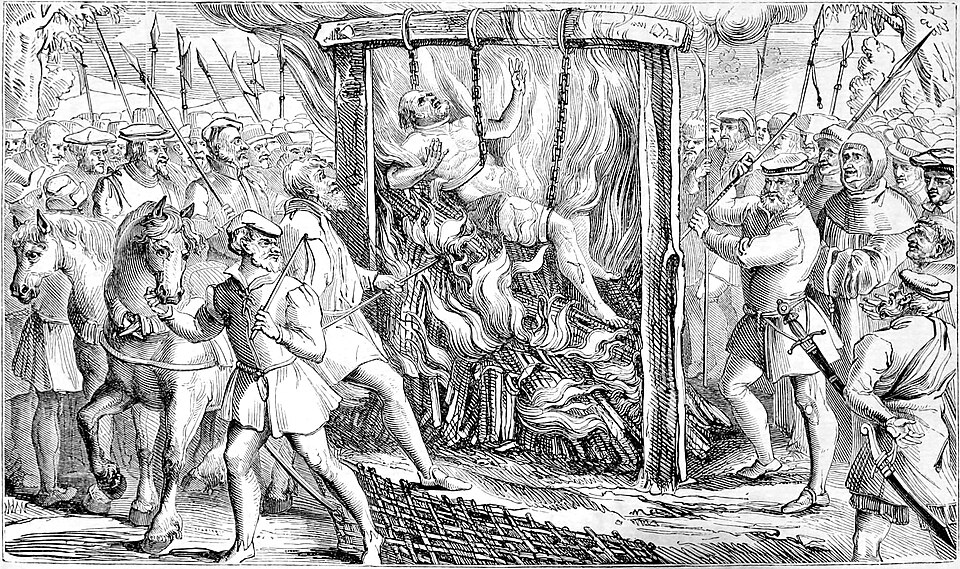
Burning of Lord Cobham
Burning of Lord Cobham.
BURNING OF LORD COBHAM.
of his elect. The which He grant, in effect, who is one God eternal! Amen.
Treason falsely surmised.Thus have you heard the whole matter concerning the martyrdom of the good lord Cobham, as we have gathered it partly out of the collections of John Bale and others.* As touching the pretensed treason of this lord Cobham, falsely ascribed unto him in his indictment, rising upon wrong suggestion and false surmise, and aggravated by rigour of words, rather than upon any ground of due probation, sufficiently hath been discoursed before in my defence of the said lord Cobham, against Alanus Copus; where again, it is to be noted, as I said before, and by this it appeareth, that the lord Cobham was never executed by force of the indictment or outlawry, because if he had, he should then have been brought to the bar in the King's Bench, and there the judges should have demanded of him, what he could have said, why he should not have died; and then not showing sufficient cause for the discharge or delay of execution, the judges should have awarded and given the judgment of treason: which being not so, it is clear he was not executed upon the indictment. Besides, to prove that he was not executed upon the indictment and the outlawry, the manner of the execution proveth it, because it was neither an execution of a traitor, nor was the whole punishment thereof pronounced by the judge, as by due order of law was requisite.
Finally, as I said before, here I repeat again, that albeit the said lord Cobham was attainted of treason by the act, and that the king, the lords, and the commons, assented to the act: yet all that bindeth not in such sort (as if indeed he were no traitor) that any man may not, by search of the truth, utter and set forth sincerely and justly the very true and certain cause whereupon his execution did follow. Which seemeth by all circumstance and firm arguments, to rise principally of his religion, which first brought him in hatred of the bishops; the bishops brought him in hatred of the king; the hatred of the king brought him to his death and martyrdom. And thus much for the death and execution of this worthy servant of Christ, the lord Cobham.
*This is not to be forgotten, which is reported by many, that he should say: that he should die here on earth after the sort and manner of Elias; which, whether it sprang of the common people without cause, or was foreshowed by himself, I think it, not without good consideration. That it sprang not without some gift of prophecy, the end of the matter doth sufficiently prove; for, like as when Elias should leave this mortal life, he was carried by a fiery chariot into immortality; even so the order of this man's death, not being much unlike, followed the figure of his departure. For he, first of all, being lifted up upon the gallows, as into a chariot, and encompassed round about with flaming fire; what other thing, I pray you, did this most holy martyr of Christ represent, than only a figure of a certain Elias, flying up into heaven, who went up into heaven by a fiery chariot.
Such, gentle reader, are the fruits of Wickliff's doctrine. Now let the papists mark and consider what profits or fruits their papistical holiness hath brought forth unto the world. If we would measure every man's doctrine by his fruits, let us behold this man, whom, together with an infinite number of others, this most optable doctrine of Wickliff hath brought forth. For thus, as is before said, Walden, who otherwise was his most grievous enemy, reported of the said sir John Oldcastle: That he did never understand how great the poison and spot of sin was, but only by reading of Wickliff's books. This I thought good to recite in this place, because of Polydore Virgil, who, in the twenty-second book of his Story of England, calleth him valiant, but a wicked man. But if Polydore had showed himself as faithful in the writing of the history, as the lord Cobham was distant from impiety and wickedness, he would never have spoken those words, and would have defiled so noble a history with fewer lies.*
Moreover, in the records above mentioned, it followeth, how, in the said parliament, after the martyrdom of this valiant knight, motion then was made, that the lord Powis might "be thanked and rewarded, according to the proclamation made, for his great travail taken in the apprehension of sir John Oldcastle, knight, heretic." Thus stand the words of the record; where two things are to be noted: First, how sir John here in the record is called, not traitor, Judas but heretic only. Judas seeketh for his reward.Secondly, mark how this brother of Judas here craveth his reward for betraying the innocent blood. Wherein it is not to be doubted, but that his light fee, and 'quid vultis mihi dare' in this world, will have a heavy reward hereafter in the world to come, unless he repented.
*In D. Johan. Cobhami equitis aurati et Martyris cineres, Carmen I. F. in felicem memoriam. Anno 1418.
Stemmate, pace, toga præstans: et clarus in armis
Miles, eques, martyr: gemma, monile, decus;
Militæque dominique potens Cobhamius Heros,
Lux patriæ, et gentis gloria digna suæ:
Pertulit infestas acies, tulit aspera multa,
Bella profana gerens, pælia sacra gerens.
Hæc mente, ilia manu, parili cum laude, subibat
Parte etenim victor semper utraque stetit.
Hinc equitis debetur honos, hinc martyris illi
Gloria, qua victor tempus in omne manet.
Victus erat. Quid tum? mens quando invicta manebat,
Pars potior, nullis cedere docta malis.
O tibi, te dignus rex, si Cobhame tulisset
Suppetias, nec te destituisset ope,
Turmis sat fueras istis, turbisque Cyclopum:
Quas tua fregisset dextra labore levi
Hoc sibi, sed Christus quid si diadema reponit?
Tu meliora, quidem, tempore dignus eras.*
Furthermore, in the said parliament, it was enacted, That the church and all estates should enjoy all their liberties, which were not repealed, or repealable by the common law: meaning, belike, the excluding of the jurisdiction of the pope's foreign power, which hath always, by the common law, been excluded out of this realm. In the same parliament also, a grievous complaint was made (by the bishops, no doubt) against insurrections. All the blame laid to the Lollards.In the end they suspected that they were the Lollards, heretics, and traitors, with a request that commissions might at all times be granted to inquire of them. Whereunto answer was made, That the statutes therefore made should be executed, &c. Thus the clergy, 'Tanquam leones rugientes,' ceased not to roar after christian blood; and whosoever was else in fault, still the clergy cried, "Crucify Christ, and deliver us Barabbas:" for then all horrible facts and mischiefs, if any were done, were imputed to the poor Lollards.
Continuation of the Memorable History of the Bohemians;
WHEREIN IS PLAINLY AND TRULY SET FORTH, WHAT VEXATIONS AND CONFLICTS THEY HAD FOR THE RELIGION OF JOHN HUSS AND JEROME OF PRAGUE, AND OF THEIR VICTORIES OBTAINED AND GOTTEN, BOTH AGAINST THE PAPISTS, AND ALSO AGAINST THE EMPEROR SIGISMUND; AND, FINALLY, THE DEATH OF THEIR VALIANT CAPTAIN, ZISCA.
And now from our English matters, to return again to the story of the Bohemians, from whence we have a little digressed, as touching such things as happened after the death of John Huss and Jerome of Prague.
When the news of the barbarous cruelty exercised at Constance against John Huss and Jerome of Prague, was noised in Bohemia, the nobles and gentlemen of Moravia and Bohemia, such as favoured the cause of John Huss, gathering themselves together in the zeal of Christ, first sent their letter unto the council; expostulating with them for the injury done to those godly men, as is before expressed; for which letter they were all cited up to the council. Unto this letter Sigismund the emperor maketh answer again in the name of the whole council; first, excusing himself of the death of John Huss, which, he said, was against his safe-conduct, and against his will; insomuch that he rose in anger from the council, and departed out of Constance, as is before remembered. Secondly, he requireth them to be quiet, and to conform themselves peaceably unto the order of the catholic church of Rome, &c.
Also the council, hearing or fearing some stir to rise among the Bohemians, did make laws and articles whereby to bridle them, to the number of twenty-four.
Articles decreed in the Council of Constance, against the Bohemians.
I. That the king of Bohemia shall be sworn to give obedience, and to defend the liberties of the church of Rome.
II. That all masters, doctors, and priests, shall be sworn to abjure the doctrine of Wicklitf and Huss, in that council condemned.
III. That all they who, being cited, would not appear, should also be sworn to abjure; and they who would not appear, contemning the censure of the keys, should have process against them, and be punished.
IV. That all such laymen as had defended the causes of John Wickliff and John Huss, should swear to defend them no more, and to approve the doings of that council, and the condemnation of John Huss.
V. That all such secular men who had spoiled the clergy, should be sworn to restitution.
VI. That priests being expelled from their benefices, should be restored again.
VII. That all profaners of churches should be punished after the canonical sanctions.
VIII. That such as had been promoters in the council against John Huss, should be permitted safely to return into Bohemia again, and to enjoy their benefices.
IX. That the relics and treasure taken out of the church of Prague, should be restored fully again.
X. That the university of Prague should be restored again and reformed, and that they who had been the disturbers thereof should be really punished.
The favourers of Huss in Bohemia.XI. That the principal heretics and doctors of that sect should be sent up to the see apostolic; namely, Johannes Jessenetz, Jacobellus de Misnia, Simon de Bohemia. Tysna, Simon de Rochinzano, Christianas de Brachatitz, Johannes Cardinalis, Zdenko de Loben, the provost of Alhallows, Zaislaus de Suiertitz, and Michael de Czisko.
XII. That all secular men, who communicated under both kinds, should abjure that heresy, and swear to stop the same hereafter.
XIII. That they who were ordained priests by the suffragan of the archbishop of Prague, taken by the lord Zenco, should not be dispensed with, but sent up to the see apostolic.
Wickliff's books translated.XIV. That the treatises of John Wickliff, translated into the Bohemian tongue, by John Huss and Jacobellus, should be brought to the ordinary.
XV. That the treatises of John Huss, condemned in the council, should also be brought to the ordinary.
XVI. That all the tractations of Jacobellus, 'De Utraque specie de Antichristo' (wherein he calleth the pope Antichrist), and 'De Remanentia Panis post Consecrationem,' should likewise be brought and burned.
XVII. That all songs and ballads made to the prejudice of the council, and of the catholic persons of both states, should be forbid to be sung in cities, towns, and villages, under great and extreme punishment.
XVIII. That none should preach the word without the license of the ordidinary, or of the parson of that place.
XIX. That ordinaries and prelates, having jurisdiction, should not be stopped in their jurisdiction by the secular power, under pain of excommunication.
XX. That all and singular persons shall be commanded to obedience, under pain of excommunication; and that whosoever knoweth any person to favour any Wicklevists, or their doctrine, or that keepeth company with suspect persons, he shall present the same to his diocesans or his officials.
XXI. That the confederacy of the seculars made between themselves, or any of the spiritualty, to the prejudice of the foresaid council, and of the apostolic see and church of Rome, in favour of John Huss, Jerome of Prague, and others in the said council condemned, shall be dissolved.
Concilium malignantium.XXII. That the rights and ceremonies of the christian religion, touching God's service, images, and worshipping of relics, shall be observed, and transgressors of the same be punished.
XXIII. That all and singidar, either spiritual or secular, that shall preach, teach, hold, or maintain, the opinions and articles of John Wickliff, John Huss, and Jerome, in this council condemned and convicted of the same, shall be holden for heretics; and, falling in relapse, shall be burned.
XXIV. That all secular persons being monished and charged by the ordinaries, shall be bound to give their aid and furtherance unto them touching the premises.
The Bohemians, notwithstanding these cruel articles, contemning the vain devices of these prelates and fathers of the council, ceased not to proceed in their league and purpose begun, joining themselves more strongly together.
In the mean time it happened, that during this council of Constance, after the deposing of pope John, and spoiling of his goods, which came to seventy-five thousand pounds of gold and silver, as is reported in the Story of St. Alban's, pope Martin, on the day of St. Martin, was elected; concerning whose election great preparation was made before by the council, so that besides the cardinals, five other bishops of every nation should enter into the conclave, who there together should be kept with thin diet, till they had founded a pope. At last, when they were together, they agreed upon this man, of pope and, not tarrying for opening the door, like madmen, for haste they burst open a hole in the wall, crying out, "Habemus papam Martinum," "We have a Martin pope." The emperor hearing thereof, with like haste, came apace, and, falling down, kissed the new pope's feet. Then went they all to the church together, and sang Te Deum.
The next day following, this Martin was made priest, who was before but a cardinal deacon, and the next after was consecrated bishop, and sang his first mass; whereat were present one hundred and forty mitred bishops. After this, the next morrow, the new holy pope ordained a general procession, where a certain clerk was appointed to stand with flax and fire; who, setting the flax on fire, thus said, "Ecce, Pater sancte! sic transit gloria mundi." i. e. "Behold, holy Father! thus vadeth the transitory glory of this world." This done, the same day the holy father was brought up unto a high scaffold, saith the story (I will not say to a high mountain, where was offered to him all the glory of the world), there to be crowned for a triple king. This done, the same day after dinner the new crowned pope was brought with great triumph through the midst of the city of Constance, where all the bishops and abbots followed with their mitres. The pope's horse was all trapped with red scarlet down to the ground. The cardinals' horses were all in white silk; the emperor on the right side, and a prince elector on the left (both playing the pope's footmen), went on foot, leading the pope's horse by the bridle.
As this pageant thus with the great giant proceeded, and came to the market-place, there the Jews, according to the manner, offered to him their law and ceremonies; which the pope receiving, cast behind him, saying, "Recedant Vetera, nova sunt omnia." i. e. "Let old things pass, all things be made new," &c. This was A. D. 1417.
Thus the pope, being now confirmed in his kingdom, first beginneth to write his letters to the Bohemians, wherein partly he moveth them to catholic obedience, partly he dissembleth with them, feigning that if it were not for the emperor's request, he would enter process against them. Thirdly, and finally, he threateneth to attempt the uttermost against them, and with all force to invade them, as well with the apostolic, as also with the secular arm; if they did still persist, as they began.
Albeit, these new threats of the new bishop did nothing move the constant hearts of the Bohemians, whom the inward zeal of Christ's word had before inflamed. And although it had been to be wished, such bloodshed and wars not to have followed; yet to say the truth, how could these Rabbins greatly blame them herein, whom their—bloody tyranny had before provoked so unjustly, if now, with their glozing letters, they could not so easily appease them again?
Wherefore these aforesaid Bohemians, partly for the love of John Huss and Jerome their countrymen, partly for the hatred of their malignant papistry, assembling together, first agreed to celebrate a yearly solcmu memorial of the death of John Huss and Jerome, A yearly memorial of Huss and Jerome kept among the Bohemians.decreeing the same to be holden and celebrated yearly; and afterwards, by and by means of their friends they obtained certain churches of the king, wherein they might freely preach and minister the sacraments unto the Congregation. This done, they suppressed divers monasteries, Pharisaical temples, and idolatrous fanes; beginning, first, with the great monastery of the Black Friars, eight miles from Prague; driving away the wicked and vicious priests and monks out of them, or compelling them unto a better order. And thus their number more and more increasing, under the safe conduct of a certain noble man named Nicholas, they went again unto the king, requiring to have more and ampler churches granted unto them. The king seemed at first willingly and gently to give ear to the said Nicholas entreating for the people, and commanded them to come again the next day.
Wenceslaus threateneth Nicholas.When the people were departed, the king turning himself to the noble man Nicholas, who tarried still behind, said: "Thou hast begun a web to put me out of my kingdom, but I will make a rope of it, wherewithal I will hang thee." Whereupon he immediately departed out of the king's presence, and the king himself went into the castle of Vissegrade, and within awhile after, into a new castle, which he himself had builded five stones' casts from thence; sending ambassadors to his brother to require aid.
These protestants being assembled in the town of Prague, holding their conventions, the king sent forth his chamberlain with three hundred horsemen to run upon them; but he, having respect unto his life, fled. When news thereof was brought unto the king, all that were about him, being amazed, utterly detested the fact; but the king's cupbearer standing by, said, "I knew before, that these things would thus come to pass." Whom the king in a rage taking hold of, threw him down before his feet, and with his dagger would have slain him; but, being letted by those who were about him, with much ado he pardoned him his life. Death of king Wenceslaus.Immediately the king, being taken with a palsy, fell sick, and within eighteen days after, when he had marked the names of such whom he had appointed to be put to death, incessantly calling for aid of his brother and his other friends, he departed this life before the princes, whom he had sent unto, were come with aid, when he had reigned five and fifty years, and was about the age of seven and fifty years. A. D. 1419.
The Story of Zisca.
Immediately after the death of Wenceslaus, there was a certain nobleman named Zisca, born at Trosnovia, who, from his youth upwards, was brought up in the king's court, and had lost one of his eyes in a battle, where he had valiantly borne himself. This man, being sore grieved for the death of John Huss, and Jerome of Prague, minding to revenge the injuries which the council had done, greatly to the dishonour of the kingdom of Bohemia, upon their accomplices and adherents, gathered together a number of men of war, and subverted the monasteries and idolatrous temples, pulling down and breaking in pieces the images and idols, driving away the priests and monks, who, he said, were kept in their cloisters, like swine in their sties, to be fatted. After this his army being increased, having gathered together about forty thousand men, he attempted to take the castle of Vissegrade, which was but slenderly warded. Zisca getteth Pilsen.From thence the said Zisca, under the conduct of Coranda, went speedily unto Pilsen, where he knew he had many friends of his faction, and took the town into his power, fortifying the same very strongly, and those who tarried behind, took the castle of Vissegrade.
The queen sendeth for Sigismund.Then the queen Sophia, being very careful, sent letters and messengers unto the emperor Sigismund, and other nobles adjoined unto her, requiring aid and help; but the emperor made preparation against the Turk, who had then lately won certain castles of him. Whereupon the queen, seeing all aid so far off, together with Zenko Warterberge, gathered a host with the king's treasure, and fortified the castle of Prague, and the lesser city which joineth unto the castle, making gates and towers of wood upon the bridge, over the river Multain, to stop that the protestants should have no passage that way. Then it happened that at the isle of St. Benedict, one Peter Steremberg fought an equal or indifferent battle with them.
In the mean time, the number of the protestants being increased in Prague, they fought for the bridge. In which battle many were slain on both parts, but at length the Hussites won the bridge and the nether part of lesser Prague; the queen's part flying into the upper part thereof: where they, turning again fiercely, renewed the battle, and fought continually day and night by the space of five days. Many were slain on both parts, and goodly buildings were rased, and the council-house, which was in a low place, was utterly defliced and burned.
The emperor's ambassadors agree with the citizens of Prague.During the time of this troublous estate, the ambassadors of the emperor Sigismund were come; who, taking upon them the rule and governance of the realm, made a truce or league with the city of Prague under this condition, that the castle of Vissegrade being surrendered, it should be lawful for them to send ambassadors to the emperor Sigismund to treat as touching their estate, and that Zisca should surrender Pilsen and Piesta with the other forts which he had taken. These conditions thus agreed upon and received, all the foreign protestants departed out of the city, and the senate of the city began to govern again according to their accustomed manner, and all things were quieted. Howbeit, the papists, who were gone out of the town, durst not return again, but still looked for the emperor, by whose presence they thought they should have been safe. But this their hope was frustrated by means of certain letters which were sent from the emperor, wherein it was written. That he would shortly come and rule the kingdom, even after the same order and manner as his father Charles had done before him. Whereupon the protestants understood that their sect and religion should be utterly banished; which was not begun during the reign of the said Charles.
About Christmas the emperor Sigismund came to Brunn, a city of Moravia, and there he pardoned the citizens of Prague, under condition that they would let down the chains and bars of the city, and receive his rulers and magistrates; whereunto the whole city obeyed, and the magistrates thereof, lifting up their hands unto heaven, rejoiced at the coming of the new king. But the emperor turned another way, and went unto Uratislavia, the head city of Silesia, where, a little before, the commonalty of the city had slain, in an insurrection, the magistrates, whom his brother Wenceslaus had set in authority: the principals whereof be beheaded. Prague falls from the emperor.The news whereof when it was reported at Prague, the citizens being feared by the example of the Uratislavians, distrusting their pardon, rebelled out of hand; and having obtained Zenko on their part, who had the government of the castle of Prague, The complaint of the city of Prague against Sigismund.they sent letters into all the realm, that no man should suffer the emperor to enter, who was an enemy unto Bohemia, and sought nothing else but to destroy the kingdom: who also bound the ancient city of the Prutenians under order by pledges, and put the marquis of Brandenburg from the Bohemian crown; and had not only suffered John Huss and Jerome of Prague to be burned at the council of Constance, but also procured the same, and with all his endeavour did impugn the doctrine and faith which they taught and followed. While these things were thus done, Zisca, having given over Pilsen by composition, was twice assaulted by his enemies, but, through policy, he was always victor. The places where they fought were rough and unknown, his enemies were on horseback, and his soldiers on foot, neither could there be any battle fought but on foot. The policiy of Zisca.Whereupon, when his enemies were alighted from their horses, Zisca commanded the women who customably followed the host, to cast their kerchiefs upon the ground, wherein the horsemen being entangled by their spurs, were slain before they could unloose their feet.
After this, he went unto Ausca, a town situate upon the river Lucinitius, out of which town Procopius and Ulricius, two brethren papists, had cast out many protestants. This town Zisca took by force of arms the first night of Lent, rased it, and set it on fire. He also took the castle of Litius, which was a mile off, whither Ulricius was fled, and put Ulricius and all his family to the sword, saving one only.
The city of Tabor builded.Then, forasmuch as he had no walled or fenced town to inhabit, he chose out a certain place upon the same river, which was fenced by nature, about eight miles from the city of Ausca. This place he compassed in with walls, and commanded all men to build them houses, where they had pitched their tents, and named this city Tabor, and the inhabitants, his companions, Taborites; because their city, by all like, was builded upon the top of some hill or mount. This city, albeit it was fenced with high rocks and cliffs, yet was it compassed with a wall and vaumure, and the river of Lucinitius fenceth a great part of the town; the rest is compassed in with a great brook, which running straight into the river Lucinitius, is stopped by a great rock, and driven back towards the right hand all the length of the city, and, at the further end, it joineth with the great river. The way unto it by land is scarcely thirty feet broad, for it is almost an island. In this place there was a deep ditch cast, and a triple wall made, of such thickness, that it could not be broken with any engine. The wall was full of towers and forts set in their convenient and meet places. Zisca was the first that builded the castle, and those that came after him fortified it, every man according to his own device. At that time the Taborites had no horsemen amongst them, until such time as Nicholas, master of the Mint (whom the emperor had sent into Bohemia with a thousand horsemen to set things in order, and to withstand the Taborites, lodging all night in a village named Vogize), was surprised by Zisca coming upon him suddenly in the night, taking away all his horse and armour, and setting fire to the village. Then Zisca taught his soldiers to mount on horseback, to leap, to run, to turn, and to cast a ring, so that after this he never led army without his wings of horsemen.
Sigismund getteth the castle of Prague.In this mean time Sigismund, the emperor, gathering together the nobles of Silesia, entered unto Bohemia, and went unto Græcium, and from thence with a great army unto Cutna, alluring Zenko, with many great and large promises, to render up the castle of Prague unto him, and there placed himself to annoy the town. This Zenko, infamed with double treason, returned home. Zisca getteth the city of Prague.The citizens of Prague sent for Zisca, who, speeding himself thither with the Taborites, received the city under his governance. In the Bohemians' host, there were but only two barons, Hilco Crusina of Lutemperg, and Hilco Waldestene, with a few other nobles; all the residue were of the common people. They went about, first, to subdue the castle, which was by nature very strongly fenced, and could not be won by any other means than by famine: whereupon all the passages were stopped, that no victuals should be carried in. Besieged by Sigismund.But the emperor opened the passages by dint of sword, and when he had given unto those who were besieged all things necessary, having sent for aid out of the empire, he determined, shortly after, to besiege the city. There were, in the emperor's camp, the dukes of Saxony, the marquis of Brandenburg and his son-in-law, Albert of Austria. The city was assaulted by the space of six weeks. The emperor Sigismund was crowned in the metropolitan house in the castle, Conrad, the archbishop, solemnizing the ceremonies of the coronation. The city was straitly besieged. In the mean time the captains Rosenses and Chragery, who had taken the tents of the Taborites, being overcome in battle by Nicholas Huss, whom Zisca had sent with part of his power, for that purpose, were driven out of their tents, and Græcium, the queen's city, was also taken.
There is, also, above the town of Prague, a high hill, which is called Videchon. On this hill had Zisca strongly planted a garrison, that his enemies should not possess it, with whom the marquis of Misnia skirmishing, lost a great part of his soldiers. For when the Misnians had gotten to the top of the hill, being driven back into a corner which was broken and steep, and fiercely set upon, The marquis of Misnia overcome.Sigismund raiseth his siege.when they could no longer withstand the violent force of their enemies, some of them were slain, and some, falling headlong from the hill, were destroyed. Whereupon the emperor Sigismund, raising his siege, departed into Cutna; and Zisca, with his company, departed unto Tabor, and subdued many places; among which he subverted a town pertaining to the captain of Vissegrade. During this time the castle of Vissegrade was strongly besieged, where, when other victuals wanted, they were compelled to eat horse-flesh. Last of all, except the emperor did aid them by a certain day, they promised to yield it up; but under this condition: that if the emperor did come, they within the castle should be no more molested.
The emperor, fighting against Zisca, has the overthrow.The emperor was present before the day, but being ignorant of the truce taken, entering into a strait underneath the castle, was suddenly set upon by the soldiers of Prague, where he had a great overthrow; and so leaving his purpose unperformed, returned back again. There were slain in that conflict fourteen noblemen of the Moravians and Hungarians, and others, a great number. The castle was delivered up unto them. While these things were in doing, Zisca took Boslaus, a captain who was surnamed Cigneus, by force, in a very strong town of his, and brought him unto his religion; who, a few years after, leading the protestants' host in Austria, was wounded before Rhetium, and died. The abbeys of Pilsen subverted.There were in the territory of Pilsen many monasteries, of which Zisca subverted and burned five; and forasmuch as the monastery of St. Clare was the strongest, there he pitched himself.
Zisca putteth the emperor to flight.Thither also came the emperor with his army; but when Zisca brought forth his power against him, he most cowardly fled, and not long after, he departed and left Bohemia. Then Zisca went with his army unto Pilsen; but forasmuch as he saw the city so fenced, that he was in doubt of winning the same, he went from thence to Committavia, a famous city, which he took by force, burning all the priests therein. Zisca loseth his other eye, yet would not forsake his army.Afterwards, as he lay before the town of Raby, and strongly besieged the same, he was stricken with a shaft in the eye; having but that one before to see withal. From thence he was carried by physicians to Prague, where, being cured of his wound, and his life saved, he yet lost his sight; and for all that, he would not forsake his army, but still took the charge of them. A.D. 1421.
Zisca taketh divers towns.After this the garrisons of Prague went unto Verona, where there was a great garrison of the emperor's, and took it by force, many being slain of either part. They also took the town of Broda in Germany, and slew the garrison; and afterwards took Cutna and many other cities by composition. Further, as they led their army unto a town called Pons, which is inhabited by the Misnians, The Saxons retire.the Saxons meeting them by the way, because they durst not join battle, they returned back. After all this, the emperor appointed the princes electors a day, that at Bartholomew-tide they should, with their army, invade the west part of Bohemia, and he, with a host of Hungarians, would enter into the east part. There came unto his aid the archbishop of Mentz, the county palatine of the Rhine, the dukes of Saxony, the marquis of Brandenburg, and many other bishops out of Almaine: all the rest sent their aids. They encamped before the town of Sozius, a strong and well fenced place, which they could by no means subdue. The country was spoiled and wasted round about, and the siege continued until the feast of St. Galle. The emperor with his power entereth again into Bohemia; but afraid of Zisca flieth.Then it was broken up, because the emperor was not come at his day appointed; but he, having gathered together a great army of the Hungarians and West Moravians, about Christmas entered into Bohemia, and took certain towns by force; and Cutna was yielded unto him. But when Zisca (although he was blind) came towards him, and set upon him, he, being afraid, and many of his nobles slain, fled: but first he burned Cutna, which the Taborites, by means of the silver-mines, called The pouch of Antichrist.'The Pouch of Antichrist.' Zisca pursuing the emperor a day's journey, got great and rich spoil, and taking the town of Broda by force, set it on fire; which afterwards, almost by the space of fourteen years, remained disinhabited. The emperor passed, by a bridge, over the river of Iglaria; Noble victory of Zisca.and Piso, a Florentine, who had brought fifteen thousand horsemen out of Hungary to these wars, passed over the ice; which, by the multitude and number of his horsemen being broken, devoured and destroyed a great number. Zisca destroyeth images and idols in churches.The martyrdom of certain godly Bohemians, falsely circumventerd, and killed with the sword.Zisca, having obtained this victory, would not suffer any image or idol to be in the churches, neither thought it to be borne withal, that priests should minister with copes or vestments: for which cause he was much the more envied amongst the states of Bohemia. And the consuls of Prague, being aggrieved at the insolency of John Premonstratensis, called him and nine other of his adherents, whom they supposed to be the principals of this faction, into the council-house, as though they would confer with them as touching the commonwealth: and when they were come in, they slew them, and afterwards departed home every man to his own house, thinking the city had been quiet, as though nothing had been done. But their servants, being not circumspect enough, washing down the court or yard, washed out also the blood of those that were slain, through the sinks or channels; which being once seen, the people understood what was done. Privy murder at length comes out.By and by there was a great tumult; the council-house was straightway overthrown, and eleven of the principal citizens, who were thought to be the authors thereof, were slain, and divers houses spoiled.
About the same time the castle of Purgel, wherein the emperor had left a small garrison (whither also many papists with their wives and children were fled), was, through negligence, burned, and those who escaped out of the fire went unto Pilsen. After this, divers of the Bohemian captains, and the senate of Prague, sent ambassadors to Vitold, duke of Lithuania, and made him their king. This did Zisca and his adherents gainsay. This Vitold sent Sigismund Goributus with two thousand horsemen into Bohemia, who was honourably received by the inhabitants of Prague. At his coming they determined to lay siege to a castle situated upon a hill, which was called Charles' Stone.
Here Sigismund had left, for a garrison, four centurions of soldiers. The tents were pitched in three places. The siege continued six months, and the assault never ceased day and night. Five great slings threw continually great stones over the walls, and about two thousand vessels, tubs, or baskets, filled with dead carcases and other excrements, were cast in amongst those who were besieged; Stench very hurtful to the teeth.which thing did so infect them with stench, that their teeth did either fall ouc, or were all loose. Notwithstanding they bare it out with stout courage, and continued their fight until the winter, having privily received medicine out of Prague, to fasten their teeth again.
In the mean time Frederic the elder, prince of Brandenburg, entering into Bohemia with a great power, caused them of Prague to raise the siege; and Vitold, at the request of Uladislaus, king of Poland, who had talked with the emperor on the borders of Hungary, called Coributus, his uncle, with his whole army, out of Bohemia. Whereupon the emperor supposed that the protestants, being destitute of foreign aid, would the sooner do his commandment; but he was far deceived therein, for they, leading their armies out of Bohemia, subdued the borders thereupon adjoining. Another warlike policy of Zisca.It is also reported that Zisca went into Austria, and when the husbandmen of the country had carried away a great number of their cattle by water unto an isle of the river Danube, and by chance had left certain calves and swine in their villages behind them; Zisca drave them unto the river side, and kept them there so long, beating them, and causing them to roar out and cry, till the cattle feeding in the island, hearing the lowing and grunting of the cattle on the other side of the water, for the desire of their like, did swim over the river; by means whereof he got and drave away a great booty.
About the same time the Emperor Sigismund gave to his son-in-law Albert, duke of Austria, the country of Moravia, because it should not want a ruler. At the same time, also, Eric, king of Denmark, and Peter Infant, brother to the king of Portugal and father of James, cardinal of St. Eustace, came to the emperor (being both very expert men in the affairs of war), who did augment the emperor's host with their aid and power: whereupon they straightway pitched their camp before Lutemperge, a town of Moravia, and continued the siege for the space of three months. There was at that time a certain knight at Prague surnamed Aqua, who was very rich and of great authority. This man, forasmuch as he had no child of his own, adopted unto him his sister's son, named Procopius; whom, when he was of mean stature and age, he carried with him into France, Spain, and Italy, and unto Jerusalem; and, at his return, caused him to be made priest. This man, when the gospel began to flourish in Bohemia, took part with Zisca, and, forasmuch as he was strong and valiant, and also painful, he was greatly esteemed.
Valiant courage of Procopius Magnus.This Procopius for his valiant acts was afterwards called Procopius Magnus, and had committed unto him the whole charge of the province of Moravia, and the defence of the Lutemperges, who, receiving a great power by force (maugre all the whole power which lay in the siege) carried victuals into the town which was besieged, and so did frustrate the emperor's siege. The emperor, before this, had delivered to the marquises of Misnia the bridge and town of Ausca, upon the river Albis, that they should fortify them with their garrisons. Whereupon Zisca besieged Ausca; and Frederic, the marquis of Misnia, with his brother, the landgrave of Thuringia, gathering together a great army out of Saxony, Thuringia, Misnia, and both the Lusaces, determined to rescue and aid those who were besieged. Victory of the protestants.There was a great battle fought before the city, and the victory depended long uncertain; but at last it fell on the protestants' part. There were slain in the battle the burgraves of Misnia or Chyrpogenses, the barons of Gleichen and many other nobles, besides nine thousand common soldiers; and the town of Ausca was taken and utterly rased.
Battle between the city of Prague and Zisca.At last, dissension arising between Zisca and them of Prague, they of Prague prepared an army against him, wherewith he, perceiving himself overmatched, fled unto the river of Albis, and was almost taken, but that he had passage through the town of Poggiebras; but they of Prague, pursuing the tail of the battle, slew many of his Taborites. At length they came to certain hills, where Zisca, going into the valley, and knowing the straits of the place, that his enemies could not spread their army, commanded his standard to stand still; and exhorting and encouraging his soldiers, he gave them battle.
Noble victory of Zisca.This battle was very fierce and cruel: but Zisca, having the upper hand, slew three thousand of them of Prague, and put the rest to flight, and straightways took the city of Cutna by force (which they of Prague had repaired), and set it on fire: then, with all speed, he went with his army to besiege Prague, and encamped within a bow-shot of the town. There were many both in the city, and also in his host, who grudged sore at that siege; some accusing Zisca, others them of Prague. There were great tumults in the camp, the soldiers saying that it was not reasonable, that the city should be suppressed, which was both the head of the kingdom, and did not dissent from them in opinion; adding, that the Bohemians' power would soon decay, if their enemies should know that they were divided within themselves; also that they had sufficient wars against the emperor, and that it was but a foolish device to move wars amongst themselves. This talk came unto the ear of Zisca, who, calling together his army, and standing upon a place to be heard, spake these words.
A Notable Oration of Zisca to his Soldiers.
Brethren! be ye not aggrieved against me, neither accuse him who hath sought your health and safeguard. The victories which ye have obtained under my conduct are yet fresh in memory, neither have I brought you at any time unto any place, from whence you have not come victors. You are become famous and rich, and I, for your sake, have lost my sight, and dwell in darkness. Nothing have I gotten by all these fortunate battles, but only a vain name. For you have I fought, and for you have I vanquished; neither do I repent me of my travails, neither is my blindness grievous unto me, but only that I cannot provide for you according to my accustomed manner: neither do I persecute them of Prague for mine own cause, for it is your blood that they thirst and seek for, and not mine. It were but small pleasure for them to destroy me, being now an old man and blind; it is your valiantness and stout stomachs which they fear. Either must you or they perish; who, while they seem to lie in wait for me, do seek after your lives. You must rather fear civil wars than foreign; and civil sedition ought first to be avoided. We will subdue Prague, and banish the seditious citizens, before the emperor shall have any news of this sedition. And then, having but a few of his faction left, we may, with the less fear, look for it, better than if these doubtful citizens of Prague were still in our camp. But, because ye shall accuse me no more, I give you free liberty to do what you will. If it please you to suffer them of Prague to live in quietness, I will not be against it, so that there be no treason wrought. If you determine to have war, I am also ready. Look, which ever part you will incline unto, Zisca will be your aid and helper.
The hearts of the soldiers altered by the oration of Zisca.When he had spoken these words, the soldiers' minds were changed, and wholly determined to make wars, so that they ran, by-and-by, to take up their armour and weapons, to run unto the walls, to provoke their enemies to fight for the gates of the city. Zisca, in the mean time, prepared all things ready for the assault. There is, a little from Pilsen, a certain village named Rochezana. In this place there was a child born of poor and base parentage, whose name was John; he came to Prague, and got his living there by begging, and learned grammar and logic. When he came to man's estate, he became the schoolmaster of a noble man's child; and, forasmuch as he was of an excellent wit and ready tongue, he was received into the college of the poor; and, last of all, being made priest, he began to preach the word of God to the citizens of Prague, and was named Johannes de Rochezana, by the name of the town where he was born. Peace between Zisca and Prague.This man grew to be of great name and authority in the town of Prague. Whereupon, when Zisca besieged Prague, he, by the consent of the citizens, went out into the camp, and reconciled Zisca again unto the city.
The emperor gald to be reconciled with Zisca.When the emperor perceived that all things came to pass according to Zisca's will and mind, and that upon him alone the whole state of Bohemia did depend, he sought privy means to reconcile and get Zisca into his favour, promising him the governance of the whole kingdom, the guiding of all his hosts and armies, and great yearly revenues, if he would proclaim him king, and cause the cities to be sworn unto him. The death of Zisca.Upon which conditions, when Zisca, for the performance of the covenants, went unto the emperor, being in his journey at the castle of Priscovia, he was stricken with sickness and died. A. D. 1424.
Is is reported, that when he was demanded, being sick, in what place he would be buried; he commanded the skin to be pulled off from his dead carcase, and the flesh to be cast unto the fowls and beasts, and that a drum should be made of his skin, which they should use in their battles: The words of Zisca at his death.affirming, that as soon as their enemies should hear the sound of that drum, they would not abide, but take their flight. The Taborites, despising all other images, yet set up the picture of Zisca over the gates of the city.
The Epitaph of John Zisca, the valiant Captain of the Bohemians.
I, John Zisca, not inferior to an emperor or captain in warlike policy, a severe punisher of the pride and avarice of the clergy, and a defender of my country, do lie here. That which Appius Claudius, by giving good counsel, and M. Furius Camillus, by valiantness, did for the Romans; the same I, being blind, have done for my Bohemians. I never slacked opportunity of battle, neither did fortune at any time fail me. I, being blind, did foresee all opportunity of well ordering or doing my business. Zisca eleven times victor in the field.Eleven times, in joining battle, I went victor out of the field. I seemed to have worthily defended the cause of the victor in miserable and hungry against the delicate, fat, and gluttonous priests, and for the field, that cause to have received help at the hands of God. If their envy had not let it, without doubt I had deserved to be numbered amongst the most famous men. Notwithstanding my bones lie here in this hallowed place, even in despite of the pope.
'ΙΩΑΝΝΕΣ ΣΙΣΚΑΣ ὁ Βωιημὀς, τῶν αὶσχροκερδῶν ἱερέων ἐχθρὸς, ἀλλὰ ἐν θείω ζηλώ.
In English.—John Zisca, a Bohemian, enemy to all wicked and covetous priests, but with a godly zeal.
And thus have you the acts and doings of this worthy Zisca and other Bohemians, which, for the more credit, we have drawn out of Æneas Silvius; only his railing terms excepted, which we have here suppressed.
All this while, the emperor, with the whole power of the Germans, was not so busy on the one side, but Martin the pope was as much occupied on the other side; who, about the same time, directed down a terrible bull, full of all poison, to all bishops and archbishops, against all such as took any part or side with Wickliff, John Huss, Jerome, or with their doctrine and opinions. The copy of which bull, which I found in an old written monument, I wish the reader thoroughly to peruse; wherein he shall see the pope to pour out at once all his poison.
The Bull of Pope Martin directed forth against the Followers of John Wickliff of England, of John Huss of Bohemia, and of Jerome of Prague.
Pope Martin's bloody bull to all bishops and archbishops.Martin, bishop, the servant of God's servants, to our reverend brethren the archbishops of Salzburg, Gueznen, and Prague, and to the bishops of Olumitz, Luthomysl, Bamberg, Misnia, Patavia, Uratislavia, Ratisbon, Cracow, Posnamen, and Nitrien, and also to our beloved children the inquisitors appointed by the prelates above recited, or where else soever, unto whom these present letters shall come: greeting, and apostolical benediction.
Amongst all other pastoral cares wherewith we are oppressed, this chiefly and specially doth enforce us: that heretics, with their false doctrine and errors, being utterly expulsed from amongst the company of christian men, and rooted out (so far forth as God will make us able to do), the right and catholic faith may remain sound and undefiled; and that all christian people, immovable and inviolate, may stand and abide in the sincerity of the same faith, the whole veil of obscurity being removed. But lately, in divers places of the world, but especially in Bohemia, and the dukedom of Moravia, and in the straits adjoining thereunto, certain arch-heretics have risen and sprung up, not against one only, but against divers and sundry documents of the catholic faith, being land-lopers, schismatics, and seditious persons, fraught with devilish pride and wolvish madness, deceived by the subtlety of Satan, and from one evil vanity brought to a worse; who although they rose and sprang up in divers parts of the world, yet agreed they all in one, having their tails, as it were, knit together; to wit, John Wickliff of England, John Huss of Bohemia, and Jerome of Prague, of damnable memory, who drew with them no small number to miserable ruin and infidelity. For when those, and such like pestiferous persons, did, in the beginning of their poisoned doctrine, obstinately sow and spread abroad perverse and false opinions, the prelates, who had the regiment and execution of the judicial power, like dumb dogs not able to bark, neither yet revenging speedily with the apostle all such disobedience, nor regarding corporally to cast out of the Lord's house (as they were enjoined by the canons) those subtle and pestilent arch-heretics, and their wolvish fury and cruelty, with all expedition; but, suffering their false and pernicious doctrine negligently, by their over-long delays, to grow and wax strong; a great multitude of people, instead of true doctrine, received those things which they did long, falsely, perniciously, and damnably sow among them; and, giving credit unto them, fell from the right faith, and are entangled (the more the pity) in the foul errors of paganism: insomuch, that these arch-heretics, and such as spring of them, have infected the catholic flock of Christ in divers climates of the world, and parts bordering upon the same, and have caused them to putrefy in the filthy dunghill of their lies. Wherefore the general synod of Constance was compelled, with St. Augustine, to exclaim against so great and ruinous a plague of faithful men, and of the sound and true faith itself, saying: 'What shall the sovereign medicine of the church do? with motherly love seeking the health of her sheep, chafing as it were, amongst a company of men frantic, and having the disease of the lethargy. What! shall she desist and leave off her good purpose? No, not so. But rather let her, if there be no remedy, be sharp to both these sorts, which are the grievous enemies of her womb. For the physician is sharp unto the man bestraught and raging in his frenzy; and yet he is a father to his own rude and unmannerly son, in binding the one, in beating the other, by showing therein his great love vinto them both.' 'But, if they be negligent, and suffer them to perish,' saith St. Augustine, 'this mansuetude is rather to be supposed false cruelty.'
And therefore the aforesaid synod, to the glory of Almighty God, and preservation of his catholic faith, and augmenting of christian religion, and for the salvation of men's souls, hath corporally rejected and cast forth of the household of God, the aforesaid John Wickliff, John Huss, and Jerome; who, amongst other things, did believe, preach, teach, and maintain, of the sacrament of the altar, and other sacraments of the church, and articles of the faith, contrary to that the holy church of Rome believeth, holdeth, preacheth, and teacheth; and have presimied obstinately to preach, teach, hold, and believe many other besides, to the damnation of themselves and others: and the said synod hath separated the same, as obstinate and malapert heretics, from the communion of the faithful people; and hath declared them to be spiritually thrown forth. And many other things, both wholesome and profitable, hath the same council, as touching the premises, established and decreed; whereby they, who, by the means of those arch-heretics, and by their false doctrine, have spiritually departed from the Lord's house, may, by the canonical rides, be reduced to the straight path of truth and verity.
And, moreover, as we to our great grief do hear, not only in the kingdom of Bohemia, and the dukedom of Moravia, and in other places above recited, but also in certain parts and provinces near adjoining and bordering upon the same, there be many other of the sectaries and followers of the aforesaid arch-heretics and heretical opinions; casting behind their backs as well the fear of God, as the shame of the world, neither receiving fruit of conversion and repentance by the miserable destruction of the aforesaid John Huss and Jerome; but who, as men drowned in the dungeon of their sins, cease not to blaspheme the Lord God, taking his name in vain (whose minds the father of lies hath damnably blinded), and do read and study the aforesaid books or works, containing heresies and errors, being lately by the aforesaid synod condemned to be burned; who, also, to the peril of themselves and many other simple men, and against the statutes, decrees, and ordinances in the synod aforesaid, and the canonical sanctions, do presume to preach and teach the same, to the great peril of souls, and derogation of the catholic faith, and to the slander of many others besides: We, therefore, considering that error, where it is not resisted, seemeth to be allowed and liked: and having a desire to resist such evil and pernicious errors, and utterly root them out from amongst the company of faithful Christians, especially from the afore-recited places of Bohemia, Moravia, and other straits and islands joining and bordering upon the same (lest they should stretch out and enlarge their limits), we will and command your discretions, by our letters apostolical, the holy council of Constance approving and allowing the same, that you that are archbishops, bishops, and others of the clergy, and every one of you by himself, or by any other or otliers, being grave and fit persons to have spiritual jurisdiction, do see that all and singular persons, of what dignity, office, pre-eminence, state, or condition soever they be, and by what name soever they are known, who shall presume otherwise to teach, preach, or observe, touching the most high and excellent, the most wholesome and super-admirable sacrament of the blood of our Lord Jesus Christ, or else of the sacrament of baptism, confession of sins, penance for sins, and extreme unction; or of any other sacraments of the church, and the articles of the faith, than that which the right holy and universal church of Rome doth hold, teach, preach, and observe; or that shall presume obstinately, by any ways or menus, privily or apertly, to hold, believe, and teach the articles, books, or doctrine of the aforesaid archheretics, John Wickliff, John Huss, and Jerome of Prague, being by the aforesaid synod of Constance with their authors (as is said) damned and condemned; or dare presume publicly or privily to allow or commend in any wise the death and end of the said arch-heretics, or of any other their receivers, aiders, and favourers, in the favour or supportation of the aforesaid errors, as also their believers and adherents: that then, as before, you see and cause them and every of them to be most severely punished; and that you judge and give sentence upon them as heretics, and that as arrant heretics you leave them to the secular court or power. Let the receivers, also, and favourers and defenders of such most pestiferous persons (notwithstanding they neither believe, favour, nor have devotion towards tlieir errors, but haply shall receive or entertain such pestiferous persons because of carnal affection or friendly love,) besides the punishment due unto them by both laws (over and above the same punishment), by competent judges be so afflicted, and for such heinous acts of theirs, with such severe pain and punishment excruciated, that the same may be to others in like case offending, an example of terror; that at least those whom the fear of God by no means may revoke from such evil doing, yet the severity of this our discipline may force and constrain.
As touching the third sort, who shall be any manner of ways infected with this damnable sect, and shall, after competent admonition, repent and amend themselves of such errors and sects aforesaid, and will return again into the lap and unity of our holy mother the church, and fully acknowledge and confess the catholic faith, towards them let the severity of justice, as the quality of the fact shall require, be somewhat tempered with a taste of mercy.
And furthermore, we will and command, that by this our authority apostolical ye exhort and admonish all the professors of the catholic faith, as emperors, kings, dukes, princes, marquises, earls, barons, knights, and other magistrates, rectors, consids, proconsids, shires, countries, and universities of the kingdoms, provinces, cities, towns, castles, villages, their lands and other places, and all others executing temporal jurisdiction, according to the form and exigence of the law, that they expel out of their kingdoms, provinces, cities, towns, castles, villages and lands, and other places, all and all manner of such heretics, according to the eftect and tenor of the council of Lateran, beginning, "Sicut ait Ecclesia," &c.: that those who publicly and manifestly, by the evidence of their deeds, shall be known to be such as, like sick and scabbed sheep, infect the Lord's flock, they expel and banish, till such time as from us or you, or other ecclesiastical judges or inquisitors, holding the faith and communion of the holy church of Rome, they shall receive other order and countermand; and that they suffer no such, within their shires and circuits, to preach or to keep either house or family, or yet to use any handicraft or occupations, or other trades of merchandise ; or to solace themselves in any way, or frequent the company of christian men.
And furthermore, if such public and known heretics shall chance to die (although not so denounced by the church), yet in this so great a crime let him and them want christian burial, and let no offerings or oblations be made for them, nor received. His goods and substance, also, from the time of his death, according to the canonical sanctions being confiscated, let no such enjoy them to whom they appertain, till that by the ecclesiastical judges, having power and authority in this behalf, sentence upon that his or their crime of heresy be declared, and promulgated; and let such owners as be found suspected or noted with any such suspicion of heresy, before a competent and ecclesiasticcal judge, according to the consideration and exigence of that suspicion, and according to the quality of the person, by the arbitrement of such a judge, show and declare his proper and own innocency with devotion; as beseemeth in that behalf. And if, in his purgation, being canonically interdicted, he do fail, or be not able canonically to make his purgation, or refuse to take his oath by damnable obstinacy to make such purgation; then let him be condemned as a heretic. But such as through negligence or through slothfulness shall omit to show their said innocency, and to make such purgation, let them be excommunicated, and so long be put out from the company of christian men, till that they shall make condign satisfaction; so that if, by the space of one whole year, they shall remain in such excommunication, then let them, as heretics, be condemned.
And further, if any shall be found culpable in any point of the aforesaid pestiferous doctrine of the arch-heretics aforesaid, or in any article thereof, whether it be by the report of the seditious, or else well-disposed ; let them yet be punished according to the canons. If only, through infamy and suspicion of the aforesaid articles, or any of them, any man shall be found suspected, and in his purgation canonical for this thing, being interdicted, shall fail; let him be accounted as a man convicted; and, as a convicted person, by the canons let him be punished.
And furthermore, we, invocating and putting in execution the canon of our predecessor of happy memory, pope Boniface VIII., which beginneth thus, 'Ut inquisitionis negotium,' &c., in exhorting-wise require, and also command, all temporal potentates, lords, and judges before recited, by whatsoever dignities, offices, and names they are known, that, as they desire to be had, esteemed, and counted for the faithful members and children of the church, and do rejoice in the name of Christ, so in likewise, for defence of the same faith, they will obey, intend, and give their aid and favourable help to you that are archbishops, bishops, and ecclesiastical men, inquisitors of all heretical pravity, and other judges and ecclesiastical persons by you hereunto, as aforesaid, appointed (holding the faith and communion of our holy mother the church) for the searching out, taking, and safe custody of all the aforesaid heretics, their believers, their favourers, their receivers, and their defenders, whensoever they shall be thereunto of them required.
And that they bring, and cause to be brought (all delay set apart), the aforesaid pestiferous persons so seeking to destroy others with them, into such safe keeping and prisons, as by you the archbishops, bishops, clergy, and inquisitors aforesaid, are to be appointed; or else unto such other place or places, as either you or they shall command within any of their dominions, governments, and rectories, where they, by catholic men, that is, by you the archbishops, bishops, the clergy and inquisitors, or any others that shall be by you appointed, or are already appointed by any of you, may be holden and kept in safe keeping; Satan raiseth his chains.putting them in fetters, shackles, bolts, and manacles of iron, under most straight custody for escaping away, till such time as all that business, which belongeth unto them, be, by the judgment of the church, finished and determined, and that of such heresy, by a competent ecclesiastical judge (who firmly holdeth the faith and commimion of the aforesaid holy church of Rome) they be condemned.
The residue let the aforesaid temporal lords, rectors, judges, or other their officers and pursuivants take amongst them, with condign deaths, without any delay to punish. But fearing lest, to the prejudice and slander of the aforesaid catholic faith and religion, through the pretext of ignorance, any man herein should be circumvented, or that any subtle and crafty men should, under the veil of frivolous excuse, cloak and dissemble in this matter; and that as touching the convincing or apprehending of the aforesaid heretics, their receivers and defenders, favourers, believers and adherents; and also of such as are suspected of heresy, and with such like perverse doctrine in any wise spotted, we might give more perfect instruction: therefore, as well to the kingdom of Bohemia, and parts near adjoining to the same, as all others where this superstitious doctrine first began to spread, we have thought it good to send the articles hereunder written, concerning the sect of those arch-heretics, for the better direction of the aforesaid catholic faith.
Touching which articles, by virtue of holy obedience, we charge and command you and all other archbishops and bishops, all manner of commissaries and inquisitors, that every of them, within the diocese and limits of their jurisdiction, and also in the aforesaid kingdom and dukedom, and places near adjoining (although the same places be beyond the same their jurisdiction), in the favour of the catholic faith, do give most diligent and vigilant care about the extirpation and correction of those errors, arch-heresies, and most pestiferous sects aforesaid; and also that they compel all defamed persons and suspected of so pestiferous a contagion, whether it be under the penalty of the crime confessed, or of excomnumication, suspension, or interdict, or any other formidable pain canonical or legal, when and wheresoever it shall seem good unto them, and as the quahty of the fact requireth, The old manner of the popish oath.by an oath corporally taken, either upon the Holy Evangelists, or upon the relics of saints, or upon the image of the crucifix, according to the observances of certain places, and according to the interrogatories, to make convenient answer to every article therein written. For we intend, against all and singular archbishops, bishops, ecclesiastical persons, or inquisitors, who shall show themselves negligent and remiss in the extirpation of the leaven of this heretical pravity, and in purging their territories, dioceses, and places to them appointed, of such evil and wicked men; to proceed and cause to be proceeded, unto the deprivation and deposition of their pontifical dignities: and shall substitute such others in their places, who can and may be able to confound the said heretical pravity; and shall proceed to further pains against such by the laws limited. And to others yet more grievous (if need require) we ourselves will proceed and cause to be proceeded, accordhig as the feet of the party, and the filthiness of his crime committed, shall deserve. The tenor of those articles whereof we have made mention in this our own writing, is in words as follows:
The Articles of John Huss to be inquired upon.
I. There is one only universal church, which is the university of the predestinate; as shall after be declared.
II. The universal church is only one; as there is one university of those that are predestinate.
III. Paul was never a member of the devil, although he did certain acts like unto the acts of the church malignant.
Speaking of the invisible church, the article is true.IV. The reprobate are not parts of the church, for that no part of the same finally falleth from her, because the charity of predestination, which bindeth the same church together, never faileth.
V. The two natures, that is, the divinity and the humanity, be one Christ.
VI. The reprobate, although he be some time in grace, according to present is true, justice, yet is he never a part of the holy church; and the predestinate is ever a member of the church, although some time he fall trom grace 'adventitia,' but not from grace of predestination; ever taking the church for the convocation of the predestinate, whether they be in grace or not, according to present justice. And after this sort, the church is an article of our belief.
VII. Peter is not, nor ever was, the head of the holy catholic church.
VIII. Priests living viciously do defile the authority of priesthood; and so, as unfaithful children, do unfaithfully believe of the seven sacraments, of the keys of the church, of offices, of censures, of ceremonies, of the worshipping of relics; of indulgences, orders, and other holy things of the church.
The papal dignity touched.IX. The papal dignity came and grew from the emperor, and its government and institution sprang from the emperor's government.
X. No man can reasonably affirm, either of himself or others, that he is the head of any particular church, or that the bishop of Rome is the head of the church of Rome.
XI. A man ought not to believe, that he who is bishop of Rome is the head of every particular church, unless God have predestinated him.
XII. None is the vicar of Christ, or of Peter, unless he follow him in manners and conditions; seeing that there is no other following more pertinent, nor otherwise apt to receive of God this power procuratory. For unto the office of a vicegerent of Christ is required the conformity of manners, and the authority of the institutor.
XIII. The pope is not the manifest and true successor of Peter, the prince of the apostles, if he live in manners contrary to Peter; and if he hunt after avarice, then is he the vicar of Judas Iscariot. And likewise the cardinals be not the true and manifest successors of the college of the other apostles of Christ, unless they live according to the manner of the apostles, keeping the commandments and councils of our Lord Jesus Christ.
XIV. The doctors, alleging that, if a man who will not be amended by the ecclesiastical censures, is to be delivered to the secular powers, do follow in this point the bishops, Scribes, and Pharisees, who delivered Christ to the secular power, saying, 'It is not lawful for us to kill any man' (because he would not obey them in all things); and that such be greater homicides than Pilate.
XV. The ecclesiastical obedience is such an obedience as the priests of the church have found out, besides the express authority of the Scripture. The immediate division of human works, is, that they be either virtuous or vicious; and if a man be vicious, and doth any thing, then doth he it viciously; and if he be virtuous, and doth any thing, then doth he it virtuously. For like as vice, which is called a great offence or mortal sin, doth stain all the doings of a vicious man; so virtue doth quicken all the doings of a virtuous man.
XVI. A priest of God, living after his law, and having the knowledge of the Scripture, and a desire to edify the people, ought to preach, notwithstanding any excommunication pretended of the pope. And further, if the pope, or any other magistrate, doth forbid a priest, so disposed, to preach, the priest ought not to be obedient to him. For every one that taketh upon him the order of priesthood, receiveth in charge the office of a preacher; and of that burden ought he well to discharge himself, any excommunication against him pretended in any wise notwithstanding.
XVII. By the censures ecclesiastical (as of excommunication, suspending, and interdict), the clergy, to their own advancement, cause the lay-people to aid them; they multiply their avarice, they defend their malice, and prepare the
way to Antichrist. And it is an evident sign that such censures proceed from Antichrist, which in their process they call 'fulminationes;' that is, their thunderbolts, wherewith the clergy principally proceed against those that declare the wickedness of Antichrist; who, so greatly for his own commodity, hath abused them.
XVIII. If the pope be evil, especially if he be a reprobate, then is he, with Judas, a very devil, a thief, and the son of perdition; and is not the head of the holy church militant, nor any member of the same.
XIX. The grace of predestination is the band wherewith the body of the church, and every member of the same, are indissolubly joined to their head, Christ.
XX. The pope or prelate that is evil and a reprobate, is a pastor in name, and not in deed; yea he is a thief and a robber in very deed.
XXI. The pope ought not to be called the most holy one, for his office-sake; for then ought a king to be called by his office the most holy one: and the hangman, with other such officers also, were to be called holy; yea, the devil himself ought to be called holy, forasmuch as he is God's officer.
XXII. If the pope live contrary to Christ, although he climb up by the right and lawful election, according to the common custom of men; yet, notwithstanding, should he otherwise climb than by Christ; yea, though we admit that he should enter by the election principally made by God. For Judas Iscariot was lawfully elect of God, Christ Jesus, to his bishopric, and yet came not he the same way he ought to do, unto the sheepfold.
XXIII. The condemnation of forty-five articles of John Wickliff, made by the doctors, is unreasonable, wicked, and nought; and the cause by them alleged is feigned; that is, that none of them are catholic, but every one of them heretical, erroneous, or slanderous.
Election maketh not the successor of Peter, but imitation.XXIV. Not for that the electors, or the most part of them, have consented together with lively voice, according to the custom of men, upon the person of any, therefore that person is lawfully elect; or, therefore, is the true and manifest successor and vicar of Peter the apostle, or of any other the apostles in the ecclesiastical office. Wherefore, whether the electors have either well or evil made their election, it behoveth us to believe the same by the works of him that is elected. For in this, that every one worketh more meritoriously to the profit of the church, he hath so much the greater authority from God.
XXV. There is not so much as one spark of appearance, that there ought to be one head, ruling and governing the church in spiritual causes, which should always be conversant in the church militant; for Christ, without any such monstrous heads, by his true disciples dispersed through the whole world, could, better a great deal, rule his church.
XXVI. The apostles and faithful priests of God have right worthily, in all things necessary to salvation, governed the church before the pope's office took place; and so might they do again, by like possibiliy, until Christ came to judgment, if the pope's office should fail.
Let every one that is suspected in the aforesaid articles, or else otherwise found with the assertion of them, be examined in manner and form as followeth:—
The form and manner of the pope's inquisition.Imprimis: Whether he knew John Wickliff of England, John Huss of Bohemia, and Jerome of Prague, or any of them, and how he came by the knowledge of them? and whether during the lives of them, or any of them, he had either been conversant with them, or found any friendship at their hands?
II. Item, Whether he, knowing them, or any of them, to be excommunicated, did willingly participate with them; esteeming and affirming the same their participation to be no sin?
Heresy to pray for Wickliff or Huss.III. Item, Whether after their deaths, he ever prayed for them, or say of them, openly or privily, doing any work of mercy for them, affirming them either saints, or else to be saved?
IV. Item, Whether he thought them, or any of them, to be saints, or whether he ever spake such words, and whether he did ever exhibit any worship unto them as unto saints?
V. Item, Whether he believe, hold and affirm, that every general council, as also the council of Constance, doth represent the universal church?
Heresy not to believe the council of Constance.VI. Item, Whether he do believe, that that which the holy council of Constance, representing the universal church, hath and doth allow, in favour of the faith and salvation of souls, is to be approved and allowed by all the faithful council of Christians; and that whatsoever the same council hath condemned, and doth condemn, to be contrary both to the faith and to all good men, is to be believed, holden, and affirmed, for condemned, or not?
VII. Item, Whether he believe that the condemnations of John Huss, John Wickliff, and Jerome of Prague, made as well upon their persons, as their books and doctrine, by the holy general council of Constance, be rightly and justly made, and, of every good catholic man, are so to be holden and affirmed, or not?
VIII. Item, Whether he believe, hold, and affirm, that John Wickliff of England, John Huss of Bohemia, and Jerome of Prague, were heretics or not, and for heretics to be nominated and preached? yea or not: and whether their books and doctrines were, and be, perverse or not; for which, together with their pertinacy, they were condemned by the holy sacred council of Constance for heretics?
IX. Item, Whether he have in his custody any treatises, small works, epistles, or other writings in what language or tongue soever, set forth and translated by any of these heretics, John Wickliff, John Huss, and Jerome, or any other of their false disciples and followers? that he may deliver them to the ordinaries of that place, or his commissary, or to the inquisitors upon his oath. And if he say that he hath no such writing about him, but that they are in some other place, that then you swear him to bring the same before his ordinary or other aforenamed, within a certain time to him prefixed.
X. Item, Whether he know any that have the treatises, works, epistles, or any other writings of the aforesaid John Wickliff, John Huss, and Jerome, in whatsoever tongue they are made or translated, and that he detect and manifest the same, for the purgation of their faith and execution of justice.
XI. Item, Especially let the learned be examined, whether he believe that the sentence of the holy council of Constance upon the forty-five articles of John Wickliff, and the thirty articles of John Huss, be not catholic, which saith that some of them are notorious and heretical, some erroneous, some blasphemous, some slanderous, some rash and seditious, some offensive to godly ears?
XII. Item, Whether he believe and affirm that in no case it is lawful for a man to swear?
XIII. Item, Whether he believe, that at the commandment of a judge, or any other, it is lawful to take an oath to tell the truth in any convenient cause, although it be but purging of an infamy, or not?
XIV. Item, Whether he believe that perjury wittingly committed, upon what cause soever, whether it be for the safeguard of his own life, or of any other man's life, yea although it be in the cause and defence of the faith, be a sin or not?
XV. Item, Whether a man contemning purposely the rites of the church, and the ceremonies of exorcism, of catechism, and the consecration of the water of baptism, be in deadly sin or not?
XVI. Item, Whether he believe, that after the consecration of the priest in the sacrament of the altar, under the figure of bread and wine, be no material bread and wine; but in all points the same very Christ who was crucified upon the cross, and sitteth upon the right hand of the Father?
XVII. Item, Whether he believe, that after the consecration made by the priest, under the only form of bread, and besides the form of wine, be the very flesh of Christ and his blood, his soul and his deity, and so whole Christ as he is? and in like wise, whether, under the form of wine, without the form of bread, be the very flesh of Christ and his very blood, his soul and deity, and so whole Christ, and the same body absolutely under everyone of those kinds singularly?
Heresy to minister in both kinds.XVIII. Item, Whether he do believe, that the custom of houseling of the lay-people under the form of bread only, observed of the universal church, and allowed by the only council of Constance, be to be used; and not, without the authority of the church, at men's pleasures, to be altered? and whether they that obstinately affirm the contrary to this, are to be punished as heretics, or not?
XIX. Item, Whether he believe that those who contemn the receiving of the sacraments of confirmation, or extreme unction, or the solemnization of matrimony, commit deadly sin or not?
XX. Item, Whether he believe that a christian man, over and besides the contrition of heart, being licensed of a convenient priest, is bound to confess himself only to a priest, and not to any lay-man, be he ever so devout or good, upon the necessity of salvation?
XXI. Item, whether he believe, that in the cases before put, a priest may absolve a sinner confessing himself and being contrite, from all sins, and enjoin him penance for the same?
XXII. Item, Whether he believe, that an evil priest, with due manner and form, and with the intention of doing, doth verily consecrate, doth verily absolve, doth verily baptize, and doth verily dispose all other sacraments even as the church doth?
XXIII. Item, Whether he believe that St. Peter was the vicar of Christ, having power to bind and to loose upon the earth?
XXIV. Item, Whether he believe that the pope, being canonically elect (who for the time shall be), by that name expressly be the successor of Peter or not, having supreme authority in the church of God?
XXV. Item, Whether he believe that the authority or jurisdiction of the pope, an archbishop, or a bishop, in binding or loosing, be more than the authority of a simple priest or not, although he have charge of souls?
Heresy to deny the pope's indulgences.XXVI. Item, Whether he believe that the pope may, upon a just and good cause, give indulgences and remission of sins to all christian men, being verily contrite and confessed, especially to those that go on pilgrimage to holy places and do good deeds?
XXVII. Item, Whether he believe, that by such grant the pilgrims that visit those churches, and give them any thing, may obtain remission of sins or not?
XXVIII. Item, Whether he believe that all bishops may grant unto their subjects, according as the holy canons do limit, such indulgences, or not?
Heresy not to worship images.XXIX. Item, Whether he believe and affirm, that it is lawful for faithful Christians to worship images and the relics of saints, or not?
XXX. Item, Whether he believe that those religions, which the church hath allowed, were lawfully and reasonably brought in by the holy fathers, or not?
XXXI. Item, Whether he believe that the pope, or any other prelate for the time being, or their vicars, may excommunicate their subject ecclesiastical or secular for disobedience or contumacy; so that such a one is to be holden and taken for excommunicated, or not?
XXXII. Item, Whether he believe, that for the disobedience and contumacy of persons excommunicated, increasing, the prelates, or their vicars, in spiritual things, have power to aggravate and to re-aggravate, to put upon men the interdict, and to call for the secular arm; and that the same secular arm or power ought to be obedient to the censures, by their inferiors called for?
XXXIII. Item, Whether he believe that the pope and other prelates, or else their vicars, have power in spiritual things to excommunicate priests and lay-men, that are stubborn and disobedient, from their office, benefice, or entrance into the church, and from the administration of the sacraments of the church; also to suspend them?
These popes will be sure to lose nothing.XXXIV. Item, Whether he believe that it is lawful for ecclesiastical persons, without committing sin, to have any possessions and temporal goods? and whether he believe that it is not lawful for lay-men to take away the same from them by their authority; but rather that such takers away of, and encroachers upon, ecclesiastical goods, are to be punished as committers of sacrilege, yea, although such ecclesiastical persons live naughtily, that have such goods?
Wealthy wickedness maintained.XXXV. Item, Whether any such taking-away from, or encroaching upon, any priest rashly or violently made, although the priest be an evil liver, be sacrilege, or not?
XXXVI. Item, Whether he believe that it is lawful for lay-men, of what sex soever, that is, men and women, to preach the word of God, or not?
XXXVII. Item, Whether he believe that it is lawful to all priests freely to preach the word of God wheresoever, hensoever, and to whomsoever it shall please them, although they be not sent at all?
XXXVIII. Item, Whether he believe that all mortal sins, and especially such as be manifest and public, are to be corrected and to be extirpated, or not?
Furthermore, we will, command, and decree, that if any, by secret information, by you or any other to be received, shall be found either infamed or suspected of any kind of the pestiferous sect, heresy, and doctrine of the most pestilent men, John Wickliff, John Huss, and Jerome of Prague, the arch-heretics aforesaid, or of favouring, receiving, or defending the aforesaid damned men while they lived on the earth, their false followers and disciples, or any that believeth their errors, or any that after their de.ath prayeth for them or any of them, or that nominateth them to be amongst the number of catholic men, or that defendeth them to be placed amongst the number of the saints, either by their preaching, worshipping, or other ways, wherein they deserve to be suspected; that then they, by you or some of you, may be cited personally to appear before you or some of you, without either proctor or doctor to answer for them, an oath being openly taken by them as is aforesaid, to speak the plain and mere verity of the articles above written, and every of them, or other opportune, as case and circumstance shall require, according to your discretion, as you or any of you shall see expedient to proceed against them, or any of them, according to these presents, or otherwise canonically, as you shall think good.
Also that you do publish solemnly, and cause to be published these present letters, omitting the articles and interrogatories herein contained, in the cities and other places of your diocese, .where conveniently you may, under our authority; and there to denounce, and cause to be denounced, all and singular such heretics, with their abettors and favourers of their heresies and errors; of what sex or kind soever, that do hold and defend the said errors, or do participate any manner of way with heretics, privily or apertly; of what state, dignity, or condition soever he or they be, patriarch, archbishop, king, queen, duke, or of what other dignity, either ecclesiastical or secular, he be; Papa spirat minas et cædes.also with their advocates and procurators whosoever, that are believers, followers, favourers, defenders, or receivers of such heretics, or suspected to be believers, followers, fautors, defenders, or receivers of them, to be excommunicated every Sunday and festival day, in the presence of the people.
Furthermore, that you diligently cause to be inquired, by the said our authority, upon all and singular such persons, both men and women, that maintain, approve, defend, and teach such errors, or that be favourers, receivers, and defenders of them, whether exempt or not exempt; of what dignity, state, pre-eminence, degree, order, or condition soever. And that such as you shall find in the said your inquisition, either by their own confession, or by any other mean to be defamed, or otherwise infected with the spot of such heresy or error, you, through the sentence of excommunication, suspension, interdict, and privation of their dignities, parsonages, offices, or other benefices of the church, and fees which they hold of any church, monastery, and other ecclesiastical places; also of honours and secular dignities and degrees of sciences, or other faculties; as also by other pains and censures of the church, or by ways and means whatsover else shall seem to you expedient, by taking and imprisoning their bodies, and other corporal pimishments wherewith heretics are punished, or are wont and are commanded by canonical sanctions to be used; and, if they be clerks, that you by degradation, do correct and punish, and cause them to be corrected and punished, with all diligence.
Furthermore, that you do rise up stoutly and courageously against such heretics, and the goods as well of them, as of the lay-men, according to the canonical sanction made against heretics and their followers, under which we will and command them and their partakers to be subject. And also such persons as shall be infamed of the heresies or errors aforesaid, or any of the premises, shall be bound to purge themselves at your arbitrement: but the others, who, either by witnesses, or by their own confessions, or other allegations or probations, shall be convicted of the aforesaid heresies or articles, or of any the premises, they shall be compelled to revoke and abjure publicly and solemnly the said articles and errors, and to suffer condign penance and punishment, yea even to perpetual imprisonment, if need be, for the same.
And, to the intent that they shall not nourish any kind of heresies hereafter, either in word, deed, or gesture, or shall induce others either in word or deed, privily or apertly, directly or indirectly, to believe the same, they shall be forced to put in sufficient surety: who, if it so chance that they will not publicly and solemnly renounce and abjure their articles and errors, and take at your hands condign penance, though it be to perpetual or temporal punishment according to your discretion, neither will be contented to piit in sufficient surety that they will not hereafter hold or nourish these errors and heresies, neither will induce others by word or deed, privily or apertly, directly or indirectly, or by any other manner of colour to believe the same, that then you shall proceed against them, according to the quality of their errors and demerits; yea, and if you see it so expedient, as against heretics, and as infected with heresy, by our authority, according to the canonical sanctions summarily, and simply and plainly, 'sine strepitu el figura judicii,' and of office (all appellation or appellations whatsoever ceasing); and that you punish the same, according to the sanctions and traditions canonical, yea, if need be, in leaving and committing them to the secular power; and against such as be superiors or learned doctors, laying the censures of ecclesiastical excommunication, all appellation set aside: also invocating, if need shall require, aid of the secular arm. Pope Martin V. contrary to pope Boniface VIII.The constitution as well of our predecessor pope Boniface VIII. of blessed memory, wherein is decreed that no man without his city or diocese (except in certain cases), or in places being one day's journey distant from thence where he inhabiteth, shall be called into judgment; and that no man do presume to depute judges from the see apostolic, without the city and diocese, where they are deputed to proceed against any; or do presume to commit their authority to any other person or persons, or to fetch and remove any man beyond one day's journey from out his diocese where he dwelleth, or at most two days' journey, if it be in a general council; as also all other constitutions of any bishop of Rome, touching as well judges delegate, as persons not to be called to judgment beyond a certain number; Pope Martin undoeth the acts and edicts of all other popes.or else any other edict, indulgence, privilege, or exemption general or special, granted from the apostolic see, for any person or persons not to he interdicted, suspended, or excommunicated, or cited up to judgment without the compass of certain limits; or else whatsover thing otherwise may hinder, stop, or impeach your jurisdiction, power, too weak and free proceeding herein by any means to the contrary notwithstanding.
Given at Constance, the first year of our popedom.
This bloody and abominable commission of pope Martin, which I have copied out of a certain old monument remaining in the hands of Master Hackluyt, student in the Temple, seemeth to be directed and given out for the public destruction of all faithful christian men, about the latter end and breaking up of the council of Constance, A. D. 1418; Note how Antichrist rageth and riseth against Christ.by which the prudent reader hath this to note and consider: what labour, what policy, what counsel, and what laws have been set, what ways have been taken, what severity hath been showed, how men's power, wit, and the authority of the whole world, have conspired together from time to time, continually, by all manner of means, to subvert and supplant the word and way of the Lord; and yet, notwithstanding, man hath not prevailed, but all his force and devised policies have been overthrown, dispatched, and, with the counsel of Ahithophel and Ammon, have been brought to nought; and, contrary to the fury of the world, the gospel of Christ hath still increased. Man's power and councel too weak against Christ.Neither yet for all this will the pope cease to spurn and rebel still against the kingdom of Christ and his gospel, against which neither he, nor yet the gates of hell, shall ever prevail. The Lord of hosts be merciful to his poor persecuted flock! Amen.
Against this pestilent bull and inquisition of pope Martin, the great Antichrist, I thought good here to adjoin and annex another contrary writing of the Bohemians, bearing the name and subscription of Procopius, Conrad, and other captains of the Bohemians; which seemeth, not long after the death of Zisca, to be written against the pestiferous see of Rome; the tenor whereof here followeth.
A Fruitful and Christian Exhortation of the Bohemians, to Kings and Princes, to stir them up to the zeal of the Gospel.
May the Almighty God the Father, by his well-beloved Son Jesus Christ, by his Holy Spirit, open the understanding both of you and of all Christians, and enlighten your hearts with the light of his doctrine of righteousness, and make you to continue therein surely established to the end! This we desire of you for your salvation, all ye honourable, wise, and honest noble men; and all the commonalty, yea rich and poor, hear and consider with diligent heed the words of this present letter, which is sent unto you from the country of the Bohemians.
The pope and prelates, by their letters, stirred them to fight.It is manifest and well known to you and many other cities, kings, princes, and lords, that now a certain number of years there hath been great discord betwixt us and you; and there have been some who have moved you by letters, and provoked you to make war against us, and to destroy us. And, as well on your part as on ours, many men, as well noble as unnoble, have foolishly lost their lives. Yet never hitherto have ye in any part understood our faith by our own confession, neither whether we be able to prove the same out of the Scriptures, yea or no; and yet, in the mean time, kings, princes, lords, and cities, have sustained great damage. And hereof we greatly marvel that you do so much trust and believe the pope and his priests, who give you drink full of poison, and such comfort as no man can understand, in that they say that they will give you forgiveness of all your sins, and great grace and pardon, to this end, that you should war upon us and destroy us: whereas their graces and pardons are none other than great lies, and a great seducing of the body and soul of all them that believe them, and put their trust in them. This we would prove unto them, and overcome them by the holy Scripture; and we would suffer, that whosoever is desirous to hear, the same should hear it. The pope seduceth the world with vain promises of things which he cannot give.For the pope and all his priests herein deal with you, as the devil would have done with our Lord Jesus Christ, of whom Luke writeth [chap. iv.]. That he brought him upon a high hill, and showed unto him, in the twinkling of an eye, all the kingdoms that are in the compass of the earth, and said unto him, 'I will give thee,' &c. So the devil deceiveth the pope and all the priests, with the riches of the world, and worldly power; and they think they can give grace and pardon when they will; and they themselves shall never find favour before Almighty God, except they repent and make amends, because of their great deceiving of Christendom. And how can they give that to others, which they themselves have not? So did the devil, who was rich in promising, and poor in giving. The devil and the pope rich in promising, and poor in giving.And like as the devil is not ashamed to tell a lie, so all they are not ashamed to speak that which shall never be found true, nor be proved by the holy Scriptures; because for no cause they stir up kings, princes, lords, and cities, to make war against us, not to the end that christian faith should thereby be defended, but because they fear that their secret vices and heresies shall be disclosed and made manifest. For if they had a true cause, and a godly love to the christian faith, they would then take the books of the holy Scripture, and would come unto us, and overcome us with the weapons of God's word: and that is our chief desire. For so did the apostles of our Lord Jesus Christ, who came to the Pagans and Jews, and brought them from their infidelity to the true faith of our Lord Jesus Christ; and this they did in the spirit of meekness, as the apostle Paul writeth in Galatians vi. 'Brethren, if any man be grieved,' &c. So ought they also to do, if they perceived that they were just and we unjust. And if we would not abide instruction, then they might take to them kings, princes, lords, and imperial cities, and resist us according to the commandments of the holy Scripture. False pretences of the papists. Huss and Jerome, by wrongful violence, put to death.But this is the subtle defence of all the bishops and priests, that they say that Master Huss and Jerome, who were burnt at Constance, were overcome by the holy father the pope, and by the whole council. For ye must understand that they were not overcome by the Holy Ghost, but unjustly, with wrongful violence, which God may yet hereafter grievously punish in all them that gave their counsel and aid thereto. And they say, it ought not to be suffered, that we should be heard in confessing our faith. How may that be proved by the holy Scripture, since Christ heard the devil, as it is written in Matt. iv.? and they are not better than Christ, nor we worse than the devil. If they be just and have the truth with them (as they say they have), and we be unrighteous, why do they fear, since the truth ought not be afraid of falsehood, as Esdras writeth in his second book, chap. iii. Zerubabel declared that truth is of all things the most mighty, and overcometh all things. For Christ is the truth [John xiv.], 'I am the way, the truth,' &c.; and the devil is the father of lies, [John viii.]; 'He is a liar from the beginning, and never abode in the truth, and there is no truth in him.' Therefore, if the pope and his priests have the truth, let them overcome us with the word of God. But if they have lies, then they cannot long abide in all their presumption. A just and godly request of the Bohemians.Wherefore, we exhort and beseech all the imperial cities, all kings, princes, noble men, rich and poor, for God's sake and for his righteousness, that one of them write hereof to another, and that there may be some means made, how we may commune with you safely and friendly, at some such place as shall be fit both for you and us; and bring with you your bishops and teachers, and let them and our teachers fight together with the word of God, and let us hear them, and let not the one overcome the other by violence or false subtlety, but only by the word of God. And if your bishops and teachers have better proofs of their faith out of the holy Scripture, than we, and our faith be found untrue, we will receive penance and satisfaction, according to the gospel; but if your bishops and teachers be overcome of ours by the holy Scripture, then do ye repent and hearken to us, and hold with us. And if your bishops and teachers will cease from their spiritual pride, and repent and make satisfaction, then we will help you according to our power, and will compel them, either to join with us, or else we will expel them out of Christendom. And if your bishops and teachers will say, that it is not lawful for laymen to hear such reasoning, or to be present at it; that may you understand to tend to no other end, but that they fear they should be overcome and put to shame in the sight of you. Wherefore the pope's clergy will abide ne conference with the laity.For, if they knew that they should overcome therein, out of doubt they would desire that every man should hear it; and thereby their glory should become the greater, and their fame and praises should be increased upon the earth. And if your bishops and teachers counsel you to come to no hearing with us, then do it, whether they will or no; and suffer not yourselves, at any time, to be so foolishly seduced with their foolish pardons, but tarry at home in your houses with your wives and children. And let the pope of Rome come to us with all his cardinals and bishops, and with all his priests, with his own person and power, to war with us, and let themselves deserve the absolution of sins, grace, and pardon, which they preach to you (for they have great need of forgiveness of sins, grace and pardon), and, by the grace of God, we will give them pardon enough as they shall need. The pope's pretensed excuse detected.But their subtle excuse is this; they say, that it belongeth not to priests to fight with bodily weapons: and true it is, that belongeth not to them; but it belongeth as little to them to stir up, to counsel, and to fortify others thereto. For Paul saith in Romans i., and Galatians v., detected, that all that do such things are worthy of everlasting death.
Experience of God's blessing, where the pope hath cursed.And if ye will not determine to do any other thing than to fight against us, then will we take the Lord to our help, and his truth, and we will defend it to the death, and we will not be afraid for the excommunication or curse of the pope, or his cardinals, or of the bishops; because we know that the pope is not where the God, as he maketh himself, that he can curse and excommunicate when he will, or bless when he will; who hath now these many years cursed and excommunicated us, and yet, notwithstanding, God and his gracious blessing have been our help. Objection.But, peradventure, ye will say, that though we see that bishops and priests be evil and wicked, yet we cannot lack them; for who should baptize our children, who should hear confessions, and minister the holy sacraments? and then also we should be within the excommunication of the pope, and of his bishops. Answer.Well-beloved! ye need to take no care for these matters. The excommunicating of the pope hurteth you nothing. Fear ye the excommunicating of God, and the Lord will provide for those things well enough. If ye would banish evil bishops and priests, ye should have good priests who should baptize your children, hear confessions, and minister the holy mysteries; because when the devil is banished, then place is made for the Holy Ghost: so when ill bishops and priests shall be banished, then place shall be made for good priests and bishops. Also, your bishops and priests say, that we are miscreants and heretics, and that we believe not on purgatory, nor upon the Virgin Mary, nor upon the saints; wherein they say ill, for we will prove, by the holy Scripture, that we know better, by God's grace, how we ought to believe upon purgatory, and upon Mary, the mother of our Lord, and upon his well-beloved saints, than they can tell us. The pope's false accusation answered.Also they say, that we will not be obedient unto the pope. Truly, when he shall become holy and just, then know well that we ought to be obedient to him in all things, and not before. They say, also, that we destroy God's holy service, in that we destroy monasteries, banishing thence the wicked monks and nuns. Truly we did it, thinking once that they were holy, that they did the reverend service of God; but after that we well perceived and considered their life and works, then we perceived that they were false lowly hypocrites, and wicked builders on high, and sellers of pardons and masses for the dead, and such as devoured in themselves the sins of the people. And whereas they said that they rise at midnight when other men sleep, and pray for the sins of the people—forasmuch as their selling of their prayers and masses for the dead for gifts, is no better than hypocrisy and heresy; therefore, if we do speak against them and destroy their monasteries, we do not therein destroy the service of God, but rather the service of the devil, and the schools of heretics: and if ye knew them as we know them, ye would as diligently destroy them as we do. For Christ our Lord did not ordain any such order, and therefore it must needs come to pass that shortly it shall be destroyed; as our Lord saith in the Gospel of St. Matthew [chap. xv.], 'Every plant which my Father hath not planted, shall be rooted up.' We desire you also, that ye would diligently consider the articles here written, wherein your bishops and priests are guilty.
Abuse of popish religion in making priests, cardinals, &c.The first article is, That when your bishops will ordain priests, they do it not except he that is to be made priest have sufficient living, either of inheritance left him by his parents, or of benefices: whereas notwithstanding, Christ would
that priests should be poor, forasmuch as it is enough for the scholar to be as his Master is, and for the servant to be as his Lord is; and the bishops will that they should be rich upon earth, which is unjust before the Lord.
The second article is, 'That bishops take money of such as are to be ordained; but St. Peter did therefore sharply rebuke Simon Magus, when he would have given him money, as it is written in Acts viii.
Abuse of popish religion in taking orders.The third article is, That they that come to be priests, enter into priesthood, popish not for God's service-sake, because they mean to preach and increase it among the christian people, so as the people may be edified and made better, but rather for an idle life, and that they may eat well and drink well, that they may be honoured and reverenced upon earth. For every one waiteth upon his priest as a thief and a robber, as John writeth, chap. x.
Popish excom-munication abused.The fourth article is, Of excommunication, which the pope and all his priests take to themselves, and therewith fetter and bind all christian people as they will; and they think that whosoever they excommunicate or curse, he is abused, accursed and excommunicated before God. And we will prove by the holy Scripture, that they themselves are excommunicated and accursed before God, because they keep not the commandment of the love of God, whereof the apostle writeth in 1 Cor. xvi., 'If any man loveth not our Lord Jesus Christ, he is excommunicated in the day of the coming of the Lord.' For they cannot excommunicate you, who are already bound and excommunicate before God and his saints; and, therefore, why fear ye their excommunication?
The pope's church poisoned with buying and selling their praying and singing, and all their doing for money.The fifth article is, That they take gifts to pray for the dead, and to say mass for their souls. This is a wickedness and heresy before the Lord, and all they that contribute to them to this end, do wickedly, for that hereby priests become merchants of prayers and of masses; and herewith is all the church of Rome poisoned and defiled. For if they would pray for the dead, and say mass for their souls, yet no man ought to hire them thereto, forasmuch as they ought to take no gifts, neither little nor great. And every one that taketh rewards to this end, to redeem souls out of purgatory, doth therewithal cast his own soul down into hell; and they that give any thing to that end, do altogether lose that which they give. And with such devilish subtlety the pope with all his priests have deceived, spoiled, and disherited kings, princes, lords, and knights, and good householders, and many others, of their lawful inheritances; because their ancestors and progenitors gave them to colleges, monasteries and churches, that they might make memorials of them, and sing or say prayers or masses for their souls, that they might be redeemed out of purgatory. And, with such goods, bishops, canons, and monasteries have made themselves so rich, that now they fall at variance with cities and princes: and whereas they should procure peace betwixt cities and rulers, there they are the first that begin war; and as long as they have such goods, they will never cease to be at strife with lords and cities, neither will they begin to teach you the true foundation of the truth. For they do as a dog, which as long as he holdeth a bone in his mouth and gnaweth it, so long he holdeth his peace, and cannot bark; even so, as long as they have this bone of pleasant riches, it will never be well in the world. Wherefore, ail kings, princes, and imperial cities would do a great work of godliness and mercy, if by them they were compelled to do this, as the dog is, when the bone is taken from him.
The subtlety of the devil in making the church rich.And, therefore, ye noble men, kings, princes, lords, imperial cities, and all the commonalty, both rich and poor, if ye have been asleep, yet now awake and open your eyes, and behold the subtlety of the devil, how he hath blinded the church of Rome, and take again that which is yours, and not theirs. And if you will make a good memorial for your souls, then do as the wise man saith [Eccles. xix.], 'Lay up alms.' &c.
The sixth article is, That they are full of pride and of high mind; which is manifestly known by their long, costly, and superfluous garments, wherein they walk very unlike to Christ our Lord, who had a garment without a seam, and to the well-beloved John Baptist, who had a garment of camels' hair; and they will be honoured and worshipped; and they preach and say that priesthood ought to be honoured (and so it ought indeed to be); Popish priests with their long and sumptuous gowns, more like to the Pharisees htan Christ.†The Pope's church poisoned with covetousness and whoredome. The pope's church and monasteries poisoned with devilish envy.but there are none that do so much slander and abase it, as they themselves, with their evil works and gay apparel, and with their evil words, wherein they pass all other men. St. Paul saith [1 Tim. iii.], 'Let the elders that govern well, be honoured with double honour; chiefly, they that labour in the word and doctrine of the Lord.' Consider what he saith, 'They that govern well.'
The seventh article is. That they are covetous, from the highest to the lowest and for covetousness they preach many foolish deeds and manifest lies, and sell the holy sacraments, which is a great heresy; for God commanded that they should give freely. St. Paul writeth [1 Tim. i.], 'Covetousness is the root of all mischief, whereunto many have been given; and, therefore, they are separated from the faith, and have denied the truth.'
The eighth article is. That they commonly are called 'Notorious whoremongers,' This is manifestly seen in their concubines and children, who walk with openly in all men's sight, and make many men's wives adulterous, or corrupt their daughters being virgins, and make them priests' harlots, and ribalds.
The ninth article is, That they are full of devilish envy; and especially in all monasteries they have great envy and hatred amongst themselves, because when any thing is given or disposed to one monastery or college, then there are others that hate it, and envy at it, and would more gladly have it themselves: like as among dogs, when any thing is given to the one and not to the other, which the other seeing, envieth his fellow, and the other likewise will rather devour all himself, than give any part to his fellow. Wherefore it were well that they were brought from that great sin of envy, by giving nothing unto them; and it were better that their possessions were taken from them, and that they should do that which the Lord spake to his disciples, saying, 'Go ye and preach the gospel to all men.'
The pope's church poisoned with idleness and belly-cheer.The tenth article is. That they are idle, and chiefly the bishops, canons, and other prelates, who will not labour diligently in the holy Scripture, wherewith they might cure the miseries of Christendom, whereto they have bound themselves; and they eat the bread thereof in idleness, because when other men watch and labour to maintain themselves and their little ones, then are they with their lemans; or else they walk in some city, carrying hawks on their fists; or else they sit at their good wine with their concubines, and there they sing and play the Lucians, and eat of the best: and therefore all that willingly bring and give to them, shall be made partners of that curse which is given them of God, because they eat their bread unjustly, whereof St. Paul writeth [2 Thess. iii.], 'He that laboureth not, let him not eat.'
Infamous for notorious lies.The eleventh article. That they are notorious liars; because, to the end that they may please men, they tell many tales and lies, which have no foundation nor proof in the holy Scripture. Of such writeth John in the Apocal. xxi.
Erreth in diminishing one part of sacrament.The twelfth article is, That they do not rightly give or minister to the people the body of our Lord Jesus Christ, and they give it not as God hath instituted it and commanded. This is a great and devilish sin, and too great malapertness. Herein we would overcome them, with the testimonies of the evangelists; I say, we would overcome the pope, and all his priests, with the authorities of Mark, Luke, and Paul [Rom. xiii.], and we would suffer that kings, princes, lords, and all that are willing to hear, should hear it.
The pope's church charged with partiality.The thirteenth article is, That they sit in spiritual judgment, and then, many times, they judge according to favour, and not according to the righteousness of God; that they take bribes, giving sentence for him, who, in God's sight, hath the wrongful cause. Woe be to such sentencers, as it is written in Isaiah v., 'Woe be to you that,' &c.
The fourteenth article is, That they sit hearing confessions, and when there come to them usurers, raveners, and thieves, they take bribes of them of their ill-gotten goods, to spare them; and they willingly suffer them in cities and towns. And likewise of adulterers and other notorious whoremongers and whores: and they neither let nor stay them in their great sins; to the end that the Scripture may be fulfilled in them, which saith, 'Gifts and the love of money do draw to hell, and do blind the eyes of judges.'
The fifteenth article is, That they receive tithes of men, and will of right have them, and preach and say that men are bound to give them tithes. And therein they say falsely; for they cannot prove by the New Testament, that our Lord Jesus Christ commanded it, and his disciples warned no man to do so, neither did themselves receive them. But although in the Old Testament it were commanded to give tithes, yet it cannot thereby be proved, that christian men are bound thereto; for this precept of the Old Testament had an end in the first year of our Lord Jesus Christ, like as the precept of circumcision. Wherefore, beloved! consider and see how your bishops seduce you and shut your eyes with things that have no proof. Christ saith [Luke xi.], 'Give alms of those things that remain;' but he said not, Give the tenth of the goods which ye possess, but give alms. But when they hear the word, they may say as the lawyer said to Christ, 'Master, when thou sayest so, thou givest offence,' [Ib.]
The pope's church charged with usury.The sixteenth article is. That they, in many places, lend money or goods to have treasure or usury, and have in cities and towns yearly payments and perpetual revenues, as great princes and lords; wherein they clo against the gospel, which saith, 'Do not ye possess gold nor silver.' And whereas they lend for gain and usury, against that speaketh the Lord [Deut. xxiv.], 'Lend not on usury to thy brother,' &c. Yea, honest, discreet, and well-beloved lords! all the aforesaid articles we will prove against the pope and all his priests, with many testimonies of the holy Scripture, which, for brevity's sake, we have not here mentioned. But note ye chiefly these four articles, for which we strive, and desire to defend them to the death.
The first article is. That all public and customable mortal sins ought to be forbidden and prohibited to all priests and laymen, according to the commandment of the holy Scripture.
The second article is. That riches ought to be taken from the pope and all his priests, from the highest to the lowest; and they ought to be made poor, as the disciples of our Lord Jesus Christ were, who had nothing of their own, neither possessions in this world, neither worldly power.
Men appointed, many preach, though the pope forbid them.When the pope holdeth his council, let men look to their wives and daughters.The third article is, That the word of God ought to be free for every man appointed and ordained thereto, to preach and read in all places whither they shall come, without resistance of any man, and without any inhibition of either spiritual or earthly power, openly or manifestly.
The fourth article is. That the body of our Lord Jesus Christ ought to be delivered to every Christian as our Lord hath ordained it, and as the holy evangelists have written. We have also understood that there shall be a council in Basil; wherefore let no man be exalted, but let them diligently keep their wives, their daughters, and their virgins, from bishops, priests, and monks. And do not think that there is made any holy assembly of bishops and priests for the common commodity and profit of Christendom; but only to this end, that they may hide their secret vices and heresies with the cloak of hypocrisy, and let and hinder the righteousness of God, which is much contrary to them. And for this cause, consider ye diligently, that they will not make a holy assembly, but the congregation of Satan. And take ye heed that it be not done as some did at Constance, who took money of bishops and prelates, and suffered them to sleep with their wives. Ye well-beloved and honest lords! if ye find any thing in these aforesaid articles or words written somewhat sharply, we did it not to offend or contemn you, but to the end that ye should diligently consider and devise, how Christendom is so ill kept and led by the priests of this present age. Our Lord Jesus Christ keep you both in body and soul, Amen. In the year of our Lord 1430.
Procopius, Smahors, Conrad, Samssmolich; captains of Bohemia.
Now to prosecute the wars of the Bohemians again. After Zisca was dead, A.D. 1424, whereof we did treat before, there was great fear, sorrow, and lamentation in the army, the soldiers accusing fortune which gave over such an invincible captain to be overcome with death. The army of Zisca divided.Immediately there was a division in the host, the one part choosing Procopius Magnus to be their captain, the other part saying that there was none could be found worthy to succeed Zisca: whereupon they, choosing out certain to serve the wars, named themselves 'Orphans.'
Thus the Taborites, being divided into two armies, the one part retained their old and accustomed name, and the other, by means of the death of their captain, named themselves Orphans. And albeit that oftentimes there was dissension between them, yet whensoever any foreign power came towards them, they joined their powers together in one camp, and defended themselves. They seldom went unto any fenced towns, except it were to buy necessaries, but lived with their wives and children in their camp and tents. They had amongst them many cars, which they used as a bulwark; for whensoever they went unto battle, they made two wings of them, which closed in the footmen. The wings of the horsemen were on the outside, and when they saw their time to join battle, the waggon-men who led the wings, going forth unto the emperor's standard, and compassing such part of their enemies as they would, did close themselves in together, The order and policy that the army of Zisca used in war after his decease.whereby the enemies being enclosed so that they could not be rescued, they were, partly by the footmen, and partly by the men that were in the cars, with their darts slain. The horsemen fought without the fortification; and if it happened that they were oppressed or put to flight, by and by the cars, opening themselves, received them as it were into a fenced city; and by this means they got many victories, forasmuch as their enemies were ignorant of their policies.
These two armies went forth, the one into Silesia, and the other into Moravia, and returned again with great prey, before their enemies knew of their coming. After this they besieged the town of Swietla in Austria, where the Taborites and the Orphans, during two nights, continually assaulted the walls without ceasing. But Albert, duke of Austria, coming with his host to aid the citizens, they fought by the space of almost four hours, the valiantest warriors being slain on both parts. At length the battle was broken off, and the Taborites lost their cars, and Albert was put out of his camp and tents. Within a while after, Procopius Magnus came again and enclosed the city of Rhetium in Austria with a notable siege. They of Prague were in his army, and Boslaus Cygneus, of whom we spake before, was slain there with a dart, and the city of Rhetium was taken by force, sacked, and burnt. The burgrave of Malderburg, lord of the town, was also taken and carried unto Prague, where he died in prison.
Sigismund, who burned Huss and Jerome before, now is fain to treat for his kingdom.These things thus done, the emperor sent for the nobles of Bohemia, who went unto him unto a town of Hungary, called Presberg, in the borders of Austria, upon the banks of the river of Danube; but they would not enter into the town, but remained without the town in their tents; whither the emperor going out unto them, communed much with them, as touching his right and title, and the recovering of his father's kingdom, promising if there were any cause which did alienate the Bohemians' minds from him, that he would take away all the occasion thereof. They made answer, that he had made war upon them without a cause, and that he had suffered their countrymen, contrary to his promise, The death of John Huss and Jerome dwelt upon.to be burnt at Constance not being heard, and the kingdom to be contumeliously interdicted, and Huss and the nobles of Bohemia to be condemned by the church of Rome as heretics; and that he should think the force and power of the Bohemians not to be so small, but that they would provide for their own honour. Whereunto the emperor answered very gently, and offered them a general council, wherein they might declare their innocency, if they would submit themselves to the judgment of the universal church: but the Bohemians, who were become valiant victors in arms, would not be overcome with words; and so, nothing being finally concluded, the emperor returned home.
A cardinal sent into Germany, to raise war against the Bohemians.Then pope Martin, perceiving the gospel to increase daily more and more, sent the cardinal of Winchester, an Englishman, bom of a noble house, into Germany, to move them to war against the Bohemians; whereunto the emperor also did assist him.
There were three armies provided. In the first army were the dukes of Saxony, and the lower cities.
The second army, which was gathered of the Franconians, was under the conduct of the marquis of Brandenburg.
The third army was led by Otho, archbishop of Treves, whom the Rhenenses, the Bavarians, and the imperial cities of Swevia followed. God rescueth his people newly converted.These armies, entering into Bohemia in three several parts, after they were passed the wood, joined together and pitched before Misnia. This town, a certain learned and eloquent protestant named Prichicho, the night before, had won from the papists; wherefore the army was determined first to recover that city, before they would go any further. But when news came unto the host, how the protestants had gathered an army, and came with all speed towards them; The pope's army flieth.they fled before they saw their enemies, and went unto Tacovia, leaving behind them their warlike engines, with a great prey. The cardinal was not yet come into the camp, but meeting them in their flight at Tacovia, he marvelled at the cowardly flight of so many noble and valiant men, desiring them that they would turn again unto their enemies, who, he said, were far weaker than they. Like captain, like soldier.Which thing when he had long travailed about in vain, he was fain to be a companion with them in their flight. They had scarcely entered the wood, when the Bohemians, coming upon them, set upon the rearward. Then was their flight much more disordered and fearful than before, neither did they leave flying, before the Bohemians left following. Then, all impediment or let being taken away, they vanquished Tacovia; and, having obtained great store of warlike engines, they destroyed Misnia. And when they would have returned home by Franconia, they had great sums of money sent unto them, that they should not waste or destroy the countries of Bamberg and Nuremberg; The pope raiseth war the second time against the Bohemians.whereby the host of the Bohemians was greatly enriched.
Sigismund the emperor, having news of these things, went straight unto Nuremberg, and gathered there new aid and help. Also pope Martin sent Julian, the cardinal of St. Angel, into Germany with his ambassage, to make war against the Bohemians, and that he should, in the council of Basil, which doth now shortly draw on, be president in the pope's name. He, entering into Germany, went straight to Nuremberg to the emperor, where many of the nobles of Germany were assembled.
There was a new expedition decreed against the Bohemians, against the eighth of the kalends of July, and Frederic, marquis of Brandenburg, was appointed general of that war, who should follow the cardinal. He entered into Bohemia by the way that leadeth unto Thopa, and Albert, prince of Austria, was appointed to bring his army through Moravia.
In this expedition were Albert and Christopher of Bavaria, and Frederic, dukes of Saxony; John and Albert, princes of Brandenburg, with their father who was general of those wars; also the bishops of Hyperbolis, Bamberg and Eysten; also the company of the Swevians, which they called the company of St. George, and the magistrates of the imperial cities, the bishop of Mentz, Treves, and Cologne, sent their aids, and with them the chieftains of their provinces. The number of the pope's army against the Bohemians.It is said that the number of their horsemen was above forty thousand, but their footmen were not full so many, for the Germans, for the most part, do use to fight their battles on horseback.
Also Rhenatus, prince of Lorraine, promised to come to these wars; but being letted by his civil wars, forasmuch as he went about to vanquish the earl of Vandome, he could not keep his promise; and the county palatine of Rhine, who did aid and succour the earl of Vandome, could not go against the Bohemians. The cardinal, staying for them, deferred his journey until the kalends of August. In the mean time Albert, leading his army out of Austria (understanding that the cardinal was not present at the day appointed, and seeing himself unable to encounter with the Bohemian power), returned back again. Cardinal Julian entereth Bohemia. His cruel slaughter.After this the cardinal entered into Bohemia with a huge army, and destroyed many of the protestants' towns, killing men, women, and children, sparing neither old nor young: notwithstanding this his tyranny was exercised in the uttermost borders of Bohemia, for his captains feared to enter far into the land. The Bohemians, as soon as they had heard tell that their enemy was come, made ready and gathered their host with all speed, and laid siege to a tower called Stiltiverge, and brought it under subjection.
God striketh fear into the pope's army.In the mean season there fell such a marvellous sudden fear amongst the papists throughout the whole camp, that they began most shamefully to run away before any enemy appeared in sight. The the pope's cardinal Julian, marvelling at this most sudden fear, and what should move so great an army to flee, went about unto the captains, exhorting them to put on armour, to order their battles, and courageously to abide their enemies, saying, they did not fight for the glory of their kingdom, or for the possession of lands, but for their lives, and honour, and the religion of Christ, and for the salvation of souls. "How ignominious a thing is it," saith he, "for the Germans to flee in battle, whose courage and valiantness all the world doth extol? It were much better to die, than to give place to any enemies before they are seen; for they can by no means live in safety within the walls, who give place unto their enemy in the field; for it is the weapon that defendeth a man and not the walls; and except they would even presently defend their liberty with the sword, they should shortly be in greater bondage, more miserable than any death." The cardinal's army run away for fear.But this exhortation was all in vain, for fear had put away all boldness; for the ensigns were snatched up, and, as though there had been no captain in the host, every man ran headlong away. No man regarded any commandment, neither once took his leave of his captain, but, casting away their armour, with speedy flight they ran away, as though their enemy had been at their backs. The cardinal, also, although it were against his will, was forced to do the like.
Thus the protestants, by the fear of their enemies made the more bold and courageous, pursued them through the woods, and had a great prey and spoil of them. Notwithstanding, Albert, when he heard tell that the cardinal was entered into Bohemia, with all speed came again out of Austria with his army, and besieged the strong town of Prezorabia. But when he understood how the cardinal was fled, he left off his purpose, and returned through Moravia, which was not yet subject unto him, and destroyed above fifty towns with fire and sword, took many of their cities by force, and spoiled them, Great slaughter in Bohemia by duke Albert.committing great murder and slaughter, and so afflicted them that they took upon them his yoke, and promised to be subject and obedient to him under this condition: that, as touching religion, he would be bound to do that which the council of Basil should determine.
A letter of the emperor to the Bohemians.Then was there an ambassage sent out of Bohemia unto Basil, where Sigismuud held the council, who, during the time of the wars, had kept himself at Nuremburg. When he should take his journey unto Rome to be crowned emperor, he wrote letters unto the nobles of Bohemia, wherein was contained, how that he was a Bohemian born, and how he was not more affection ed to any nation than to his own, and that he went to Rome for no other cause but to be crowned; which his honour should also be a renown to the Bohemians, whom to advance, it hath been always his special care.
Also, how that through his endeavour the council was begun at Basil; exhorting all such as were desirous to be heard as touching religion, that they should come thither, and that they would not maintain any quarrel contrary to the holy mother the church; that the council would lovingly and gently hear their reasons; that they should only endeavour themselves to agree with the synod as touching religion, and reserve and keep a quiet and peaceable kingdom for him, against his return; neither should the Bohemians think to refuse his regiment, whose brother, father, and uncle, had reigned over
them; and that he would reign over them after no other mean or sort, than other christian kings used to do.
The Bohemians sent for.The council of Basil also wrote their letter to the Bohemians, that they should send their ambassadors who should show a reason of their faith, promising safe-conduct to go and come, and free liberty to speak what they would. The Bohemians in this point were of two opinions; for the protestants, and almost all the common people, said, it was not good to go, alleging the examples of John Huss and Jerome of Prague, who, going to Constance, under the safe-conduct of the emperor, were there openly burned. But the nobility, following the mind of Maynard, prince of the new House, said, that they ought to go to the council, and that they are not to be suffered who had invented those new and strange opinions of faith, and that new kind of religion, except they would render account of their doings and sayings before the universal church, and defend those things which they had openly taught before learned men. This opinion took place, and an ambassage of three hundred horse was sent to Basil, the chief whereof were William Cosca, a valiant knight, and Procopius, surnamed Magnus, a man of worthy fame for his manifold victories; John Rhochezana, preacher of Prague, Nicholas Gallicus, minister of the Taborites, and one Peter, an Englishman, of excellent, prompt, and pregnant wit. A. D. 1433. The people came in great number out of the town, and many out of the synod and council, attending before the gates to see the coming of this valiant and famous people; others gathered together in great numbers into the streets where they should pass through. The matrons, maids, and children, filled the windows and houses to behold and see, and to marvel at their strange kind of apparel and stout courageous countenances; saying, that it was not untrue which was reported of them. Notwithstanding all men beheld Procopius, saying, "This is he who hath overthrown the papists in so many battles, who hath subverted so many towns, and slain so many men, whom both his enemies, and also his own soldiers do fear and reverence;" also, that he was a bold, valiant, and invincible captain, who could not be overcome with any terror, labour, or travail.
These Bohemian ambassadors were gently received. The next day after, cardinal Julian, sending for them unto the council house, made a gentle, long, and eloquent oration unto them, to this effect.
The Oration of Cardinal Julian.
He exhorted them to unity and peace, saying, that the church was the spouse of our Saviour Christ, and the mother of all the faithful, that it hath the keys of binding and loosing, and also that it is white and fair, without spot or wrinkle, and cannot err in those points that are necessary to salvation; and that he who doth contemn the same church is to be counted as a profane, an ethnic and publican, neither can this church be represented better by any means than in this council. He exhorteth them also to receive the decrees of the council, and to give no less credit to the council than unto the gospel, by whose authority the Scriptures themselves are received and allowed. Also that the Bohemians, who call themselves the children of the church, ought to hear the voice of their mother, who is never unmindful of her children: how that now, of late, they have lived apart from their mother; 'albeit,' said he, ' that is no new or strange thing, for there have been many, in times past, who have forsaken their mother, and yet, seeking after salvation, have returned to her again; that in the time of Noah's flood, as many as were without the ark perished; that the Lord's passover was to be eaten in one house; that there is no salvation to be sought for out of the church, and that this is the garden and famous fountain of water, whereof whosoever shall drink, shall not thirst everlastingly; that the Bohemians have done as they ought, in that they have sought the fountains of this water at the council, and have determined now at length to give ear unto their mother. Now all hatred ought to cease, all armour and weapon to be laid apart, and all occasion of war utterly to be rejected. For the fathers would lovingly and gently hear whatsoever they would there say in their own cause or quarrel; requiring only that they would willingly receive and embrace the good counsels and determinations of the sacred synod; whereunto not only the Bohemians, but also all other faithful Christians, ought to consent and agree, if they will be partakers of eternal life.'
The Bohemians' answer to the cardinal's oration.This oration of the cardinal was heard and very well allowed of the fathers. Whereunto the Bohemians answered in few words: That they neither had contemned the church nor the council; that the sentence given at Constance, against those who were unheard, doth diminish nothing of the christian religion; that the authority of the fathers hath always remained amongst them inviolate; and that whatsoever thing the Bohemians have taught, was confirmed by the Scriptures and gospel; and that they are now come to manifest their innocency before the whole church, and to require open audience, where the laity may also be present. Their request was granted them; and being further demanded in what points they did disagree from the church of Rome, they propounded four articles.
Articles wherein the Bohemians dissented from the church of Rome.First, They affirmed, That all such as would be saved, ought of necessity to receive the communion of the last supper under both kinds, bread and wine.
The second article. They affirmed all civil rule and dominion to be forbidden dissented unto the clergy by the law of God.
The third article. That the preaching of the word of God is free for all men, and in all places.
The fourth article. As touching open crimes and offences, which are in no wise to be suffered, for the avoiding of greater evil.
These were the only propositions which they propounded before the council in the name of the whole realm. Then another ambassador affirmed, that he had heard of the Bohemians divers and sundry things offensive to christian ears, amongst which this was one point: that they should preach that the invention of the order of begging friars was diabolical.
Then Procopius rising up, said, "Neither is it untrue; for if neither Moses, neither before him the patriarchs, neither after him the prophets, neither in the new law Christ and his apostles, did institute the order of begging friars, who doth doubt but that it was an invention of the devil, and a work of darkness?"
This answer of Procopius was derided of them all, and cardinal Julian went about to prove, that not only the decrees of the patriarchs and prophets, and those things which Christ and his apostles had instituted, were of God only, but also that all such decrees as the church should ordain, being guided through the Holy Ghost, be the works of God. Albeit, as he said, the order of begging friars might seem to be taken out of some part of the gospel.
Certain appointed by the Bohemians and the council to dispute.The Bohemians chose out four divines who should declare their articles to be taken out of the Scriptures. Likewise, on the contrary part, there were four appointed by the council. This disputation continued fifty days, where many things were alleged on either part, whereof, as place shall serve, more hereafter, by the grace of Christ, shall be said, when we come to the time of that council.
In the mean season, while the Bohemians were thus in long conflicts with Sigismund the emperor, and the pope, fighting for their religion, unto whom, notwithstanding all the fulness of the pope's power was bent against them, God, of his goodness, had given such noble victories, as is above-expressed, and ever did prosper them so long as they could agree among themselves. As these things, I say, were doing in Bohemia, king Henry V., fighting likewise in France, albeit for no like matter of religion, fell sick at Blois and died, after he had reigned nine years, five months, three weeks, and odd days, from his coronation. This king, in life, and in all his doings, was so devout and serviceable to the pope and his chaplains, that he was called of many, the 'prince of priests:' who left behind him a son being yet an infant, nine months and fifteen days of age, whom he had by queen Katherine, daughter to the French king, married to him about two or three years before; the name of which prince, succeeding after his father, was Henry VI., who was left under the government and protection of his uncle, named Humphrey, duke of Gloucester.
The Names of the Archbishops of Canterbury in this Fifth Book Contained.
Thomas Bagley, Priest.
And now to proceed as we have begun with our former stories, generally we find in Fabian's Chronicles, that in the same year of our Lord, 1431, Thomas Bagley, a priest, vicar of Monenden beside Malden, being a valiant disciple and adherent of Wickliff, was condemned by the bishops of heresy at London, about the middle of Lent, and was degraded and burned in Smithfield.
Paul Craw, a Bohemian, Martyr.
The same year also was Paul Craw, a Bohemian, taken at St. Andrew's, by the bishop Henry, and delivered over to the secular power to be burnt, for holding opinions contrary unto the church of Rome, touching the sacrament of the Lord's Supper, the worshipping of saints, auricular confession, with other Wickliff's opinions.
A FURTHER CONTINUATION OF
The Memorable History of the Bohemians,
BEING A BRIEF EPITOME, SHOWING HOW THEY WERE CALLED AND BROUGHT UNTO THE COUNCIL OF BASIL;
Briefly collected and gathered out of the Commentaries of Æneas Sylvius.
*Forasmuch as the Bohemians, as is before said, being incensed for the death of John Huss and Jerome of Prague, persevered still in the maintaining of their opinions, Julian, cardinal of St. Angelo, was sent ambassador into Germany to make preparation against them; for the bishop of Rome thought that nation would have easily been vanquished by the Germans. But the matter came far otherwise to pass; for the Germans, being often put to flight, as is aforesaid, they put such a terror into the hearts of all the borderers, that Germany desired nothing more than peace.*
The Bohemians then, as is before declared, having always the upper hand, albeit they were accused by the new bishop Eugene, yet it was thought good that they should be called unto Basil, where the council was appointed. Whereupon cardinal Julian sent thither before John Pullumair, doctor of the law, and John de Raguso, a divine; who, coining unto Basil in the month of August, A.D. 1431, called by their letters unto the council, John, abbot of Mulbrun, and John Gelhusius, monk of the same cloister; which men, for dexterity of their wit, and their experience, and knowledge of countries, were very meet and necessary for embassages.
The Bohemians invited to come to the council.Within a few days after, Julian also came thither, as he had promised, and immediately sent out John Gelhusius, and Hammon Offenbourgh, a senator of Basil, first, unto the emperor Sigismund, being at Feldkirch, and, afterwards, unto Frederic, duke of Austria, for the appeasing of the wars between him and Philip, duke of Burgundy. This was done, to the intent that peace being had, not only the ecclesiastical prelates, but also the merchants, might have safe access unto Basil, and so bring in all things necessary for sustentation.
They, going on this embassage, received letters from the synod, to be delivered unto the emperor Sigismund, whereby the Bohemians and Moravians were called unto the council. These letters he, by and by, caused to be carried unto Bohemia. But, forasmuch as he himself went into Italy, to receive the imperial crown of the bishop, he left William, duke of Bavaria, as his deputy, to be protector unto the council. Furthermore, when the synod understood that our men would take a peace with the Bohemians, after their most shameful flight, they sent John Niderius, a divine, and John Gelhusius, to comfort the people who joined upon Bohemia, and earnestly to move the Moravians and Bohemians, who were before called, to come unto the council.
They, departing from Basil about the end of October, took their journey toward Monachum, a town of Bavaria; where, after they had saluted William, duke of Bavaria, and his brother Ernest, and Albert, the son of Ernest, and had declared the commission of their embassage, and had showed unto duke William, how that, as soon as he should come unto Basil, the protection of the council should be committed unto him by the emperor; they exhorted Frederic, marquis of Brandenburgh, and John, duke of Bavaria, the senate of Nuremberg, and other princes and lords, partly by the letters of the council, and partly by word of mouth, that they should by no means take any trace with the Bohemians, for that it might be hurtful unto the church; and said, they should have aid out of hand. They desired them also, in the name of the council. That if the Bohemians would send their ambassadors unto Basil, they would guide them, every man through his country, in safety; which they promised to do. It is incredible how all men rejoiced that the Bohemians were sent for.
After this, when they counselled with the senate of Nuremberg, touching the sending of the council's letters into Bohemia, it seemed best first of all to inquire of the rulers of Egra, whether the Bohemians had made any answer to the former letters of the council which they had sent. The rulers of Egra, being advertised by these letters, sent him who carried the council's letters into Bohemia, unto Nuremberg. He reported how reverently the council of the greater city of Prague received the letters, and how he was rewarded; whereupon they conceived great hope of the good success of the embassage. Therefore the ambassadors, using the counsel of the senate of Nuremberg, and divers others, sent the messenger back again unto Egra, with their own private letters, and with letters of the council: there was no better mean to send the letters to Bohemia. The Bohemians are laboured to come to the council.Much travail was taken by them of Egra, Frederic, marquis of Brandenburgh, and John, duke of Bavaria, in this matter; for that they were come to very desirous that peace might be had amongst Christians. The copy of those letters, whereby the synod did call the Bohemians unto the council, and other letters exhortatory of the ambassadors, and the Bohemians' answer unto the same, for brevity's cause we have here pretermitted. The Bohemians, not in all points trusting unto the ambassadors, required by their letters that the council's ambassadors, with the other princes, would come unto Egra, where their ambassadors should be also present, to treat upon the safe-conduct, and other matters.
The ambassadors at Egra.The day appointed for the meeting was the Sunday after Easter, which was the 27th day of April. Then came the ambassadors of the council unto Egra, with the noble princes, Frederic, marquis of Brandenburgh, and John, duke of Bavaria, with other nobles, almost to the number of two hundred and fifty-two horse. But none of the Bohemians were present, because the inhabitants of Pilsina, and the lord Swamberg, had not sent their safe-conduct. When they understood this by their letters, they brought it to pass, that the ambassadors of the Bohemians, Nicholas Humpolz, secretary of the greater city of Prague, and Matthew Clumpezane, president of Piesta, should be brought forth by them of Egra and the Elenbogenses; and so they came unto Egra with nineteen horse, the eighth day of May. The next day after, Henry Toegye received the Bohemian ambassadors before the marquis with an eloquent oration, taking this part of the gospel for his theme, "Pax vobis," that is, "Peace be with you." Then they propounded what great injuries they had hitherto received at their hands, which was the cause of so many great slaughters on either party, and that they were glad that now, at length, there was some hope that they should be heard.
The Bohemians require pledges.After this they conferred as touching the safe-conduct. The Bohemians required pledges, and that, not of the common sort, but princes and nobles. Which thing, forasmuch as it did not content the ambassadors, and that the matter should so be put off, the common people of Egra began to cry out. That for a long time a concord had not been made with the Bohemians by the ecclesiastical princes. Princes bound to the Bohemians.Then Frederic, marquis of Brandenburgh, and John, duke of Bavaria, bound themselves of their own good wills; the like also did William, duke of Bavaria, at the request of the council. Likewise also did the council and the emperor Sigismund. The Bohemians require the emperor to be present.Furthermore, promise was made, That all the princes and cities should do the like, through whose dominion they should come, and the city of Basil also; the copy of which safe-conduct was afterwards sent unto Prague. This also was required by the Bohemians, That if it were possible the emperor should be present at the council.
This convention at Egra, continued twenty-one days. But the Bohemians, albeit they heard the council's ambassadors make great promises, yet did they not fully give credit unto them. The Bohemians send two ambassadors.Whereupon they chose out two ambassadors, Nicholas Humgolizius, and John Zaezenses, who should go to Basil, and diligently inquire out all things. These men, Conrad, bishop of Ratisbon, and Conrad Seglaver, dean of Estein, brought unto Cattelspurg, where the marquis dwelt, being sent out by the synod a little before, to inquire whether the Bohemian ambassadors would come or not. When they were come to Biberack, one being over curious, inquired of one of the Bohemian ambassadors, of what county he was. He answered that he was a Zaczen. Good justice upon a slanderous railer. Gentleness of the Bohemian ambassadors."There," said he, "are most execrable heretics and naughty men," &c.; who, for that slanderous word, as a breaker of the truce, was straightway carried to prison, and there should have suffered more punishment, if the Bohemian ambassadors, and the abbot ot Ebera, had not entreated for him. When they came to Basil, they were honourably received with wine and fish: they tarried there five days and a half. The tenth day of October they came unto the synod, which was assembled at the friars Augustine.
The ambassadors of the Bohemians return home.These ambassadors, when they were returned home with the charter of the synod, and declared those things which they had seen, and that the matter was earnestly handled without fraud or deceit; there were ambassadors chosen to be sent unto the council, both for the kingdom of Bohemia, and the marquisdom of Moravia, who coming unto Tusca, were brought from thence with thirty-two horse, and divers noblemen, unto Chambia. The Bohemians send up other solemn ambassadors.From thence they came to Swenkendorph, and so unto Nuremberg, where, beside their entertainment of wine and fish, twenty-two horsemen accompanied them unto Ulm; from thence they of Ulm brought them unto Biberack and Sulgotia, where James Tunches, a knight, receiving them, brought them to Stockacum, and from thence the bands of the duke of Bavaria brought them unto Schaffhausen. There they, taking ship the 4th of January, came to Basil the 9th of the same month. What were the names of these ambassadors of the Bohemians, who were brought up with three hundred horse, and how they were received at Basil, mention is made before. Oration of the cardinal Julian.When they came unto the synod, cardinal Julian made an oration, That whatsoever was in any place in cloubt, the same ought to be determined by the authority of the council, forasmuch as all men are bound to submit themselves to the judgment of the holy church, which the general council doth represent.—Which oration was not allowed of all the Bohemians.
Three articles of the Bohemians.Then Rochezanus made an oration, requiring to have a day appointed when they should be heard, which was appointed the 16th day of the same month; upon which day John Rochezanus, having made his preface, began to propound the first article, touching the communion to be ministered under both kinds, and disputed upon the same by the space of three days, always before noon. Then Wenceslaus, the Taborite, disputed upon the second article, touching the correction and punishing of sin, by the space of two days. After whom Ulderic, priest of the Orphans, propounded and disputed upon the third article by the space of two days, touching the free preaching of the word of God.
The fourth article.Last of all, Peter Paine, an Englishman, disputed three days upon the fourth article, touching the civil dominion of the clergy, and afterwards gave copies of their disputations in writing unto the—council, with hearty thanks that they were heard. The three last fourth did somewhat inveigh against the council, condemning John Huss and John Wickliff for their doctrine. Whereupon John de Raguso, a divine, rising up, desired that he might have leave to answer in his own name, to the first article of the Bohemians. The council consented thereunto; so that by the space of eight days in the forenoon, he disputed thereupon. Oration of the abbot of Sistercia.But, before he began to answer, John, the abbot of Sistertia, made an oration unto the Bohemians, that they should submit themselves to the determination of the holy church, which this council (said he) doth represent. This matter did not a little offend the Bohemians. John Ragusinus, a divine, after scholars' fashion, in his answer spake often of heresies and heretics. Procopius could not suffer it, but, rising up with an angry stomach, complained openly to the council of this injury. "This our countryman," saith he, "doth us great injury, calling us oftentimes heretics." John Tagusinus replieth against the first article.Whereunto Ragusinus answered, "forasmuch as I am your countryman both by tongue and nation, I do the more desire to reduce you again unto the church." He was a Dalmatian born, and it appeareth that the Dalmatians, going into Bohemia, took their name from the country which they possessed. It came almost to this point, that through this offence the Bohemians would depart from Basil, and could scarcely be appeased. Certain of the Bohemians would not hear Ragusinus finish his disputation.
Egidius Carlerius to the second.Henry Coldiron to the third.J. Polomarius to the fourth.After him a famous divine, one Egidius Carlerius, dean of the church of Cambray, answered unto the second article, by the space of four days. To the third article answered one Henricus, surnamed Frigidum Ferrum, three days together. Last of all one Johannes Polomarius, master of the requests of the palace, answered unto the fourth article likewise by the space of three days, so that the long time which they used in disputations seemed tedious unto the Bohemians. Notwithstanding this answer, the Bohemians still defended their articles, and especially the first, insomuch that John Rochezanus did strongly impugn Ragusinus' answer by the space of six days. But, forasmuch as one disputation bred another, and it was not perceived how that by this means any concord could be made, the prince William, duke of Bavaria, protector of the council, attempted another remedy, that all disputations being set apart, the matter should be friendly debated.
Certain chosen on both sides to determine the matter.There were certain appointed on either part to treat upon the certain concord; who coming together the 11th day of March, those who were appointed for the council, were demanded to say their minds. "It seemeth good," said they, "if these men would be united unto us, and be made one body with us, that this body might then accord, declare, and determine, all manner of diversities of opinions and sects, what is to be believed or done in them."
The Bohemians, when they had awhile paused, said, "This way seemed not apt enough, except, first of all, the four articles were exactly discussed, so that either we should agree with them, or they with us; for, otherwise, it would be but a frivolous matter, if they being now united, again disagree in the deciding of the articles." Here answer was made to the Bohemians, That if they were rightly united, and the aid of the Holy Ghost called for, they should not err in the deciding of the matter, forasmuch as every Christian ought to believe that determination; which if they would do, it would breed a most firm and strong concord and amity on either part.—But this answer satisfied them not, insomuch that the other three rose up, and disputed against the answers which were given. At that time cardinal Julian, president of the council, made this oration unto the Bohemian ambassadors.
Oration of cardinal Julian."This sacred synod," saith he, " hath now, by the space of ten days, patiently heard the propositions of your four articles;" and afterwards he annexed, "You have propounded," saith he, "four articles; but we understand that, beside these four, you have many other strange doctrines, wherein ye dissent from us. Wherefore it is necessary, if a perfect unity and fraternity shall follow between us, that all these things be declared in the council, to the end that by the grace of the Holy Ghost, who is the author of peace and truth, due provision may be made therein. For we have not gathered these things of light conjectures, but have heard them of credible persons, and partly here are some present who have seen them with their own eyes in Bohemia, and partly we do gather it by your own report: Master Nicholas charged by the cardinal, for commending of John Wickliff.for Master Nicholas, who was the second that did propound, amongst other things alleged, that John Wickliff was an evangelical doctor. If ye believe him to be a true doctor, it followeth that you must repute his works as authentic; if ye do not so think, it is reason that it should be opened unto us. Wherefore we desire you, that you will certify us upon these and certain other points, what you do believe, or what credit you do give unto them. But we do not require, that you should now declare your reasons; but it shall satisfy us, if you will answer unto every article by this word, 'credimus' or, 'non credimus;' that is, 'we believe,' or, 'we believe not.' Which if you will do (as we trust you will), then we shall manifestly perceive that you desire, that we should conceive a good estimation of you. If there be any thing whereof you would be certified by us, ask it boldly, and we will give you an answer out of hand; for we are ready, according to the doctrine of St. Peter, to render account unto every man who shall require it, touching the faith which we hold."
Prudent answer to cardinal Julian.Hereunto the Bohemian ambassadors answered in few words, that they came only to propound those four articles, not in their own name, but in the name of the whole kingdom of Bohemia;—and spake no more. Whereupon William, the noble protector of the council, calling unto him four men on either part, treated touching the pacifying the matter; by whose advice the council decreed to send a famous embassage with the Bohemian ambassadors, unto Prague, where the people should assemble upon Sunday. The ambassadors return without agreement.But they would not receive these conditions of peace which were offered, but made haste to depart. Whereupon, on the 14th day of April, there were ten chosen out of the council, to go with the Bohemian ambassadors unto Prague.
It were too long here to declare what honour was done unto these ambassadors all the way in their journey, and especially when they came into Bohemia, by the citizens of Prague, when a great number of Bohemians were assembled at Prague at the day appointed, both of the clergy, nobility, and common people.
The coming of the legates to Prague.After the coming of those ambassadors, much contention began to rise between the parties. First began John Rochezanus, who speaking in the public person of the commonalty, laboured to commend and prefer the four verities of the Bohemians before propounded; charging also the prelates and priests, for their slanderous obtrectations and undeserved contumelies, wherewith they did infame the noble kingdom of Bohemia; complaining also that they would not receive those christian verities, left and allowed by their king Wenceslaus now departed. Wherefore he required them in the behalf of the whole nation, that they would leave off hereafter to oppress them in such sort, that they would restore to them again their Joseph's vesture; that is, the ornament of their good fame and name, whereof their brethren, their enemies, had spoiled them, &c.
To this Polomar maketh answer again, with a long and curious oration, exhorting them to peace and unity of the church, which if they would embrace, all other obstacles and impediments (said he) should be soon removed: promising also, that this their vesture of honour and flime should be amply restored again; and that afterwards, if there were any doubtful matters, they might and should be the better discussed.
But all this pleased not the Bohemians, unless they might first have a declaration of their four articles, which if they might obtain, they promised then to embrace peace and concord; which peace (said they) began first to be broken by themselves, in that the council of Constance, by their unjust condemnation, burned John Huss and Jerome of Prague, and also, by their cruel bulls and censures, raised up first excommunication, then war, against the whole kingdom of Bohemia.
Hereunto Polomar, reclaiming again, began to advance and magnify the honour and dignity of general councils. To conclude, as much as the said Polomar did extol the authority of the councils, so much did the answer of the Bohemians extenuate the same; saying, General councils may err, and have erred.That the later councils, which are not expressed in the law of God, have erred, and might err, not only in faith, but also in manners. For that which hath chanced to the green wood, may also chance unto the dry. But of others, the most strong pillars of the militant church, the apostles I mean, seem all to have erred, and the catholic faith to have remained three days sound and uncorrupt only in the Virgin Mary. No christian man, therefore, ought to be compelled to stand to the determination of the pope or the council, except it be in that which is plainly expressed in the law of God. For it is evident, that all the general councils which have been of long time, have reformed very few things as touching the faith, peace and manners of the church, but have always, both in their life and decrees, notoriously swerved, ami have not established themselves upon the foundation, which is Christ. Wherefore the said Bohemians protested, that they would not simply and plainly (God being their good Lord) yield themselves to their doctrine, nor to such rash and hasty decrees; lest, through that their hasty and uncircumspect submission, they should bind their faith and life contrary to the wholesome and sound doctrine of our Lord Christ Jesus. In short, in no case would they enter into any agreement of peace, except their four articles, which they counted for evangelical verities, were first accepted and approved. Which being obtained (said they), if they would condescend with them in the verity of the gospel, so would they join together, and be made one with them in the Lord, &c.
The ambassdors and Bohemians cannot agree.When the ambassadors saw the matter would not otherwise be brought to pass, they required to have those articles delivered unto them in a certain form, which they sent unto the council by three Bohemian ambassadors.
Afterwards the council sent a declaration into Bohemia, to be published unto the people in the common assemblies of the kingdom by the ambassadors, who were commanded to report unto the Bohemians, in the name of the council, that if they would receive the declaration of those three articles, and the unity of the church, there should be a mean found whereby the matter touching the first article, of the communion under both kinds, should be passed with peace and quietness.
They propounded in Prague, in an open assembly of the nobles and commons, the declarations of the three articles in form following:
A Declaration of the Council of Basil touching the three last Articles of the Bohemians, already alleged.
Forasmuch as touching the doctrine of the verity, we ought to proceed soberly and warily, that the truth may be declared with words so orderly conceived and uttered, that there be no offence given to any man, whereby he should fall to take occasion of error, and (to use the words of Isidore) that nothing by obscurity be left doubtful; whereas you have propounded touching the inhibition and correction of sins in these words, The second article of the Bohemians, with the declaration of the council.'All mortal sins, and especially open offences, ought to be rooted out, punished, and inhibited, by them whose duty it is so to do, reasonably and according to the law of God.' Here it is to be marked and understood, that these words, 'whose duty it is', are too general, and may be an offence; and according to the meaning of the Scripture, we ought not to lay any stumbling stock before the blind, and the ditches are to be closed up, that our neighbour's ox do not fall therein: all occasion of offence is to be taken away. Therefore we say, that according to the meaning of the holy Scripture, and the doctrine of the holy doctors, it is thus universally to be holden, that all mortal sins, especially public offences, Punishing of public offences, how and by whom.are to be rooted out, corrected, and inhibited, as reasonably as may be, according to the law of God, and the institutions of the fathers. The power to punish these offenders doth not pertain unto any private person, but only unto those who have jurisdiction of the law over them, the distinction of law and justice being orderly observed.
The third article of the Bohemians, with the declaration of the council.As touching the preaching of the word of God, which article you have alleged in this form, 'That the word of God should be freely and faithfully preached by the fit and apt ministers of the Lord:' lest by this word 'freely' occasion might be taken of disordered liberty (which, as you have often said, you do not mean), the circumstance thereof is to be understood; and we say, that (according to the meaning of the holy Scripture, and doctrine of the holy fathers) it is thus universally to be believed: That the word of God ought freely, but not every where, but faithfully and orderly, to be preached by the priests and Levites of the Lord, being allowed and sent by their superiors unto whom that office appertaineth; Liberty of preaching, how far, and to whom it extendeth.the authority of the bishop always reserved, who is the provider of all things, according to the institution of the holy Fathers.
As concerning the last article, expressed under these words, 'It is not lawful for the christian clergy, in the time of the law of grace, to have dominion over temporal goods;' we remember that in the solemn disputation holden in the sacred council, he who was appointed by the council to dispute, propounded two conclusions in this sort:
First, That such of the clergy as were not religious, and had not bound themselves thereunto by a vow, might lawfully have and possess any temporal goods: as the inheritance of his father or any other, if it be left unto him; or any other goods justly gotten by means of any gift, or other lawful contract, or else some lawful art.
The fourth article of the Bohemians. Temporal possessions in the clergymen’s hands.The papists stand hard for their temporal lordships.The second conclusion, 'The church may lawfully have and possess temporal goods, moveable and unmoveable, houses, lands, towns and villages, castles and cities; and in them have a private and civil dominion.' Your ambassador who disputed against him, granted those conclusions, saying, That they did not impugn the sense of this article being well understood, forasmuch as he understandeth this article of civil dominion, formerly meant. Whereby, and also by other things, it may be understood, that those words, 'to have secular dominion,' expressed in the aforesaid article, seem to be referred to some special manner or kind of dominion. But, forasmuch as the doctrine of the church is not to be treated upon by any ambiguous or doubtful words, but fully and plainly; therefore we have thought good more plainly to express that, which according to the law of God, and the doctrine of the holy doctors, is universally to be believed; that is to say, the two aforesaid conclusions to be true. And also, that the clergy ought faithfully to distribute the goods of the Church, whose administrators they are, according to the decrees of the holy Fathers; and that the usurpation of the administration of the church goods, done by any other than by them, unto whom the administration is canonically committed, cannot be without guilt of sacrilege.
'Thus the sacred council,' said they, 'hath diligently gone about, according to the verity of the gospel, all ambiguity set apart, to expound the true sense of the three aforesaid articles. Wherefore, if there do yet remain any doubt, according to the information which we have received in the sacred council, we are ready, by God's help, who is the principal Verity, to declare the truth unto you. If ye do receive and embrace the declaration of the said three articles, which is grounded upon the verity of the holy Scripture, as you are bound, and will effectually have a pure, simple, and perfect unity, touching the liberty of the communion under both kinds, which you desire and require, which also you cannot lawfully have without the license of holy church; we have authority from the general council, by certain means to treat and conclude with you, trusting that you will show yourselves as you will continue.'
The Bohemians take a deliberation upon the first article.These things thus declared, after the Bohemians had taken deliberation, they said, That they would give no answer unto the premises, before they understood what should be offered them as touching the communion. Wherefore it shall be necessary to declare the matter, as it was written in form following:
A Declaration of the Council of Basil touching the first Article of the Communion.
In the name of God and our Saviour Jesus Christ, upon the sacrament of whose most blessed Last Supper we shall treat, that he who hath instituted this most blessed sacrament of unity and peace, will vouchsafe to work this effect in us, and to make us that we nuiy be one in the said Lord .Jesus our head, and that he will subvert all the subtleties of the devil, who, through his envious craftiness, hath made the sacrament of peace and unity, an occasion of war and discord; that, while Christians do contend touching the manner of communicating, they be not deprived of the fruit of the communion. Whereupon St. Augustine, in his Sermon upon Infants, in the decree 'De consecrat.' distinct. 2. 'Quia passus,' saith thus: 'So the Lord Jesus Christ certified us, and willed that we should appertain unto him, and consecrate the mystery of our peace and unity upon the table. He that receiveth the mystery of unity, and doth not keep the bond of peace, doth not receive a mystery for himself, but a testimony against himself.' This we thought good above all things to be premised, that the general custom of the church, which your fathers and you also in times past have observed, hath a long time had and still useth, that they who do not consecrate, communicate only under the kind of bread. This is to set up the church above the Scripture.Which custom being lawfully brought in by the church and holy fathers, and now a long time observed, it is not lawful to reject, or to change at your will and pleasure, without the authority of the church. Therefore, to change the custom of the church, and to take in hand to communicate unto the people under both kinds, without the authority of holy church, is altogether unlawful; for holy church, upon reasonable occasions, may grant liberty unto the people to communicate under both kinds. And every communion, which, being attempted without the authority and license of the church, should be unlawful, when it is done with the authority of holy church, shall be lawful, if other things let it not; because, as the apostle saith, 'He that eateth and drinketh unworthily, eateth and drinketh his own damnation.'
The holy communion requireth amendment.Whereupon St. Isidore, of the second distinction upon the Consecration, writeth thus: 'They who live wickedly, and cease not daily to communicate in the church, thinking thereby to be cleansed, let them learn that it doth nothing at all profit them to the cleansing of their sins.' And St. Augustine, in the same distinction, saith, 'Holy things may hurt the evil, for unto the good they are salvation, but unto the evil, damnation.' There are besides this many other Holy authorities. Holy things nothing profit the wicked.The apostle Judas was amongst those who did first communicate, but, forasmuch as he received unworthily, having that sin of treason in his heart, it did profit him nothing; but the devil, by and by, exercised the more wicked, power and authority over him. This is declared by a great reason. Which of you is it, that if you should receive your lord into your house, would not with all diligence and care study to make clean and adorn his house, The reverend receiving of the sacraments.that he may receive the lord honestly? Much more he that shall receive the Lord and Saviour into the house of his soul, ought diligently to make clean and deck his soul, to cleanse it by the sacrament of penance, with sorrow and contrition of heart, humbly, purely, and truly confessing his sins, and receiving due satisfaction and penance, to adorn and deck the same with the puqjle or rich array of devotion, that the heart being so purged and adorned with fervent desire, he may come to that most holy sacrament, whereby God reconcileth all the world unto him.
Wherefore the most sacred synod admonisheth, exhorteth, and commandeth, that all priests should diligently exhort and admonish the people, and that they should use all their care and endeavour, that no man come to that most blessed sacrament, except he be duly prepared with great reverence and devotion, lest that which is received for the salvation of the soul, redound to the condemnation, through the unworthy receiving thereof.
Receiving under one kind, for avoiding two perils. Error grounded upon error. Causes why to minister under one kind.Moreover, doctors do say, that the custom of communicating unto the people only under the kind of bread, was reasonably introduced by the church and holy fathers, for reasonable causes, especially for the avoiding of two perils—error and irreverence. Of error, as to think that the one part of Christ's body were in the bread, and the other part in the cup; which were a great error. Of irreverence, forasmuch as many things may happen, as well on the part of the minister, as on the part of the receiver: as it is said, that it happened when a certain priest carried the sacrament of the cup unto a sick man, when he should have ministered, he found nothing in the cup, being all spilt by the way, with many other such like chances. We have heard, moreover, that it hath often happened, that the sacrament consecrated in the cup, hath not been sufficient for the number of communicants, whereby a new consecration must be made, which is not agreeable to the doctrine of the holy fathers; and, also, that oftentimes they do minister wine unconsecrated for consecrate wine, which is a great peril. By this means then, it shall be brought to pass, that if you will effectually receive the unity and peace of the church, in all other things besides the use of the communion under both kinds, conforming yourselves to the faith and order of the universal chuch, you that have that use and custom, shall communicate still, by the authority of the church, under both kinds; and this article shall be discussed fully in the sacred council, where you shall see what, as touching this article, is to be holden as a universal verity, and is to be done for the profit and salvation of the christian people: and all things being thus throughly handled, then, if you persevere in your desire, and your ambassadors do require it, Receiving in both kinds, permitted to the Bohemians.the sacred council will grant license in the Lord unto your ministers, to communicate unto the people under both kinds; that is to say, to such as be of lawful years and descretion, and shall reverently and devoutly require the same: this always observed, that the ministers shall say unto those who shall communicate, that they ought firmly to believe, not the flesh only to be contained under the form of bread, and the blood only under the wine, but under each kind to be whole and perfect Christ.
Doubts or questions of the Bohemians.Thus, hitherto, we have declared the decree of the council. As touching the other doubts and questions which were afterwards moved by the masters and prelates of Bohemia, the ambassadors of the council answered thus:
Answer. Permission of both kinds granted to the Bohemians, not of sufferance, but by full authority.First they said, That it was not the meaning of the sacred council, to suffer the communion under both kinds by toleration, or as the libel of divorcement was permitted to the Jews; forasmuch as the council, intending even to open the bowels of motherly charity and pity unto the Bohemians and Moravians, doth not mean to suffer it with such kind of sufferance, which should not exclude sin, but so to grant it, that by the authority of our Lord Jesus Christ, and of his true spouse the church, it may be lawful, profitable, and healthful, unto those who worthily receive the same.
Punishing of offences considered.Also, as touching that which was spoken by the said Bohemians, of the punishing of offences, that it is in the Scriptures, how that God offences oftentimes stirreth up the hearts of private persons to the correcting and punishing of sins, and so it should seem lawful unto the inferiors to correct and punish their superiors: they answered, alleging the text of St. Augustine in the thirty-third decree, How and by whom offenders ought to be punished. To do that God commandeth, is obedience, and no sin, though it be extraordinary."He that striketh wicked men in that they are wicked, and hath cause of death against them, is the minister of God: but he who, without any public administration or office, murdereth or maimeth any wicked thief, sacrilegious, punished, adulterous, or perjured person, or any other offender, shall be judged as a homicide; and so much the more sharply, in that he feared not to abuse and usurp the power not granted him of God." And truly this city would take it much more grievously, if any private man should attempt to punish an offender, and set up a gallows in the street and there hang him, than if one man should kill another in brawl or quarrel. They alleged, also, other texts of St. Ambrose and St. Jerome, agreeable to the same. They said that no man doubteth that the law of God is duly and holily appointed, and therein is simply written, "Thou shalt not steal;" and, notwithstanding, by the commandment of God, The Israelites did steal from the Egyptians without sin.Samson killed himself without sin.the children of Israel carried away the goods of the Egyptians, which they had borrowed of them. Also, in the same law it is plainly written, "Thou shalt do no murder." Whereupon St. Augustine, in his first book 'De Civitate Dei,' proveth that it is not lawful for any man to kill himself; and when he maketh example of Samson, he answereth with these words: "When God commandeth, and doth affirm himself to command, without any doubt, who is he that will call obedience sin? or who will accuse the obedience to God? Here,
in this proposition, you have the words of St. Augustine for answer. But let every man well foresee, if God do command, or that he do intimate the commandment without any circumstances, and let him prove the spirits, whether they be of God. Of extraordinary commandment no general law to be made.But in such cases there are no laws to be given, neither are they much to be talked of; for thereby there should easily arise occasion to make sedition, and for inferiors to risc against the superiors. For, when any man had stolen any thing, or killed any man, he would say that he was moved thereunto by the Spirit of God: but without manifest proof thereof, he should be punished.
Objection.Answer.How the laity hath power over the clergy, and wherein. The pope will be judged by his own law.Again, they said that there were certain cases wherein the laity had power over the clergy. It was answered, That there were certain cases in the law, wherein the laity had power over the clergy, and oftentimes over cardinals. For if, the pope being dead, the cardinals would not enter the conclave to elect a new pope, the king, prince, or other lord or secular power, may compel them: but, in these cases, he is now no private person, but useth his jurisdiction by the authority of the law. The like is to be understood of all other cases expressed in the law.
Objection.They said further, That no common law hath any right or justice, except God's law do allow the same. Answer.It was answered. That no common law hath right or justice, if it be against the law of God; because the law of God is the rule of all other laws. But there is great cunning and knowledge in applying the rule to that which is made by the rule; for oftentimes it seemeth that there is diversity in the thing made by the rule, when there is none indeed; but the default is in the applying, because the rule is not duly applied to the thing made by it.
Objection.As touching the article of preaching the word of God, it was moved that oftentimes some prelates, through their own envy and malice, without any reasonable cause, do inhibit a good and meet preacher that preacheth catholicly and well. Answer.Abuse of prelates inhibiting true preachersAnswer was made, how that they understood well enough that the abuse of certain prelates, who did inordinately behave themselves, gave a great occasion of those troubles. Also, that they never heard of any such complaints in those parties, but that the prelates do favour good preachers, and stir them up to preach, by entreaty, favour, and promotion. Remedy of appeal.In all such cases there are remedies already provided by the law; for, when any man is so prohibited to use his right, he hath remedy to appeal: and if he do trust his appeal to be just, he may use his right, all violence both of the spiritual and secular power set apart; for the end of the matter shall declare, if he had just cause to appeal. Then shall it be declared that the superior hath done evil in prohibiting, and the plaintiff justly in doing, and the superior, for his unjust prohibition, shall be punished. But if he be justly prohibited, and that through his temerity he do contemn the just commandment of his superior, he is worthy to be punished with condign punishment.
Objection.Where it was moved concerning the third article, Whether it were lawful for the ecclesiastical prelates to exercise in their proper person, the "acts of secular dominion," Answer. Acts of secular dominion to be exercised of the clergy, after a double respect, 'vel per se vel per alium.'hereunto it was answered, That if by these words, "acts of secular dominion," are understood acts which a secular lord may do or exercise, then it is to be said, that a prelate may lawfully exercise some such acts in his proper person, as to sell, pawn, or pledge, to enfeoff by manner and form ordained by law: but there are some acts which it is not lawful for them to exercise in their proper person, but they ought to have, afterwards, a vice-gerent or proctor to do the same: whereupon there is prohibition made in the law in the rubric, "Ne Clerus vel Monachus secularibus negotiis se immisceat, et in aliis rebus."
Objection.It was also moved, whether that coactive power, which ought to be exercised by a steward, &c. be in the hands of an ecclesiastical prelate. Answer.Coactive power, whether it belongeth to the clergy, and how.Whereupon John Polomar answered. That this question pre-supposeth another, whereof there are divers opinions amongst the doctors. In whose power the dominion of the church should be: and furthermore, whether the actions be in the person of the tutor or proctor; or, if they be not in their person, they be notwithstanding, by the constitution of any actor or proctor, whose exercising of those actions doth give authority under the actor or proctor; with other difficulties, whereof it is not needful to speak at this present. But forasmuch as he was urged to say his opinion, he said, that to such as had either leisure or pleasure in disputation, and would argue against him, he would be contented to give the choice, to take which part he would: but his opinion was rather that the dominion of church matters should be in the power of Christ; and the prelates, with the other clergy, are but canonical administrators in manner of tutors, but they have more power and administration than tutors, and by constituting a steward or vicegerent, &c. their constitution being made, the steward or vicegerent hath the same coactive power and exercise of jurisdiction.
Also, as touching the fourth article, for the declaration of the first conclusion, it is agreed that these words, "juste requisita," i. e. "justly gotten," alleged therein, determine all things contained in the same.
The goods of the church, in whose possession they be properly.Also, as touching the second conclusion, where the sacred canons and holy doctors speak thus: "The goods of the church, the substance of the church, and the possessions of the church;" and divers other opinions there be amongst the doctors, in whose power the possession they rule thereof should be; as it is noted in the Glossary, cap. "Expedit." 12 Quæst. 1. "They do not intend to constrain any man to any of those opinions neither to exclude any of them; but that every man should have liberty probably to maintain which of them he thinketh best."
The clergy be administrators, not lords of the temporalties of the church.Moreover the Bohemians said, That they did believe that the clergy are but administrators of the temporalties of the church, and not lords thereof, according to the manner of speaking of the Scriptures, holy doctors, and canons. Also the Bohemians said. That on all of the occasions which should hereafter arise, they would wholly stand to the determination of the judge agreed upon at Egra, with one consent. In this manner did the ambassadors make answer unto the Bohemians.
At last, after much communication had to and fro, a concord and unity was concluded and confirmed by setting-to their hands. The Bohemians promised to receive the peace and unity of the church, and the declaration of the three articles. A. D. 1438.This was done A. D. 1438, about the feast of St. Martin. It was afterwards agreed, both by the ambassadors of that council, and of Bohemia, that whatsoever remained should be determined and agreed upon, first at Ratisbon, afterward at Brunn, in the diocese of Olmutz; then at Alba in Hungary, before the emperor Sigismund. But the matter could not be ended in any place.
At last the concord was confirmed by writing with their seals at Inglavia, a city of Moravia, the fifth day of July, in the presence of the emperor.
Certain Petitions which the Bohemians put up, last of all, in the sacred Council of Basil, A.D. 1438, in the Month of November.
Unto the most reverend fathers in Christ, and our most gracious lords: We, the ambassadors of the kingdom of Bohemia, do most humbly and heartily require you, that for the perpetual preservation of peace and concord, and for the firm preservation of all things contained in the composition, you will vouchsafe of your clemency to give and grant unto us, all and singular our requests hereunder written, with effectual execution of the same.
First, And above all things, we desire and require you, for the extirpation of divers dissensions and controversies which will undoubtedly follow amongst our people under the diversity of the communion, and for the abolishing of infinite evils which we are not able to express as we have conceived them, The communion in both kinds to be generally granted.that you will gently vouchsafe, of your goodness and liberality, to give, grant, and command, unto our kingdom of Bohemia, and marquisdom of Moravia, one uniform order of the communion unto all men, under both kinds; that is to say, unto the archbishop of Prague, the bishop of Luthonis, Olmutz, and other prelates of the kingdom and marquisdom, having charge of souls, and to their vicars, and also to their flocks and subjects: and that according to those things which are contained in the bull of the ambassadors, and in the compositions made in the name of the whole council, written in the chapter, 'Pro firmitate,' where it is thus said, 'And all other things shall be done, which shall be meet and necessary for the preservation of the peace and unity.' For this done, by your benefit the whole kingdom shall be comforted above measure, and established in brotherly love; whereby a uniform subjection and obedience shall be perpetually attributed unto the holy church.
Item, We require and desire, as before, for the avoiding of all false suspicion and doubtfulness of many, who suppose that the sacred council hath granted the said communion under both kinds unto us, but for a time, as neither profitable nor wholesome, but as the libel of divorcement; that you will vouchsafe (according to this chapter alleged in the compositions; 'First they said, that it was not the intent of the sacred council,' &c.) wholesomely and speedily to provide for our safety, and, with your grant in this behalf, and with the bulls of your letters, to confirm that chapter, together with the other pertaining to the office of your ambassadors.
To have a good and lawful pastor and bishop.Item, We beseech you, as before, that for the confirmation of obedience, and for the discipline of all the clergy, and for the final defence and observation of all things determined and agreed upon, and for the good order in spiritualties, ye will vouchsafe eflTectually to provide for us a good and lawful pastor, archbishops, and bishops, who shall seem unto us most meet and acceptable for our kingdom, to execute those offices and duties.
Free communion under both kinds to be permitted to all princes.Item, We require you, as aforesaid, that your fatherly reverences will vouchsafe, for the defence of the worthy fame of the kingdom and marquisdom, to declare and show our innocency, in that they have commimicated, do and hereafter shall communicate, under both kinds; to give out, ordain, and direct the letters of the sacred council, in manner and form most apt and meet for such declaration, unto all princes, as well secular as spiritual, cities and commonalties, according to the compositions, and as the lords the ambassadors are bound unto us to do.
Item, We desire you that in the discussing of the matter for the communion under both kinds, and of the commandment thereof given unto all the faithful, ye will not proceed otherwise tlian according to the Concordatum agreed upon at Egra: that is to say, according to the law of God, the order of Christ and his apostles, the general councils, and the minds of the holy doctors, truly grounded upon the law of God.
Item, We desire that your fatherly reverences, considering the great affection of our people, will give us the desired liberty to communicate unto the younger sort the sacrament of the supper. For if this use of communicating should be taken away, which our kingdom, being godly moved by the writings of most great and holy doctors, and brought in by example, hath received as catholic, and exercised now a long time; verily it should raise up an intolerable ofience amongst the people, and their minds would be grievously vexed and troubled.
The gospels and epistles to be read in the vulgar tongue.Item, We require you, as before, that, for like causes, your fatherly reverences would vouchsafe to permit at least the gospels, epistles, and creed, to be epistles to sung and read in the church in our vulgar tongue, before the people, to move them unto devotion; for in our Sclavonic language it hath been used of old in the church, and likewise in our kingdom.
Incorporations to be granted to universities, an unlawful request.Item, We require you, in the name of the said kingdom, and of the famous university of Prague, that your fatherly reverences would vouchsafe to show such diligence and care toward the desired reformation of that university, that according to the manner and form of other universities refonned by the church, prebends, and collations of certain benefices of cathedral and parish churches, may be annexed and incorporated unto the said university, that thereby it may be increased and preferred.
A request for necessary reformation and discipline.Item, We desire you, as before, as heartily as we may, and also (saving always your fatherly reverences) require you, and by the former compositions we most instantly admonish you, that with your whole minds and endeavours, and with all care and study, your reverences will watch and seek for that long desired and most necessary reformation of the church and christian religion, and effectually labour for the rooting out of all public evils, as well in the head as in the members, as you have often promised to do in our kingdom, in the compositions; and as our fourth article, touching the avoiding of all public evils, doth exact and require.
There were certain answers provided by the council to these petitions of the Bohemians, which were not delivered unto them, but kept back, for what purpose and intent we know not. Wherefore, because we thought them not greatly necessary for this place, and also to avoid prolixity, we have judged it meet at this present to omit them. Thus have ye heard compendiously the chief and principal matters treated of and done in this famous council of Basil. And here, to conclude withal, we have thought good to declare unto you, for the aid and help of the ignorant people (who judge many things to be of longer time and continuance than indeed they be; and, thereupon, have established a great part of their opinions), how that, towards the latter end of this council, that is to say, in the thirty-seventh session of the same, A.D.1439.The 'Conception of our Lady' brought into the church.The 'Visitation of our Lady' brought in.holden the 17th of September, A.D. 1439, the feast of the Conception of our Lady was ordained to be holden and celebrated yearly. In like case, also, in the forty-fourth session of the same council, holden the 1st day of July, A.D. 1441, it was ordained that the feast of the Visitation of our Lady should be celebrated and holden yearly in the month of July. We have also thought it good, before we do end this story, to annex hereunto certain decrees, profitably and wholesomely ordained in the said council, against the inordinate giving of the ecclesiastical benefices and livings by the pope, with certain other constitutions also, fruitful for the behalf and edification of the church.
Vowsons of benefices before they were void, debarred by the council; which vowsons are here called 'Expectative graces. Inconveniences that arise by vowsons of benefices.During the time that the general council at Basil was so diligent and careful about the reformation of the church, this one thing seemed good unto them, to be prosecuted and followed with an earnest care and diligence: that throughout every church, apt and meet ministers might be appointed, who might shine in virtue and knowledge, to the glory of Christ, and the healthful edifying of the christian people; whereunto the multitude of expectative graces hath been a great impediment and let, in that they have been found to have brought grievous troubles, divers disorders, and many dangers upon the ecclesiastical state. For hereby, oftentimes, scarcely apt or meet ministers have been appointed for the churches, who are neither known nor examined; and this expectation of void benefices, as the old laws do witness, doth give occasion to desire another man's death, which is greatly prejudicial unto salvation: besides that innumerable quarrels and contentions are moved amongst the servants of God; rancour and malice nourished; the ambition and greedy desire of pluralities of benefices maintained; and the riches and substance, of kingdoms and provinces marvellously consumed. Poor men suffer innumerable vexations by running unto the court of Rome. They are oftentimes spoiled and robbed by the way, troubled and afflicted with divers plagues, and having spent their patrimony and substance, left them by their parents, they are constrained to live in extreme poverty. Many do challenge benefices, who, without any just title (yea such, indeed, as ought not to have them), obtain and get the same; such, I say, as have most craft and subtlety to deceive their neighbour, or have greatest substance to contend in the law. It happeneth oftentimes, that under the intrication of these prerogatives, antelations, and such others as do associate these expectative graces, much craft and deceit is found. Also, oftentimes, the ministry is taken away from young men by their ordinary givers, while, by the troubles of those contentions, and divers discourses, running to and fro by means of those graces, they are vexed and troubled; the ecclesiastical order is confounded, while every man's authority and jurisdiction is not preserved; and the bishops of Rome, also, by challenging and taking upon them too much the office of the inferiors, are withdrawn from more weighty and fruitful matters; neither do they diligently attend to the guiding and correction of the inferiors, as the public utility doth require. All which things do bring a great confusion unto the clergy and ecclesiastical state, to the great prejudice and hinderance of God's true worship, and public salvation.
Respecting controversies to be brought to Rome.In the same council, also, divers other constitutions were made, not unprofitable for reformation, and for removing of certain abuses and disorders brought in, especially by the bishop of Rome, as touching causes not to be brought up and translated to the court of Rome; wherein it was decreed, that no actions nor controversies should be brought from other countries to be pleaded at Rome, which were beyond four days' journey distant from the said court of Rome, a few principal matters only excepted. Also, that no frivolous appeals should be made to the pope hereafter. It was, moreover, in the same council decreed, for the number, age, and condition, of the cardinals, that they should not exceed the number of four and twenty, besides them that were already; and that they should be freely taken out of all countries; and that they should not be of kin to the bishop of Rome, or to the cardinals, nor yet blemished with any spot or crime. Also for 'annates' or first fruits, or half fruits, it was there provided that no such annates nor confirmation of elections, nor collation of benefices, should be paid or reserved any more to the pope, for the first year's voidance.Against the pope's first fruits. All which things, there agreed and concluded by them, were afterwards confirmed and ratified by the French king, Charles VII., with the full consent of all his prelates, in his high court of parliament in Bourges, and there called 'Pragmatica sanctio,' A.D. 1438; whereupon great utility ensued afterwards to the kingdom of France. Albeit in process of time divers friars there were, who wrote against the same.
Amongst many decrees of the said council of Basil, in the nineteenth session there was also a decree made touching the converting of Jews, and young novices in religion, unto the christian faith.
Act for the conversion of the Jews.Also, that all ordinaries should yearly, at appointed times, provide certain men well learned in the holy Scriptures, in such places where Jews and other infidels did dwell, to declare to them the truth of the catholic faith, that they, acknowledging their error, might forsake the same; unto which preaching the said ministers should compel them to resort, and to hear, under pain of excluding them from occupying any more in that place; provided that the said diocesans and preachers should behave themselves towards them mercifully and with all charity, whereby they might win them to Christ, not only by the declaring of the verity, but also by exhibiting their offices of humanity.
For studying the Hebrew, Latin, and Chaldee.And, to the intent their preaching might be the more fruitful, and that the preachers might be the better instructed in the tongues, it was also, in the same council, provided and commanded, that the constitution made before in the council of Vienna, for learning the Hebrew, Chaldee, Arabic, and Greek tongues, should, by all means, be observed and kept, and ordinary stipends provided for them that should teach the same tongues.
Another decree, moreover, in the twentieth session was enacted, that whosoever was known or publicly noted to be a keeper of concubines, should be sequestered from all fruits of his benefices for the space of three months, which fruits should be converted by the ordinary to the reparations, or some other utility of the church; and, if he did not so amend, it was by the synod decreed, that he should be clearly deposed from all his benefices.
Furthermore the said synod did greatly inveigh against those, who, having the jurisdiction of the church, did not shame to suffer such offenders, for bribes and money, still to continue in their filthiness, &c.
By these decrees of the council above specified, it is to be seen, what corruption had been then frequented in the church of God, through the bishop, and court of Rome. For the more express declaration thereof, we thought it not much impertinent here to infer the words of one Martin Meyre, writing to Æneas Sylvius, touching and noting the said corruptions; the tenor of whose epistle here ensueth.
An Epistle of Martin Meyre to Æneas Sylvius, translated into English, the Latin whereof is extant in the former Edition of this Book.
Unto the reverend father, the lord Æneas, cardinal of Sienna; Martin Meyre, chancellor to the bishop of Mentz, wisheth health. I have understood, by certain of my friends' letters, that you are created cardinal. I am glad for your part, that you have received so worthy rewards for your virtues. I rejoice, also, for mine own part, that my friend hath attained unto such a dignity, wherein he may, in time to come, both help me and my friends: but this is a grief unto me, that you have happened upon those days, which seem to be troublesome unto the apostolic see. For there are many complaints made unto my lord the archbishop, upon the pope, that he will neither keep the decrees of the council of Constance, neither of Basil|, neither yet thinketh himself boimd to the covenants of his predecessors, and seemeth utterly to contemn our nation, and to seek the utter ruin thereof. For it is evident that the election of prelates is every where rejected; benefices and dignities, of what sort soever they be, are reserved for the cardinals, and chief notaries; and you yourself have obtained the reservation of three provinces of Germany, under such a form as hath not been accustomed or heard of. Advowsons or gifts of benefices are granted without number; yearly stipends and half the revenues are exacted without delay; and it is evident that there is more extorted than is due. The regiment of churches is not committed imto such as best deserve them, but unto such as offer most money for them; and new pardons are granted out daily to scrape and gather together money. Tithes are commanded to be exacted without the consent of our prelates, for the Turkish war and those matters which were accustomed to be debated and determined at home, are now carried unto the apostolic see of Rome. The corruption of the church of Rome detected.A thousand ways are invented and devised, how the see of Rome may, by subtlety and craft, extort and get gold and treasure from us, even as it were of the Turks or barbarians; whereby our nation, which was sometime famous and valiant, which by their power and blood conquered the Roman empire, and was once the lady and queen of all the world, now, being brought unto poverty, is made a hand-maid, and become tributary; and being now in extreme misery, hath of long time bewailed her cruel fortune and poverty. But now our nobles, being, as it were, awakened out of their sleep, have begun to consider and devise with themselves, by what means they might withstand this calamity, and utterly shake off this yoke and bondage, and have determined with themselves to challenge again their former liberty. This will be no small loss unto the court of Rome, if the princes of Germany bring to pass that which they have devised. Wherefore, as much as I do rejoice of your late obtained dignity, so much also am I moved and grieved that these things happen in your days. But peradventure God's determination is otherwise, and his will shall surely take place. You, in the mean time, be of good cheer, and devise according to your wisdom, by what means the vehemency of these floods may be stayed. "Thus, fare ye well.
From Hasthaffenberg, the last day of August.
The authority of the council of Basil.Concerning the authority of this general council of Basil, what is to be esteemed of it, by the acts and fruits thereof, may be understood of all good men. Neither was it of any man doubted in the first beginning, so long as the pope agreed and consented unto it. But, after the pope began to draw back, many others followed, especially of the richer sort of prelates, who had any thing to lose; whereof sufficiently hath been said by Arelatensis, the cardinal, before. In the number of these inconstant prelates, besides many others, was first, cardinal Julian, the first collector of this council, and vicegerent of the pope, as by his fervent and vehement letter, written to pope Eugene in defence of this council, may well appear; wherein he most earnestly doth expostulate with the foresaid pope Eugene, for seeking to dissolve the council, and declareth in the same many causes, why he should rather rejoice, and give God thanks for the godly proceedings and joyftd agreement between the council and the Bohemians; and so exhortcth him, with manifold persuasions, to resort to the council himself, and not to seek the dissolution of the same. The copy and tenor of Julian's epistle to the pope, if any be disposed to peruse the same, we thought here good to set down to be seen.
The Copy of an Epistle which Julian, Cardinal of St. Angelo, and the Pope's Ambassador into Germany, wrote marvellous boldly and freely unto Eugene, Bishop of Rome, for that he went about to dissolve the Council of Basil.
Most blessed father! after the devout kisses of your blessed feet.
Now shall the whole world understaud aud know, whether your holiness have in you the bowels of fatherly love and charity, and the zeal of the house of God; whether you be sent to make peace or discord, to congregate or disperse; or whether you be that good shepherd that giveth his life for his sheep. Behold the door beginneth now to be opened, whereby the lost sheep may return again unto their own fold; now is there good hope even at hand of the reconciliation of the Bohemians. If your holiness, as it is your duty, do help and further the same, you shall obtain great glory both in heaven and earth. But if, peradventure, you go about to let the same (which is not to be expected at your hands), all men will reprove you of impiety; heaven and earth will conspire against you; all men will forsake you. For how is he to be followed, who, with one word, may restore peace and quietness to the church, and refuseth to do it? But I conceive a better hope in you, how that your holiness, without any excuse, will, with your whole heart and mind, favour this most sacred council, and give thanks unto Almighty God for his great goodness, that this congregation hath not departed. The ambassadors of the council are returned from Egra.Behold the ambassadors of this sacred council are returned with great joy and gladness from Egra, reporting how that, through the grace of the Holy Ghost, they have firmly concluded with the ambassadors of the Bohemians (that is to say, of the Pragueians, Orphans, and Taborites, amongst whom were also present the captains of their enemies, and specially Procopius), that a solemn ambassade of all the estates of the realm should come unto the council of Basil, after a safe conduct has been sent unto them by the said council in form conditioned, which shall be done with speed. This sacred congregation is marvellously exhilarate and joyful, for those our ambassadors affirm, that all things were handled with such charity at Egra, and that they did see such things amongst the Bohemians, that, not without cause, they do conceive great hope of their reconciliation.
And at last, gently embracing one another, even with tears of gladness, they departed from Egra; the Bohemians requiring our ambassadors, that the matter might be ended with all expedition. They report also, that many things happened in that treaty, which, if any man heard, and did not weep for joy, he might well think himself to be but smally affectioned unto Christ. As for three of the four articles, they seem not to make any great difficulty upon them. As touching the fourth, that is, of the communion under both kinds, there is good hope that they will follow the judgment of the council. Who is it, then, that dare counsel your holiness to persevere any longer in the purpose of dissolution? for, if the council had not been appointed at all, for so great hope and necessity, it ought to have been appointed in this place. How worthy of praise and commendation should your holiness act, if you would leave Italy and all other affairs, and come hither in your own person; although you should need to be canned in a waggon or litter. The keeping and defence of the temporal patrimony of the church may well be disposed and done by legates and vicars. What the church is.This is the true patrimony of the church, to win souls; for the church is not a heap of stones and walls. Christ hath not made you a keeper of castles and forts, but a pastor of souls. Therefore, you should do that in your own person, which is most necessary and acceptable unto Christ, and all other things by your substitutes. For so did the apostles, who, to the intent they might the more freely attend to the preaching of the word of God, did institute seven to serve the tables, and for the ministration of other inferior things. I hear that, by the grace of God, your holiness doth daily recover and amend; and if so be, as it is said, you do visit some churches on foot, ye may also come hither on horseback; for you cannot go unto any thing more profitable or concordant to your office, than to go unto the place where innumerable benefits and goodness may spring. Let your holiness understand and consider wherein Christ, whose vicar you are, and St. Peter, whose successor you are, and the apostles and holy bishops, did exercise and occupy themselves; and, as you do succeed them in office, so succeed them in manners. But if, peradventure, your holiness cannot come hither, I do counsel you, that, for so great a benefit, you would send the more part of the reverend lords, cardinals of the court of Rome, and command all other prelates to come hither. Do not let or hinder those that are willing to come, as it is reported you do, but rather allure them to come hither.
Your holiness may believe me, that only charity moveth me to counsel you in this sort; be ye not separate from your members; nourish your children as the hen doth her chickens under her wings. And, if so be that you will do nothing else, yet speak this only word, 'Placet,' that is to say, that it pleaseth you that the council of Basil should go forward. For a few days past there came news hither, for which your holiness ought altogether to cease from your dissolution. The reverend father, the archbishop of Lyons, hath written unto the council, and unto me also, how that the prelates of France have assembled together in the city of Bourges, and there, after long and exact examination, have concluded, that the council is lawfully congregated in this place; and that it is necessary that it should be holden and celebrated here at this present; and how the prelates of France should come unto it. He also directed hither the cause which moved them so to conclude, the copy whereof I suppose is sent unto your holiness by some other. Whereupon, then, doth your holiness stay? You have gone about as much as in you lay, by your messengers, letters, and divers means, to draw back the prelates, and have laboured with all your endeavour to dissolve the council: yet, notwithstanding, as you do see, it is increased day by day; and the more it is forbidden, the more are all men's minds inflamed to the contrary. Is not this, then, to resist the will of God? Eugene provoketh the church.Why do ye provoke the church to anger? Why do ye stir up the christian people? Vouchsafe I pray you so to do, that ye may get the love and favour of the people, and not the hatred; for all nations are greatly offended, when they hear these your doings. Suffer not your holiness to be seduced by any man, who, peradventure, shall inculcate fear unto you (whereas there is nothing at all to be doubted), or that doth persuade you this to be no lawful council. I know I should offend your holiness if I should go about to prove the contrary, but it is better that I do offend you a little in words, and profit you in my deeds; for a physician layeth a burning corrosive unto the disease, and healeth the sore; for the medicine cannot profit, except it be sharp and bitter in taste. Under this hope and confidence, I will not fear to declare the truth; that, it being known, your holiness may the better provide both for yourself and the church. It dependeth upon the council of Constance, whether this council be lawful or not. If that were a true council, so is this also. No man seemeth to doubt whether that council was lawful, and likewise whatsoever was there decreed, to be lawful; A strong argument against Eugene.for, if any man will say, that the decrees of that council are not of force, he must needs grant that the deprivation of pope John, which was done by the force of those decrees, was of no effect. If that deprivation were not of effect, neither was the election of pope Martin of any force, which was done he being yet alive. If Martin were no true pope, neither is your holiness, who was chosen by the cardinals that he made: wherefore, it standeth no man more upon, to defend the decrees of that council, than your holiness; for, if any decree of that council be called into doubt, by like means may all the rest of the decrees be revoked. And by like means shall the decrees of any other council be of no force and effect; for, by like reason, as the faith of one council is weakened, all the rest shall also be weakened, according to St. Augustine's saying, in the 9th Distinct, capitulo, 'Si ad scripturas.' Then, saith he, both the faith and all other sacraments shall be put in doubt, if there be once any doubt made of the force and power of any council lawfully congregated. There was a decree made in the council of Constance, entitled 'Frequens,' whereby it was ordained that the first council after that, should be holden within five years, and another, within seven years after that again. The council of Constance being ended, and the five years passed, the councils of Pavia and Sienna were holden, after which, seven years being also run over, this council is begun to be celebrated. To what end then is it expressed in the bull of the dissolution, amongst other causes, that the seventh year is already past, when, as of necessity, it ought to be passed before the council can be celebrated? For these words, from seven years or five years, signify, according to the law, that all parts of time should be passed, and the last day looked for. Wherefore it behoved that seven years should be fully complete, before this council of Basil should begin; like as five years were fully expired, before the council of Pavia did begin.
But, peradventure, some man will say, that it ought to have begun the first day after the seventh year was expired; for, otherwise, the term of the council is passed. But hereunto we may answer, that it is not contained in the chapter 'Frequens,' that except it were holden the first day, it should not be holden at all, neither can it be gathered either by the words or meaning. For it is only required that it should be holden after seven years are expired; but, whether it be the second or third day, or the third or four month after the seventh year, it doth satisfy the chapter 'Frequens.' For, when the first day is come, then beginneth the power and liberty to celebrate the council, but not before: but it is not prohibited to celebrate it after; neither doth this word, 'In quinquennium,' that is to say against five years next following, which is alleged in the chapter 'Frequens,' and seemeth to be repeated also for the seven years; for it is not understood that it is necessary to be holden the first day precisely after the seventh year, but because it should not be understood of other seven years to come. For, in speaking simply of seven years, it is understood of seven years next ensuing. Admit also that in the chapter 'Frequens,' any of these words had been joined with these immediately following, as 'by and by,' 'out of hand,' 'immediately,' or 'straightways after,' or such other words: yet ought they to be understood with a certain moderation and distance of time, that is, as soon as might be convenient; as these words are expounded by the lawyers and doctors, for they are enlarged and restrained according to the subject and divers circumstances of the matters and affairs. For it is not by any means likely that it was the mind of those who made the decree, that, considering the long journey and hard preparation of such affairs, and also the manifold impediments which may happen, that they would restrain so precise a time, even at the first day, that if it were not then celebrated, it should not be holden at all; for, by such subtle means, it shoidd also be holden even in the first moment and very instant after, the same year.
But, forasmuch as words are civilly to be understood, this sense or understanding is far too disagreeable. For if any man will say, 'Then it is commanded to be prorogued,' that is also forbidden in the chapter 'Frequens.' He that doth so argue, doth not understand himself nor the force of the words. It is not prorogued, if it be begun the second or third month; but it is rather a continuation or execution of that which is in their power. For, if it were a prorogation, then, forasmuch as a prorogation doth savour of the nature of the first delay, it could not be begun *before the time prorogued: but this happeneth not in our case; for, albeit it were not begun* in the first month, but in the second or third, it is not thereby concluded that it could not be begun in the first: but, if there had been any prorogation made till the second month, then it could not have been begun in the first. As for example, I promise to give a hundred pounds after Easter; before Easter it cannot be required; but, by and by after Easter, it may be required: and, albeit that I be not urged for it, notwithstanding I do not cease to be bound; and, if so be I be demanded it in the second or third month after, it is not thereby understood that there is any prorogation made; neither doth it follow, but that it might have been demanded in the beginning, which could not have been done, if there had been any prorogation made. Also, it is the nature of prorogation, to be made before the first term or day be passed; for otherwise, it is no prorogation, but a new appointment. And albeit it may be said, that then it may be long delayed; it is answered, that in this point we must stand unto the judgment of the church, which, considering divers circumstances, would think the time meet. For the liberty of celebrating councils, was instituted for the profit and favour of the church. What if it should happen that when the time cometh, in the place where a council should be kept, there be a great plague or some siege, which should continue for the space of three or four months, and the pope, in the mean time, doth not change the place, according to the form of the chapter 'Frequens,' and that, through such impediments, the prelates did not come the first day unto the place, or, if any were coming, that they were taken by the way, who, if they had not been taken, had been present at the first day in the place appointed: is it therefore to be said that the power of the council is past? or that the impediment ceasing, and the prelates coming thither, the council cannot be holden? That truly were greatly absurd and too much prejudicial to the church of God. But, in this our case, the cause is probable why the prelates did defer to come at the beginning of the time appointed; for as much as when the time drew near, pope Martin died the 20th of February: Cause of the long delay of the prelates.for which cause the prelates might well doubt upon some impediment of the council. Also they tarried looking that some should come thither in the name of the pope, because they would not tarry in that place in vain without a president. As for the legate who was appointed for the council, whose presence all men tarried for, until he would prepare himself for that journey, he came not at the time appointed unto the council, but went unto Nuremberg, to persecute the Bohemians; according to the commandment of pope Martin, who had enjoined him to go first thither, before he went to Basil.
And the same legate, being oftentimes required at Nuremberg, that he should go to Basil to hold the council, answered, that he would not go before he had the consent of the new bishop. This was the cause of the prelates' delay; neither is it greatly to be imputed unto the prelates, who suspected that pope Martin would not have holden the council, and feared to bring themselves into trouble: Council of Sienna.and good cause had they so to fear, through those things which happened in the council of Sienna; for there were many things spoken which caused great suspicion. It was reported unto me, that many had said, I came unto Germany to disturb the council.
Also this was pope Martin's mind and intent, that, albeit the council was not begun at the beginning of March, notwithstanding, the authority of holding the council should not be void. For he, when the time of the council approached, willed me that I should first go unto Boliemia, before I went unto the council; whereof, also, mention is made in the bull of the consistory dissolution.
But what need we any other proof, than by the letters of your holiness? In which your letters, dated the 2d of the calends of June, and delivered unto me long after the time, by the space of three months, you do command me, that, my business being done in Bohemia, I should take my way to Basil, to hold the council, and there to foresee unto all things, as it was enjoined me, and ordained in the council of Constance. The same also you repeat in the bull of the dissolution brought unto me by the lord Parentine; the words whereof
are these: 'Unto your circumspection! Since your going into Germany no prelates have assembled in Basil for the celebrating of the council: we gave you in commandment that, in the mean time, you should be diligent about the expedition against the Bohemian heretics, which is committed to your charge, and afterwards you shall come unto Basil, the place appointed for the council, and there rule in our place in the name of the church.' What is more evident than this? If any thing were doubtful, by the tenor of these letters it were evidently taken away. If any man would say, that neither pope Martin, nor Eugene, could confirm the council by writing such letters, because there was a prorogation which is prohibited by the chapter 'Frequens:' it is answered, that there is no prorogation, but execution of that which is in power, or a declaration that it is not necessary to hold the council precisely even at the beginning. Also it is no prorogation, for a prorogation is made before the term is expired and not after; for after, it is rather called a new indiction or appointment. And if any man will say that there can be no new indiction made, then may this be objected: how could the council of Bologna be newly appointed? If they will answer, that the appointment of the council of Bologna was of force, because the council of Basil was dissolved by your holiness, then I have my intent; for, if it were dissolved, ergo, it was a council before, because it presupposeth the habit. If it were a council before, then, as hereafter shall be proved, it could not be dissolved without the consent of the council. What more can be answered hereunto? For the greater declaration and evidence of the matter, the abbot of Vergilia, even upon the same day of the time appointed or before, gathering together the prelates of the great church and many other prelates and notable men, made a solemn protestation, how the time was come to celebrate and hold the council, and that he was come unto Basil for the same purpose; requiring them that they would confer and treat together upon matters touching the council: and, hereupon, there is a public instrument or testimonial.
Within a month after, the ambassadors of the university of Paris came thither, and began to treat of matters touching the council, writing also unto the emperor, and to the other princes of Germany, that they should send unto the council; which letters I myself did see, neither doth the small number of men let; for, where authority is, a great number is not required, according to the saying of Christ, 'Where two or three are gathered together in my name, I am in the midst of them:' upon which authority the councils are grounded. Now therefore, your holiness doth manifestly see the said objection to be but frivolous. For to what end should any dissolution be made, if it had not been a council? Wherefore, it is not to be doubted but that it was a lawful council, and canonically congregated. And, peradventure, it is scarcely found where any council
hath been confirmed by so many authorities as this; that is to say, by the two councils before passed, of Constance and of Sienna, and confirmed by two bishops of Rome.
Besides this, I have heard that some do report at Rome, that I could not call the prelates unto the council, because that clause was not added in the bull of pope Martin. I greatly marvel why this should be objected, especially seeing that not I alone have called them, but I, together with the rest who are here assembled in the council. It is a marvellous matter: pope Martin gave me authority, by the advice of the council, to root out heresies, to pacify kingdoms, to reform the manners of every state of Christendom, and yet they will say that I cannot cite them. Power is given me to judge and to condemn, and have I not also power to cite? The law doth say; unto whom any power or jurisdiction is committed, all things seem to be committed unto him, without which he cannot exercise his jurisdiction; for how could all the premises be done, if the prelates or others should not come hither? Also, why is it said in the chapter 'Ego enim de jurejurando,' 'I will come unto the synod if I be called,' if he cannot be called.' By whom, then, is it presupposed that he should be called, but only by the council, or by him who ruleth the council? Also the whole eighteenth distinction treateth of no other matter, but that the bishops being called unto the council, if they come not, they may be excommunicated and suspended. Let these men read the Book of Councils of St. Isidore, and they shall find how that in many councils the prelates have been called by the synod.
Now it remaineth, that we should declare, whether the dissolution be of force or no. Wherein I do again fear to move your holiness unto anger, but charity forceth me thereunto; for, peradventure, your holiness doth think the dissolution to be effectual, and therefore do persevere in it; whereby, forasmuch as many offences may arise, my conscience doth move me not to hold my peace. First of all, the chapter 'Frequens,' declareth that it is of no force; for if prorogation be forbidden and prohibited, which is a small matter, much more is dissolution, which is a greater, for it is a greater matter to take away than to defer; for, by proroguing, a thing is but deferred, and by dissolving, it is utterly taken away. Also these men say, that the said constitution in the chapter 'Frequens,' may be made void, for that as soon as the council is begun, it may be dissolved without any thing done, as it is said that it was done at Sienna; and now they say also, that your holiness hath been perversely informed touching the dissolution. They say also, that the said dissolution doth manifestly tend to the subversion of faith, the ruin of the church, and the trouble of the christian people: therefore it cannot be done, neither obeyed.
They say, moreover, that the said dissolution could not be made by means of a certain decree of the council of Constance in that behalf provided; that in such matters as pertain unto faith, the extirpation of sin, and reformation of the church in the head and in the members, all men, of what estate or condition soever they be, yea the pope himself, should be bound to obey the statutes, precepts, and ordinances, of every general council; and, except they did obey, the council had power to punish them. Mark how these things—to have powerto determine upon any man, to command him, and punish him, if he be not obedient—are signs of superiority, in those matters which he doth decree, command, or punish; and, to be bound to obedience, to be subject and obey the same, are signs of inferiority in the said cases. Ergo, in the aforesaid cases, seeing that the pope, as they say, is under the council, which also hath been; in that for one of the said three cases the council did deprive John, and for another Benedict, neither could the pope dissolve the council, in that, he that is inferior unto the council, cannot bind or compel the superior, as in the chapter 'Cum inferior:' otherwise it should contain in it a contradiction, that he is bound to obey, and is not bound to obey, because he may dissolve; for how should he be obedient unto the ordinance and decree of the council, if he may annihilate and take away the same ordinance and decree? This council is congregated for the rooting out of heresies, for the making of peace, and for the reformation of manners; and in the first session it did ordain, that their whole intent and respect should be thereunto, and that he who should procure to let the council, to prorogue or alter it, should be punished, and have process against him, as against a common disturber of the peace, &c. If it may be dissolved, it is evident that they do not obey the said ordinance; whereby this, also, must of necessity be granted, that if it may be dissolved, the decree of the council of Constance is of no force.
This is also proved by another reason. No man doubteth but if any controversy of heresy should be moved against any bishop of Rome, that he could not dissolve the council: for, if he might dissolve the council, he could not be judged, which were contrary to the chapter 'Si Papa,' 40 dist. Ergo, like as it is in heresy, so is it in the two other cases; for these three were pacified by the council of Constance: for thus speaketh the council, as it is in the chapter, 'Si Papa in illo uno.' And, as I have before said, the council of Constance allowed this decree, through which they deprived Peter de Lima, for making a schism, and pope John, for the deformity of his life.
And albeit there be certain laws that say, The principal seat cannot be judged of any man; and again, no man judgeth the chief seat; and, no man saith unto himself, why doest thou so? There is to be understood in the three cases, first, that there was proviso made for the faith in the chapter 'Si Papa;' and in the other two points, by the decree of Constance. Otherwise it should be understood, without any exception, that the first seat, &c., and then the chapter 'Si Papa,' 40 dist., and the said decree of Constance should be false. If the chapter 'Si Papa' had added causes of heresies, no man would have doubted upon these two cases, touching the said sentence; so, likewise, no man ought to doubt of the decree of the council, that it was made by the authority of the pope, and representeth the universal church. And, if any man would say, that in all councils the authority of the pope is excepted: I answer, that is true, when the person of the pope is not specially included. But, if he be specially included, he cannot be excepted, because it should savour of contradiction. Most blessed father! God is my witness, that I have spoken these things with great anguish and sorrow of mind; but I am forced so to speak, that your holiness may cease from the said dissolution, lest there might happen infinite evils in the church of God. If your holiness did see my pure mind, my upright conscience, and entire affection towards you, whereby I am moved to write these things, even for very love you would embrace and kiss me, and, without doubt, love me as your own son. I have often said, and now do say, and protest before God and man, that you will be the cause of schism and infinite mischiefs, if you do not alter and change your mind and purpose. Almighty God preserve your holiness in the prosperity of a virtuous man! unto whose feet I do most humbly recommend me.
From Basil, the fifth day of June.
Thus endeth the epistle of cardinal Julian, written unto pope Eugene; wherein, forasmuch as mention is made how the Bohemians had promised to send their ambassadors unto the council, and, as before is partly touched in the Bohemian story, of their coming into Basil and propounding of certain articles, wherein they dissented from the pope; we thought it not any thing differing from our purpose, to have annexed a brief epitome, declaring the whole circumstance of their ambassage, their articles, disputations, and answers, which they had at the said council of Basil, with their petitions and answers unto the same: faithfully translated out of Latin by F. W.
In like manner Æneas Sylvius also, with his own hand-writing, not only gave testimony to the authority of this council, but also bestowed his labour and travail in setting forth the whole story thereof. Notwithstanding the same Sylvius afterwards, being made pope, with his new honour, did alter and change his old sentence. The epistle of which Æneas, touching the commendation of the said council, because it is but short, and will occupy but little room, I thought hereunder, for the more satisfying of the reader’s mind, to insert.
An Epistle of Æneas Sylvius to the Rector of the University of Cologne, in defence of the Council of Basil.
To a christian man who will be a true Christian indeed, nothing ought to be more desired, than that the sincerity and pureness of faith, given to us of Christ by our forefathers, be kept of all men immaculate: and, if at any time any thing be wrought or attempted against the true doctrine of the gospel, the people ought with one consent to provide lawful remedy, and every man to bring with him some water to quench the general fire; neither must we fear how we be hated or envied, so we bring the truth. We must resist every man to his face, whether he be Paul or Peter, if he walk not directly to the truth of the gospel: which thing I am glad, and so are we all, to hear what your university hath done in this council of Basil. For a certain treatise of yours is brought hither unto us, wherein you reprehend the rudeness, or rather the rashness of such, as do deny the bishop of Rome, and the consistory of his judgment, to be subject unto the general council; The tribunal seat standeth not in one bishop.and that the supreme tribunal seat of judgment standeth in the church, and in no one bishop. Such men as deny this, you so confound with lively reasons and truth of the Scriptures, that they are neither able to slide away like slippery eels, neither to cavil or bring any objection against you.
*But, as our common proverb sayeth, "Honours change manners," so it happened with this Sylvius, who, after he came once to be pope, was much altered from what he was before. For whereas before, he preferred general councils before the pope, now, being pope, he did decree that no man should appeal from the high bishop of Rome, to any general council.
And likewise for priests' marriages; whereas before he thought it best for them to have their wives, likewise he altered his mind otherwise: insomuch that in his book treating of Germany, and there speaking of the noble city of Augsburg, by occasion he inveigheth against a certain epistle of Huldericke, a bishop of the said city, written against the constitution of the single life of priests. Whereby it appeareth how the mind of this Sylvius, then pope Pius, was altered from what it was before.*
These be the, words of Sylvius.—Furthermore, as touching the authority and approbation of the aforesaid council, this is to be noted, that during the life of Sigismund, the emperor, no man resisted this council. The authority of the council of Basil maintained.The practice of pope Eugene to undo the council.Also, during the time of Charles VII., the French king, the said council of Basil was fully and wholly received through all France. But, after the death of Sigismund, when Eugene was deposed, and Felix, duke of Savoy, was elected pope, great discords arose, and much practice was wrought, but especially on Eugene's part; who, being now excommunicated by the council of Basil, to make his party more strong, made eighteen new cardinals. Then he sent his orators unto the Germans, labouring by all persuasions to dissolve the council of Basil. The Germans, at that time, were so divided, that some of them did hold with Felix and the council of Basil; others with Eugene and the council of Ferrara; and some were neuters. Stirreth up war.After this, the French king being dead, who was Charles VII., about A.D. 1444, the pope beginneth a new practice, after the old guise of Rome, to excite, as is supposed, the dauphin of France, by force of arms, to dissipate that council collected against him. Who, leading an army of fifteen thousand men into Alsace, did cruelly waste and spoil the country; and, after that, laid siege unto Basil, to expel and drive out the prelates of the council. The dauphin driven away by a few Germans.But the Helvetians, most stoutly meeting their enemies, with a small power did vanquish the Frenchmen, and put them to sword and away by flight; like as the Lacedemonians, with only three hundred, did suppress and scatter all the mighty army of Xerxes at Thermopylæ.
Although Basil, by the valiantness of the Helvetians, was thus defended, yet, notwithstanding, the council, through these tumults, could not continue by reason of the princes' ambassadors, who shrunk away and would not tarry; so that at length Eugene brought to pass, Dissolution of the council of Basil.partly through the help of Frederic (being not yet emperor, but labouring for the empire), partly by his orators (in the number of whom was Æneas Sylvius, above mentioned, amongst the Germans), that they were content to give over, both the council of Basil, and Basil, their neutrality.
Frederic of Austria, great grand-father to this Ferdinand.This Frederic of Austria being not yet emperor, but looking towards the empire, brought also to pass, that Felix, who was chosen of the council of Basil to be pope, was contented to renounce and resign his papacy to Nicholas V., successor to Eugene, by which Nicholas the said Frederic was confirmed at Rome to be emperor, and there crowned, A.D. 1451.
The legates of the Greeks condescend first to the pope's law.As these things were doing at Basil, in the mean season pope Eugene brought to pass, in his convocation at Florence, that the emperor and the patriarch of Constantinople, with the rest of the Grecians there present, were persuaded to receive the sentence of the church of Rome, concerning the proceedings of the Holy Ghost; also to receive the communion in unleavened bread, to admit purgatory, and to yield themselves to the authority of the Romish bishop. Whereunto, notwithstanding, the other churches of Grecia would in no wise assent, at their coming home; insomuch that with a public execration they did condemn, afterwards, all those legates who had consented to these articles, that none of them should be buried in christian burial: which was, A.D. 1439.
And thus endeth the story, both of the council of Basil, and of the council of Florence; also, of the emperor Sigismund, and of the schism between pope Eugene and pope Felix, and also of the Bohemians; which Bohemians, notwithstanding all these troubles and tumults above-said, did right well, and were strong enough against all their enemies, till at length, through discord, partly between the two churches preachers of the old and new city of Prague, partly also through the discord of the messengers and captains taking sides one against the other, they made their enemies strong, and enfeebled themselves. Albeit afterwards, in process of time, they so defended the cause of their religion, not by sword, but by argument and disputation, that the bishop of Rome could never yet to this day remove the Taborites and city of Prague from the communion of both kinds, nor could ever cause them to keep the conditions, which, in the beginning of the council, were enjoined their priests to observe; as testifieth Cochleus: with him also accordeth Antoninus, who saith, that the doctrine of the Bohemians (which he termeth by the name of Zizania), did take such deep root with them, and grew so fast, that afterwards, neither by fire nor sword, it could be extinguished.
Concerning which Bohemians, briefly and in a general sum to recapitulate their whole acts and doings, here is to be noted: that they, in their own defence, and in the quarrel of John Huss and Jerome of Prague, provoked by their catholic adversaries to war, fighting under Zisca their captain, had eleven battles with the pope's side, and ever went away victors. Moreover, in the History of Peucer it is testified that pope Martin V., sending for the bishop of Winchester, then cardinal, had levied three main armies, intending to overrun all the Bohemians; one army of the Saxons under the prince elector; the second of the Francones, under the marquis of Brandenburg; the third of Rhenates, Bavarians, and Switzers, under Octo, archbishop of Treves. With these, Sigismund also, the emperor, and cardinal Julian, the pope's legate (who at last was slain in war, and being spoiled of all his attire, was left naked in the field), joined all their force; who, joining together five times (saith the story), with five sundry battles, assailed and invaded the Bohemians; Marvellous fear fallen upon the pope's army.at every such battle, five times the said adversaries, stricken and daunted with a sudden fear, ran away out of the field, leaving their tents with all their implements and furniture behind them, before any stroke was given; Whereby it may appear that the holy angels of God do fight for them who embrace the sincere doctrine of Christ's gospel.
Thus the Bohemians, through the mighty protection of Almighty God, continued a long time invincible, during all the life of Zisca, and also of Procopius, till, at length, through discord growing between them and their captains Procopius and Mainardus, they were subdued unto their enemies.
Cruelty of Mainardus against the Bohemians.And here by the way is not to be omitted the wicked and cruel fact of Mainardus, who, after the death of Procopius, thinking to purge the realm of Bohemia of those chief and priincipal soldiers, who had been long expert and trained up in wars, found means for a proclamation to be made, as though he would war against other countries of their enemies bordering about them, craftily to train all those who were disposed to take wages, into certain bams or hovels prepared for the same purpose; and so, shutting the doors upon them, the wicked dissembler set fire upon them, and burnt of them divers thousands, and so brought the rest, by that means, under subjection to the emperor during his lifetime, which, after that continued not long; Thousands of the Bohemian soldiers burnt.which soldiers if they had fought as much for the catholic liberties of the pope and his church, as they had fought against him, it is marvel if the pope had not dignified them all for holy martyrs. But they that kill with the sword (saith Christ) shall perish with the sword. Notwithstanding, the cruel deceit of Mainardus is worthy of all men to be detested.
England noted for cruelty.During this business among the bishops beyond the sea, in the mean time our bishops here also in England were not unoccupied. Whether it be the nature of the country that so giveth, or whether the great livings and wealthy promotions of the clergy do draw with them a more insensible untowardness in God's religion, hard it is to say: Burning and slaying in England.this is manifest to all them who will read and mark our stories from time to time, that in England is more burning and slaying for religion and for all other matters; more bloodshed among us, than in any other land or nation in Christendom besides.
Richard Wiche, Priest, Martyr
After the burning of Richard Hoveden, and Nicholas Canon, and Thomas Bagley, priest, above recorded, whom the bishops condemned to death, A.D. 1431, not long after, about the year of our Lord 1439, which was the eighteenth of the reign of king Henry VI., they had another poor man by the back, named Richard Wiche, priest, mentioned both in Robert Fabian, and also in another old English chronicle borrowed of one Perminger. What his opinions were, they do not express. This they record, that this Richard Wiche was first degraded, then burnt at Tower-hill for heresy. Some do affirm, that he, before his death, revolted; but that seemeth, by his burning, not to be true.
It is also testified of him, that before his death he spake (as prophesying) that the postern of the Tower should sink; which, also, afterwards came, as he saith, to pass: wherefore of many of the people he was counted for a holy man; Wiche, after his death sainted.insomuch that, as it is affirmed, they came to the place where he was burnt, and there made their oblations and prayers, and upreared a great heap of stones, and set up a cross there by night; so that, by this means, a great clamour ran upon the churchmen, and especially upon such as put him to death. Then, to cease the rumour, the king gave commandment to punish such as went thither on pilgrimage: the copy whereof is here to be seen as followeth.
The King's Writ, prohibiting Pilgrimage to the Tomb of Richard Wiche.
Rex Vicecomitibus London et Midd. salutem. Albeit Richard Wiche, late clerk, who heretofore long since heretically did hold, teach, and publicly preach, certain heresies and erroneous opinions in many places within our realm of England, and for the same many years now past being judicially convicted, did, before a judge, in that behalf sufficient, abjure all heresy generally, and afterwards, as a dog returning to his vomit, did presume to maintain, teach, and publicly preach, his former errors and heresies, so that he was worthily adjudged a relapse: and again, being impeached for the same before the reverend father in God, Robert, bishop of London, his lawful ordinary, was called forth to judgment; and being before him, did judicially confess his errors and heresies. For which cause the reverend father, upon mature deliberation by him, the said reverend father, first had, with the advice of the learned in the law, his assistants, lawfully proceeding against the said Richard, did, by his sentence definitive, pronounce and adjudge him to be a relapse, and did degrade him from the order and dignity of priesthood, and took from him all priestly ornaments, and deprived him of all priestly function and privilege (according to justice), and, last of all, turned him over to the secular power as the manner is; and afterwards you, by our princely commandment and warrant, did, according to the law of our realm, for his last punishment, consume the body of the said Richard to ashes, being a relapse, convict, and degraded, as a notorious traitor, not only against God, but also against us and our crown and dignity; all which notwithstanding, certain our subjects (as we have been sundry times informed) being pricked forward with a diabolical spirit, practising, of all likelihood, not only sedition, but also idolatry, within our realm, are not afraid publicly to affirm, that the said Richard was altogether innocent of heretical pravity. Nay rather they do most shamefully, with their vain devices, and wickedly conceived imaginations, blaze abroad, that he was, and died, a good, a just, and a holy man, and that he doth many miracles: whereas indeed no such miracles be done by him. Which disordinate persons we may well, and upon probable causes, repute and deem culpable, not only of heretical pravity, but also of high treason, and as rebels to our person, majesty, and violators of the peace and dignity of our realm, as withal, breakers and trespassers against the sacred canons of the church, who dare so presumptuously adventure to worship the said Richard as a saint, whereas it is not lawful to worship any manner of person, be he ever so holy, before he be canonized by the authority of the bishop of Rome: We, therefore, being very careful for the good preservation of our peace, and desirous to abolish from out of all the coasts of the same all manner of idolatry, do charge and command you, that, in certain places within your liberties, where you shall think most convenient, you cause, forthwith, proclamations to be made on our behalf, straitly charging that no person from henceforth presume to resort to the place where the said Richard was executed, under colour of a pilgrim, or for any other cause of devotion whatsoever; nor send any offering thither, nor worship him hereafter openly or secretly, or adjudge, esteem, repute, name, or talk of him as otherwise justified or innocent, than such as the said reverend father, by his definitive sentence, hath pronounced him to be: upon pain and penalty to be taken and reputed for a heretic or a favourer of heretics, and to receive condign punishment provided for heretics. And that you arrest all and every person whom you shall find to do any thing contrary to this our proclamation, and the same, so arrested, commit to our prison; there to remain until we shall think good to send countermand for their deliverance.
Witness the king at his manor of Easthampstead, the fifteenth day of July, in the eighteenth year of his reign.
Per ipsum Regem.
Like writs, and to the same effect, were directed to all the sheriffs through all the realm, bearing all one and the same date; by virtue of which letters, the mayor and sheriffs did use such diligence, that shortly after, that concourse and seeking of the people was left off.
After the burning of this man, which was about the month of June, in the same year, about November, a convocation was called by Henry, archbishop of Canterbury, wherein was propounded among the clergy, The bishops consult to abolish the law of Præmuniri facias.to consult with themselves what way were best to be taken for the removing away the law of 'Præmuniri facias;' for so were the hearts then of the temporalty set against the ecclesiastical sort, that where any vantage might be given them by the law, they did nothing spare; by reason whereof the church-men at that time were greatly molested by the said law of 'Præmuniri,' and by the king's writs, and other indictments, to their no small annoyance. By long consultation and good advisement, at last this way was taken: that a petition or supplication should be drawn and presented to the king, for the abolishing of the aforesaid law of 'Præmuniri facias;' and, also, for the restraining of other briefs, writs, and indictments, which seemed then to lie heavy upon the clergy. This bill or supplication being contrived and exhibited, by the archbishops of Canterbury and of York, unto the king, standing in need at the same time of a subsidy to be collected of the clergy, this answer was given to their supplication, on the king's behalf: The king's answer to the bill.that, forasmuch as the time of Christmas then tbew near, whereby he had, as yet, no sufficient leisure to advise upon the matter, he would take therein a farther pause. In the mean time, as one tendering their quiet, he would send to all his officers and ministers within his realm, that no such brief of 'Præmuniri' should pass against them or any of them, from the said time of Christmas, till the next parliament, A. D.1439.
Continue Reading
The Trail of Blood — Tracing Baptist history from the time of Christ to the present.
God's Plan of Salvation — Learn how to know for certain you are going to heaven.
What We Believe — Our statement of faith and doctrinal position.